

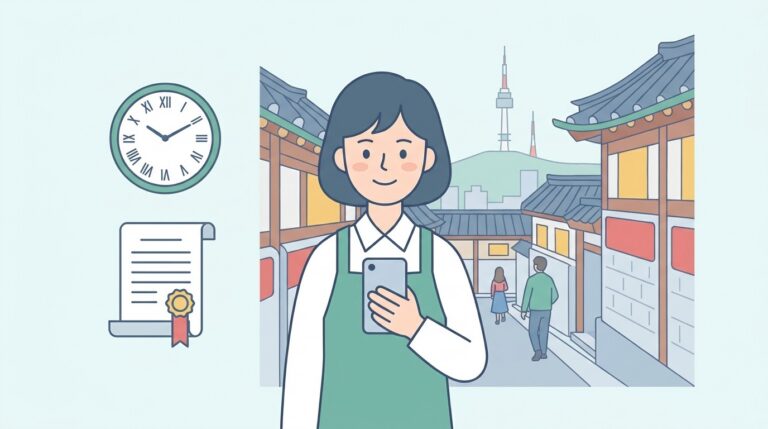
Phase 1: Empathy & Story Opening
안녕하세요! 매일한글 에디터입니다. (Annyeonghaseyo! Maeil Hangeul editeo-imnida. — Hello! This is your Daily Hangul Editor.) Imagine landing your dream part-time job at a cozy Seoul café—just like the vibrant scenes in the K-Drama Business Proposal. You sign your contract, excited for your first paycheck. Then payday arrives, and something feels off! Did they count your late night shift? What about your weekly holiday pay? Many foreign learners tell us they hesitated to speak up because they lacked proof of their exact hours. Today, based on real feedback from expats working in Korea, you will master how to log your daily arrival and departure times and verify key contract benefits with total confidence.
Phase 2: Deep Dive Into 3 Essential Expressions
1. 출퇴근 기록을 정확히 남겼어요 (Chul-toe-geun gi-ro-geul jeong-hwak-hi nam-gyeo-sseo-yo)
- Pronunciation: Chul-toe-geun gi-ro-geul jeong-hwak-hi nam-gyeo-sseo-yo (Think of “Chul” like “chilly” with an “oo”, and “gi-ro-geul” rolling softly like “key-roh-gool”—don’t punch the “g” too hard!)
- Meaning: Literal: “I accurately left behind a commuting record.” / Actual Nuance: “I logged my exact arrival and departure times so there’s a clear paper trail.”
- K-Culture Moment: Picture a hardworking alba (part-timer) in a K-Drama like * Itaewon Class* or Start-Up tapping the tablet at the counter every morning and night, then calmly showing the manager their verified shift history when checking payroll.
- Editor’s Insight: Using the verb 남기다 (nam-gi-da, to leave behind) instead of just 쓰다 (sseu-da, to write) sounds much more professional at B1 level. It emphasizes that a permanent, verifiable trace remains on the store app or attendance book!
- Situation Spectrum: Casual ⚠️ (A bit stiff with close friends; add -어 instead of -어요) | Semi-formal ✅ (Perfect with coworkers & managers!) | Formal ✅ (Great for HR or official disputes, or switch to -남겼습니다)
- 🤔 Think About It: In your home country, does keeping your own daily time log feel normal, or might a boss think you don’t trust them? Why do you think Korean workplaces value recorded proof alongside jeong (warm human connection)?
2. 계약서에 주휴수당과 야간수당이 포함되어 있나요? (Gye-yak-seo-e ju-hyu-su-dang-gwa ya-gan-su-dang-i po-ham-doe-eo in-na-yo?)
- Pronunciation: Gye-yak-seo-e ju-hyu-su-dang-gwa ya-gan-su-dang-i po-ham-doe-eo in-na-yo? (“Gye” rhymes with “yeah” with a soft “g”, and “po-ham” sounds like “poh-hahm” as if warmly greeting someone.)
- Meaning: Literal: “Are weekly holiday pay and night pay included in the contract?” / Actual Nuance: “Can you confirm my legal overtime/holiday allowances are written into this agreement?”
- K-Culture Moment: In reality variety shows about Koreans running pop-up cafés or guest houses abroad (like Jinny’s Kitchen), cast members jokingly ask the boss about extra pay when working past 10 PM!
- Editor’s Insight: Asking “포함되어 있나요?” (Is it included?) is a brilliant soft-power phrase. Instead of sounding accusatory (“Are you going to pay me?”), you frame it as checking the document together.
- Situation Spectrum: Casual 🚫 (Too formal for friends) | Semi-formal ✅ (Ideal when reviewing a contract with a café owner or store manager) | Formal ✅ (Spot-on for company HR interviews)
- 🤔 Think About It: Many languages use direct modal verbs like “Must you pay…?” How does Korea’s indirect passive style (“포함되어 있나요?” — “Does it happen to be included?”) protect the relationship while still defending your rights?
3. 4대 보험 가입 여부도 꼭 확인하고 싶어요 (Sa-dae bo-heom ga-ip yeo-bu-do kkok hwa-gin-ha-go si-peo-yo)
- Pronunciation: Sa-dae bo-heom ga-ip yeo-bu-do kkok hwa-gin-ha-go si-peo-yo (“Sa-dae” sounds like “sah-deh”, “kkok” is a crisp, tight “k” like the “ck” in “clock” held briefly, and “hwa-gin” blends smoothly like “hwah-geen”.)
- Meaning: Literal: “I also definitely want to confirm the enrollment status of the 4 major insurances.” / Actual Nuance: “Please let me verify whether I’m registered for National Pension, Health, Employment, and Industrial Accident Insurance.”
- K-Culture Moment: You’ll hear this exact vocabulary in realistic Korean office dramas like Misaeng or Daily Dose of Sunshine, where new hires learn how crucial social insurance is for long-term stability in Korea.
- Editor’s Insight: Adding 여부 (yeo-bu, “whether or not”) elevates your Korean instantly from A2 to B1! It signals that you understand legal and administrative Korean without sounding robotic.
- Situation Spectrum: Casual 🚫 (Never needed in casual hangouts) | Semi-formal ✅ (Polite and clear with a store owner) | Formal ✅ (Standard business Korean)
- 🤔 Think About It: In your country, are workplace insurances automatically bundled into every part-time job, or do employees need to double-check enrollment like in Korea?
Phase 3: Textbook Korean vs. Real Korean
Situation 1: Telling your manager you logged your hours on the app
- 📖 Textbook Korean: 매일 매장 앱에 출근 시간과 퇴근 시간을 정확하게 기록했습니다. (Mae-il mae-jang aeb-e chul-geun si-gan-gwa toe-geun si-gan-eul jeong-hwak-ha-ge gi-rok-haet-seum-ni-da.)
- 🗣️ Real Korean: 매니저님, 혹시 몰라서 앱에 출퇴근 시간 매일 찍어 뒀어요! (Mae-ni-jeo-nim, hok-si mol-la-seo aeb-e chul-toe-geun si-gan mae-il jji-geo dwo-sseo-yo!)
- 💡 Why the difference? Textbooks love formal Sino-Korean verbs like 기록하다 (gi-rok-ha-da, to record), which can sound like a police report! In real Korean workplaces, people say 찍어 두다 (jji-geo du-da, “to tap/stamp and keep ready”)—referencing tapping a time-clock app—and soften it with 혹시 몰라서 (hok-si mol-la-seo, “just in case”).
Situation 2: Asking about weekly holiday & night pay before signing
- 📖 Textbook Korean: 근로계약서 내용 중 주휴수당과 야간수당 지급 규정을 알려 주십시오. (Geul-lo-gye-yak-seo nae-yong jung ju-hyu-su-dang-gwa ya-gan-su-dang ji-geup gyu-jeong-eul al-lyeo ju-sip-si-o.)
- 🗣️ Real Korean: 사장님, 계약서에 주휴수당이랑 야간수당도 같이 들어가는 거죠? (Sa-jang-nim, gye-yak-seo-e ju-hyu-su-dang-i-rang ya-gan-su-dang-do ga-chi deu-reo-ga-neun geo-jyo?)
- 💡 Why the difference? Real-life B1 speakers replace stiff words like 지급 규정 (payment regulations) with friendly everyday imagery like 같이 들어가다 (go in together), and end with -는 거죠? (“right?”) to invite warm agreement instead of a confrontation.
Phase 4: K-Culture Deep Dive & Non-Verbal Manners
4-1. Nunchi (눈치) & Gestures
When discussing your attendance log or contract clauses in Korea, timing and body language are half the conversation:
* Soft Openers: Never walk up mid-rush while customers are lining up! Wait for a quiet moment (한가할 때, han-ga-hal ttae) and gently say, “잠깐 시간 괜찮으세요?” (Jam-kkan si-gan gwaen-chan-eu-se-yo? — “Do you have a quick moment?”).
* Two Hands & Open Posture: When handing over a paper attendance log (출근부) or showing your phone screen with the store app, hold your phone or document with both hands or support your right wrist lightly with your left hand. Tilt the screen comfortably toward your manager rather than shoving it close to their face.
* Eye Contact & Tone: Maintain warm, steady eye contact—not a fierce stare—and keep your tone curious rather than defensive. A slight nod while listening shows you respect the process.
4-2. Cultural Code Analysis: Alba Culture & Clear Paperwork
In Korea, part-time work—affectionately called 알바 (al-ba, from German Arbeit)—is a massive rite of passage featured everywhere from K-Dramas like Weightlifting Fairy Kim Bok-joo to YouTube vlogs of cozy Hongdae cafés. Historically, small neighborhood shops ran on informal trust (jeong, 정). However, modern Korea has strict labor protections! Today, even the friendliest sajangnim (boss) expects clear digital time logs on apps like Albachunkuk or KakaoWork, and written contracts (근로계약서, geul-lo-gye-yak-seo) are legally mandatory on day one. Keeping exact attendance records protects both you and your employer!
Phase 5: Real-Life Roleplay Scenario
Setting: A sunlit specialty coffee shop in Yeonnam-dong, Seoul. The espresso machine hisses softly in the background. You are chatting with Manager Min-su (민수 매니저), a kind 30-something barista who always wears a neat denim apron, right before your first payday.
- Min-su: 🎭 Checking a tablet behind the counter with a friendly smile 어, 왔어요? 오늘 마감 조죠? 이번 달 첫 월급날이 내일이네요! (Eo, wa-sseo-yo? O-neul ma-gam jo-jyo? I-beon dal cheot wol-geum-nal-i nae-il-i-ne-yo! — Oh, you’re here? You’re on the closing shift today, right? Your first payday this month is tomorrow!)
- You: 🎭 Holding your phone with both hands politely 네, 매니저님! 그래서 그런데, 혹시 이번 달 출퇴근 기록 한 번만 같이 확인해 볼 수 있을까요? (Ne, mae-ni-jeo-nim! Geu-rae-seo geu-reon-de, hok-si i-beon dal chul-toe-geun gi-rok han beon-man ga-chi hwa-gin-hae bol su i-sseul-kka-yo? — Yes, Manager! Actually, by any chance could we double-check this month’s attendance records together once?)
- Min-su: 🎭 Raising his eyebrows slightly, curious 아, 네! 물론이죠. 혹시 시간 계산에 착오가 있는 것 같나요? (A, ne! Mul-lon-i-jyo. Hok-si si-gan gye-san-e cha-go-ga in-neun geot gan-na-yo? — Ah, sure! Of course. Do you think there might be a mistake in the hours?)
- You: 🎭 Showing your store app calmly 아뇨, 실수가 있을까 봐 제가 출퇴근 기록이 남도록 매장 앱에 매일 정확한 시간을 기록해 두었어요. (A-nyo, sil-su-ga i-sseul-kka bwa je-ga chul-toe-geun gi-ro-gi nam-do-rok mae-jang aeb-e mae-il jeong-hwak-han si-gan-eul gi-rok-hae du-eo-sseo-yo. — No, just in case of any mistake, I logged my exact arrival and departure times daily on the store app so clear attendance records remain.)
- Min-su: 🎭 Nodding impressed as he scans your screen 오, 엄청 꼼꼼하시네요! 지난주 금요일에 밤 10시 넘어서까지 연장 근무하셨죠? (O, eom-cheong kkom-kkom-ha-si-ne-yo! Ji-nan-ju geum-yo-il-e bam yeol-si neo-meo-seo-kka-ji yeon-jang geun-mu-ha-syeot-jyo? — Oh, you’re super thorough! Last Friday you worked past 10 PM, right?)
- You: 🎭 Smiling with relief 네! 그리고 근로계약서 쓸 때 확인했던 주휴수당이랑 야간수당도 이번에 같이 들어오는지 궁금해서요. (Ne! Geu-ri-go geul-lo-gye-yak-seo sseul ttae hwa-gin-haet-deon ju-hyu-su-dang-i-rang ya-gan-su-dang-do i-beon-e ga-chi deu-reo-o-neun-ji gung-geum-hae-seo-yo. — Yes! Also, I was wondering if the weekly holiday pay and night pay we checked when writing the contract are included this time too.)
- Min-su: 🎭 Tapping his calculator and checking the printed contract 당연하죠. 주 15시간 넘으셨으니까 주휴수당 다 챙겨 드렸고, 야간수당도 빠짐없이 계산했어요. (Dang-yeon-ha-jyo. Ju sib-o-si-gan neo-meu-syeo-sseu-ni-kka ju-hyu-su-dang da chaeng-gyeo deu-ryeot-go, ya-gan-su-dang-do ppa-jim-eop-si gye-san-hae-sseo-yo. — Of course. Since you worked over 15 hours a week, we included all your weekly holiday pay, and we calculated the night pay without missing a minute.)
- You: 🎭 Giving a slight, grateful bow 감사합니다! 4대 보험 가입 내역서도 나중에 메일로 받을 수 있을까요? (Gam-sa-ham-ni-da! Sa-dae bo-heom ga-ip nae-yeok-seo-do na-jung-e me-il-lo ba-deul su i-sseul-kka-yo? — Thank you! Could I also receive the 4 major insurance enrollment statement by email later?)
🔀 Interactive Branching Point: Manager Min-su pauses and asks, “By the way, yesterday the app glitched for 10 minutes—did you note your clock-out time anywhere else?” What do you say?
- A) “아, 어제는 앱이 멈춰서 종이 출근부에도 따로 적어 두고 사진 찍어 뒀어요!” (A, eo-je-neun aeb-i meom-chwo-seo jong-i chul-geun-bu-e-do tta-ro jeo-geo du-go sa-jin jji-geo dwo-sseo-yo! — “Oh, yesterday the app froze, so I also wrote it on the paper attendance sheet and took a photo!”)
- Feedback (🏆 Best!): Genius move! Backing up an app glitch with the paper 출근부 (attendance book) and a timestamped photo shows top-notch professionalism and Korean workplace smarts.
- B) “그냥 대충 10시쯤 끝난 것 같은데 알아서 주세요.” (Geu-nyang dae-chung yeol-si-jjeum kkeun-nan geot gat-eun-de a-ra-seo ju-se-yo. — “I think I finished roughly around 10, so just pay whatever you think.”)
- Feedback (❌ Bad!): Saying 대충 (roughly) and 알아서 해 주세요 (do as you see fit) invites miscalculations! Always keep exact records.
- C) “앱 오류는 매장 책임이니까 1시간 더 쳐 주세요!” (Aeb o-ryu-neun mae-jang chaeg-im-i-ni-kka han si-gan deo chyeo ju-se-yo! — “App errors are the store’s fault, so pay me an extra hour!”)
- Feedback (⚠️ Risk!): Too confrontational! Even when a store system glitches, demanding extra unearned pay damages trust and hurts your working relationship.
Phase 6: 10-Second Emotional Shadowing Drill
Read aloud with the exact pauses (/) and emotions! Repeat three times in 10 seconds:
[🧐 Calmly and thoroughly]출퇴근 기록이 남도록 / 매장 앱에 / 매일 정확한 시간을 / 기록해 두었어요. (Chul-toe-geun gi-ro-gi nam-do-rok / mae-jang aeb-e / mae-il jeong-hwak-han si-gan-eul / gi-rok-hae du-eo-sseo-yo. — “I logged my exact times daily on the store app so attendance records remain.”)[😊 Warmly and politely]계약서에 / 주휴수당이랑 야간수당도 / 다 포함되는 거죠? (Gye-yak-seo-e / ju-hyu-su-dang-i-rang ya-gan-su-dang-do / da po-ham-doe-neun geo-jyo? — “Weekly holiday pay and night pay are all included in the contract too, right?”)[😌 Relieved and appreciative]꼼꼼하게 챙겨 주셔서 / 정말 감사합니다! (Kkom-kkom-ha-ge chaeng-gyeo ju-syeo-seo / jeong-mal gam-sa-ham-ni-da! — “Thank you so much for taking care of it so thoroughly!”)
Phase 7: K-Culture Mini Dictionary
- 주휴수당 (Ju-hyu-su-dang) | Weekly Holiday Pay | Paid rest-day bonus legally required if you work 15+ hours a week and fulfill all scheduled shifts without unauthorized absences.
- 야간수당 (Ya-gan-su-dang) | Night Shift Allowance | Extra 50% bonus pay for work done between 10:00 PM and 6:00 AM (applicable at workplaces with 5 or more regular employees).
- 4대 보험 (Sa-dae bo-heom) | Four Major Social Insurances | Korea’s mandatory social safety net: National Pension (국민연금), Health Insurance (건강보험), Employment Insurance (고용보험), and Industrial Accident Insurance (산재보험).
- 출퇴근부 (Chul-toe-geun-bu) | Attendance Log / Time Sheet | A paper sign-in sheet or digital app log where employees record exact arrival and departure times daily.
Phase 8: Survival Kit for Expats & Working Travelers
Top 3 Survival Phrases
- 근로계약서 사본 하나 주실 수 있나요? (Geul-lo-gye-yak-seo sa-bon ha-na ju-sil su in-na-yo? — “Can I get a copy of the employment contract?”)
- Pro Tip: Korean law requires employers to give you a signed copy! Keep a photo of it in a dedicated phone folder.
- 출근 도장 찍었어요! (Chul-geun do-jang jji-geo-sseo-yo! — “I clocked in!”)
- Pro Tip: Even without a physical stamp (도장), Koreans still say 도장 찍다 or 출근 찍다 when tapping a digital time-clock app.
- 급여 명세서 확인해 볼 수 있을까요? (Geub-yeo myeong-se-seo hwa-gin-hae bol su i-sseul-kka-yo? — “Could I check my pay stub?”)
- Pro Tip: Pay stubs are mandatory in Korea—check that base pay, allowances, and tax/insurance deductions match your logged hours!
Editor’s Travel & Work Note
Before your first shift in Korea, make sure your smartphone is fully equipped! Use the Naver Map App Navigation Guide to time your commute accurately so you’re never late clocking in, and download a dedicated Korean part-time shift tracker from the Albachunkuk Part-Time Job Portal to auto-calculate your weekly holiday pay. Also, don’t forget to link your Korean bank account (통장, tong-jang) and Alien Registration Card (외국인등록증) before payday, and keep a rechargeable T-money card handy for late-night buses after night shifts!
Phase 9: One Step Deeper (Cultural Reflection)
In Korean society, workplace harmony often relies on a delicate balance between 정 (jeong, warm interpersonal affection) and 공사 구분 (gong-sa gu-bun, separating work duties from personal feelings). Many foreign learners worry that logging every minute on an app or asking about weekly holiday pay might make them look greedy or untrusting. In reality, modern Korean workers view clear documentation as a sign of 성실함 (seong-sil-ham, sincerity and diligence)—it prevents awkward misunderstandings later so everyone can enjoy genuine jeong without hidden resentment.
💬 Your Turn: Have you ever worked a part-time job in Korea or abroad where you had to double-check your hours or contract? Share your story or any tricky Korean workplace phrases you’ve heard in the comments below!
Phase 10: FAQ & Common Mistakes
Q: Can I still get Weekly Holiday Pay (주휴수당) if I’m on a Working Holiday or Student Visa?
A: Yes! Korean labor law protects workers regardless of nationality. As long as you are legally permitted to work, have a contract for 15 hours or more per week, and complete all your scheduled shifts that week without unexcused absences, you qualify for 주휴수당.
Q: What if my store doesn’t have a fancy attendance app—how should I keep proof?
A: If your workplace uses a paper 출근부 (attendance book), write your exact arrival and departure times neatly and snap a quick timestamped photo of the page at the end of your shift. You can also send a polite daily KakaoTalk message like “오늘 마감하고 퇴근했습니다!” (I finished closing and clocked out today!) so there is a digital record.
Q: Do ALL workplaces in Korea have to pay the 50% Night Shift Allowance (야간수당)?
A: Not every tiny shop—under Korea’s Labor Standards Act, the mandatory 50% night shift surcharge (for 10:00 PM–6:00 AM) legally applies to businesses with 5 or more regular employees (상시 근로자 5인 이상). That is why checking your contract details before starting is so important!
🚨 Common Mistakes Warning Board
- Mistake: Saying “돈 주세요” (Don ju-se-yo — “Give me money”) when asking about missing pay.
- Correct Action: Say “이번 달 급여 내역 한번 확인 부탁드려도 될까요?” (I-beon dal geub-yeo nae-yeok han-beon hwa-gin bu-tak-deu-ryeo-do doel-kka-yo? — “Could I ask to check this month’s pay breakdown?”).
- Mistake: Working extra minutes off the clock without logging them because you feel shy.
- Correct Action: Always record your actual clock-in and clock-out times on the app or 출근부 as soon as your shift starts and ends.
- Mistake: Signing a contract without checking if it says “주휴수당 포함” (Weekly holiday pay included in the hourly rate).
- Correct Action: Confirm whether your quoted hourly wage already bundles allowances or adds them on top!
Phase 11: Action Missions
- 🥉 Bronze Mission (Solo Practice): Open a voice recorder app on your phone and complete the Phase 6 shadowing drill three times in under 10 seconds without stumbling over “주휴수당” or “출퇴근 기록”.
- 🥈 Silver Mission (Share & Accountability): Post one new Korean labor term you learned today (like 야간수당 or 4대 보험) on your Instagram Story or study group with a quick English explanation—tag
@DailyHangul! - 🥇 Gold Mission (Real-World Action): Check your current work contract or practice asking a Korean language partner to roleplay Manager Min-su while you verify your attendance log!
- 🎮 K-Culture Mission: Watch an episode of a Korean workplace or café vlog on YouTube or a K-Drama featuring an alba worker, and listen closely for words like 알바 (part-time), 사장님 (boss), 출근 (clock in), or 월급 (monthly salary)!
Phase 12: Interactive Quiz Challenge
Quiz 1 (Situational Judgment): You worked from 10:00 PM to 2:00 AM at a convenience store with 8 employees, and you logged every shift on the store app. What should you check on your contract and pay stub?
* A) Only your base hourly wage
* B) 야간수당 (Night shift allowance) and exact 출퇴근 기록 (attendance records)
* C) Just your lunch break time
👉 Click to reveal Answer & Explanation for Quiz 1
Answer: B! Because the store has 5 or more employees and you worked between 10:00 PM and 6:00 AM, you should verify your 야간수당 (50% extra night allowance) alongside your logged 출퇴근 기록! (If you picked A or C, you might miss out on extra pay you legally earned!)
Quiz 2 (Fill in the Blank): Complete this polite sentence to tell your manager you kept exact records on the app:
“매일 앱에 정확한 시간을 ( ) 두었어요.”
* Hint: Means “recorded/left logged” (7 Hangul syllables / 4 syllables: 기-록-해)
👉 Click to reveal Answer & Explanation for Quiz 2
Answer: 기록해 (gi-rok-hae)! Full sentence: “매일 앱에 정확한 시간을 기록해 두었어요.” Using -아/어 두다 emphasizes doing something carefully in advance for future reference!
Quiz 3 (True / False Culture Quiz):
“In Korea, a part-time worker does NOT need a written 근로계약서 (employment contract) if the boss is friendly and promises to pay in cash.”
👉 Click to reveal Answer & Explanation for Quiz 3
Answer: FALSE! By Korean law, employers must provide a written employment contract regardless of how friendly the workplace is or how small the shop may be. Always ask for your copy!
🎬 Watch Our Daily Videos! (Daily Hangul Official Instagram)
Review the expressions you learned in this article with our fun daily short videos! Check out native pronunciation and real-life nuances in action.
- Instagram @dailyhangul_en







