Phase 1: Why “Not Too Sweet” Is Your Secret Weapon in Seoul
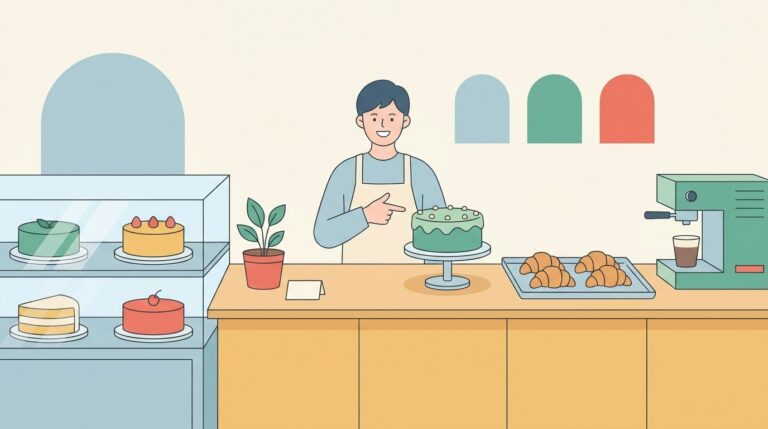
Hello! This is your Daily Hangul Editor. Picture yourself walking into a dreamy, aesthetic cafe in Seongsu-dong, Seoul. Glass cases glow with cloud-like strawberry cakes, glossy croissants, and matcha scones straight out of a K-Drama. You point at a gorgeous tart, take one bite, and whoa—it is way too sweet for your taste! Many Level 2 Korean learners told us they end up buying random pastries just because they do not know how to ask for something mild. Today, based on real student feedback, we are fixing that! You will learn natural, polite phrases to ask for less-sweet treats like a true Seoul local. Ready to order confidently?
Phase 2: Deep Dive Into the Top 3 Must-Know Expressions
1. 너무 달지 않은 걸로 추천해 주세요 (Neomu dalji aneun geollo chucheonhae juseyo)
- Pronunciation: [Neomu dalji aneun geollo chucheonhae juseyo] (Think of it like: “Nuh-moo dahl-jee ah-neun guhl-loh choo-chuhn-hae joo-seh-yoh.” “Nuh-moo” sounds like a quiet cow saying “no moo,” and “choo-chuhn” sounds like a soft sneeze “achoo” plus “churn”!)
- Meaning: Literally means “By the thing that is not too sweet, please recommend.” In real life, it means “Please recommend something that isn’t too sweet.”
- K-Culture Moment: Imagine the lead character in a romantic K-Drama visiting a cozy neighborhood bakery to buy a cake for a picky boss, politely asking the baker for advice so they don’t mess up.
- Editor’s Insight: Adding “-은 걸로 (-eun geollo)” makes your request super soft and natural. Instead of pointing blindly, you are inviting the staff to share their best mild pick!
- Situation Spectrum: Casual 🚫 | Semi-formal ✅ | Formal ✅
- 🤔 Think About It: In English, we often ask directly, “What isn’t too sweet?” Why do Koreans add “please recommend for me” (추천해 주세요)? Think about how Korean puts the listener’s expertise first!
2. 이거 많이 달아요? (Igeo mani darayo?)
- Pronunciation: [Igeo mani darayo?] (Think of it like: “Ee-guh mah-nee dah-rah-yoh?” “Ee-guh” sounds like “eager” without the R, and “mah-nee” sounds like “money” with an A. Notice the H in 많이 disappears completely!)
- Meaning: Literally “This thing, is it sweet a lot?” Actual nuance: “Is this very sweet?”—a friendly quick check before you commit to a slice.
- K-Culture Moment: Just like K-Pop idols filming a bakery vlog behind the scenes, eyeing a chocolate pastry and checking with the staff so they do not break their diet too hard!
- Editor’s Insight: Beginners often try to pronounce the “ㅎ (h)” in 많이 and say “man-hi.” Don’t fall into that trap! Let the N slide straight into the I for a smooth “ma-ni.”
- Situation Spectrum: Casual ⚠️ (Drop 요 with close friends: 이거 많이 달아?) | Semi-formal ✅ | Formal ✅
- 🤔 Think About It: In many Western bakeries, “very sweet” is a selling point. In Korea, asking “Is it very sweet?” usually hints that you are hoping the answer is “No!” How does your culture view sweetness in desserts?
3. 덜 단 빵은 뭐가 있어요? (Deol dan ppangeun mwoga isseoyo?)
- Pronunciation: [Deol dan ppangeun mwoga isseoyo?] (Think of it like: “Duhl dahn ppahng-eun mwoh-gah ee-ssuh-yoh?” “Duhl” rhymes with “dull,” and “ppahng” starts with a crisp, punchy P with zero air puff—like popping a bubble!)
- Meaning: Literally “Less sweet bread, what exists?” In reality: “What less-sweet breads do you have?”
- K-Culture Moment: Picture a weekend Korean food show where hungry hosts step into a famous local bakery and scan rows of pastries for something mild to bring home to their parents.
- Editor’s Insight: The magic word here is 덜 (deol = less). Once you know this, you can swap 빵 (ppang = bread) with 케이크 (keikeu = cake) or 디저트 (dijeoteu = dessert) anytime!
- Situation Spectrum: Casual 🚫 | Semi-formal ✅ | Formal ✅
- 🤔 Think About It: Korean uses one tiny adverb 덜 (deol) right before an adjective to mean “less.” How do you compare flavor levels in your native language?
Phase 3: Textbook Korean vs. Real Korean
Situation 1: Asking for a mild dessert
- 📖 Textbook Korean: 당도가 낮은 디저트를 추천해 주십시오. (Dangdoga najeun dijeoteureul chucheonhae jusipsio.) — “Please recommend a dessert with low sugar content.”
- 🗣️ Real Korean: 너무 안 단 걸로 하나 추천해 주세요! (Neomu an dan geollo hana chucheonhae juseyo!) — “Please recommend one that’s not too sweet!”
- 💡 Why is it different?: Words like “당도 (sugar level)” belong on fruit labels or in science labs, not cozy cafes! Real locals use the warm, simple phrase “안 단 거 (an dan geo – not sweet thing)” to keep the vibe friendly.
Situation 2: Asking what mild options are available
- 📖 Textbook Korean: 달지 않은 빵의 종류가 무엇입니까? (Dalji aneun ppangui jongnyuga mueosimnikka?) — “What are the varieties of non-sweet bread?”
- 🗣️ Real Korean: 혹시 덜 단 거 뭐 있어요? (Hoksi deol dan geo mwo isseoyo?) — “By any chance, what do you have that’s less sweet?”
- 💡 Why is it different?: Starting with “혹시 (hoksi – by any chance)” instantly softens your tone so you never sound demanding, and “뭐 있어요?” keeps the conversation relaxed and natural.
Phase 4: K-Culture Deep Dive & Non-Verbal Manners
4-1. Nunchi (눈치) & Bakery Gestures
In Korean bakeries—from nationwide chains to indie spots in Yeonnam-dong—you usually serve yourself using a tray (쟁반, jaengban) and tongs (집게, jipge). When you are looking at cakes behind the glass counter and want to ask the barista for help, gesture gently toward the cake with an open hand instead of tapping the glass! Make brief, friendly eye contact and give a small head nod as you say 추천해 주세요 (chucheonhae juseyo). Also, practice good nunchi: if a line is building up behind you, ask one quick question like “이거 많이 달아요?” rather than quizzing the staff on every single pastry.
4-2. Cultural Code Analysis: Why “Not Sweet” Is the Ultimate Compliment
If you watch Korean food vlogs, you will quickly notice the highest praise a Korean can give a cake: “와, 안 달아서 진짜 맛있다!” (Wa, an daraseo jinzza masitda! — “Whoa, it’s so good because it’s not sweet!”). While Western desserts often celebrate rich buttercream and heavy sugar, Korean K-Food and cafe culture prizes balanced, earthy, and light flavors. Look out for beloved local flavors like Injeolmi (인절미 – roasted soybean powder), black sesame (흑임자 – heugimja), mugwort (쑥 – ssuk), and fresh whipped cream cakes (생크림 케이크) that feel light on the stomach.
Phase 5: Real-Life Roleplay Scenario
- Setting: A sunlit boutique bakery in Yeonnam-dong smelling of warm butter and freshly ground espresso. Glass shelves shimmer with colorful fruit tarts and earthy green tea rolls.
- Characters: You (a Level 2 Korean learner hunting for a light afternoon snack) and Minjun (a cheerful baker wearing a crisp linen apron).
- Minjun: 어서 오세요! 찾으시는 빵 있으세요? (Eoseo oseyo! Chajeusineun ppang isseuseyo?) — “Welcome! Is there any bread you are looking for?” 🎭 Smiling warmly from behind the espresso machine.
- You: 안녕하세요! 저기, 너무 달지 않은 디저트로 추천해 주세요. (Annyeonghaseyo! Jeogi, neomu dalji aneun dijeoteuro chucheonhae juseyo.) — “Hello! Excuse me, please recommend a dessert that isn’t too sweet.” 🎭 Nodding politely while glancing at the glass display.
- Minjun: 아, 그럼 이 얼그레이 케이크는 어때요? (A, geureom i eolgeurei keikeuneun eottaeyo?) — “Ah, then how about this Earl Grey cake?” 🎭 Gesturing gently toward a light beige chiffon slice.
- You: 어, 예쁘네요! 이거 많이 달아요? (Eo, yeppeuneyo! Igeo mani darayo?) — “Oh, it’s pretty! Is this very sweet?” 🎭 Leaning in slightly with curious eyes.
- Minjun: 아니요, 생크림이라서 아주 부드럽고 덜 달아요. (Aniyo, saengkeurimiraseo aju budeureopgo deol darayo.) — “No, because it is fresh cream, it is very soft and less sweet.” 🎭 Giving a reassuring thumbs-up.
- You: 좋아요! 혹시 덜 단 빵은 뭐가 있어요? (Joayo! Hoksi deol dan ppangeun mwoga isseoyo?) — “Sounds good! By any chance, what less-sweet breads do you have?” 🎭 Holding your tray and tongs ready.
- Minjun: 저기 있는 소금빵이 제일 담백하고 인기가 많아요! (Jeogi inneun sogeumppangi jeil dambaekhago ingiga manayo!) — “The salt bread over there is the cleanest-tasting and most popular!” 🎭 Pointing toward a tray of golden, flaky rolls.
- You: 그럼 케이크 하나랑 소금빵 하나 주세요! (Geureom keikeu hanarang sogeumppang hana juseyo!) — “Then please give me one cake and one salt bread!” 🎭 Beaming happily as you place the salt bread on your tray.
🔀 Interactive Branching Point
Before Minjun wraps up your order, he asks: “고소한 맛 좋아하세요, 아니면 상큼한 과일 맛 좋아하세요?” (Gosohan mat joahaseyo, animyeon sangkeumhan gwail mat joahaseyo? — “Do you like nutty flavors, or refreshing fruit flavors?”)
How do you reply?
- Option A: “고소한 맛으로 추천해 주세요!” (Gosohan maseuro chucheonhae juseyo! — Please recommend a nutty flavor!)
- Feedback (Best ✅): Fantastic choice! Korean bakeries shine with gosohan (nutty/roasted) flavors like black sesame, chestnut, and soybean powder, which are almost always mild and not too sweet.
- Option B: “설탕 빼고 케이크 주세요.” (Seoltang ppaego keikeu juseyo. — Give me a cake without sugar.)
- Feedback (Bad ❌): Oops! While you can adjust sugar in a latte, bakers cannot remove sugar from a cake that is already baked. Minjun might look confused!
- Option C: “그냥 제일 비싼 걸로 주세요.” (Geunyang jeil bissan geollo juseyo. — Just give me the most expensive one.)
- Feedback (Risk ⚠️): Bold move! However, the priciest cake might be a super-rich triple-chocolate mousse—the exact opposite of “not too sweet”!
Phase 6: 10-Second Emotional Shadowing Drill
Read each line aloud, pausing briefly at the / marks and matching the emotion!
- [😊 Curious & Polite] 저기요, / 이거 / 많이 달아요? (Jeogiyo, / igeo / mani darayo?) — Excuse me, is this very sweet?
- [🥺 Hopeful & Gentle] 너무 달지 않은 걸로 / 추천해 주세요. (Neomu dalji aneun geollo / chucheonhae juseyo.) — Please recommend something not too sweet.
- [🤔 Scanning the Menu] 혹시 / 덜 단 빵은 / 뭐가 있어요? (Hoksi / deol dan ppangeun / mwoga isseoyo?) — By any chance, what less-sweet breads do you have?
- [😋 Happy & Satisfied] 와, / 덜 달아서 / 진짜 맛있어요! (Wa, / deol daraseo / jinzza masisseoyo!) — Whoa, it’s less sweet so it’s really delicious!
Phase 7: K-Culture Mini Dictionary (4 Keywords)
- 담백하다 (dambaekhada) | Light, clean, and not greasy or overly sweet | Everyday food praise; the #1 adjective Koreans use for great bread, broth, and mild pastries.
- 덜 달다 (deol dalda) | Less sweet | Crucial phrase for comparing desserts or customizing cafe drinks (e.g., “덜 달게 해 주세요” — make it less sweet).
- 꾸덕하다 (kkudeokhada) | Dense, thick, and fudgy | A massive K-Cafe trend word used for Greek yogurt, Basque cheesecake, and rich brownies!
- 시그니처 (sigeunicheo) | Signature (house special) | Konglish you will see on almost every trendy Korean cafe menu board to highlight their must-try treat.
Phase 8: Survival Kit for Travelers
Top 3 Bakery Survival Phrases
- 이거 뭐가 들어갔어요? (Igeo mwoga deureogasseoyo?) — “What’s inside this?” Pro Tip: Great for checking whether a bun hides sweet red bean paste (팥) or savory cheese!
- 덜 달게 해 주세요. (Deol dalge hae juseyo.) — “Please make it less sweet.” Pro Tip: Use this for drinks like Matcha Latte or Milk Tea when pairing them with cake.
- 포장해 주세요. (Pojanghae juseyo.) — “Please pack it to go.” Pro Tip: Many Korean cafes follow a “1 person, 1 drink” rule if you sit inside, so takeout is super convenient!
Editor’s Travel Note
Before heading out on your cafe tour, be sure to Download the Naver Map App for Korean Cafe Hunting since Google Maps walking directions do not work well in South Korea. You can also browse VisitKorea Official Seoul Dessert Travel Tips to find top neighborhood spots like Seongsu-dong and Ikseon-dong. For payments, international Visa/Mastercard cards and T-money work smoothly at almost every bakery. Just remember to place a thin paper liner on your tray before grabbing bread with the tongs!
Phase 9: One Step Deeper — The Heart Behind Soft Requests
Have you noticed how Korean adds gentle cushions like “혹시 (by any chance)” and “추천해 주세요 (please recommend)” to simple bakery questions? In Korean culture, protecting gibun (mood and feelings) and maintaining warm harmony (jeong) matters deeply, even during a 30-second counter chat. Instead of bluntly rejecting sweet pastries, asking the baker for a mild recommendation turns a quick transaction into a friendly connection. In Korea, good food is not just about sugar—it is about making everyone at the table feel comfortable.
💬 Your Turn: What is your all-time favorite “not too sweet” dessert—flaky salt bread, Earl Grey cake, or nutty black sesame? Drop your pick in the comments!
Phase 10: FAQ & Myth-Busting
Q: Can I ask a Korean bakery to make an already-baked cake less sweet?
A: No, pre-baked cakes and breads cannot have their sugar reduced. Instead, ask “덜 단 걸로 추천해 주세요 (Deol dan geollo chucheonhae juseyo)” to pick a naturally mild pastry, and save “덜 달게 해 주세요 (Deol dalge hae juseyo)” for custom drinks like lattes or ades!
Q: What is the difference between “안 달아요 (an darayo)” and “덜 달아요 (deol darayo)”?
A: “안 달아요” means “it is not sweet” (almost zero sugar, like plain baguette or salt bread), whereas “덜 달아요” means “it is less sweet” (still a dessert, just gently sweetened and balanced).
Q: Is “담백하다 (dambaekhada)” a good or bad word for a dessert?
A: It is a huge compliment! While English speakers might hear “plain” and think boring, in Korean “담백하다” means clean, wholesome, and effortless to eat without feeling overwhelmed by sugar or grease.
🚨 Common Mistakes Warning Board
- Mistake: Saying “단 거 싫어요” (Dan geo sireoyo — “I hate sweet things”). -> Correct Action: Soften it to “너무 단 건 잘 못 먹어요” (Neomu dan geon jal mot meogeoyo — “I can’t eat things that are too sweet well”) so you sound warm and polite.
- Mistake: Grabbing pastries with your bare hands or leaving tongs on the table. -> Correct Action: Always use the tongs (집게) to move bread onto your tray (쟁반), then return the tongs to their holder.
- Mistake: Pronouncing 많이 with a hard H sound (“man-hi”). -> Correct Action: Drop the H completely and say “ma-ni” smoothly: “이거 많이 달아요?”
Phase 11: Action Mission & Engagement
- 🥉 Bronze Mission (Solo Practice): Stand in front of your mirror and say “너무 달지 않은 걸로 추천해 주세요” three times using our 10-second shadowing pauses.
- 🥈 Silver Mission (Share Online): Snap a photo of your favorite mild pastry or coffee pairing and share it on social media with the Korean caption: “덜 달아서 맛있어요! #DailyHangul”
- 🥇 Gold Mission (Real-World Use): Next time you visit a Korean bakery (like Paris Baguette, Tous Les Jours, or an indie Seoul cafe), ask the staff “이거 많이 달아요?” before ordering!
🎮 K-Culture Mission: Turn on your favorite Korean cafe vlog or K-Drama bakery scene this week and listen closely! Can you catch anyone saying “안 달아서 맛있다” or “담백하다”?
Phase 12: Interactive Quiz Challenge
Test your new bakery skills! Try all three questions before opening the answer toggle below.
- Situation Judgment: You see a gorgeous matcha cake in a Seoul cafe, and you want to check if it’s overly sweet before buying. What should you say?
- A) 설탕 빼고 주세요. (Seoltang ppaego juseyo.)
- B) 이거 많이 달아요? (Igeo mani darayo?)
- C) 단 거 싫어요. (Dan geo sireoyo.)
- Fill in the Blank: Complete the polite phrase for “What less-sweet breads do you have?”
- “( ___ ) 단 빵은 뭐가 있어요?” (Hint: It sounds like “dull”!)
- True or False (Culture Quiz): In Korea, saying a cake is “not sweet” (안 달아서 맛있다) is usually meant as an insult to the baker.
Click here to reveal the answers & explanations!
- Question 1 Answer: B) 이거 많이 달아요? (Igeo mani darayo?) — Feedback: If you picked A, remember you cannot remove sugar from a cake that is already baked! If you picked C, “싫어요 (I hate it)” sounds a bit too blunt to a friendly baker.
- Question 2 Answer: 덜 (deol) — “덜 단 빵은 뭐가 있어요?” (Deol dan ppangeun mwoga isseoyo?)
- Question 3 Answer: False! In Korean dessert culture, “안 달아서 맛있다” (it’s delicious because it’s not sweet) is actually one of the highest compliments you can give!
🎬 Watch Our Daily Videos! (Daily Hangul Official Instagram)
Review the expressions you learned in this article with our fun daily short videos! Check out native pronunciation and real-life nuances in action.
- Instagram @dailyhangul_en