

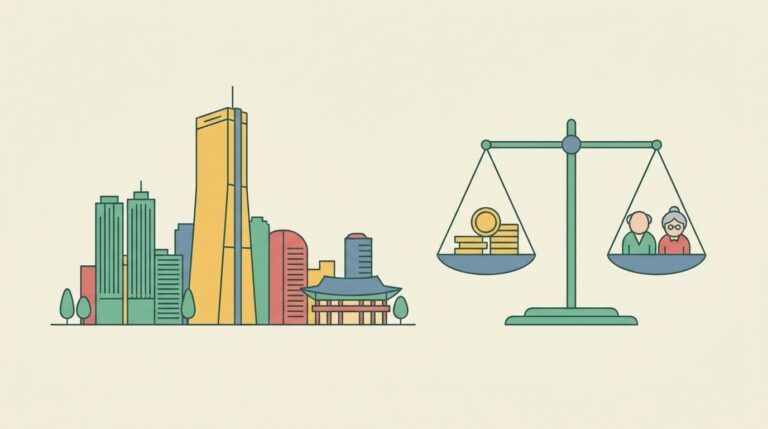
Phase 1: Why Even Advanced Learners Freeze at the Dinner Table
안녕하세요! 매일한글 에디터입니다. (Annyeonghaseyo! Maeil Hangul Editeo-imnida. — Hello! I’m your Daily Hangul Editor.)
Imagine sitting in a cozy Euljiro pocha over crispy pajeon with Korean friends while a heated JTBC economic debate plays on TV. Everything flows smoothly until the anchor mentions aging demographics, mandatory spending, and trimming tax exemptions. Suddenly, you freeze! Even advanced learners tell us they hit a wall when fiscal policy pops up in K-dramas like Chief of Staff or real-world news. Built from real Level 5 learner feedback, this guide turns intimidating economic jargon into confident, razor-sharp Korean you can actually use.
Phase 2: Deep Dive into 3 Core Expressions
1. 의무지출이 급증하다 (Uimujichuri geupjeunghada — Mandatory spending surges)
- Pronunciation: Ui-mu-ji-chu-ri geup-jeung-ha-da (Think of “Ui” as a quick glide from “oo” to “ee” like saying oo-ee fast, “ji-chu-ri” like jee-choo-ree, and “geup-jeung” with a crisp, short geup as if catching your breath before jeung like “juhng”.)
- Meaning: Literally “obligatory expenditure rapidly increases.” In policy discourse, it refers to non-discretionary government spending locked in by law—such as national pensions, health insurance, and basic livelihood subsidies—that balloons automatically as society ages.
- K-Culture Moment: Picture a tense National Assembly briefing scene in a political K-drama like Chief of Staff (보좌관), where a chief aide slams a thick budget report onto a glass table and warns that pension outlays will overwhelm discretionary budgets within a decade.
- Editor’s Insight: Unlike 재량지출 (jaeryangjichul — discretionary spending), which politicians can cut with a pen stroke, 의무지출 (uimujichul) is legally mandated. Using 급증하다 (geupjeunghada — to surge) rather than the milder 늘어나다 (neureonada — to increase) signals urgency and structural crisis—exact nuance every Level 5 speaker needs in debates.
- Situation Spectrum: Casual 🚫 (Way too stiff for casual chat unless joking) / Semi-formal ⚠️ (Great in serious news discussions with friends) / Formal ✅ (Gold standard for briefings, essays, and TOPIK II)
- 🤔 Think About It: English debates often frame entitlement growth around individual “benefits” or “entitlements,” whereas Korean uses 의무 (uimu — duty/obligation), emphasizing the state’s legal obligation to citizens. How does your native language frame government welfare spending—as a right, a duty, or a cost?
2. 비과세·감면을 정비하다 (Bigwase·gammyeoneul jeongbihada — To streamline tax exemptions and reductions)
- Pronunciation: Bi-gwa-se gam-myeo-neul jeong-bi-ha-da (Say “bi-gwa-se” smoothly like bee-gwah-seh, “gam-myeo-neul” like gahm-myuh-neul with a soft nasal flow between the two M sounds, and “jeong-bi” like juhng-bee.)
- Meaning: Literally “to overhaul/reorganize non-taxation and tax reductions.” In real policy talk, it means trimming outdated tax loopholes, sunset clauses, and special deductions that erode government revenue.
- K-Culture Moment: On Korean current-affairs talk shows like 100-Minute Debate (100분 토론), fiscal conservatives and progressive economists clash over whether cutting corporate tax breaks or middle-class deductions is fairer when budgets tighten.
- Editor’s Insight: Notice the verb 정비하다 (jeongbihada — to overhaul/put in order)! Politicians almost never say 폐지하다 (pyejihada — to abolish) right away because it sparks public backlash (조세 저항, jose jeohang). 정비하다 sounds rational, surgical, and neutral—like tuning an engine rather than wrecking someone’s tax break.
- Situation Spectrum: Casual 🚫 / Semi-formal ✅ (Perfect when summarizing news at work or in study groups) / Formal ✅ (Essential for policy papers and presentations)
- 🤔 Think About It: In Korean, the middle dot (
·) in 비과세·감면 neatly bundles two distinct legal concepts (zero tax vs. partial reduction) into one rhythmic policy buzzword. Does your language rely on similar paired compounds to soften politically sensitive tax hikes?3. 넓은 세원을 확보하다 (Neolbeun sewoneul hwakbohada — To secure a broad tax base)
- Pronunciation: Neol-beun se-wo-neul hwak-bo-ha-da (Focus on “neol-beun”: drop the final “l” slightly like nuhl-beun, “se-won” like seh-wuhn, and “hwak-bo” like hwahk-poh with a crisp pop on “bo”.)
- Meaning: Literally “to secure a wide source of tax.” It conveys the core principle of “넓은 세원, 낮은 세율” (neolbeun sewon, najeun seyul — broad tax base, low tax rate), meaning taxing a wider range of income or activities fairly rather than squeezing the same taxpayers harder.
- K-Culture Moment: Imagine an investigative economics YouTuber or a sharp finance reporter in a drama like The Whirlwind (돌풍) drawing a pie chart on a whiteboard, showing how narrowing exemptions widens the revenue pie without raising headline tax rates.
- Editor’s Insight: Learners often mistakenly use 세금 (segeum — tax) instead of 세원 (sewon — tax base/source). 세금 is the money collected; 세원 is the underlying pool of taxable income, assets, or transactions. Pairing it with 확보하다 (hwakbohada — to secure/lock in) conveys strategic foresight.
- Situation Spectrum: Casual 🚫 / Semi-formal ⚠️ / Formal ✅ (Impressive C1–C2 phrasing for business, academia, and debates)
- 🤔 Think About It: Korean fiscal debates often invoke fairness (형평성, hyeongpyeongseong) alongside efficiency. When you hear “broadening the tax base” in your home country, does the public hear “fairness” or “stealth tax hike”?
Phase 3: Textbook Korean vs. Real Korean
Situation 1: Talking about rising pension & welfare costs over coffee with a colleague
- 📖 교과서 한국어 (Textbook Korean): 고령화로 인해 사회보장 관련 의무지출이 급격히 증가하고 있으므로 재정 개혁이 시급합니다. (Goryeonghwaro inhae sahoebojang gwallyeon uimujichuri geupgyeokhi jeunggahago isseumeuro jaejeong gaehyeogi sigeuphamnida. — Due to aging, mandatory spending related to social security is increasing rapidly, so fiscal reform is urgent.)
- 🗣️ 진짜 한국어 (Real Korean): 노인 인구는 계속 느는데 법으로 묶인 지출이 눈덩이처럼 불어나니까 나라 곳간이 텅 빌 판이에요. (Noin inguneun gyesok neuneunde beobeuro mukkin jichuri nunddeongicheoreom bureonanikka nara gotgani teong bil panieyo. — The elderly population keeps growing and legally locked-in spending is snowballing, so the national coffers are about to go empty.)
- 💡 왜 다를까? (Why the Difference?): Even Korean economists switch from Sino-Korean policy terms (의무지출) to vivid native metaphors like 눈덩이처럼 불어나다 (snowball) and 나라 곳간 (the nation’s granary/coffers) in spoken conversation to make abstract debt feel visceral.
Situation 2: Commenting on cutting tax breaks in a policy seminar vs. casual debrief
- 📖 교과서 한국어 (Textbook Korean): 세입 기반을 확충하기 위하여 비과세 및 감면 제도를 전면적으로 정비할 필요가 있습니다. (Seip gibaneul hwakchunghagi wihayeo bigwase mit gammyeon jedoreul jeonmyeonjeogeuro jeongbihal piryoga itseumnida. — To expand the revenue base, it is necessary to comprehensively overhaul tax exemption and reduction systems.)
- 🗣️ 진짜 한국어 (Real Korean): 깎아 주던 세금 혜택을 대대적으로 손보지 않으면 세수 구멍을 메우기가 쉽지 않죠. (Kkakka judeon segeum hyetaegeul daedaejeogeuro sonboji aneumyeon sesu gumeongeul meugiga swipji anchyo. — Unless we majorly overhaul the tax perks we used to hand out, plugging the tax revenue hole won’t be easy.)
- 💡 왜 다를까? (Why the Difference?): In spoken Korean, 비과세·감면 often becomes 깎아 주던 세금 혜택 (tax perks we used to shave off), and 정비하다 turns into the idiomatic 손보다 (to fix/tinker with). Knowing both registers lets you read official reports and sound effortlessly natural in discussion.
Phase 4: K-Culture Deep Dive & Non-Verbal Manners
4-1. Nunchi (눈치) & Debating Etiquette
Debating taxes and welfare in Korea requires sharp 눈치 (nunchi — social awareness). Because South Korea is aging faster than almost any OECD nation, pension reform and tax hikes touch generational nerves directly. When discussing 확장 재정 (hwakjang jaejeong — expansionary finance) vs. 건전 재정 (geonjeon jaejeong — sound finance), Koreans rarely point fingers aggressively or interrupt mid-sentence. Instead, maintain steady eye contact, nod thoughtfully (고개를 끄덕이다, gogaereul kkeudeogida) while your counterpart finishes, and soften disagreement with phrases like “일리가 있는 말씀이지만…” (Illiga inneun malsseumijiman… — “That’s a valid point, however…”). Keep your hand gestures restrained below chest height; sweeping arm movements can look combative in a formal Korean meeting.
4-2. Cultural Code: Korean News Debates & “The National Coffers”
If you watch Korean political dramas or YouTube channels like Sampro TV (삼프로TV)—hugely popular among Korean office workers during lunch breaks—you’ll notice a recurring cultural motif: “나라 곳간” (nara gotgan — the nation’s granary) and “미래 세대에게 빚을 떠넘기다” (mirae sedae-ege bijeul tteoneomgida — passing debt onto future generations). Because Korea achieved rapid industrialization within a single generation, older and younger Koreans view fiscal sustainability through intense intergenerational responsibility. Understanding this emotional undercurrent explains why dry words like 세원 확보 (securing the tax base) spark passionate debates everywhere from Yeouido boardrooms to late-night dinners.
Phase 5: Real-Life Roleplay Scenario
Setting: A sleek sunlit café in Yeouido, Seoul’s financial and political hub. Rain taps gently against the glass as you meet Min-jun (민준), a sharp 30-something senior researcher at a public policy institute, to prepare for a bilingual panel on Korea’s fiscal outlook.
- 민준 (Min-jun): 🎭 (pushing a printed budget chart across the table) 이번 보고서 초안 보셨죠? 고령화로 의무지출이 급증하는 구조가 생각보다 훨씬 심각해요. (Ibeon bogoseo choan bosyeotjyo? Goryeonghwaro uimujichuri geupjeunghaneun gujoga saenggakboda hwolssin simgakaeyo. — You saw this report draft, right? The structure where mandatory spending surges due to aging is much more serious than expected.)
- 나 (You): 🎭 (leaning in, tracing the upward curve on the page) 네, 맞아요. 단순히 확장 재정으로 버티기엔 재정 건전성이 너무 빠르게 악화되고 있더라고요. (Ne, majayo. Dansunhi hwakjang jaejeongeuro beotigien jaejeong geonjeonseongi neomu ppareuge akhwadoego itdeoragoyo. — Yes, right. Fiscal soundness is deteriorating too fast to simply hold out with expansionary finance.)
- 민준 (Min-jun): 🎭 (nodding approvingly while stirring his iced Americano) 정확해요. 그래서 결국 세율을 무작정 올리기보다 비과세·감면을 정비해 넓은 세원을 확보해야 해요. (Jeonghwakaeyo. Geuraeseo gyeolguk seyureul mujakjeong olligiboda bigwase·gammyeoneul jeongbihae neolbeun sewoneul hwakbohaeya haeyo. — Exactly. So ultimately, rather than blindly raising tax rates, we must trim tax exemptions and secure a broad tax base.)
- 나 (You): 🎭 (tilting head thoughtfully) 그런데 관행적으로 유지되던 세금 혜택을 줄이면 조세 저항이 만만치 않을 텐데요. (Geureonde gwanhaengjeogeuro yujidoedeon segeum hyetaegeul jurimyeon jose jeohangi manmanchi aneul tendeyo. — Still, if we cut tax benefits kept out of habit, tax resistance won’t be trivial.)
- 민준 (Min-jun): 🎭 (lowering his voice slightly, leaning forward) 바로 그 지점이에요. 일몰 제도를 활용해서 단계적으로 정비하는 로드맵이 필요하죠. (Baro geu jijeomieyo. Ilmol jedoreul hwaryonghaeseo dangyejeogeuro jeongbihaneun rodeumaebi piryohajyo. — That’s the exact point. We need a roadmap to streamline them step by step using sunset clauses.)
- 나 (You): 🎭 (jotting a note in your tablet) 국민들이 세금의 쓰임새를 신뢰할 수 있도록 지출 효율화도 병행해야겠네요. (Gungmindeuri segeumui sseuimsaereul silloehal su itdorok jichul hyoyulhwado byeonghaenghaeyagetneyo. — We’ll also need to pair that with spending efficiency so citizens can trust how taxes are used.)
- 민준 (Min-jun): 🎭 (smiling with genuine respect) 완벽한 정리네요. 내일 패널 토론에서 그 논리를 그대로 쓰셔도 좋겠어요. (Wanbyeokan jeongnineyo. Naeil paeneol toroneseo geu nollireul geudaero sseushyeodo jokesseoyo. — That’s a spotless summary. You could use that exact logic in tomorrow’s panel.)
- 나 (You): 🎭 (raising your coffee cup lightly) 감사합니다. 덕분에 핵심 쟁점이 확실히 잡혔어요! (Gamsahamnida. Deokbune haeksim jaengjeomi hwaksilhi japyeosseoyo! — Thank you. Thanks to you, the core issues are crystal clear!)
🔀 Interactive Branching Point: How would you respond if a panelist challenges you by saying, “Cutting exemptions hurts ordinary families”?
- Choice A: “당장 모든 감면을 폐지하자는 게 아니라, 고소득층과 대기업 중심의 중복 혜택을 정비해 형평성을 높이자는 겁니다.” (Dangjang modeun gammyeoneul pyejihajaneun ge anira, gosodeukcheunggwa daegieop jungsimui jungbok hyetaegeul jeongbihae hyeongpyeongseongeul nopijaneun geomnida. — “We aren’t calling to abolish all exemptions immediately, but to streamline overlapping breaks skewed toward high earners and conglomerates to raise fairness.”)
- Feedback (Best ✅): Diplomatic, razor-sharp Level 5 rebuttal! Using 정비하다 and 형평성 (equity) disarms emotional pushback immediately.
- Choice B: “서민이 힘들더라도 나라가 빚더미에 앉으면 안 되니까 무조건 세금을 더 걷어야 합니다.” (Seomini himdeuldeorado naraga bitdeomie anjeumyeon an doenikka mujogeon segeumeul deo geodeoya hamnida. — “Even if ordinary folks struggle, the country can’t sit on a pile of debt, so we must collect more taxes unconditionally.”)
- Feedback (Bad 🚫): Politically tone-deaf! 무조건 (unconditionally) sounds rigid and ignores social consensus, which violates Korean debate nunchi.
- Choice C: “그건 복지 예산을 깎자는 이야기지, 세원 확보와는 별개 문제입니다.” (Geugeon bokji yesaneul kkakjaneun iyagiji, sewon hwakbowaneun byeolgae munjeimnida. — “That’s an argument about cutting welfare budgets, which is separate from securing the tax base.”)
- Feedback (Risk ⚠️): Logically defensible, yet slightly dismissive. Framing it as “separate” misses the chance to connect 의무지출 directly to revenue reform.
Phase 6: 10-Second Emotional Shadowing Drill
Read aloud at natural broadcast speed, pausing briefly at / and matching the emotional cue:
[🧐 진지하고 분석적으로 (Seriously and analytically)]고령화로 / 의무지출이 급증하는 구조 속에서 / 재정 건전성은 선택이 아니라 / 필수입니다. (Goryeonghwaro / uimujichuri geupjeunghaneun gujo sogeseo / jaejeong geonjeonseongeun seontaegi anira / pilsuimnida. — Amid a structure where mandatory spending surges due to aging, fiscal soundness is not a choice, but a necessity.)[💡 설득력 있고 차분하게 (Persuasively and calmly)]세율을 무작정 올리기보다 / 비과세·감면을 정비해 / 넓은 세원을 확보해야 해요. (Seyureul mujakjeong olligiboda / bigwase·gammyeoneul jeongbihae / neolbeun sewoneul hwakbohaeya haeyo. — Rather than blindly raising tax rates, we need to trim exemptions and secure a broad tax base.)[😟 우려를 담아 단호하게 (With concern yet firmness)]지금 구조 개혁을 미루면 / 미래 세대의 부담이 / 눈덩이처럼 불어날 수밖에 없습니다. (Jigeum gujo gaehyeogeul mirumyeon / mirae sedaeui budami / nunddeongicheoreom bureonal subakke eopseumnida. — If we delay structural reform now, the burden on future generations cannot help but snowball.)
Phase 7: K-Culture Mini Dictionary
- 재정 건전성 (Jaejeong geonjeonseong) | Fiscal soundness / sustainability | Used constantly in business news and corporate ESG or government reports to describe keeping national debt and deficits within manageable bounds.
- 확장 재정 (Hwakjang jaejeong) | Expansionary fiscal policy | Refers to boosting government spending or cutting taxes to stimulate growth during a downturn—often contrasted with 긴축 재정 (ginchuk jaejeong — austerity) or 건전 재정 (sound finance).
- 조세 저항 (Jose jeohang) | Tax resistance | Everyday political shorthand for public backlash or voter anger when governments try to raise taxes or remove popular deductions like year-end credit card tax breaks.
- 세수 결손 (Sesu gyeolson) | Tax revenue shortfall | A major headline phrase in Korean newspapers whenever actual tax collection falls significantly short of the government’s annual budget forecast.
Phase 8: Survival Kit for Expats & Long-Term Visitors
Even if you aren’t debating in Yeouido, Korea’s tax system affects daily life—from year-end tax settlements (연말정산, yeonmaljeongsan) to getting cash receipts (현금영수증, hyeongeum yeongsujeung).
- 1. “현금영수증 해 주세요.” (Hyeongeum yeongsujeung hae juseyo. — “Please issue a cash receipt.”) Pro Tip: When paying cash or via bank transfer at clinics, cafes, or hair salons, give your phone number at the register so the expense counts toward your income tax deduction!
- 2. “연말정산 간소화 자료가 필요해요.” (Yeonmaljeongsan gansohwa jaryoga piryohaeyo. — “I need the simplified year-end tax settlement documents.”) Pro Tip: Every January, HR departments ask for this PDF from the National Tax Service—knowing this phrase saves hours of confusion.
- 3. “부가세 별도인가요, 포함인가요?” (Bugase byeoldoingayo, pohamingayo? — “Is VAT separate or included?”) Pro Tip: In restaurants VAT is included, but at B2B agencies, dental procedures, or freelance contracts, 10% 부가가치세 (bugagachise) is often quoted separately.
Editor’s Travel & Living Note: Before settling in or staying long-term, get set up with official tools. For navigating transit and calculating local costs, try the Naver Map app download and register a T-money card linked to your mobile wallet so your transit spending automatically logs for year-end tax deductions! For expats earning Korean income, bookmark the National Tax Service Hometax Guide (and their mobile app Sontax) to check your 비과세 (tax-exempt) allowances and deduction status in real time.
Phase 9: One Step Deeper
Behind South Korea’s intense debate over 확장 재정 (expansionary finance) and 건전 재정 (sound finance) lies a profound cultural tension between 공동체적 연대 (gongdongchejeok yeondae — communal solidarity) and 세대 간 형평성 (sedae gan hyeongpyeongseong — intergenerational equity). Having transformed from poverty to a tech powerhouse within living memory, Koreans hold a deep respect for elders who built the country—yet young professionals worry about bearing exploding pension and healthcare costs alone. That is why trimming 비과세·감면 (tax exemptions) isn’t just arithmetic; it is a national conversation about who carries the shared umbrella when demographic rainstorms hit.
💬 Your Turn: In your country, how do people react when politicians propose cutting popular tax deductions to fund aging populations? Share your thoughts in the comments below!
Phase 10: FAQ & Myth-Busting
Q: What is the exact difference between 비과세 (bigwase) and 감면 (gammyeon)?
A: 비과세 (bigwase) means income or transactions that are not taxed at all from the start (zero tax liability, like certain meal allowances). 감면 (gammyeon) combines 감세 (tax reduction) and 면제 (exemption)—meaning the item is normally taxable, yet the law reduces or waives the bill under specific conditions.
Q: Why does Korean news say “건전 재정 (sound finance)” instead of “긴축 재정 (austerity)”?
A: 긴축 (ginchuk) carries a harsh, belt-tightening connotation of slashing budgets painfully. Policymakers prefer 건전 재정 (geonjeon jaejeong) because it sounds prudent, healthy, and future-oriented—just like keeping personal finances in good shape.
Q: Can I use “세원을 확보하다” when talking about my company’s revenue?
A: No! 세원 (sewon) strictly refers to government tax bases. For a private business, use 수익원을 확보하다 (suigwoneul hwakbohada — to secure revenue streams) instead.
🚨 Common Mistakes Warning Board
- Mistake: Saying “의무지출을 끄다” or “지출을 부수다” to mean cutting spending. -> Correct Action: Use 의무지출을 효율화하다 (make mandatory spending efficient) or 지출을 절감하다 (cut/reduce expenditure).
- Mistake: Confusing 세율 (seyul — tax rate) with 세원 (sewon — tax base). -> Correct Action: Remember 율 (yul) = rate/percentage (%), while 원 (won) = source/origin.
- Mistake: Dropping honorifics or using blunt commands like “세금을 더 내야 해” in formal policy discussions. -> Correct Action: Frame proposals objectively using “~할 필요가 있습니다” or “~해야 합니다”.
Phase 11: Action Mission & Engagement
- 🥉 Bronze Mission (Solo Practice): Record yourself reading the 3 sentences in Phase 6 on your phone, focusing on crisp pronunciation of 의무지출 and 비과세·감면.
- 🥈 Silver Mission (Community Share): Post one sentence in Korean summarizing your view on 확장 재정 vs. 건전 재정 on your language-learning journal or social media and tag a study partner.
- 🥇 Gold Mission (Real-World Use): Next time you chat with a Korean colleague or tutor, ask: “요즘 한국에서도 고령화 때문에 세원 확보 논의가 많나요?” (Yojeum Hangugeseodo goryeonghwa ttaemune sewon hwakbo nonuiga mannayo? — Is there a lot of discussion in Korea lately about securing the tax base due to aging?)
- 🎮 K-Culture Mission: Watch a 5-minute clip of Sampro TV or a political drama like Chief of Staff / The Whirlwind with Korean subtitles and spot at least two terms from Phase 7!
Phase 12: Interactive Quiz Challenge
1. [Situational Judgment] You are in a formal policy briefing and want to suggest trimming outdated corporate tax breaks rather than abolishing all citizen perks overnight. Which sentence is most natural and tactful?
* A) 당장 모든 세금 혜택을 없애야 합니다. (Dangjang modeun segeum hyetaegeul eopsaeya hamnida.)
* B) 비과세·감면 제도를 단계적으로 정비해 넓은 세원을 확보할 필요가 있습니다. (Bigwase·gammyeon jedoreul dangyejeogeuro jeongbihae neolbeun sewoneul hwakbohal piryoga itseumnida.)
* C) 세금이 부족하니까 그냥 세율을 대폭 올립시다. (Segeumi bujokanikka geunyang seyureul daepok ollipsida.)
2. [Fill in the Blank] Fill in the missing policy term:
고령화로 인해 연금 등 법적으로 정해진 ( __________ )이/가 급증하고 있습니다.
(Goryeonghwaro inhae yeongeum deung beopjeogeuro jeonghaejin __________-i/ga geupjeunghago itseumnida.)
3. [True / False Cultural Quiz] In Korean everyday and business discourse, 세원 (sewon) and 수익원 (suigwon) can be used interchangeably to describe a private startup’s revenue sources. (True / False?)
Click here to reveal Answers & Detailed Explanations!
- 1. Correct Answer: B
- Why: 정비하다 (streamline/overhaul) paired with 단계적으로 (step by step) demonstrates polished Level 5 tact. Choice A sounds extreme and triggers 조세 저항, while Choice C lacks policy nuance.
- 2. Correct Answer: 의무지출 (uimujichul — mandatory spending)
- Why: Pensions and legally mandated welfare outlays fall under 의무지출, not discretionary spending (재량지출).
- 3. Correct Answer: False
- Why: 세원 (sewon) belongs strictly to public taxation (조세). For startups or companies, always use 수익원 (suigwon — revenue stream).
🎬 Watch Our Daily Videos! (Daily Hangul Official Instagram)
Review the expressions you learned in this article with our fun daily short videos! Check out native pronunciation and real-life nuances in action.
- Instagram @dailyhangul_en







