

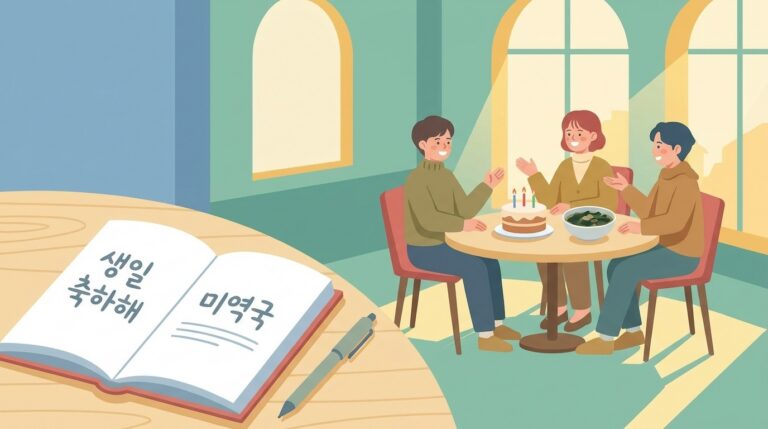
Phase 1: Why Korean Birthdays Feel So Tricky (And How to Nail Them!)
안녕하세요! 매일한글 에디터입니다. (Annyeonghaseyo! Maeil Hangeul editeoimnida. – Hello! I am your Daily Hangul Editor.) Picture this: you are at a cozy K-Pop birthday cafe in Seoul, chatting with a new Korean friend over iced lattes. Suddenly, they smile and ask when your birthday is! Your mind goes blank. Should you say hana, dul, set or il, i, sam? What if you accidentally mispronounce May 10th? Don’t worry, my friend! Built from real feedback by over 500 beginner learners just like you, this guide gives you the exact phrases to share your birthday naturally, avoid awkward number mix-ups, and instantly spark warm friendships in Korea.
Phase 2: Top 3 Must-Know Expressions
1. 제 생일은 5월 10일이에요 (Je saengireun owol sibirieyo)
- Pronunciation: Je saeng-i-reun o-wol si-bi-ri-e-yo. Think of owol like saying “oh, wall!” quickly, and sibirieyo smoothly links the sounds like “she-bee-ree-eh-yo”!
- Meaning: Literal: “As for my birthday, it is month 5, day 10.” Nuance: Warm, polite, and the gold-standard way to share your birthday.
- K-Culture Moment: In K-Dramas like Business Proposal or K-Pop idol livestreams, stars always use this exact sentence pattern when introducing their birthdays to fans.
- Editor’s Insight: Beginners often use nae (my – casual) instead of je (my – polite). Pairing je with -ieyo keeps you sounding sweet and respectful right from the start!
- Situation Spectrum: Casual ⚠️ (Too polite for besties; use Nae saengireun…) / Semi-formal ✅ (Perfect daily choice!) / Formal ⚠️ (Use -imnida in a job interview)
- 🤔 Think About It: In English, we say “May 10th” (name of month + ordinal number). In Korean, you say “5-month 10-day.” Why do you think Korean puts the bigger unit (month) before the smaller unit (day)?
2. 생일이 언제예요? (Saengiri eonjeyeyo?)
- Pronunciation: Saeng-i-ri eon-je-ye-yo. Eonje sounds like “uhn-jeh” (like “uh” in “under” + “jeh” in “jet”).
- Meaning: Literal: “Birthday, when is it?” Nuance: Friendly, curious, and natural without sounding intrusive.
- K-Culture Moment: Fans love asking rookie K-Pop idols this at fansign events, and Korean coworkers ask it over coffee to plan office cake surprises!
- Editor’s Insight: Notice there is no word for “your” here! Skipping “you” and “your” in Korean actually makes the question feel warmer and much less blunt.
- Situation Spectrum: Casual ⚠️ (Use Saengil eonjeya?) / Semi-formal ✅ (Your everyday go-to!) / Formal 🚫 (Too casual for elders; use Saengsini eonjeyeyo?)
- 🤔 Think About It: Korean drops “your” in friendly questions, relying on context instead. How does removing “you/your” change the feeling of closeness compared to English?
3. 몇 살이에요? (Myeot sarieyo?)
- Pronunciation: Myeot sa-ri-e-yo. Myeot sounds like “myuht” with a quick stopped “t,” and sarieyo flows like “sah-ree-eh-yo.”
- Meaning: Literal: “How many years old are you?” Nuance: A super common icebreaker among peers, though never used toward much older adults.
- K-Culture Moment: On Korean variety shows like Running Man, guests ask this within minutes of meeting so they know who gets to be unnie (older sister) or oppa (older brother).
- Editor’s Insight: Plot twist! Dates use Sino-Korean numbers (il, i, sam), while age uses Native Korean numbers (hana, dul, set—like seumul-daseot sal for 25!).
- Situation Spectrum: Casual ⚠️ (Use Myeot sariya?) / Semi-formal ✅ (Great for peers and new friends) / Formal 🚫 (Never ask elders this directly!)
- 🤔 Think About It: In Western cultures, asking someone’s age right away can feel rude. In Korea, knowing age helps people choose respectful language. Which approach feels easier to you?
Phase 3: Textbook Korean vs. Real Korean
Situation 1: Telling a new friend your birthday
- 📖 Textbook Korean (교과서 한국어): 저의 생일은 오 월 십 일입니다. (Jeoui saengireun o wol sip irimnida.)
- 🗣️ Real Korean (진짜 한국어): 내 생일은 5월 10일이야! (Nae saengireun owol sibiriya!)
- 💡 Why the difference? (왜 다를까?): Textbooks teach stiff -imnida endings and jeoui (my), which sound like a news anchor! With friends your age, Koreans switch to nae and -iya for an instant cozy, friendly vibe.
Situation 2: Finding out you were born in the same year
- 📖 Textbook Korean (교과서 한국어): 저는 스물다섯 살입니다. 나이가 같습니다. (Jeoneun seumuldaseot sarimnida. Naiga gatseumnida.)
- 🗣️ Real Korean (진짜 한국어): 어? 우리 동갑이네요! (Eo? Uri donggabineyo!)
- 💡 Why the difference? (왜 다를까?): Nobody stiffly announces “our ages are equal” in real life! Koreans light up and say donggap (same-age peer), which is a magic word that turns strangers into instant buddies.
Phase 4: K-Culture Deep Dive & Non-Verbal Manners
4-1. Nunchi (눈치) & Body Language
When sharing your birthday or age, keep soft eye contact and a warm smile. If you are speaking to someone older, give a gentle little head nod as you say je saengireun… (제 생일은…). Never point a finger when asking myeot sarieyo? (몇 살이에요?)—keep your hands relaxed! Also, practice nunchi (social awareness): if an older colleague doesn’t bring up their age, don’t press them for numbers.
4-2. K-Culture Code: Seaweed Soup & Birthday Cafes
In almost every K-Drama, characters wake up on their birthday to a steaming bowl of miyeokguk (미역국 – seaweed soup). Koreans eat it for health and to thank their mothers for giving birth to them! Meanwhile, in modern K-Pop culture, fans celebrate idols’ birthdays by decorating entire cafes in Hongdae or Gangnam as “Saengil Cafes” (생일 카페) filled with custom cup sleeves and photo zones.
Phase 5: Real-Life Roleplay Scenario
Setting: A sunny afternoon inside a pastel-pink K-Pop birthday cafe in Hongdae, Seoul. Soft pop music plays as iced strawberry lattes arrive at the counter.
NPC: Minji (민지), a bubbly 22-year-old Korean college student working part-time and handing out birthday cup holders.
- Minji: 안녕하세요! 아이스 라떼 나왔습니다. 🎭 (Smiling brightly as she slides the cup across the counter)
(Annyeonghaseyo! Aiseu latte nawatseumnida.) – “Hello! Your iced latte is ready.” - You: 감사합니다! 혹시 오늘 누구 생일이에요? 🎭 (Pointing gently at the cute birthday banner)
(Gamsahamnida! Hoksi oneul nugu saengirieyo?) – “Thank you! By any chance, whose birthday is it today?” - Minji: 아, 오늘 저희 멤버 생일이에요! 5월 10일! 🎭 (Giggling proudly and pointing at a poster)
(A, oneul jeohui membeo saengirieyo! Owol sibiril!) – “Ah, today is our member’s birthday! May 10th!” - You: 우와, 진짜요? 제 생일도 5월 10일이에요! 🎭 (Eyes widening in happy surprise)
(Uwa, jinjjayo? Je saengildo owol sibirieyo!) – “Whoa, really? My birthday is May 10th too!” - Minji: 대박! 너무 신기해요! 혹시 몇 살이에요? 🎭 (Clapping her hands excitedly)
(Daebak! Neomu singihaeyo! Hoksi myeot sarieyo?) – “Awesome! That’s so cool! If you don’t mind, how old are you?” - You: 저는 스물두 살이에요. 민지 씨는요? 🎭 (Smiling warmly and tilting your head slightly)
(Jeoneun seumuldu sarieyo. Minji ssineunyo?) – “I am 22 years old. How about you, Minji?” - Minji: 어머! 저도 스물두 살이에요! 우리 동갑이네요! 🎭 (Gasping happily and offering a friendly high-five)
(Eomeo! Jeodo seumuldu sarieyo! Uri donggabineyo!) – “Oh my! I’m 22 too! We are the same age!” - You: 반가워요! 생일 축하해요! 🎭 (Laughing and clinking your iced coffee cup gently)
(Bangawoyo! Saengil chukahaeyo!) – “Nice to meet you! Happy birthday!”
🔀 Interactive Branching: What Do You Say Next at Turn 6?
- Option A: “저는 스물두 살이에요. 민지 씨는요?” (Jeoneun seumuldu sarieyo. Minji ssineunyo?)
- Feedback (Best ✅): Spot on! You used Native Korean numbers (seumuldu) for age, kept the polite -ieyo ending, and politely asked her back using -ssineunyo?. Instant bestie energy!
- Option B: “저는 이십이 살이에요.” (Jeoneun isibi sarieyo.)
- Feedback (Bad ❌): Oops! Isibi is a Sino-Korean number, which is used for dates and money—not age! Minji will understand you, but it sounds clunky. Remember: dates = Sino-Korean (owol sibil), age = Native Korean (seumuldu sal).
- Option C: “야, 너 몇 살이야?” (Ya, neo myeot sariya?)
- Feedback (Risk 🚨):Whoa, slow down! Calling a stranger ya (hey) and using casual banmal (sariya) sounds rude in Korea before you know each other’s ages. Always start polite!
Phase 6: 10-Second Emotion Shadowing Drill
Read each line aloud with the / pauses and match the emotion!
[😊 Happy & Excited]제 생일은 / 5월 10일이에요! (Je saengireun / owol sibirieyo!) — “My birthday is / May 10th!”[🤔 Curious & Friendly]혹시 / 생일이 언제예요? (Hoksi / saengiri eonjeyeyo?) — “By chance, / when is your birthday?”[🥳 Surprised & Warm]어? / 우리 동갑이네요! (Eo? / Uri donggabineyo!) — “Oh? / We are the same age!”
Phase 7: K-Culture Mini Dictionary
- 생일 (Saengil) | Birthday | Used daily for friends, coworkers, and idols. (When talking about grandparents or elders, switch to the honorific word saengsin 생신!)
- 미역국 (Miyeokguk) | Seaweed soup | The classic Korean birthday breakfast eaten for good health and to honor one’s mother.
- 동갑 (Donggap) | Same-age peer | A beloved social shortcut used when two people discover they were born in the same year.
- 만 나이 (Man nai) | International age | Korea’s official age system since June 2023, starting at 0 at birth and adding 1 on your actual birthday.
Phase 8: Traveler’s Survival Kit
Top 3 Survival Phrases
- 오늘 제 생일이에요! (Oneul je saengirieyo! – Today is my birthday!) -> Pro Tip: Mention this at a cozy cafe or BBQ place; friendly staff sometimes add a free dessert or cheerful applause!
- 생일 축하해요! (Saengil chukahaeyo! – Happy birthday!) -> Pro Tip: Use this at K-Pop birthday cafes or when celebrating with Korean friends.
- 몇 월 며칠이에요? (Myeot wol myeochirieyo? – What month and date is it?) -> Pro Tip: Super helpful at ticket booths or tourist centers when confirming event dates.
Editor’s Travel Note
Heading to Seoul for a birthday trip or K-Pop cafe tour? Before you land, Download Naver Map App for Seoul Cafe Routes since Google Maps walking directions don’t work well in Korea. Pair it with Install Papago Korean Translator for Instant Menus to decode cafe specials! Grab a T-money card at any convenience store (CU or GS25) for subways, and carry a WOWPASS or Visa/Mastercard since most Seoul cafes are completely cashless.
Phase 9: One Step Deeper
In June 2023, South Korea officially unified its age system to man nai (international age), retiring the famous “Korean age” where newborns started at age one. Yet even with modern rules, sharing your birthday and age in Korea isn’t about being nosy—it’s about finding your place in a warm community. Knowing someone’s birth date helps Koreans decide how to speak respectfully and builds jeong (정 – deep affection). Even a one-year difference quickly transforms into a caring unnie or oppa bond!
💬 Your Turn: How do you say YOUR birthday in Korean? Drop your birthday in the comments using 제 생일은 ~월 ~일이에요 (Je saengireun ~wol ~irieyo), and let’s see if you find a birthday twin!
Phase 10: FAQ & Common Mistakes
Q: Why do Koreans use one number system for May 10th and another for age?
A: Korean has two number sets! Dates, months, money, and phone numbers use Sino-Korean numbers (il, i, sam, sa, o…), while counting your age (sal 살) uses Native Korean numbers (hana, dul, set…). It feels odd at first, but with a little practice, your brain separates “calendar numbers” from “age numbers” automatically!
Q: Are all months regular like May (오월)? Are there any tricky months?
A: Great catch! Ten months are totally regular, just number + wol (월). However, June is 유월 (yuwol) instead of yukwol, and October is 시월 (siwol) instead of sipwol—we drop the final consonant so it rolls off the tongue smoothly!
Q: Do Koreans still ask for birth year instead of age?
A: Yes, very often! Instead of asking your exact age, new friends might ask 몇 년생이에요? (Myeot nyeonsaengieyo? – What year were you born?) because birth year never changes throughout the calendar year.
🚨 Common Mistakes TOP 3
- Saying “오월 십” without “일” (Forgetting “day”): Saying owol sip sounds unfinished! Correct Action: Always attach il (일 – day) after the date number: owol sibil (5월 10일).
- Using Sino-Korean numbers for age: Saying isip sal instead of seumul sal for 20. Correct Action: Memorize Native tens for age (yeol 10, seumul 20, seoreun 30)!
- Pronouncing 10일 literally as “sip-il”: Correct Action: Let the “p/b” sound glide smoothly into “il” so it sounds like si-bil (시빌), and with -ieyo it flows as si-bi-ri-e-yo!
Phase 11: Action Mission & Community Challenge
- 🥉 Bronze Mission (Solo Practice): Look in the mirror and say your own birthday and age aloud 5 times using 제 생일은 ~월 ~일이에요 (Je saengireun ~wol ~irieyo).
- 🥈 Silver Mission (Share Online): Post your birthday in Hangul on Instagram Stories or our comment section and tag a friend to guess the date!
- 🥇 Gold Mission (Real-World Use): Next time you visit a Korean restaurant or language exchange app, ask a friend 생일이 언제예요? (Saengiri eonjeyeyo?) and celebrate if you share a birth month!
- 🎮 K-Culture Mission: Watch a K-Pop idol birthday live or a K-Drama birthday scene this week—can you spot the words 생일 (saengil) or 미역국 (miyeokguk)?
Phase 12: Interactive Quiz Challenge
Quiz 1: Situational Check
You meet a friendly Korean cafe barista around your age, and she asks, “생일이 언제예요?” (Saengiri eonjeyeyo?). Which reply is the most natural and polite?
* A) 내 생일은 오월 십이야. (Nae saengireun owol sibiya.)
* B) 제 생일은 5월 10일이에요. (Je saengireun owol sibirieyo.)
* C) 몇 살이에요? (Myeot sarieyo?)
Check Answer & Explanation
Correct Answer: B! Using Je saengireun owol sibirieyo is polite, complete (with il for day), and matches her friendly tone. Option A is too casual for a stranger and misses il (day), while Option C ignores her question completely!
Quiz 2: Fill in the Blank
Complete the polite question to ask someone’s age: 몇 ______이에요? (Myeot ______ieyo?)
Check Answer & Explanation
Correct Answer: 살 (sal)! The full phrase is 몇 살이에요? (Myeot sarieyo?). Remember that sal is the counter for age and pairs with Native Korean numbers.
Quiz 3: True or False Culture Quiz
Statement: In Korean, June is pronounced yukwol (육월) and October is pronounced sipwol (십월).
Check Answer & Explanation
False! June and October are the two irregular months in Korean: June is 유월 (yuwol) and October is 시월 (siwol). May (오월 – owol) is completely regular!
🎬 Watch Our Daily Videos! (Daily Hangul Official Instagram)
Review the expressions you learned in this article with our fun daily short videos! Check out native pronunciation and real-life nuances in action.
- Instagram @dailyhangul_en







