

Phase 1: Empathy
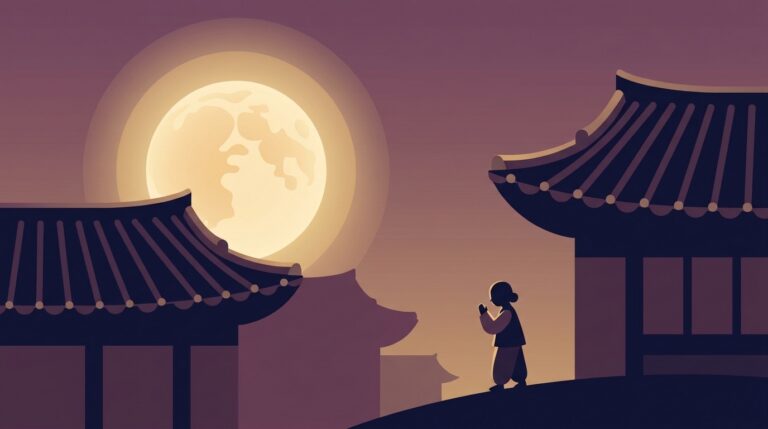
Hello! I am your Daily Hangul Editor. Imagine it is Chuseok (추석, Korean Thanksgiving). You are standing on a Hanok rooftop in Seoul with your Korean friends. The autumn breeze feels cool, and a giant, glowing full moon rises in the night sky. Everyone clasps their hands together and closes their eyes to make a wish. Suddenly, your friend whispers to you, “Make a wish!” You freeze! What do you say in Korean? Do you say “Happy Chuseok” or talk about the moon? Don’t worry! Many A1 beginners get shy during this magical K-Culture moment. Based on real student feedback, this guide gives you the exact easy phrases you need to join in and shine under the Chuseok moon!
Phase 2: Deep Dive into 3 Core Expressions
1. 추석 잘 보내세요 (Chuseok jal bonaeseyo)
- Pronunciation: Chuseok jal bonaeseyo (Choo-suhk jahl boh-neh-seh-yo — “jal” sounds like “jar” without the r, and “seyo” sounds like “say-yo”)
- Meaning: Literally “Spend Chuseok well.” In real life, it is the warmest, most natural way to say “Happy Chuseok!”
- K-Culture Moment: In K-Dramas or K-Pop holiday vlogs, idols wear colorful Hanbok (한복) and bow slightly to fans while saying this phrase with big smiles.
- Editor’s Insight: Unlike “Merry Christmas,” Koreans focus on spending time well during holidays. You can also swap Chuseok with Seollal (설날, Lunar New Year) to say 설날 잘 보내세요 (Seollal jal bonaeseyo)!
- Situation Spectrum: Casual 🚫 | Semi-formal ✅ | Formal ✅
- 🤔 Think About It: In English, you wish someone a “Happy” holiday. In Korean, you wish them to “spend it well.” How does this show Korea’s focus on family time and peaceful rest?
2. 보름달 보고 소원 빌어요 (Boreumdal bogo sowon bireoyo)
- Pronunciation: Boreumdal bogo sowon bireoyo (Boh-reum-dahl boh-goh soh-wuhn bee-ruh-yo — “reum” sounds like “room” with a relaxed mouth, and “bireoyo” rhymes with “hero-yo”)
- Meaning: Literally “Look at the full moon and pray a wish.” Naturally, it means “Let’s make a wish at the full moon!”
- K-Culture Moment: Picture a cozy autumn scene in a slice-of-life K-Drama where a family steps onto the porch after dinner, spots the bright moon, and nudges each other to make a wish.
- Editor’s Insight: The word 보름달 (boreumdal) specifically means the bright 15th-day full moon, not just any moon (달, dal). Using it shows you really know Korean autumn culture!
- Situation Spectrum: Casual ⚠️ | Semi-formal ✅ | Formal ✅
- 🤔 Think About It: In Western cultures, people often wish on shooting stars or birthday candles. Why do you think a round, full moon felt so hopeful to Korean farmers in the past?
3. 건강하게 해 주세요 (Geonganghage hae juseyo)
- Pronunciation: Geonganghage hae juseyo (Guhn-gahng-hah-geh heh joo-seh-yo — “geon” sounds like “gun,” and “juseyo” sounds like “joo-say-yo”)
- Meaning: Literally “Please make it healthy.” Naturally, it is the top Korean wish: “Please keep us healthy!”
- K-Culture Moment: You will hear this sweet wish in variety shows whenever stars visit their grandparents or look up at the Chuseok moon.
- Editor’s Insight: For A1 beginners, adding 해 주세요 (hae juseyo, please make/do it for me) to any simple wish word is a magic cheat code! You do not need hard grammar to sound heartfelt.
- Situation Spectrum: Casual 🚫 | Semi-formal ✅ | Formal ✅
- 🤔 Think About It: When Koreans make wishes, they often wish for health (건강, geongang) for their whole family before money or personal success. What is the first thing you usually wish for?
Phase 3: Textbook Korean vs. Real Korean
Situation 1: Greeting your friend during Chuseok
- 📖 Textbook Korean: 즐거운 추석 명절 되시기를 바랍니다. (Jeulgeoun Chuseok myeongjeol doesigireul baramnida. — I hope you have a joyful Chuseok holiday.)
- 🗣️ Real Korean: 해피 추석! 추석 잘 보내! (Haepi Chuseok! Chuseok jal bonae! — Happy Chuseok! Have a great Chuseok!)
- 💡 Why the difference? Textbook Korean sounds like a formal news anchor or a company email. Between close friends, Koreans love mixing fun English loanwords like “해피 (haepi)” and dropping the polite “-세요 (-seyo)” ending!
Situation 2: Reacting to the giant full moon
- 📖 Textbook Korean: 오늘 밤 하늘의 보름달이 매우 큽니다. (Oneul bam haneurui boreumdari maeu keumnida. — Tonight’s full moon in the sky is very big.)
- 🗣️ Real Korean: 와, 달 진짜 크다! (Wa, dal jinjja keuda! — Whoa, the moon is really big!)
- 💡 Why the difference? Nobody uses formal “-니다 (-nida)” endings when gasping at a pretty moon! Real Koreans use quick reaction words like “와 (wa, whoa)” and “진짜 (jinjja, really)” to share instant excitement.
Phase 4: K-Culture Deep Dive & Non-Verbal Manners
4-1. Nunchi (눈치) & Gestures
When Koreans look at the Chuseok full moon to make a wish, the vibe is quiet, warm, and sincere. Clasp both hands gently together in front of your chest (like a soft prayer), tilt your head up toward the moon, and close your eyes for a few seconds. Avoid shouting your wish out loud—Koreans believe keeping your wish in your heart helps it come true! If you greet an elder first, give a gentle 15-degree bow with both hands resting calmly in front of you.
4-2. Cultural Code Analysis: K-Food & K-Drama Magic
In almost every Chuseok K-Drama episode, two things appear together: the bright full moon and Songpyeon (송편), half-moon-shaped rice cakes! Why half-moon instead of full? Legend says a half-moon grows fuller and brighter, symbolizing a bright future ahead. Families sit together making Songpyeon before stepping outside to wish on the full moon.
Phase 5: Real-Life Roleplay Scenario
Setting: A cozy neighborhood rooftop in Bukchon Hanok Village, Seoul. Crisp autumn air, warm string lights, and a plate of sweet Songpyeon on a wooden table.
Character: Minjun (민준) — your warm-hearted Korean friend who invited you to his family’s Chuseok evening.
- Minjun: 추석 잘 보내세요! 우리 집까지 와 줘서 고마워요. (Chuseok jal bonaeseyo! Uri jipkkaji wa jwoseo gomawoyo.)
🎭 Minjun smiles brightly while holding a plate of colorful rice cakes.
“Happy Chuseok! Thank you for coming all the way to my house.” - You: 초대해 줘서 고마워요! 추석 잘 보내세요! (Chodaehae jwoseo gomawoyo! Chuseok jal bonaeseyo!)
🎭 You give a small, polite bow and smile back.
“Thank you for inviting me! Have a great Chuseok!” - Minjun: 어! 저기 하늘 좀 보세요! (Eo! Jeogi haneul jom boseyo!)
🎭 Minjun points excitedly toward the dark night sky over the Hanok roofs.
“Oh! Look at the sky over there!” - You: 와, 달 진짜 크다! (Wa, dal jinjja keuda!)
🎭 Your eyes go wide as you see the glowing golden full moon.
“Whoa, the moon is really big!” - Minjun: 맞아요, 보름달이에요! 보름달 보고 소원 빌어요. (Majayo, boreumdarieyo! Boreumdal bogo sowon bireoyo.)
🎭 Minjun clasps his hands together gently to show you what to do.
“Right, it’s the full moon! Make a wish looking at the full moon.” - You: 네! 음… 어떻게 빌어요? (Ne! Eum… eotteoke bireoyo?)
🎭 You mimic Minjun and clasp your hands, looking curious.
“Yes! Um… how do I make a wish?” - Minjun: 눈 감고 마음속으로 빌면 돼요! 뭐 빌 거예요? (Nun gamgo maeumsogeuro bilmyeon dwaeyo! Mwo bil geoyeyo?)
🎭 Minjun whispers softly so he does not break the peaceful mood.
“Just close your eyes and wish in your heart! What are you going to wish for?” - You: 가족 모두 건강하게 해 주세요! (Gajok modu geonganghage hae juseyo!)
🎭 You close your eyes, smile warmly, and whisper your wish.
“Please keep my whole family healthy!”
🔀 Interactive Branching Point
Right after you finish wishing, Minjun’s grandmother steps onto the rooftop carrying warm tea. What should you say to her first?
* A) “할머니, 추석 잘 보내세요! (Halmeoni, Chuseok jal bonaeseyo!)” with a gentle bow.
* B) “해피 추석, 할머니! (Haepi Chuseok, halmeoni!)” with a casual high-five.
* C) Say nothing and just keep staring at the moon.
Feedback:
* Option A (Best!): 10/10 Nunchi! Using the polite “-세요 (-seyo)” ending and bowing gently shows huge respect to Korean elders. Grandmother will immediately adore you!
* Option B (Bad!): Oops! Casual English slang and a high-five with an elder you just met might surprise her. Keep casual vibes for friends your age!
* Option C (Risk!): A bit risky! Ignoring an elder who just arrived can look awkward in Korea, even if you are shy. A simple smile and “안녕하세요 (Annyeonghaseyo)” works wonders!
Phase 6: 10-Second Emotion Shadowing Drill
Read each line aloud using the / marks for natural pauses and channel the mood!
[😊 Happy and warm]추석 / 잘 보내세요! (Chuseok / jal bonaeseyo! — Have a great Chuseok!)[😲 Amazed and excited]와! / 보름달 / 진짜 크다! (Wa! / Boreumdal / jinjja keuda! — Whoa! The full moon is really big!)[🥺 Hopeful and earnest]보름달 보고 / 소원 빌어요. (Boreumdal bogo / sowon bireoyo. — Make a wish looking at the full moon.)[💖 Sincere and gentle]모두 / 건강하게 해 주세요. (Modu / geonganghage hae juseyo. — Please keep everyone healthy.)
Phase 7: K-Culture Mini Dictionary
- 보름달 (Boreumdal) | Full moon | Used specifically for the bright full moon during Chuseok or Jeongwol Daeboreum (first full moon of the lunar year). Never used for crescent moons!
- 소원 (Sowon) | Wish | Used when making a wish on the moon, birthday candles, or New Year’s sunrise. Often paired with the verb 빌다 (bilda, to wish/pray).
- 추석 (Chuseok) | Korean Autumn Harvest Holiday | One of Korea’s two biggest holidays (with Seollal). Families gather, eat Songpyeon, and honor ancestors.
- 명절 (Myeongjeol) | Traditional Holiday | An umbrella word covering both Seollal and Chuseok. You will see it on Korean store signs saying “명절 휴무 (Closed for the holiday).”
Phase 8: Survival Kit for Travelers
Top 3 Survival Expressions
- 명절 잘 보내세요 (Myeongjeol jal bonaeseyo) — “Have a great holiday!” Pro Tip: Works for BOTH Seollal and Chuseok, so you never mix up the holiday names!
- 오늘 문 열어요? (Oneul mun yeoreoyo?) — “Are you open today?” Pro Tip: Many small shops close during Chuseok, so ask this before walking in!
- 사진 찍어 주세요 (Sajin jjigeo juseyo) — “Please take a photo for me.” Pro Tip: Perfect when you wear Hanbok under the evening palace lights!
Editor’s Travel Note
During Seollal and Chuseok, Korea gets wonderfully peaceful, but many restaurants and cafes take a holiday break! Before heading out to view the full moon at Namsan Tower or Gyeongbokgung Palace, check holiday opening hours by searching your destination with the Naver Map App for Korean Holidays. Also, remember that Seoul buses and subways run normally, and you can easily pay with a T-money card at any convenience store—which stays open 24/7 even on Chuseok day!
Phase 9: One Step Deeper
In Korea, holidays like Seollal and Chuseok are not just days off work—they are moments to reconnect with “Uri (우리, our/we).” Even when Koreans make a private wish under the bright full moon, they rarely think only about themselves. Wishing for “건강 (health)” and “행복 (happiness)” for family and friends reflects Korea’s warm community spirit. By learning just a few respectful holiday phrases, you are not only speaking Korean—you are stepping right into the heart of Korean kindness.
💬 Your Turn: If you could make one wish under the Chuseok full moon tonight, what would you wish for? Tell us in the comments!
Phase 10: FAQ & Myth Busting
Q: Can I use “추석 잘 보내세요” for Seollal too?
A: No! Chuseok is in autumn, while Seollal (설날) is Lunar New Year in winter. For Seollal, say “새해 복 많이 받으세요 (Saehae bok mani badeuseyo, Happy New Year)!” If you want one phrase for both, use “명절 잘 보내세요 (Myeongjeol jal bonaeseyo).”
Q: Do Koreans really make wishes on the moon every Chuseok?
A: Yes! While busy city life means not everyone gathers on rooftops, families still step outside after Chuseok dinner, admire the bright moon, and playfully tell kids to make a wish.
Q: Should I say my wish out loud in Korean?
A: Usually, no! Just like blowing out birthday candles, Koreans whisper their wish silently in their heart so the magic stays strong.
🚨 Common Mistakes Warning Board
- Mistake: Saying “행복한 추석 (Haengbokan Chuseok)” directly from English “Happy Chuseok.” -> Correct Action: Say 추석 잘 보내세요 (Chuseok jal bonaeseyo) instead!
- Mistake: Calling the full moon just “큰 달 (keun dal, big moon)” when talking about the tradition. -> Correct Action: Use the special word 보름달 (boreumdal)!
- Mistake: Dropping “-세요 (-seyo)” when greeting elders or store staff. -> Correct Action: Always keep -세요 (-seyo) for anyone older or unfamiliar.
Phase 11: Action Mission & Engagement
- 🥉 Bronze Mission: Look in the mirror tonight and practice saying 추석 잘 보내세요 (Chuseok jal bonaeseyo) three times with a warm smile!
- 🥈 Silver Mission: Take a photo of the moon from your window tonight and post it on social media with the caption: “보름달 보고 소원 빌어요! (Boreumdal bogo sowon bireoyo!)”
- 🥇 Gold Mission: Message a Korean friend or language partner during the next holiday season using 명절 잘 보내세요 (Myeongjeol jal bonaeseyo)!
- 🎮 K-Culture Mission: Watch a Chuseok special vlog from your favorite K-Pop group on YouTube and try to spot the words 추석 (Chuseok) or 보름달 (boreumdal)!
Phase 12: Interactive Quiz Challenge
Quiz 1 (Situation Judgment): You meet your Korean neighbor in the elevator on Chuseok morning. What is the best greeting?
1. 해피 추석! (Haepi Chuseok!)
2. 추석 잘 보내세요! (Chuseok jal bonaeseyo!)
3. 보름달 진짜 크다! (Boreumdal jinjja keuda!)
Check Quiz 1 Answer & Feedback
Answer: 2. 추석 잘 보내세요! (Chuseok jal bonaeseyo!)
Why? Option 1 is too casual for a neighbor, and Option 3 makes no sense in the morning elevator! Option 2 is warm, polite, and natural.
Quiz 2 (Fill in the Blank): Complete the phrase for making a wish at the full moon:
“______ 보고 소원 빌어요!” (______ bogo sowon bireoyo!)
Check Quiz 2 Answer & Feedback
Answer: 보름달 (Boreumdal)
Great job! 보름달 (boreumdal) means the full moon.
Quiz 3 (True or False): Koreans believe you must shout your Chuseok full moon wish as loudly as possible so the moon hears you. (True / False)
Check Quiz 3 Answer & Feedback
Answer: False!
Koreans softly clasp their hands, close their eyes, and make their wish silently in their heart.
🎬 Watch Our Daily Videos! (Daily Hangul Official Instagram)
Review the expressions you learned in this article with our fun daily short videos! Check out native pronunciation and real-life nuances in action.
- Instagram @dailyhangul_en






