

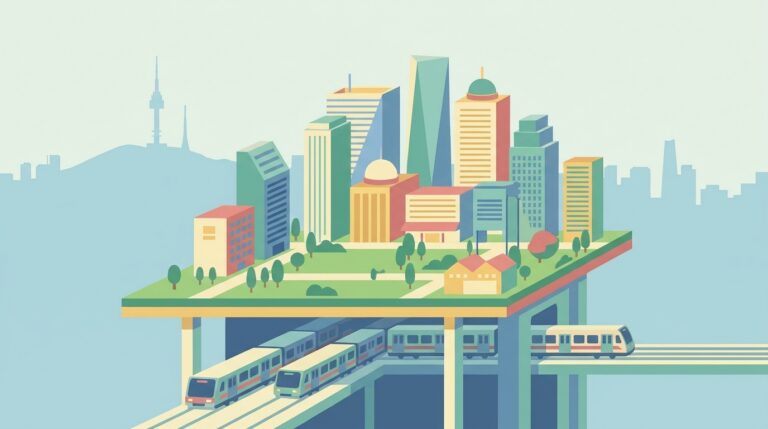
Phase 1: Why Seoul’s Vertical Magic Leaves Even Advanced Learners Speechless
안녕하세요! 매일한글 에디터입니다. (Annyeonghaseyo! Maeil Hangeul Editeo-imnida.) Hello, I’m your Daily Hangul Editor! Picture this: you’re watching a sleek K-Drama about Seoul’s skyline or strolling through Yeontral Park, where trendy cafes bloom right above buried train tracks. Suddenly, an architect on screen drops heavy jargon like ‘입체 복합 개발 (ipche bokhap gaebal)’—vertical mixed-use development—and your C2 confidence hits a wall. Based on real feedback from advanced learners navigating urban planning talks in Korea, this guide bridges that exact gap. Master these authentic expressions, and you won’t just translate city policy—you’ll debate Seoul’s future like a native urbanist.
Phase 2: Deep Dive into 3 Core C2 Expressions
1. 입체 복합 개발 (Ipche bokhap gaebal)
- Pronunciation: Ip-che bok-hap gae-bal (Sounds like ip in tip + che in chess + bok in book + hop + gay + balm)
- Meaning: Literally “three-dimensional complex development.” In practice, it refers to multi-dimensional, vertical mixed-use zoning that stacks parks, housing, offices, and transit infrastructure on top of each other—such as decking over rail yards and arterial highways.
- K-Culture Moment: Picture a high-stakes boardroom scene in prestige K-Dramas like Agency or The Auditors, or a deep-dive episode on star architect Yoo Hyun-jun’s YouTube channel (Sherlock Hyun-jun), where planners unveil a sleek 3D Digital Twin hologram of Seoul’s future rail-deck districts.
- Editor’s Insight: Standard “재개발 (jaegaebal / redevelopment)” implies tearing down old houses to build apartments. “입체 복합 개발 (ipche bokhap gaebal)” signals hyper-modern spatial efficiency—turning dead, noisy corridors into multi-layered civic ecosystems.
- Situation Spectrum: Casual ⚠️ (A bit stiff over beer unless you’re talking real estate!) | Semi-formal ✅ | Formal ✅
- 🤔 Think About It: Western cities often prize horizontal sprawl and separated zoning. Why does Korean urbanism embrace “입체 (ipche / three-dimensionality)” not as cramped compromise, but as futuristic innovation?
2. 단절된 공간을 잇다 (Danjeoldoen gongganeul itda)
- Pronunciation: Dan-jeol-doen gong-ga-neul it-da (don + just-ul + dwen + gong + gone–ul + a crisp it-ta with a slight pause before t)
- Meaning: Literally “to link severed spaces.” Its real nuance is healing the socio-economic scars of a city split in half by noisy railways or highways.
- K-Culture Moment: Often heard in poignant Korean urban documentaries profiling how Seoul’s Gyeongui Line Forest Park (Yeontral Park) or Seoullo 7017 transformed grim concrete barriers into pedestrian-friendly romantic date spots.
- Editor’s Insight: Instead of cold engineering verbs like “연결하다 (yeongyeolhada / connect),” planners favor the pure Korean verb “잇다 (itda).” It evokes stitching torn fabric back together—connecting neighborhoods emotionally, culturally, and physically.
- Situation Spectrum: Casual ⚠️ | Semi-formal ✅ | Formal ✅
- 🤔 Think About It: In English, we “bridge the gap” or “reconnect neighborhoods.” In Korean, “잇다 (itda)” also means to inherit a legacy or continue a story. How does framing infrastructure as “stitching lives together” change public support for urban projects?
3. 상부 인공 데크화 (Sangbu ingong dekeuhwa)
- Pronunciation: Sang-bu in-gong de-keu-hwa (song + boo + in + gong + deck + cooh without rounding lips + what)
- Meaning: Literally “upper-level artificial deck-ization.” It describes constructing a massive load-bearing structural slab over active train yards or expressways to create buildable green land above.
- K-Culture Moment: You’ll hear this exact phrasing during Seoul Metropolitan Government press briefings or smart-city architecture podcasts discussing how to cap the Gyeongbu rail line or Dongbu Expressway.
- Editor’s Insight: Notice how Korean seamlessly fuses the English loanword “데크 (dekeu / deck)” with the Sino-Korean suffix “-화 (-hwa / -ization).” Dropping “-화 (-hwa)” at the end of a noun instantly elevates your speech to C2 policy-briefing fluency.
- Situation Spectrum: Casual 🚫 (Too technical for casual hangout) | Semi-formal ✅ | Formal ✅
- 🤔 Think About It: Korean urban jargon frequently hybridizes English engineering terms with Sino-Korean grammatical suffixes. What does this linguistic agility reveal about Korea’s rapid, globalized approach to smart-city problem-solving?
Phase 3: Textbook Korean vs. Real Korean
Even advanced textbooks sound painfully robotic when describing real Seoul neighborhoods. Here is how native urbanists and savvy locals actually talk.
Situation 1: Explaining how a highway or rail yard split a neighborhood
- 📖 Textbook Korean: 철도가 있어서 동네가 나누어졌어요. (Cheoldoga isseoseo dongnega nanueojyeosseoyo.) — Because there is a railroad, the neighborhood was divided.
- 🗣️ 진짜 한국어 (Real Korean): 철길 하나 때문에 상권이랑 생활권이 완전히 두 동강 났죠. (Cheolgil hana ttaemune sanggwonirang saenghwalgwoni wanjeonhi du donggang natjyo.) — Just because of that one rail track, both the commercial zone and living sphere got completely snapped in two.
- 💡 왜 다를까? (Why is it different?): Textbooks give dry cause-and-effect. Real Koreans use the visceral idiom “두 동강 나다 (du donggang nada / to snap cleanly into two pieces)” alongside “상권 (sanggwon / commercial catchment)” and “생활권 (saenghwalgwon / daily living zone)” to emphasize the economic and emotional pain of urban severance.
Situation 2: Praising a deck-over compact city hub
- 📖 Textbook Korean: 역 위에 공원과 건물을 같이 지어서 편리해요. (Yeok wie gongwongwa geonmureul gachi jieoseo pyeonrihaeyo.) — It’s convenient because they built a park and buildings together over the station.
- 🗣️ 진짜 한국어 (Real Korean): 역세권 상부를 데크로 덮어서 원스톱 압축도시로 탈바꿈시켰더라고요. (Yeoksegwon sangbureul dekeuro deopeoseo wonseutop apchukdosiro talbakkumsikyeotdeoragoyo.) — I noticed they decked over the transit hub and completely transformed it into a one-stop compact city.
- 💡 왜 다를까? (Why is it different?): Natives bundle entire urban concepts into punchy nouns like “역세권 (yeoksegwon / station-influence area)” and “압축도시 (apchukdosi / compact city),” topped off with “탈바꿈시키다 (talbakkumsikida / transform dramatically)” and the observational ending “-더라고요 (-deoragoyo)” to sound effortlessly perceptive.
Phase 4: K-Culture Deep Dive & Non-Verbal Manners
4-1. 눈치 (Nunchi) & Gestures in Urban Discussions
When you’re discussing multi-dimensional zoning or reviewing a Digital Twin city simulation with Korean colleagues, keep your non-verbal cues sharp. First, never point at a 3D map or architectural screen with a single index finger—it feels aggressive. Instead, sweep your open palm gently across the spatial axis while nodding slightly and saying, “아, 이 축을 따라 연결되는 거군요 (A, i chugeul ttara yeongyeoldoeneun geogunyo / Ah, so it connects along this axis).” Second, read the room’s nunchi when touching on local property values or NIMBY issues. Koreans value consensus; frame deck-over parks as a win-win for “쾌적성 (kwaejeokseong / urban pleasantness)” and “지역 상생 (jiyeok sangsaeng / mutual regional prosperity)” rather than bluntly criticizing old zoning laws.
4-2. Cultural Code: K-Travel & Seoul’s Living Urbanism
If you’ve ever sipped an iced Americano along Yeontral Park (연트럴파크 / Yeonteureol Pakeu) in Yeonnam-dong, you’ve witnessed the spirit of deck-over regeneration firsthand. Decades ago, the surface Gyeongui railway sliced through western Seoul with noise and soot. By burying the tracks underground and turning the surface corridor into a lush linear park, Seoul didn’t just plant trees—it birthed a global K-Travel mecca packed with indie bookstores, Michelin-recognized bistros, and K-Drama filming spots. Today, Korea is taking that DNA even further with Digital Twin urban planning: modeling wind corridors, sunlight rights, and pedestrian flow before laying a single artificial deck over sprawling rail depots.
Phase 5: Practical Roleplay Scenario
Setting: Inside the sleek Seoul Smart City Urban Lab in Yongsan. Floor-to-ceiling glass looks out over sprawling rail yards, while a glowing Digital Twin projection hovers over the conference table.
Characters: Min-jun (민준), a sharp yet coffee-obsessed Senior Urban Planner, and You, a visiting C2-level international urbanist.
- Min-jun: 🎭 (tapping a tablet to rotate the 3D Digital Twin model of the rail depot)
지금 보시는 이 철도 부지가 지난 50년간 동네를 양분해 왔습니다. (Jigeum bosineun i cheoldo bujiga jinan osipnyeongan dongnereul yangbunhae watseumnida.)
This rail yard you’re looking at has bisected the neighborhood for the past 50 years. - You: 🎭 (leaning forward thoughtfully, tracing the rail line with an open palm)
그러게요. 철로 때문에 상권과 보행 동선이 완전히 단절된 느낌이에요. (Geureogeyo. Cheollo ttaemune sanggwongwa bohaeng dongseoni wanjeonhi danjeoldoen neukkimieyo.)
Indeed. It feels like commercial zones and pedestrian flows are completely severed because of the tracks. - Min-jun: 🎭 (smiling warmly, impressed by your phrasing)
정확히 보셨어요. 그래서 저희가 상부 인공 데크화를 통해 입체 복합 개발을 추진 중입니다. (Jeonghwakhi bosyeosseoyo. Geuraeseo jeohuiga sangbu ingong dekeuhwareul tonghae ipche bokhap gaebareul chujin jungimnida.)
You spotted it right away. That’s why we’re pushing multi-dimensional mixed-use development by decking over the upper level. - You: 🎭 (pointing gently to the virtual park layer above the tracks)
데크 위에 공원과 복합 단지를 올리면 진정한 의미의 압축도시가 되겠네요. (Dekeu wie gongwongwa bokhap danjireul ollimyeon jinjeonghan uimiui apchukdosiga doegetneyo.)
If you put a park and mixed-use complex atop the deck, it will become a compact city in the truest sense. - Min-jun: 🎭 (nodding enthusiastically, holding up two fingers)
맞아요. 하부는 교통 허브로, 상부는 시민들의 녹지 공간으로 재탄생시키는 거죠. (Majayo. Habuneun gyotong heobeuro, sangbuneun simindeului nokji gongganeureo jaetansaengsikineun geojyo.)
Exactly. We’re rebirthing the lower level as a transit hub and the upper level as green space for citizens. - You: 🎭 (tilting head slightly with an analytical smile)
그런데 시공비도 만만치 않을 텐데, 인근 주민들의 일조권이나 소음 민원은 어떻게 조율하시나요? (Geureonde sigongbido manmanchi aneul tende, ingeun jumindeului iljogwonina soeum mineoneun eotteoke joyulhasinayo?)
Construction costs must be hefty, though—how are you mediating nearby residents’ complaints about sunlight rights and noise? - Min-jun: 🎭 (sighing half-jokingly while adjusting his glasses)
역시 핵심을 찌르시네요. 디지털 트윈 시뮬레이션으로 일조량을 사전에 검증하고 있습니다. (Yeoksi haeksimeul jjireusineyo. Dijiteol teuwin simyulleisyeoneuro iljoryangeul sajeone geomjeunghago itseumnida.)
You go straight for the core issue, as expected. We’re verifying sunlight exposure in advance using Digital Twin simulations. - You: 🎭 (giving a subtle thumbs-up)
기술과 도시 재생의 조화가 정말 인상적이네요. (Gisulgwa dosi jaesaengui johwaga jeongmal insangjeogineyo.)
The harmony between technology and urban regeneration is truly impressive.
🔀 Interactive Branching Point
During the Q&A session, a local resident worries that private developers will hog all the profits on the new upper deck. How do you respond in C2 Korean?
- A. “그건 개발사 마음이죠. 돈이 있어야 데크를 짓죠.” (Geugeon gaebalsa maeumijyo. Doni isseoya dekeureul jitjyo. — That’s up to the developer. You need money to build a deck.) -> ❌ Bad: Too blunt and dismissive of Korea’s strong civic expectation for public equity. Expect angry murmurs.
- B. “공공기여 비율을 높여서 데크 상부의 일정 면적을 시민 공원으로 환원하도록 설계했습니다.” (Gonggonggiyeo biyureul nopyeoseo dekeu sangbuui iljeong myeonjeogeul simin gongwoneuro hwanwonhadarok seolgyehaetseumnida. — We raised the public contribution ratio so a set portion of the upper deck is returned as a civic park.) -> 🏆 Best: Spot-on C2 policy mastery! Using “공공기여 (public contribution)” and “환원하다 (return to the public)” directly calms fears of privatization.
- C. “아마 정부에서 다 알아서 잘 해결해 줄 거예요.” (Ama jeongbueseo da araseo jal haegyeolhae jul geoyeyo. — The government will probably take care of it fine.) -> ⚠️ Risk: Sounds vague and irresponsible to sophisticated Korean stakeholders who expect concrete data and zoning safeguards.
Phase 6: 10-Second Emotion Shadowing Drill
Read these out loud! Pause cleanly at the / marks and lean into the emotional cue.
- [🧐 Insightful & Analytical]
철길로 단절됐던 공간이 / 인공 데크 하나만으로 / 완전히 새로운 생활권으로 이어집니다. (Cheolgilro danjeoldwaetdeon gonggani / ingong dekeu hanamaneuro / wanjeonhi saeroun saenghwalgwoneuro ieojimnida.)
Spaces once severed by rail tracks are connected into an entirely new living sphere through just one artificial deck. -
[🤩 Passionate & Visionary]
단순한 고층 빌딩이 아니라, / 디지털 트윈을 기반으로 한 / 사람 중심의 입체 복합 개발이 해답입니다! (Dansunhan gocheung bildingi anira, / dijiteol teuwineul gibaneuro han / saram jungsimui ipche bokhap gaebari haedabimnida!)
Not mere skyscrapers, but human-centered, multi-dimensional mixed-use development backed by Digital Twin technology is the answer! -
[🤝 Reassuring & Empathetic]
공사 기간의 소음은 최소화하고, / 완공 후에는 쾌적한 녹지 공간을 / 지역 주민께 온전히 돌려드리겠습니다. (Gongsa giganui soeumeun choesohwahago, / wangong hueneun kwaejeokhan nokji gongganeul / jiyeok juminkke onjeonhi dollyeodeurigetseumnida.)
We will minimize noise during construction and, upon completion, return a pleasant green space entirely to local residents.
Phase 7: K-Culture Mini Dictionary (4 Core Keywords)
- 압축도시 (Apchukdosi) | Compact City | Used in urban policy debates and ESG reports to describe high-density, transit-connected cities that curb suburban sprawl and lower carbon footprints.
- 디지털 트윈 (Dijiteol teuwin) | Digital Twin | Frequently heard in Korean tech news (like Naver Labs or Seoul’s S-Map project) referring to real-time 3D virtual replicas used to test traffic, wind, and sunlight before construction.
- 공공기여 / 기부채납 (Gonggonggiyeo / Gibuchaenap) | Public Contribution | Crucial real-estate and K-Drama boardroom jargon where developers receive higher Floor Area Ratio (용적률) bonuses in exchange for building parks, libraries, or transit decks for the city.
- 역세권 개발 (Yeoksegwon gaebal) | Transit-Oriented Development (TOD) | Everyday Korean obsession! Whether hunting for an apartment or pitching a startup office, “역세권” defines convenience, property value, and vibrant street life.
Phase 8: Survival Kit for Travelers
Exploring Seoul’s multi-level parks, elevated walkways, and massive underground-to-deck transit hubs? Keep these three phrases handy:
- 상부 데크 공원으로 올라가는 엘리베이터는 어디에 있나요? (Sangbu dekeu gongwoneuro ollaganeun ellibeiteoneun eodie innayo?) — Where is the elevator going up to the upper-deck park? -> Pro Tip: Multi-level Korean complexes often label floors strangely (e.g., B1 connects to street level on one slope, while 2F opens onto a sky deck!).
- 이 보행교가 반대편 동네랑 바로 연결되나요? (I bohaenggyoga bandaepyeon dongnerang baro yeongyeoldoenayo?) — Does this pedestrian deck bridge connect directly to the neighborhood on the other side? -> Pro Tip: Handy around Seoul Station’s Seoullo 7017 or Yongsan’s elevated walkways.
- 도시재생 전시관 관람 예약이 필요한가요? (Dosi jaesaeng jeonsigwan gwallam yeyagi piryohangayo?) — Do I need a reservation to view the urban regeneration exhibition hall? -> Pro Tip: Most municipal urbanism halls in Seoul are completely free for walk-ins!
Editor’s Travel Note
Before walking Seoul’s multi-layered districts, Download the Naver Map app for multi-level pedestrian routes—Google Maps doesn’t reliably map elevated pedestrian decks or underground station exits in Korea! Also, if you love architecture, Explore the Seoul Hall of Urbanism & Architecture exhibition schedule near City Hall, where massive physical and digital models of Seoul’s past and future sit side by side. Keep a T-money card topped up so you can hop effortlessly between underground subway hubs and surface green decks.
Phase 9: One Step Deeper — Space, Scars, and Korean Solidarity
In a mountainous country where flat buildable land is perpetually scarce, South Korea has long viewed vertical density not as an aesthetic choice, but as collective survival. Yet after decades of breakneck industrialization sliced neighborhoods apart with concrete highways and rail corridors, Korean urbanism is undergoing a soulful shift. “입체 복합 개발 (ipche bokhap gaebal)” isn’t merely clever engineering to squeeze more square meters out of a city; it reflects a cultural yearning to mend severed communities—turning noisy borders into shared “마당 (madang / communal courtyards)” in the sky. When Seoul covers tracks with trees and benches, it asks a profound question: can vertical density actually bring neighbors closer together?
💬 Your Turn: Does your hometown have a highway or railway that divides neighborhoods? Would a deck-over park work where you live? Drop your thoughts in the comments!
Phase 10: FAQ & Myth-Busting
Q: Why does Korean urban vocabulary mix so many English loanwords like ‘데크’ and ‘디지털 트윈’ with Hanja roots?
A: Because urban tech evolves faster than traditional dictionaries! Korean effortlessly attaches native or Sino-Korean suffixes like -화 (-hwa / -ization) to imported engineering terms (such as 데크화), creating hyper-precise policy terms that sound natural to modern professionals.
Q: Is ‘입체 복합 개발’ the same as building a regular skyscraper?
A: Not quite. A regular skyscraper (초고층 빌딩) simply stacks private floors upward on standard land. ‘입체 복합 개발’ specifically implies vertical integration across public infrastructure—like layering a transit terminal underground, an artificial deck in the middle, and public parks plus mixed-use buildings on top.
Q: How polite should I be when discussing controversial redevelopment projects in Korean?
A: Extremely diplomatic! Urban renewal touches directly on housing prices and personal livelihoods. Use softeners like ~라는 관점에서 보면 (~raneun gwanjeomeseo bomyeon / from the perspective of...) and avoid blunt judgmental adjectives.
🚨 Common Mistakes TOP 3
- Calling every urban renewal “재개발 (jaegaebal)”: Mistake: Using “재개발” when you mean creative deck-over regeneration. Correct Action: Distinguish “재개발” (demolition-heavy redevelopment) from “도시 재생 (dosi jaesaeng / urban regeneration)” and “입체 복합 개발 (multi-dimensional mixed-use development).”
- Using “자르다 (jareuda / to cut)” for divided neighborhoods: Mistake: Saying “철도가 동네를 잘랐어요.” Correct Action: Use “단절시키다 (danjeolsikida / to sever)” or the idiomatic “두 동강 나다 (du donggang nada / snapped in two)” for natural spatial nuance.
- Forgetting the noun-maker in “데크화”: Mistake: Saying “데크를 하다” like doing a patio renovation. Correct Action: In urban planning contexts, say “상부를 데크화하다 (deck over the upper level)” to signal architectural scale.
Phase 11: Action Mission & Engagement
- 🥉 Bronze Mission (Solo Practice): Record yourself doing the Phase 6 shadowing drill once at normal speed, then once with a confident news-anchor cadence.
- 🥈 Silver Mission (Share Online): Snap a photo of an elevated park, overpass, or train station in your city and caption it in Korean using
#입체복합개발or#단절된공간을잇다! - 🥇 Gold Mission (Real-World Use): Next time you chat with a Korean friend or tutor, ask what they think about undergrounding railways in Seoul using “상부 인공 데크화 (sangbu ingong dekeuhwa).”
- 🎮 K-Culture Mission: Watch an episode of a Korean architecture channel (like Sherlock Hyun-jun) or a corporate K-Drama and see if you can catch words like
역세권 (yeoksegwon),용적률 (yongjeongnyul / floor area ratio), or기부채납 (gibuchaenap)in the wild!
Phase 12: Interactive Quiz Challenge
Quiz 1. Situational Judgment
You’re presenting a Digital Twin simulation of a new rail-deck park to Seoul city councilors. Which sentence sounds most natural and persuasive at a C2 level?
A) 기차길 위에 예쁜 잔디밭을 깔아서 동네가 안 끊어지게 할 거예요.
B) 철도 상부를 인공 데크화하여 단절된 생활권을 잇는 입체 복합 개발을 제안합니다.
C) 땅이 너무 비싸니까 그냥 철도 위로 아파트를 높게 올리겠습니다.
Click to reveal Answer & Explanation
Correct Answer: B
Explanation: Option B seamlessly combines 상부 인공 데크화 (decking over the rail), 단절된 생활권을 잇다 (reconnecting severed living spheres), and 입체 복합 개발 (multi-dimensional mixed-use development). Option A uses overly childish vocabulary (기차길, 잔디밭), while Option C sounds greedy and ignores public benefit (공공기여), which would trigger immediate pushback.
Quiz 2. Fill in the Blank
Complete the natural native sentence:
“오래된 철도가 동네를 ( _____ ) 바람에 양쪽 상권 교류가 전혀 안 됐어요.”
(Because the old railroad severed the neighborhood, there was no commercial exchange between both sides.)
Click to reveal Answer & Explanation
Correct Answer: 단절시킨 (danjeolsikin) or 두 동강 낸 (du donggang naen)
Explanation: Using 단절시킨 바람에 (formal/analytical) or 두 동강 낸 바람에 (vivid/colloquial) captures the exact nuance of urban severance caused by physical infrastructure.
Quiz 3. True or False (Culture Quiz)
Statement: In Korean urban planning, “공공기여 (public contribution)” means citizens donate money directly to private construction companies so they can build taller decks.
Click to reveal Answer & Explanation
Correct Answer: False!
Explanation: It works the other way around! When cities grant private developers zoning relaxation (like higher floor area ratios) for multi-dimensional projects, the developers contribute land, green decks, or public facilities back to the city and its citizens.
🎬 Watch Our Daily Videos! (Daily Hangul Official Instagram)
Review the expressions you learned in this article with our fun daily short videos! Check out native pronunciation and real-life nuances in action.
- Instagram @dailyhangul_en







