

Phase 1: Empathy (The Art of Silent Understanding)
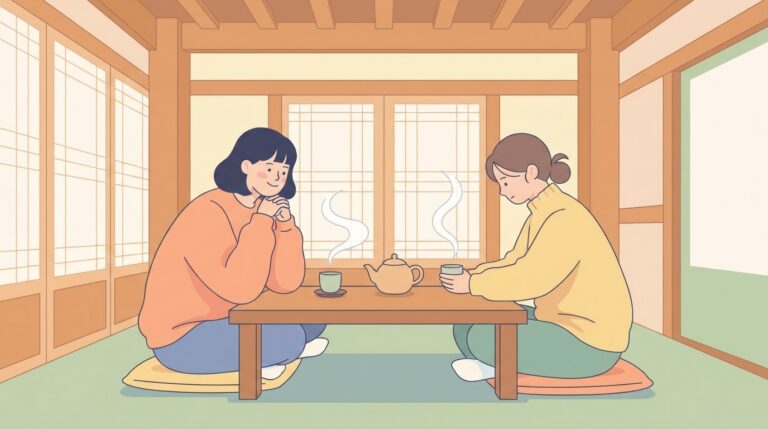
안녕하세요! 매일한글 에디터입니다. (Annyeonghaseyo! Hello, this is your Daily Hangul Editor.) Picture a rainy night in Seoul at a quiet hanok tea bar, straight out of a healing K-drama. Your Korean friend stares into a warm cup of roasted barley tea, exhausted after a brutal week. Many advanced C1 learners rush to fill that silence with eloquent vocabulary and clever advice, yet still feel an invisible wall. Why? Because in Korean culture, true intimacy rarely comes from dazzling rhetoric—it comes from baegajeolhyeon (백아절현), the rare gift of listening so deeply you hear what goes unspoken. Built from 10 years of coaching fluent learners, this guide unlocks the C1 idioms that turn polite conversations into lifelong trust.
Phase 2: Top 3 Core Expressions (Deep Dive)
If you want to move beyond sounding like a fluent textbook and start sounding like a trusted confidant, these three sajaseong-eo (사자성어 — four-character idioms) are your golden keys.
1. 백아절현 (Baegajeolhyeon)
- Pronunciation: Baegajeolhyeon (Sounds like “Beg-ah-juhl-hyuhn” — start with a soft “beg,” glide into “juhl” like “jull,” and finish with a breathy “hyuhn.”)
- Meaning: Literally “Baek-a breaks the instrument strings.” In ancient legend, master musician Baek-a had only one friend, Jong Jagi, who truly understood the soul behind his music. When that friend passed away, Baek-a cut his strings and never played again. Today, it means deeply cherishing or mourning the one soul who truly listens to and understands your heart.
- K-Culture Moment: Think of the quiet, heavy bond in healing dramas like My Mister (나의 아저씨), where characters endure exhausting lives until one person finally hears their silent pain—no flashy speeches required, just unwavering presence.
- Editor’s Insight: At the C1 level, you don’t toss this word around lightly at a party! It carries poetic, almost bittersweet gravitas. Saying someone feels like your baegajeolhyeon is one of the highest compliments of emotional trust you can offer.
- Situation Spectrum: Casual ⚠️ | Semi-formal ✅ | Formal ✅
- 🤔 Think About It: English celebrates “kindred spirits” or “soulmates,” often tied to shared hobbies or romance. Korean anchors ultimate friendship in listening to someone’s inner melody. How does that shift what makes a “good friend” in your eyes?
2. 이심전심 (Isimjeonsim)
- Pronunciation: Isimjeonsim (Sounds like “Ee-shim-juhn-shim” — “ee” as in “see,” “shim” like “shimmer,” and “juhn” like “just.”)
- Meaning: Literally “from heart to heart, mind to mind.” Figuratively, it describes effortless, unspoken telepathic understanding between two people who share the same wavelength.
- K-Culture Moment: Picture the tight-knit doctors in Hospital Playlist (슬기로운 의사생활) catching each other’s eye across a busy hallway or band practice room and instantly knowing who is stressed or heartbroken without uttering a syllable.
- Editor’s Insight: Unlike baegajeolhyeon, which feels deeply literary, 이심전심 (isimjeonsim) pops up constantly in daily life—from playful moments when two friends order the exact same iced Americano, to deeply touching moments of silent solidarity.
- Situation Spectrum: Casual ✅ | Semi-formal ✅ | Formal ✅
- 🤔 Think About It: Many Western cultures encourage hyper-explicit verbal communication (“Speak up! Tell me what you feel!”). Korean culture often treats unspoken 이심전심 (isimjeonsim) as a higher form of intimacy. When was the last time silence spoke louder than words for you?
3. 역지사지 (Yeokjisaji)
- Pronunciation: Yeokjisaji (Sounds like “Yuhk-jee-sah-jee” — “yuhk” rhymes with “luck” with a tiny “y” glide at the front, followed by crisp “jee-sah-jee.”)
- Meaning: Literally “switching places and standing in the other’s shoes.” It captures the active discipline of setting aside your ego to listen from someone else’s vantage point.
- K-Culture Moment: In workplace dramas like Misaeng (미생), conflicts between sharp-tongued managers and stressed rookies only begin to heal the moment one side pauses to practice 역지사지 (yeokjisaji)—listening to the pressure the other person is carrying.
- Editor’s Insight: Eloquence without 역지사지 (yeokjisaji) just sounds like lecturing in Korean. Dropping this idiom in a heartfelt conversation signals emotional maturity and humility, especially when resolving misunderstandings.
- Situation Spectrum: Casual ✅ | Semi-formal ✅ | Formal ✅
- 🤔 Think About It: In your native language, do idioms about empathy focus more on feeling what someone feels, or stepping into their position? Notice how 역지사지 (yeokjisaji) treats empathy as a deliberate shift in physical stance.
Phase 3: Textbook Korean vs. Real Korean
I’ll confess something embarrassing: years ago, when a Korean friend was venting about a breakup, I launched into a 10-minute TED Talk using textbook C1 grammar to “solve” his problem. He just stared at his samgyeopsal (삼겹살) and sighed. Here is how textbooks trip us up—and how real natives actually connect.
Situation 1: Showing you understand someone’s unspoken pain
- 📖 Textbook Korean: 당신의 슬픈 마음을 제가 완전히 이해합니다. (Dangsin-ui seulpeun maeum-eul jega wanjeonhi ihaehamnida. — “I completely comprehend your sad heart.”)
- 🗣️ Real Korean: 말 안 해도 다 알아요. 우리 사이에 이심전심이잖아요. (Mal an haedo da arayo. Uri sai-e isimjeonsim-ijanayo. — “You don’t even have to say it, I know. Between us, it’s heart-to-heart.”)
- 💡 Why is it different? Using 이해하다 (ihaehada — to comprehend) and 당신 (dangsin — you) sounds stiff, analytical, and strangely distant—like a robot therapist. Natives soften the air with warmth, acknowledging the unspoken bond (우리 사이 — uri sai) rather than dissecting the emotion.
Situation 2: Inviting a friend to open up while promising to just listen
- 📖 Textbook Korean: 저에게 말씀하시면 제가 주의 깊게 경청하겠습니다. (Jeo-ege malsseumhasimyeon jega juui gipge gyeongcheonghagetseumnida. — “If you speak to me, I shall listen attentively.”)
- 🗣️ Real Korean: 오늘 밤엔 내가 다 들어줄게. 속 얘기 편하게 털어놔. (Oneul bam-en naega da deureojulge. Sok yaegi pyeonhage teoreonwa. — “Tonight I’m all ears. Go ahead and get whatever’s inside off your chest.”)
- 💡 Why is it different? 경청하다 (gyeongcheonghada) is gorgeous in speeches or formal mediation, but in a cozy pojangmacha (포장마차) it sounds like a press conference. Using 털어놓다 (teoreonota — to shake out/pour out one’s heart) creates immediate psychological safety.
Phase 4: K-Culture Deep Dive & Non-Verbal Manners
4-1. Nunchi (눈치) & Gestures: Listening With Your Whole Body
In Korea, listening isn’t passive—it’s an active choreography of nunchi (눈치 — social awareness). When a Korean friend is sharing something heavy, notice how a great listener behaves:
* Soft Eye Contact, Not a Staredown: Locking eyes unblinkingly can feel confrontational in Korea. Instead, hold warm eye contact, glance gently down at your teacup during heavy pauses, and nod slowly (고개 끄덕이기 — gogae kkeudeogigi).
* Gentle Chuimsae (추임새): Total silence can make a speaker nervous, while interrupting ruins the mood. Sprinkle soft, low-toned affirmations like “응, 그랬구나 (Eung, geuraetguna — Oh, so that happened)” or “진짜 힘들었겠다 (Jinjja himdeureotgetda — That must have been so hard)” at natural breathing pauses.
* Two-Handed Care: Before launching into advice, reach across quietly to pour their tea or drink with both hands—or hold your sleeve respectfully with one hand while pouring. That tiny physical gesture whispers, “I’m taking care of you right now.”
4-2. Cultural Code Analysis: K-Drama Healing & Shared Tables
Why do so many iconic K-dramas—from Reply 1988 (응답하라 1988) to Our Blues (우리들의 블루스)—set their deepest emotional breakthroughs around a steaming pot of kimchi jjigae (김치찌개) or a late-night convenience store table? Because Korean culture rarely separates emotional healing from physical warmth. While Western storytelling often builds toward a dramatic verbal confrontation, K-dramas elevate the friend who quietly peels a tangerine for you, sits beside you in the rain, and absorbs your frustration without trying to outshine you with clever words. That is baegajeolhyeon (백아절현) brought to life on screen.
Phase 5: Practical Roleplay Scenario
Setting: It is 9:30 PM on a drizzly Friday in Jongno, Seoul. Rain patters against the wooden awning of a cozy makgeolli (막걸리 — rice wine) tavern. The air smells of crispy pajeon (파전 — scallion pancake) and damp earth.
Character: Min-jun (민준), your longtime Korean colleague who usually jokes around, is staring blankly at his ceramic bowl after being unfairly blamed for a failed team pitch.
- Min-jun: 🎭 (sighing deeply, swirling his glass) 내가 그때 팀장님한테 제대로 반박했어야 했는데… 나만 바보 된 기분이야. (Naega geuttae timjangnim-hante jedaero banbakhaesseoya haenneunde… naman babo doen gibun-iya. — “I should have pushed back against the team leader properly back then… I feel like I’m the only fool here.”)
- You: 🎭 (pouring a fresh cup for him with both hands, keeping your voice calm) 민준 씨, 오늘 진짜 많이 지쳤겠네. 일단 이거 한 잔 마시고 천천히 얘기해. (Minjun ssi, oneul jinjja mani jichyeotgenne. Ildan igeo han jan masigo cheoncheonhi yaegihae. — “Min-jun, you must be completely drained today. Have a sip of this first and take your time.”)
- Min-jun: 🎭 (looking up with surprised gratitude) 아니, 너도 바빴을 텐데 괜히 나 때문에 시간 뺏는 거 아니야? (Ani, neodo bappasseul tende gwaenhi na ttaemune sigan ppaenneun geo aniya? — “No, you must’ve been busy too—am I wasting your time with this?”)
- You: 🎭 (shaking your head gently with a warm smile) 무슨 소리야. 말 안 해도 네 속마음 다 느껴져. 이심전심이지. (Museun soriya. Mal an haedo ne songmaeum da neukkyeojyeo. Isimjeonsim-iji. — “What are you talking about? Even without words, I can feel what you’re going through. We’re on the same wavelength.”)
- Min-jun: 🎭 (his shoulders finally drop; his voice softens) 사실… 내가 말주변이 없어서 회의 때마다 자꾸 밀리는 것 같아. 속상해 죽겠어. (Sasil… naega maljubyeon-i eopseoseo hoeui ttaemada jakku millineun geot gata. Soksanghae jukgesseo. — “Honestly… because I’m not good with smooth talk, I feel like I keep getting sidelined in meetings. It hurts so much.”)
- You: 🎭 (nodding slowly, letting two seconds of comfortable silence breathe) 화려한 말솜씨보다 진심이 결국 통하는 법이야. 나는 네가 얼마나 성실했는지 다 알아. (Hwaryeohan malsomssiboda jinsim-i gyeolguk tonghaneun beob-iya. Naneun nega eolmana seongsilhaenneunji da ara. — “Sincerity always wins out over flashy rhetoric in the end. I know how hard you worked.”)
- Min-jun: 🎭 (eyes glistening slightly, chuckling softly) 와… 역시 내 마음을 알아주는 건 너밖에 없네. 백아절현이 따로 없다. (Wa… yeoksi nae maeum-eul arajuneun geon neobakke eomne. Baegajeolhyeon-i ttaro eopda. — “Wow… there really is no one who understands my heart like you. You’re a true Baek-a’s friend.”)
- You: 🎭 (clinking your ceramic cup gently against his) 언제든 답답할 땐 불러. 내가 다 들어줄게. (Eonjedeun dapdaphal ttaen bulleo. Naega da deureojulge. — “Call me anytime you feel suffocated. I’ll always be here to listen.”)
🔀 Interactive Branching Point: What Would You Say Next?
Imagine Min-jun pauses mid-story and asks: “솔직히 내가 너무 나약한 걸까? (Soljikhi naega neomu nayakhan geolkka? — Honestly, am I just being too weak?)” Choose your response!
- Option A: “전혀 아니야. 역지사지로 생각해 보면, 그 상황에서 안 힘든 사람이 어딨어?” (Jeonhyeo aniya. Yeokjisajiro saenggakhae bomyeon, geu sanghwang-eseo an himdeun saram-i eodisseo? — “Not at all. If anyone puts themselves in your shoes, who wouldn’t struggle in that situation?”)
- Feedback (🏆 Best): Brilliant C1 empathy! Using 역지사지 (yeokjisaji) validates his pain objectively while wrapping him in warmth.
- Option B: “조금 약하긴 하지. 다음부터는 논리적으로 말할 수 있게 연습해야 해.” (Jogeum yakhagin haji. Daeumbuteo-neun nollijeog-euro malhal su itge yeonseuphaeya hae. — “You are a little weak. Next time, you need to practice speaking logically.”)
- Feedback (❌ Bad): Ouch! Even if your advice is logical, dropping a cold critique when someone opens their heart breaks trust instantly.
- Option C: “글쎄, 시간이 지나면 다 해결될 거야. 그냥 잊어버려.” (Geulsse, sigan-i jinamyeon da haegyeoldoel geoya. Geunyang ijeobeoryeo. — “Well, time will solve everything. Just forget about it.”)
- Feedback (⚠️ Risk): You meant well, but brushing it off too fast makes him feel unheard—like you’re rushing to close the topic.
Phase 6: 10-Second Emotional Shadowing Drill
Read these C1 lines aloud with feeling! Pause briefly at every / mark to let the emotion settle.
- [😌 Calmly and warmly]
화려한 말보다 / 상대의 마음을 헤아리는 경청 하나가 / 평생의 신뢰를 얻는 비결이에요.
(Hwaryeohan malboda / sangdae-ui maeum-eul hearineun gyeongcheong hanaga / pyeongsaeng-ui silloereul eonneun bigyeor-ieyo. — “Rather than flashy words, one act of attentive listening that fathoms another’s heart is the secret to winning lifelong trust.”) -
[🥺 Deeply empathetic]
굳이 길게 설명하지 않아도 / 네가 얼마나 애썼는지 / 나는 다 알아.
(Guji gilge seolmyeonghaji anado / nega eolmana aesseonneunji / naneun da ara. — “Even if you don’t explain it at length, I know everything about how hard you tried.”) -
[🤝 Sincerely and reassuringly]
언제든 마음이 무거울 땐 / 혼자 참지 말고 / 나한테 편하게 털어놔.
(Eonjedeun maeum-i mugeoul ttaen / honja chamji malgo / nahante pyeonhage teoreonwa. — “Whenever your heart feels heavy, don’t bottle it up alone—pour it out to me comfortably.”)
Phase 7: K-Culture Mini Dictionary (4 Essential Keywords)
- 경청 (Gyeongcheong) | Attentive, respectful listening
- Real-world use: Essential in Korean corporate reviews, leadership seminars, and thoughtful journalism. When Koreans praise a leader, they rarely say “great talker”—they say “경청할 줄 아는 분 (someone who knows how to listen).”
- 막역지우 (Magyeokjiu) | Friends with zero barriers between their hearts
- Real-world use: A classic C1 four-character idiom used in speeches, essays, or heartfelt tributes to describe lifelong friends who never need to put up a guard around each other.
- 추임새 (Chuimsae) | Empathetic conversational interjections
- Real-world use: Originally from pansori (판소리 — traditional Korean musical storytelling), where the drummer shouts encouraging cues to the singer. Today, Koreans use it to describe warm backchanneling (맞아, 그랬구나) that keeps a friend feeling supported.
- 정 (Jeong) | Deep, unspoken affection and loyalty
- Real-world use: Forged through shared meals, hardships, and quiet patience rather than quick charm. Even after an argument, 정 (jeong) is the invisible thread that keeps people caring.
Phase 8: Survival Kit for Travelers
Even on a short trip to Korea, sincere listening and humble gratitude will open doors no flashy phrasebook ever could.
Top 3 Survival Expressions
- 말씀 천천히 해 주셔서 정말 감사해요. (Malsseum cheoncheonhi hae jusyeoseo jeongmal gamsahaeyo. — “Thank you so much for speaking slowly for me.”)
- Pro Tip: Shows genuine respect to locals who patiently bridge the language gap with you.
- 제 마음을 이렇게까지 신경 써 주시다니 감동이에요. (Je maeum-eul ireokekkaji singyeong sseo jusidani gamdong-ieyo. — “I’m deeply touched that you cared so much about how I feel.”)
- Pro Tip: Perfect when a guesthouse host or local friend goes out of their way to help you.
- 잠시만요, 제가 제대로 이해했는지 확인해 볼게요. (Jamsimanyo, jega jedaero ihaehaenneunji hwaginhae bolgeyo. — “One moment, let me check if I understood you properly.”)
- Pro Tip: Signals thoughtful 경청 (gyeongcheong) instead of nodding blindly when lost or ordering.
Editor’s Travel Note
Before boarding a flight to Incheon, install Naver Map for accurate Korean walking and transit routes and Papago AI Translator for nuanced Korean conversation support so you can focus on connecting with people rather than panicking over directions. Grab a physical T-money card at any convenience store (CU or GS25) for subways and buses, and remember: on Seoul subways and in quiet hanok cafes, keeping your voice low is one of the best ways to practice respectful nunchi (눈치) toward everyone sharing the space with you.
Phase 9: “One Step Deeper” (Cultural Reflection)
In Korean, the verb 헤아리다 (hearida) means both “to count” and “to deeply fathom someone’s heart.” That linguistic clue reveals something profound about Korea’s communal uri (우리 — “we”) culture: true connection isn’t measured by how persuasively you broadcast your own brilliance, but by how carefully you weigh the quiet burdens carried by the person across from you. Historically shaped by tight-knit village life where survival depended on harmony, Korean communication prizes 마음을 얻다 (maeum-eul eotda — winning someone’s heart) through steady presence over quick rhetorical victory. Once you stop trying to perform perfection in Korean and start listening with your whole attention, native speakers immediately feel safe dropping their guard with you.
💬 Your Turn: Have you ever experienced a moment of unspoken 이심전심 (isimjeonsim) with a friend from another culture—where a single gesture or quiet pause meant more than a thousand words? Share your story in the comments!
Phase 10: FAQ & Myth-Busting
Q: Is it unnatural to use four-character idioms like 백아절현 (Baegajeolhyeon) in everyday casual conversation?
A: Using 백아절현 (baegajeolhyeon) over casual coffee talk about Netflix would sound overly dramatic, yes! Save it for meaningful reflections, heartfelt letters, or sincere late-night talks. On the other hand, 이심전심 (isimjeonsim) and 역지사지 (yeokjisaji) are used constantly in everyday Korean conversations and even variety shows.
Q: Why do Koreans sometimes stay quiet for several seconds after I finish speaking? Did I make a grammar mistake?
A: Not at all! In Korean communication, a brief pause after someone finishes speaking is a sign of respectful 경청 (gyeongcheong)—it proves they are genuinely digesting your words rather than waiting impatiently for their turn to talk. Resist the urge to panic and fill the silence right away!
Q: How can I show empathy at a C1 level without repeating “힘들겠다 (That must be hard)” ten times?
A: Vary your reactions naturally! Mix in nuanced C1 phrases like 마음이 무거웠겠어요 (maeum-i mugeowotgesseoyo — your heart must have been heavy), 얼마나 속상했을까요 (eolmana soksanghaesseulkkayo — how upset you must have felt), or gently echo the last keyword they said with a compassionate sigh.
🚨 Common Mistakes TOP 3 & Correct Actions
- Mistake: Launching straight into unsolicited problem-solving mode while a Korean friend is venting.
- Correct Action: Hold back the fixes for the first five minutes. Use warm 추임새 (chuimsae) and validate their feelings first.
- Mistake: Confusing 백아절현 (baegajeolhyeon) with general friendship.
- Correct Action: Remember it specifically honors a rare bond of profound mutual understanding—often invoked when that irreplaceable listener is missed or deeply cherished.
- Mistake: Overusing textbook 당신 (dangsin) during emotional heart-to-hearts.
- Correct Action: Use their name + 씨 (ssi), their title, or drop the pronoun altogether to preserve warmth and closeness.
Phase 11: Action Mission & Engagement
Ready to turn passive vocabulary into real human connection? Pick your tier!
- 🥉 Bronze Mission (Solo Practice): Record yourself doing the Phase 6 shadowing drill on your phone. Listen back—does your voice sound rushed, or warm and unhurried?
- 🥈 Silver Mission (Community Share): Post your favorite four-character idiom from today (백아절현, 이심전심, or 역지사지) on social media or a study group, along with one sentence about a friend who truly listens to you.
- 🥇 Gold Mission (Real-World Use): Next time a friend (Korean or international!) shares a tough day, challenge yourself to pause for two full seconds after they finish, nod warmly, and ask one gentle follow-up question instead of offering advice.
🎮 K-Culture Mission
Watch one episode of a healing K-drama (such as My Mister, Hospital Playlist, or My Liberation Notes) and count how many times two characters resolve tension without a big argument—just by pouring a drink, sitting quietly, or sharing an 이심전심 (isimjeonsim) glance. Write down one 추임새 (chuimsae) phrase you hear!
Phase 12: Interactive Quiz Challenge
Test your C1 intuition before you go! Click the toggle below each question to reveal the answer and breakdown.
Question 1 (Situation Judgment): Your Korean teammate stayed up all night fixing a report, only for the client to reject it. They sigh and say, “다 내 잘못인 것 같아 (Da nae jalmos-in geot gata — I feel like it’s all my fault).” Which response best embodies empathetic C1 listening?
* A) “어디가 틀렸는지 같이 분석해 보자.” (Let’s analyze where you went wrong together.)
* B) “밤새 고생한 거 내가 다 알아. 네 잘못이 아니니까 너무 자책하지 마.” (I know how hard you worked all night. It’s not your fault, so don’t beat yourself up.)
* C) “백아절현이 따로 없네! 힘내!” (There’s no Baek-a’s broken strings quite like this! Cheer up!)
Click to reveal Answer & Feedback for Question 1
Correct Answer: B
* Why B works: It acknowledges their unseen effort (고생한 거 다 알아) and lifts their guilt gently.
* Why A fails: Jumping straight to post-mortem analysis feels cold when someone is emotionally raw.
* Why C fails: 백아절현 (baegajeolhyeon) describes a profound soulmate-level listener, not a casual pep talk after a rejected report!
Question 2 (Fill in the Blank):
“그 사람과 나는 눈빛만 봐도 통하는 ________ 사이야.” (Geu saramgwa naneun nunbinman bwado tonghaneun ________ saiya. — “That person and I have the kind of relationship where we understand each other with just a glance.”)
* Options: 1) 역지사지 (yeokjisaji) / 2) 이심전심 (isimjeonsim) / 3) 경청 (gyeongcheong)
Click to reveal Answer & Explanation for Question 2
Correct Answer: 2) 이심전심 (isimjeonsim)
* Explanation: 눈빛만 봐도 통하다 (understanding just by looking at each other’s eyes) is the classic Korean collocation that pairs seamlessly with 이심전심 (isimjeonsim — heart-to-heart telepathy).
Question 3 (True/False Cultural Quiz):
True or False: In Korean conversation, pausing silently for 2 seconds before replying to a friend’s emotional confession usually signals that you are bored or confused.
Click to reveal Answer & Cultural Note for Question 3
Correct Answer: False!
* Cultural Note: Thoughtful pauses paired with soft eye contact and a gentle nod signal 경청 (gyeongcheong)—showing you are taking their feelings seriously enough not to rush out a shallow reply.
🎬 Watch Our Daily Videos! (Daily Hangul Official Instagram)
Review the expressions you learned in this article with our fun daily short videos! Check out native pronunciation and real-life nuances in action.
- Instagram @dailyhangul_en






