

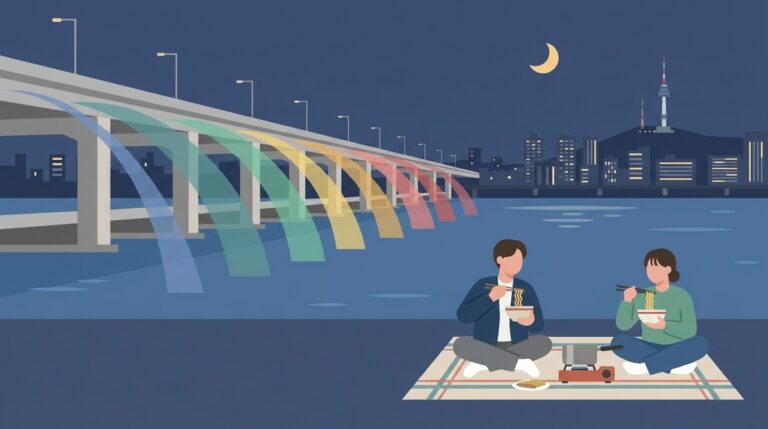
Phase 1: Empathy — Your Magical Night at Banpo Bridge
Hello! This is the Daily Hangul editor. Imagine this: It is 7:50 PM in Seoul. You are sitting on a picnic mat at Banpo Hangang Park with a steaming cup of Hangang ramen in your hands. Just like in your favorite K-drama, the night breeze feels amazing, and you are waiting for the famous Banpo Bridge Rainbow Fountain! Suddenly, the crowd around you gets excited, and you wonder, ‘When does the show start?’ or ‘How do I ask someone to take my photo?’ Many A1 learners told us they froze in this exact moment because they only knew textbook phrases. Based on real student feedback, today’s guide gives you easy, natural Korean phrases so you can enjoy the lights, the ramen, and the magic stress-free!
Phase 2: Deep Dive into 3 Core Expressions
1. 분수 언제 시작해요? (Bunsu eonje sijakaeyo?)
- Pronunciation: Bunsu eonje sijakaeyo? (Sounds like: Boon-soo un-jeh shee-jah-keh-yo? — like asking “when” with a gentle rising “yo” at the end)
- Meaning: Literal: “Fountain when start?” | Real Nuance: “What time does the fountain show start?”
- K-Culture Moment: In K-dramas and Seoul travel vlogs, couples often hurry down to the riverside with convenience store ramen and ask a nearby park staff member or local this exact question so they do not miss the first splash of music and lights.
- Editor’s Insight: Notice that Korean drops the subject “it” completely! Adding “요 (yo)” at the end makes the question instantly polite and friendly for talking to strangers.
- Situation Spectrum: Casual (⚠️) / Semi-formal (✅) / Formal (✅)
- 🤔 Think About It: In English, you need words like “does” and “the” to build a question. Korean simply puts the question word 언제 (eonje – when) right before the verb. How does dropping tiny grammar words change how fast you can speak in a new language?
2. 우와, 진짜 예쁘다! (Uwa, jinjja yeppeuda!)
- Pronunciation: Uwa, jinjja yeppeuda! (Sounds like: Oo-wah, jeen-jjah yeh-ppuh-dah! — think of “pp” like a crisp pop, not a soft “p”)
- Meaning: Literal: “Whoa, really pretty!” | Real Nuance: “OMG, look how gorgeous that is!”
- K-Culture Moment: Whenever the Banpo Bridge lights switch from deep blue to bright pink and water shoots out to a K-pop song, everyone watching along the riverbank gasps and says this out loud in unison.
- Editor’s Insight: Even though 예쁘다 (yeppeuda) is the dictionary form without 요 (yo), Koreans use it naturally as an exclamation to themselves or with friends when they are amazed in the moment.
- Situation Spectrum: Casual (✅) / Semi-formal (✅ as a self-exclamation) / Formal (🚫 when addressing a stranger directly)
- 🤔 Think About It: Koreans often express awe aloud as a shared reaction, even when nobody asked them a question. In your culture, do people share quiet moments together, or do they vocalize excitement right away?
3. 사진 좀 찍어 주세요. (Sajin jom jjigeo juseyo.)
- Pronunciation: Sajin jom jjigeo juseyo. (Sounds like: Sah-jeen jom jjee-guh joo-seh-yo — “jj” is a tight, energetic “j” sound)
- Meaning: Literal: “Photo a little take give please.” | Real Nuance: “Could you please take a picture for us?”
- K-Culture Moment: On Korean variety shows and idol vlogs at Hangang Park, stars hold their phone out toward a passerby with the rainbow fountain glowing behind them and use this polite request.
- Editor’s Insight: The tiny word 좀 (jom) literally means “a little,” but here it works like magic fairy dust that softens your request and makes you sound super polite and approachable!
- Situation Spectrum: Casual (⚠️) / Semi-formal (✅) / Formal (✅)
- 🤔 Think About It: Why do you think adding “a little” (좀) makes a request feel gentler in Korean, much like saying “real quick” in English?
Phase 3: Textbook Korean vs. Real Korean
Situation 1: Reacting to the Rainbow Fountain
- 📖 Textbook Korean: 이 분수는 매우 아름답습니다. (I bunsuneun maeu areumdapseumnida. — This fountain is very beautiful.)
- 🗣️ Real Korean: 우와, 진짜 예쁘다! (Uwa, jinjja yeppeuda! — Whoa, it’s so pretty!)
- 💡 Why the difference? Textbooks teach formal declarative sentences suited for speeches or essays, while real Koreans at the Han River use short, emotional bursts to match the fun, relaxed picnic vibe.
Situation 2: Asking a Stranger for a Photo
- 📖 Textbook Korean: 실례지만, 저희의 사진을 촬영해 주시겠습니까? (Sillyejiman, jeohuiui sajineul chwalyeonghae jusigetseumnikka? — Excuse me, would you photograph us?)
- 🗣️ Real Korean: 저기요, 사진 좀 찍어 주세요! (Jeogiyo, sajin jom jjigeo juseyo! — Excuse me, please take a photo for me!)
- 💡 Why the difference? Using words like “photograph” (촬영하다) sounds like a news reporter! 사진 좀 찍어 주세요 is warm, fast, and understood by everyone from teenagers to grandmothers.
Phase 4: K-Culture Deep Dive & Non-Verbal Manners
4-1. Nunchi (눈치) & Gestures at the River
Having good 눈치 (nunchi — social awareness) at Banpo Hangang Park makes your night twice as smooth. First, when you hand your phone to a stranger after saying 사진 좀 찍어 주세요 (Sajin jom jjigeo juseyo), hold your phone with two hands and give a small nod—this tiny gesture shows instant respect. Second, the waterfront steps get crowded right before the fountain starts. Keep your picnic mat neat, avoid standing directly in front of seated people while filming, and keep your voice warm and relaxed so everyone can hear the fountain music.
4-2. Cultural Code Analysis: K-Food & K-Travel
At Hangang Park, eating and sightseeing are inseparable. Before the 20-minute Rainbow Fountain show begins, locals line up at the floating or riverside convenience stores to cook 한강 라면 (Hangang ramyeon) in special aluminum foil bowls on automatic induction machines. Carrying that hot bowl out to the river steps while the Banpo Bridge lights shimmer over the water is the ultimate Seoul comfort ritual—combining affordable K-Food with free world-class night scenery!
Phase 5: Real-Life Roleplay Scenario
Setting: 7:55 PM at Banpo Hangang Park. The cool night breeze smells like savory ramen broth. You are holding your phone near the water, next to Minji, a friendly Korean local sitting on a picnic mat with her steaming Hangang ramen.
- You: 저기요! 분수 언제 시작해요? (Jeogiyo! Bunsu eonje sijakaeyo? — Excuse me! When does the fountain start?) 🎭 You look toward the dark bridge and smile politely.
- Minji: 아, 8시예요! 이제 곧 시작해요. (A, yeodeolsiyeyo! Ije got sijakaeyo. — Oh, at 8 o’clock! It’s starting very soon.) 🎭 Minji checks her watch and points toward the water.
- You: 감사합니다! 한강 라면 맛있겠다! (Gamsahamnida! Hangang ramyeon masitgetda! — Thank you! That Hangang ramen looks delicious!) 🎭 You give a friendly nod toward her ramen bowl.
- Minji: 네, 진짜 맛있어요! (Ne, jinjja masisseoyo! — Yes, it’s really delicious!) 🎭 Minji laughs warmly while holding her chopsticks.
- You: 우와! 저기 보세요! (Uwa! Jeogi boseyo! — Whoa! Look over there!) 🎭 Colorful rainbow lights suddenly burst onto the water as music plays.
- Minji: 와, 오늘 진짜 예쁘다! (Wa, oneul jinjja yeppeuda! — Wow, it’s really pretty today!) 🎭 Minji claps softly and watches the fountain.
- You: 저기요, 사진 좀 찍어 주세요. (Jeogiyo, sajin jom jjigeo juseyo. — Excuse me, please take a photo for me.) 🎭 You hold out your phone with both hands.
- Minji: 네, 여기 보세요! 하나, 둘, 셋! (Ne, yeogi boseyo! Hana, dul, set! — Yes, look here! One, two, three!) 🎭 Minji takes three photos with the rainbow lights behind you.
🔀 Interactive Branching Point
Minji hands your phone back with a big smile. What do you say next?
* A) “감사합니다! 진짜 잘 나왔어요!” (Gamsahamnida! Jinjja jal nawasseoyo! — Thank you! It came out really well!)
* B) “고마워.” (Gomawo. — Thanks. [Casual banmal])
* C) Just take the phone silently and walk away.
Feedback:
* Choice A (Best!): Gold-star manners! Complimenting the photo makes the helper feel proud and happy.
* Choice B (Risk!): 고마워 (Gomawo) is cute among close friends, but using casual speech with a stranger you just met can sound slightly rude.
* Choice C (Bad!): Walking away without 감사합니다 (Gamsahamnida) breaks the friendly Hangang vibe and misses a great chance to practice Korean!
Phase 6: 10-Second Emotion Shadowing Drill
Read each line aloud during your 10-second practice. Pause briefly at each / and match the emotion!
- [🥺 Curious and polite] 저기요, / 분수 / 언제 시작해요? (Jeogiyo, / bunsu / eonje sijakaeyo? — Excuse me, when does the fountain start?)
- [🤩 Amazed and dreamy] 우와, / 진짜 / 예쁘다! (Uwa, / jinjja / yeppeuda! — Whoa, it’s really pretty!)
- [😊 Warm and cheerful] 사진 좀 / 찍어 주세요! / 감사합니다! (Sajin jom / jjigeo juseyo! / Gamsahamnida! — Please take a photo! Thank you!)
Phase 7: K-Culture Mini Dictionary
- 무지개 분수 (mujigae bunsu) | Rainbow Fountain | Used for the famous Moonlight Rainbow Fountain on Banpo Bridge, which holds a Guinness World Record for the longest bridge fountain.
- 야경 (yagyeong) | Night view | A favorite Korean travel word! You will hear locals talk about 한강 야경 (Hangang yagyeong — Han River night view) all year round.
- 한강 라면 (Hangang ramyeon) | Han River instant ramen | Instant noodles cooked on riverside convenience store machines; a must-try K-Food ritual during a picnic.
- 돗자리 (dotjari) | Picnic mat | You can buy or rent a 돗자리 (dotjari) right outside the subway exit or at park convenience stores.
Phase 8: Survival Kit for Travelers
Top 3 Survival Phrases
- 여기 자리 있어요? (Yeogi jari isseoyo?) — “Is there space here?” | Pro Tip: Point gently to an empty spot on the steps or lawn before spreading your mat.
- 몇 시예요? (Myeot siyeyo?) — “What time is it?” | Pro Tip: Great for checking if you made it in time for the 7:30 PM, 8:00 PM, 8:30 PM, or 9:00 PM fountain show.
- 화장실 어디예요? (Hwajangsil eodiyeyo?) — “Where is the restroom?” | Pro Tip: Essential after drinking sodas and eating hot Hangang ramen!
Editor’s Travel Note
- Essential App: Before leaving your hotel, Download the Naver Map App for Seoul Transit to check bus and subway exits near Express Bus Terminal Station (고속터미널역, Line 3, 7, 9, Exit 8-1).
- Show Schedule Tip: The Banpo Bridge Rainbow Fountain usually runs from April to October for 20 minutes per show (evening shows typically start at 7:30 PM, 8:00 PM, 8:30 PM, and 9:00 PM, with an extra 9:30 PM show in peak summer). Note that shows pause on rainy or very windy days!
- Payment Tip: Park convenience stores accept international credit cards and T-money (티머니) cards, making late-night ramen runs effortless.
Phase 9: “One Step Deeper” — Shared Joy Along the River
In Korean culture, the Han River is more than just water—it is Seoul’s giant shared living room. Even in a fast-paced city of millions, strangers sit elbow-to-elbow on picnic mats, slurping hot ramen and gasping together when the rainbow lights hit the water. This quiet warmth among strangers connects to 정 (jeong), a deep sense of human affection and togetherness. Speaking even three simple Korean words lets you step right inside that warm circle.
💬 Your Turn: Have you ever tried eating instant ramen outdoors at night, or what is your dream picnic snack to bring to Banpo Bridge? Tell us in the comments!
Phase 10: FAQ & Myth-Busting
Q: Does the Banpo Bridge Rainbow Fountain run every night of the year?
A: No, it usually operates from April to October. During winter (November to March), the fountain is closed for maintenance and freezing temperatures.
Q: Do I need to buy a ticket to watch the fountain and eat ramen at Hangang Park?
A: Not at all! Watching the Rainbow Fountain and sitting at Banpo Hangang Park is 100% free. You only pay for your convenience store ramen or picnic snacks.
Q: Can I order delivery food directly to my picnic mat?
A: Yes! Many locals order 치맥 (chimaek — fried chicken and beer) to designated 배달존 (baedal-jon — delivery zones) at the park, though as a beginner traveler, grabbing Hangang ramen at the riverside convenience store is much easier.
🚨 Common Mistakes Warning Board
- Mistake: Saying “사진 주세요” (Sajin juseyo) to ask someone to take your photo.
- Correct Action: That means “Give me a photo!” Always include 찍어 (jjigeo — take) and say 사진 좀 찍어 주세요 (Sajin jom jjigeo juseyo).
- Mistake: Asking “언제 시작?” (Eonje sijak?) without a polite ending.
- Correct Action: Keep 해요 (haeyo) at the end: 언제 시작해요? (Eonje sijakaeyo?) so you sound polite.
- Mistake: Trying to watch the fountain from the middle of a bike lane.
- Correct Action: Look out for painted bicycle lanes along the park path and walk safely down to the pedestrian waterfront steps.
Phase 11: Action Mission & Engagement
- 🥉 Bronze Mission: Look at a photo of the Banpo Rainbow Fountain tonight and say “우와, 진짜 예쁘다!” (Uwa, jinjja yeppeuda!) out loud three times with full excitement!
- 🥈 Silver Mission: Share your favorite phrase from today’s guide on Instagram or TikTok and tag #DailyHangul.
- 🥇 Gold Mission: Next time you are at a scenic spot—even in your hometown—practice saying “사진 좀 찍어 주세요” (Sajin jom jjigeo juseyo) to get your muscle memory ready for Seoul!
- 🎮 K-Culture Mission: Watch a Seoul travel vlog or K-drama Han River scene this week and listen closely—can you catch locals saying 진짜 (jinjja) or 예쁘다 (yeppeuda)?
Phase 12: Interactive Quiz Challenge
1. Situation Judgment: You arrive at Banpo Hangang Park at 7:45 PM and want to ask a friendly local when the fountain show starts. Which is best?
* A) 사진 좀 찍어 주세요. (Sajin jom jjigeo juseyo.)
* B) 분수 언제 시작해요? (Bunsu eonje sijakaeyo?)
* C) 여기 자리 있어요? (Yeogi jari isseoyo?)
Click to check Answer & Feedback for Quiz 1
Answer: B) 분수 언제 시작해요? (Bunsu eonje sijakaeyo?)
Why? Option A asks someone to take a photo, and Option C asks if a seat is available. Option B politely asks when the fountain starts!
2. Fill in the Blank: Complete the polite request for a photo: “____ 좀 찍어 주세요.” (____ jom jjigeo juseyo.)
Click to check Answer for Quiz 2
Answer: 사진 (sajin — photo)
Full sentence: 사진 좀 찍어 주세요. (Sajin jom jjigeo juseyo.)
3. True or False Culture Quiz: True or False — You need to buy an admission ticket before entering Banpo Hangang Park to see the Rainbow Fountain.
Click to check Answer for Quiz 3
Answer: False!
Banpo Hangang Park and the Moonlight Rainbow Fountain show are completely free for everyone to enjoy!
🎬 Watch Our Daily Videos! (Daily Hangul Official Instagram)
Review the expressions you learned in this article with our fun daily short videos! Check out native pronunciation and real-life nuances in action.
- Instagram @dailyhangul_en







