

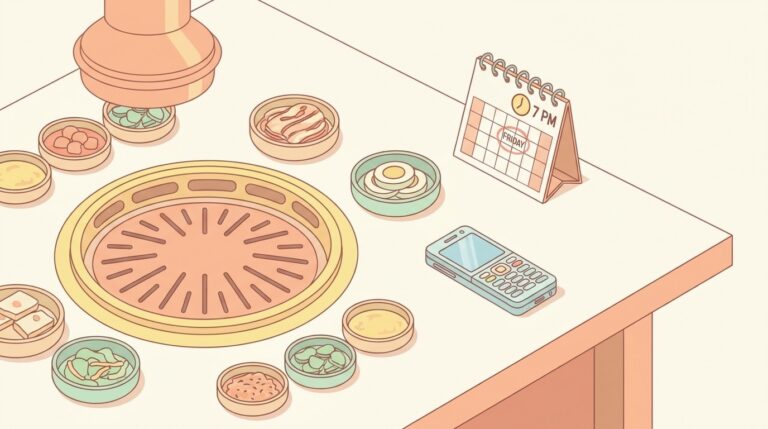
Phase 1: Why Phone Calls in Korea Feel Scary (and How to Beat Them!)
Hello! This is your Daily Hangul Editor. Imagine this: you are in Seoul, craving sizzling Samgyeopsal from that trendy restaurant you saw on a K-Drama. You tap the call button, hear “여보세요? (Yeoboseyo?)”, and suddenly your brain freezes! You are not alone. Hundreds of our A2 learners told us that booking a table by phone—especially asking for a specific day or changing the time—is their biggest hurdle in Korea. Even I used to rehearse my sentences three times before calling! Based on real feedback from travelers and students, this friendly guide gives you the exact phrases Koreans use every day. Let us turn that phone-call panic into delicious confidence!
Phase 2: Top 3 Essential Phrases Deep Dive
1. 이번 주 금요일 저녁 7시에 예약 가능한가요? (Ibeon ju geumyoil jeonyeok ilgopsie yeyak ganeunghangayo?)
- Pronunciation: Ee-bun joo geum-yo-eel juh-nyuk eel-gop-shee-eh yeh-yak ga-neung-han-ga-yo? (Think of “yeh-yak” like saying “yay, yak!” softly, and “il-gop” like “eel-gop” with a crisp p stop at the end.)
- Meaning: Literally “Is a reservation possible at 7 PM this Friday?” In real life, it is the polite, natural way to say “Can I book a table for 7 PM this Friday?”
- K-Culture Moment: In K-Dramas like Business Proposal, characters often book upscale fusion restaurants for Friday night dates using this exact polite phrasing on the phone while riding in a taxi.
- Editor’s Insight: Notice the time order in Korean! Koreans always go from biggest to smallest: This week (이번 주) → Friday (금요일) → Evening (저녁) → 7 o’clock (7시). Also, using “가능한가요? (ganeunghangayo?)” sounds softer and more respectful than directly demanding a table.
- Situation Spectrum: Casual 🚫 | Semi-formal ✅ | Formal ✅
- 🤔 Think About It: In English, we start with “Can I…” and put the time at the end. In Korean, you give the time first and ask if it is “possible” at the end. How does putting the other person’s availability last show consideration in Korean?
2. 두 명 예약하고 싶은데요. (Du myeong yeyakhago sipeundeyo.)
- Pronunciation: Doo myung yeh-yak-ha-go shee-peun-deh-yo. (Sound out “myung” like “mee-young” blended into one smooth syllable, and let “deh-yo” rise slightly at the end like a friendly question.)
- Meaning: Literally “I want to reserve two people,” which simply means “I would like to make a reservation for two.”
- K-Culture Moment: Whenever a K-Pop idol visits a famous Seoul eatery in a vlog, their manager calls ahead saying “네 명 예약하고 싶은데요 (Ne myeong yeyakhago sipeundeyo)” to secure a private room.
- Editor’s Insight: The secret sauce here is “~는데요 (-neundeyo)” at the end! Instead of ending sharply with “싶어요 (sipeoyo / I want)”, adding “~는데요” leaves a soft, open ending. It tells the restaurant staff, “This is what I would like, so please let me know what you think!”
- Situation Spectrum: Casual ⚠️ | Semi-formal ✅ | Formal ✅
- 🤔 Think About It: Koreans use the counter 명 (myeong) for people in daily calls, while native speakers also use 분 (bun) to be extra polite. Why do you think Korean separates casual counters from respectful ones?
3. 죄송한데, 시간을 8시로 바꿀 수 있을까요? (Joesonghande, siganeul yeodeolsiro bakkul su isseulkkayo?)
- Pronunciation: Jweh-song-han-deh, shee-gan-eul yuh-dul-shee-ro ba-kkool soo ee-sseul-kka-yo? (For “ba-kkool”, push a little extra air out on the double kk, similar to the k in “sky” without breathing out too hard.)
- Meaning: Literally “I am sorry, but could I change the time to 8 o’clock?” It is your lifesaver phrase when plans shift.
- K-Culture Moment: In Hospital Playlist, doctors constantly get emergency calls and have to apologize while pushing back their dinner reservations by an hour.
- Editor’s Insight: Starting with “죄송한데 (Joesonghande / I am sorry, but…)” instantly melts away any awkwardness on the phone. If you need to change the party size instead, just swap “시간을 8시로 (siganeul yeodeolsiro)” with “인원을 세 명으로 (inwoneul se myeongeuro / party size to three people)”!
- Situation Spectrum: Casual 🚫 | Semi-formal ✅ | Formal ✅
- 🤔 Think About It: Why do Koreans say “sorry” before asking for a simple schedule change? How does that compare to how you reschedule plans in your own language?
Phase 3: Textbook Korean vs. Real Korean
Situation 1: Asking if there is an open table
- 📖 Textbook Korean: 이번 주 금요일 오후 7시에 자리가 있습니까? (Ibeon ju geumyoil ohu ilgopsie jariga itseumnikka?)
- 🗣️ Real Korean: 이번 주 금요일 저녁 7시에 자리 있어요? (Ibeon ju geumyoil jeonyeok ilgopsie jari isseoyo?)
- 💡 Why is it different? Textbooks love “오후 (ohu / PM)” and the rigid “~습니까?” news-anchor ending. In real life, Koreans say “저녁 (jeonyeok / evening)” for dinner time and use the warm “~요 (-yo)” ending so they do not sound like a robot!
Situation 2: Confirming your booking name and number
- 📖 Textbook Korean: 제 이름은 마리아이고 전화번호는 010-1234-5678입니다. (Je ireumeun Mariaigo jeonhwabeonhoneun 010-1234-5678imnida.)
- 🗣️ Real Korean: 예약자 이름은 마리아고요, 번호는 010-1234-5678이에요. (Yeyakja ireumeun Mariagoyo, beonhoneun 010-1234-5678ieyo.)
- 💡 Why is it different? Using “예약자 (yeyakja / reservation holder)” and shortening “전화번호” to “번호 (beonho / number)” makes you sound like a local Seoulite who books hotspots every weekend.
Phase 4: K-Culture Deep Dive & Non-Verbal Manners
4-1. Phone Nunchi (눈치) & Manners
Even though the staff cannot see you, Koreans bring full Nunchi (눈치 / social awareness) to phone calls! Avoid calling popular restaurants during peak rush hours (12:00 PM – 1:30 PM for lunch, 6:00 PM – 7:30 PM for dinner), because the kitchen is chaotic. Call around 3:00 PM to 5:00 PM (often break time, or just before dinner service) when staff can check the reservation book calmly. Also, always wait a split second before hanging up—saying “네, 감사합니다! (Ne, gamsahamnida! / Yes, thank you!)” warmly before pressing end leaves a wonderful impression.
4-2. K-Food Culture Code: The Magic of “No-Show” Prevention
In Korea’s booming K-Food scene, tiny Michelin-listed alley restaurants and trendy BBQ spots often have limited seating. Because “no-shows” hurt small owners, Korean diners take changing times or party sizes very seriously. Calling even 30 minutes ahead to say “죄송한데, 인원이 두 명으로 줄었어요 (Joesonghande, inwoni du myeongeuro jureosseoyo / Sorry, our party went down to two)” earns huge respect—sometimes even a free 서비스 (seobiseu / complimentary side dish or drink) when you arrive!
Phase 5: Interactive Roleplay Scenario
Setting: It is Wednesday afternoon. You are sitting in a cozy Hongdae cafe, sipping an iced Americano, calling “마포 갈비 (Mapo Galbi)”, a famous BBQ spot.
NPC: Manager Kim (김 매니저) — friendly, fast-talking, and super efficient.
- Manager Kim: 여보세요, 마포 갈비입니다. (Yeoboseyo, Mapo Galbiimnida.) — Hello, this is Mapo Galbi.
🎭 Answers quickly with clinking dishes softly in the background. - You: 안녕하세요! 이번 주 금요일 저녁 7시에 예약 가능한가요? (Annyeonghaseyo! Ibeon ju geumyoil jeonyeok ilgopsie yeyak ganeunghangayo?) — Hello! Can I make a reservation for 7 PM this Friday?
🎭 Speaks clearly while checking your phone calendar. - Manager Kim: 잠시만요… 네, 가능해요! 몇 분이세요? (Jamsimanyo… Ne, ganeunghaeyo! Myeot buniseyo?) — One moment… Yes, it is available! How many people?
🎭 Flips pages in the reservation notebook. - You: 두 명 예약하고 싶은데요. (Du myeong yeyakhago sipeundeyo.) — I would like to book for two people.
🎭 Smiles into the phone, relieved the conversation is going smoothly. - Manager Kim: 두 분이요. 성함이랑 연락처 알려 주세요. (Du buniyo. Seonghamirang yeollakcheo allyeo juseyo.) — Two people. Please tell me your name and contact number.
🎭 Picks up a pen to write it down. - You: 이름은 알렉스고, 번호는 010-5555-7777이에요. (Ireumeun Allekseugo, beonhoneun 010-5555-7777ieyo.) — My name is Alex, and my number is 010-5555-7777.
🎭 Pronounces each digit slowly. - Manager Kim: 네, 금요일 저녁 7시 두 분 예약 완료됐습니다! (Ne, geumyoil jeonyeok ilgopsi du bun yeyak wallyodwaesseumnida!) — Yes, your reservation for two at 7 PM Friday is complete!
🎭 Speaks in an upbeat, welcoming voice. - You: 감사합니다! 금요일에 뵐게요! (Gamsahamnida! Geumyoire boelgeyo!) — Thank you! See you on Friday!
🎭 Waves slightly out of habit even though it is a phone call.
🔀 Interactive Branching Point: Uh-oh! Suddenly your friend texts that they are running late on Friday! How do you reply when you call back?
- Option A: “죄송한데, 시간을 8시로 바꿀 수 있을까요?” (Joesonghande, siganeul yeodeolsiro bakkul su isseulkkayo?) — “Sorry, could I change the time to 8 PM?”
- Feedback (🌟 Best!): Polite, humble, and crystal clear! Manager Kim will happily check the 8 PM slot and appreciate your early notice.
- Option B: “8시로 바꿔요.” (Yeodeolsiro bakkwoyo.) — “Change it to 8 PM.”
- Feedback (❌ Bad!): Too abrupt! Without “죄송한데 (Sorry, but…)” or “~수 있을까요? (Could I…?)”, it sounds like an order rather than a request.
- Option C: Don’t call at all and just show up at 8 PM.
- Feedback (⚠️ Risk!): Big risk in Korea! Most popular restaurants hold tables for only 10–15 minutes before giving your seat to waiting guests.
Phase 6: 10-Second Emotion Shadowing Drill
Read these out loud! Pause briefly at each / and match the emotion tag:
[😊 Cheerful & Polite]안녕하세요! / 이번 주 금요일 / 저녁 7시에 / 예약 가능한가요? (Annyeonghaseyo! / Ibeon ju geumyoil / jeonyeok ilgopsie / yeyak ganeunghangayo?)[🙂 Warm & Friendly]두 명 / 예약하고 싶은데요. (Du myeong / yeyakhago sipeundeyo.)[🥺 Apologetic & Gentle]죄송한데, / 시간을 / 8시로 / 바꿀 수 있을까요? (Joesonghande, / siganeul / yeodeolsiro / bakkul su isseulkkayo?)
Phase 7: K-Culture Mini Dictionary
- 예약 (Yeyak) | Reservation / Booking | Used everywhere in daily and business Korea—from restaurants and hair salons to K-Pop concert tickets.
- 인원 (Inwon) | Number of people / Party size | A handy word on restaurant apps and phone calls when changing how many friends are joining.
- 브레이크 타임 (Beureikeu taim) | Break time | Konglish for afternoon restaurant closing hours (usually 3 PM – 5 PM). Always check this before visiting!
- 노쇼 (Nosyo) | No-show | Used frequently in Korean news and café/restaurant policies; many spots charge a deposit to prevent it.
Phase 8: Traveler Survival Kit
Top 3 Survival Phrases
- 자리 있어요? (Jari isseoyo?) — Do you have a seat? | Pro Tip: Use this quick question when walking into a restaurant without a booking.
- 인원 추가 가능해요? (Inwon chuga ganeunghaeyo?) — Can I add more people? | Pro Tip: Lifesaver when a friend suddenly joins your dinner group!
- 예약 취소할게요. (Yeyak chwisohalgeyo.) — I will cancel the reservation. | Pro Tip: Always add “죄송합니다 (Joesonghamnida / I am sorry)” first to stay courteous.
Editor’s Travel Note
Phone calls feeling too tough right now? No stress! Before you dial, check restaurant hours and phone numbers using the Naver Map Official Service. Many trendy Seoul restaurants also let you book or join virtual lines in English through the CatchTable Global Reservation App. Keep a T-money transit card or Korean SIM/eSIM with voice minutes ready, because some local spots still call you back to confirm your table!
Phase 9: One Step Deeper — Why “We” Matters at the Table
In Korea, dining is rarely just about eating food—it is about sharing 정 (Jeong / warm human connection) around one table. When you call ahead to book or respectfully update your arrival time, you are protecting the restaurant’s flow and respecting other hungry guests waiting in line. That tiny phrase “죄송한데 (Joesonghande)” shows you care about harmony between people, not just getting your meal. Once you understand that Korean hospitality is a two-way street, speaking Korean on the phone stops feeling like a test and starts feeling like joining a warm community.
💬 Your Turn: Which Korean dish would you book a Friday 7 PM table for first—Samgyeopsal, Korean Fried Chicken, or Hanwoo BBQ? Drop your answer in the comments!
Phase 10: FAQ & Common Mistakes
Q: Do I need a Korean phone number to make a restaurant reservation by phone?
A: Many casual restaurants just write down your name and ask if you have a local number. If you only have a data eSIM, politely say “외국인이라서 한국 번호가 없어요 (Oeguginiraseo hanguk beonhoga eopseoyo / I am a foreigner so I don’t have a Korean number)” and ask if your email or hotel number works.
Q: What is the difference between “7시 (ilgopsi)” and “오후 7시 (ohu ilgopsi)”?
A: Both mean 7 PM, because Korean uses native Korean numbers (하나, 둘… 일곱) for hours! In daily dinner reservations, saying “저녁 7시 (jeonyeok ilgopsi / 7 in the evening)” sounds much more natural than “오후 7시”.
Q: How do I say “this Friday” vs. “next Friday” in Korean?
A: “This Friday” is 이번 주 금요일 (ibeon ju geumyoil), and “next Friday” is 다음 주 금요일 (daeum ju geumyoil). Repeating “이번 주” clearly avoids mix-ups!
🚨 Common Mistakes TOP 3
- Mistake: Saying “칠시 (chilsi)” instead of “일곱 시 (ilgopsi)” for 7 o’clock.
- Correct Action: Always use native Korean numbers for hours (한 시, 두 시… 일곱 시, 여덟 시) and Sino-Korean numbers only for minutes!
- Mistake: Using “사람 (saram)” to count people (“두 사람 예약해요”).
- Correct Action: Use the people counter 명 (myeong) or polite 분 (bun): “두 명 예약하고 싶은데요 (Du myeong yeyakhago sipeundeyo).”
- Mistake: Hanging up immediately after getting a “Yes”.
- Correct Action: Wait for them to confirm your name and end with “감사합니다! (Gamsahamnida!)”.
Phase 11: Action Mission & K-Culture Challenge
- 🥉 Bronze Mission (Solo Practice): Look at your calendar right now and say “이번 주 금요일 저녁 7시에 두 명 예약 가능한가요?” out loud three times in front of a mirror.
- 🥈 Silver Mission (Social Share): Record a 10-second voice memo doing the Phase 6 shadowing drill and share it with a study buddy or language-exchange partner!
- 🥇 Gold Mission (Real-World Action): Next time you visit a Korean restaurant (even in your hometown!), call ahead or greet the host using “두 명 자리 있어요? (Du myeong jari isseoyo?)”.
- 🎮 K-Culture Mission: Watch a restaurant scene in a K-Drama like Extraordinary Attorney Woo or Business Proposal and listen for words like “예약 (yeyak)”, “몇 분 (myeot bun)”, or “자리 (jari)”!
Phase 12: Interactive Quiz Challenge
Quiz 1: Situation Judgment
You booked a table for 7 PM, but your friend wants to eat at 8 PM instead. What is the best thing to say on the phone?
* A) 8시에 갈게요. (Yeodeolsie galgeyo.)
* B) 죄송한데, 시간을 8시로 바꿀 수 있을까요? (Joesonghande, siganeul yeodeolsiro bakkul su isseulkkayo?)
* C) 두 명 취소할래요. (Du myeong chwisohallaeyo.)
Click to see Answer & Feedback!
Correct Answer: B!
* Why B wins: Adding “죄송한데” and “~수 있을까요?” makes your request super polite and natural.
* Why A misses: Just saying “I will go at 8” does not ask if the restaurant has space at 8 PM.
* Why C misses: That means “I want to cancel two people,” which cancels your dinner completely!
Quiz 2: Fill in the Blank
Complete the sentence to ask for a reservation for 3 people: “세 _____ 예약하고 싶은데요.” (Se _____ yeyakhago sipeundeyo.)
Click to see Answer!
Correct Answer: 명 (myeong)
* Full sentence: 세 명 예약하고 싶은데요. (Se myeong yeyakhago sipeundeyo.) — Remember, use 명 when stating your own group size!
Quiz 3: True or False Cultural Quiz
True or False: Calling a busy Korean BBQ restaurant at 12:30 PM on a weekday is the best time to chat about a Friday reservation.
Click to see Answer & Explanation!
False!
* Explanation: 12:00 PM – 1:30 PM is peak lunch rush in Korea! Calling between 3:00 PM and 5:00 PM gives staff time to check the booking schedule calmly.
🎬 Watch Our Daily Videos! (Daily Hangul Official Instagram)
Review the expressions you learned in this article with our fun daily short videos! Check out native pronunciation and real-life nuances in action.
- Instagram @dailyhangul_en







