

Decoding Seoul’s Diplomatic Subtext
Phase 1: Empathy
안녕하세요! 매일한글 에디터입니다. (Annyeonghaseyo! Maeil Hangeul editeoimnida. / Hello! I’m your Daily Hangul editor.)
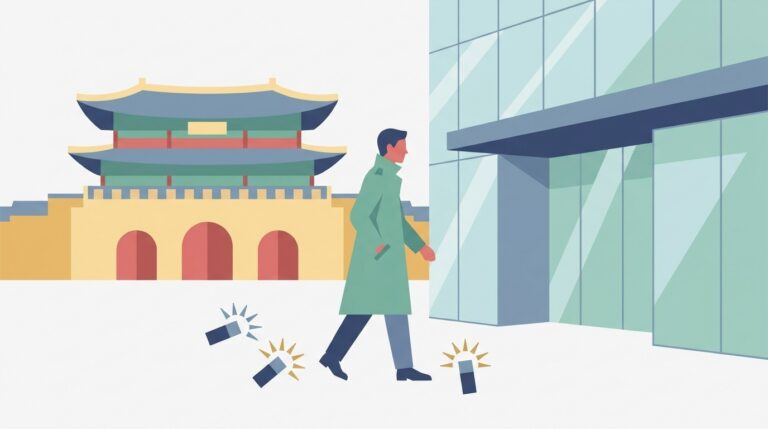
Picture a tense scene straight out of a Seoul political K-drama. A foreign ambassador steps into the Ministry of Foreign Affairs in Gwanghwamun, met by a calculated barrage of press cameras. To a casual viewer, it looks like a standard visit. Yet to native Koreans, who greets the envoy and how publicly the visit is staged broadcast the exact temperature of Seoul’s protest. Even fluent C2 learners tell us they grasp every textbook word on Korean news yet miss the strategic sting between the lines. Shaped by real learner feedback, this guide equips you to decode Korea’s calibrated diplomatic rhetoric like an insider.
Phase 2: Deep Dive into 3 Core Expressions
1. 초치하다 (Chochi-hada)
- Pronunciation:
chochi-hada(Sounds like “choh-chee hah-dah” — start with a sharp, airy “ch” as in “church,” followed by a clean “chee” as in “cheese.”)- Meaning: Literally “to invite/summon hither” (from Hanja 招致); in modern diplomacy, it exclusively means summoning a foreign ambassador or envoy to the Ministry of Foreign Affairs to lodge a formal protest.
- K-Culture Moment: Whenever geopolitical tensions flare in Korean news broadcasts or political dramas like Designated Survivor: 60 Days, anchors open with the phrase “외교부가 주한 대사를 초치했습니다” (Oegyobuga juhan daesareul chochi-haetseumnida / The Foreign Ministry has summoned the ambassador to Korea). Notice how the cameras linger on the envoy’s silent walk through the lobby—the word itself signals confrontation, never hospitality.
- Editor’s Insight: Unlike the neutral English “invite,” calling someone chochi strips away cordiality while preserving diplomatic veneer. Crucially, who conducts the chochi matters enormously: summoning by a 국장 (gukjang / Director-General) signals controlled warning, whereas a 차관 (chagwan / Vice Minister) or 장관 (janggwan / Minister) escalates the protest to red-alert status. I once misread a headline thinking it meant a tea party—classic rookie move!
- Situation Spectrum: Casual 🚫 | Semi-formal ⚠️ (only when discussing news/politics) | Formal ✅
- 🤔 Think About It: In Korean, even an official rebuke borrows a Hanja verb rooted in “calling someone over” rather than “demanding an explanation.” How does your native language balance outward politeness with unmistakable institutional power?
2. 엄중히 항의하다 (Eomjunghi hangui-hada)
- Pronunciation:
eomjunghi hangui-hada(Sounds like “uhm-joong-hee hahng-ee hah-dah” — “uhm” as in “umbrella,” and in natural broadcast Korean, “항의” glides smoothly like “hahng-ee.”)- Meaning: Literally “to protest gravely/solemnly”; practically, it signals an uncompromising, zero-tolerance diplomatic rebuke that sits several notches above routine disagreement.
- K-Culture Moment: In high-stakes press briefings after an unannounced bilateral incident, a Ministry spokesperson reads slowly from a prepared binder: “정부는 이번 사안에 대해 엄중히 항의했습니다” (Jeongbuneun ibeon sa-ane daehae eomjunghi hangui-haetseumnida / The government has lodged a stern protest regarding this matter).
- Editor’s Insight: Korean diplomatic rhetoric runs on adverbial calibration. Plain 항의하다 (hangui-hada / to protest) is standard; adding 엄중히 (eomjunghi / solemnly, gravely) or 강력히 (gangnyeoki / strongly) acts like turning up a thermostat. Journalists immediately scrutinize whether 엄중히 was paired with an open-door chochi or a quiet phone call.
- Situation Spectrum: Casual 🚫 | Semi-formal ⚠️ (humorous exaggeration among close friends) | Formal ✅
- 🤔 Think About It: English relies heavily on tone of voice or adjectives like “furious,” whereas Korean diplomacy packs emotional voltage into solemn Hanja adverbs. Which feels sharper to you: raising one’s voice or lowering one’s tone into icy formality?
3. 깊은 유감을 표명하다 (Gipeun yugameul pyomyeong-hada)
- Pronunciation:
gipeun yugameul pyomyeong-hada(Sounds like “gee-peun yoo-gahm-eul pyoh-myung hah-dah” — the “p” in “깊은” jumps across the syllable, sounding crisp like “pebble.”)- Meaning: Literally “to express deep regret”; in diplomatic subtext, it means “we strongly disapprove of what you did, and we expect corrective action without crossing into an outright breach.”
- K-Culture Moment: Think of the icy boardroom-style confrontations in Korean political dramas like The Whirlwind or evening news roundtables where pundits dissect every syllable of a joint statement: “외교부가 깊은 유감을 표명하며 재발 방지를 촉구했습니다” (Oegyobuga gipeun yugameul pyomyeong-hamyeo jaebal bangjireul chokgu-haetseumnida / The Foreign Ministry expressed deep regret and urged measures to prevent recurrence).
- Editor’s Insight: Beware the false friend! 유감 (yugam) is NOT 사과 (sagwa / apology). In Korean diplomacy, 유감 sits on a carefully graded ladder: 단순 유감 (dansun yugam / simple regret) -> 깊은 유감 (gipeun yugam / deep regret) -> 강한 유감 (ganghan yugam / strong regret). Expressing 유감 after summoning an ambassador is strategic ambiguity at its finest—firm enough for domestic voters, restrained enough to keep backchannels open.
- Situation Spectrum: Casual 🚫 | Semi-formal ⚠️ (ironic/formal disputes) | Formal ✅
- 🤔 Think About It: Why do diplomatic languages worldwide—Korean included—prefer “regret” over “anger” or “apology”? Does your language have a similar phrase that sounds soft on paper yet lands like a gavel?
Phase 3: Textbook Korean vs. Real Korean
Situation 1: Interpreting an Ambassadorial Summons on the News
- 📖 Textbook Korean: “외교부 차관이 상대국 대사를 불러서 항의 의사를 전달했습니다.” (Oegyobu chagwani sangdaeguk daesareul bulleoseo hangui uisareul jeondal-haetseumnida. / The Vice Foreign Minister called in the counterpart’s ambassador and conveyed an intent to protest.)
- 🗣️ Real Korean: “외교부가 대사 초치 수위를 차관급으로 격상해 대외적으로 강경한 메시지를 발신했습니다.” (Oegyobuga daesa chochi suwireul chagwangeubeuro gyeoksanghae daeoejeogeuro ganggyeonghan mesijireul balsin-haetseumnida. / The Ministry elevated the ambassadorial summoning to the Vice Minister level, broadcasting a hardline message externally.)
- 💡 Why the difference? Textbooks describe actions neutrally, but real Korean political discourse reads rank (급, geup) and media visibility (수위, suwi) as deliberate signals—every noun carries strategic weight.
Situation 2: Deciding Whether to Tip Off the Press Corps
- 📖 Textbook Korean: “이번 만남은 기자들에게 공개하지 않기로 결정했습니다.” (Ibeon mannameun gijadeurege gonggaehaji ankiro gyeoljeong-haetseumnida. / We decided not to disclose this meeting to reporters.)
- 🗣️ Real Korean: “양국 관계를 고려해 비공개 초치로 수위를 조절하되, 사후 백브리핑만 진행하죠.” (Yangguk gwangyereul goryeohae bigonggae chochiro suwireul jojeol-hadoe, sahu baekbeuripingman jinhaenghajyo. / Considering bilateral ties, let’s calibrate the intensity via a closed-door summoning and just hold a background briefing afterward.)
- 💡 Why the difference? In Korean officialdom, “not telling reporters” is rarely binary. Diplomats distinguish between full photo-line exposure, non-public chochi (비공개 초치), and off-the-record background briefings (백브리핑) to control domestic and foreign fallout.
Phase 4: K-Culture Deep Dive & Non-Verbal Manners
4-1. Nunchi & Body Language in Diplomatic Summoning
In Korea, chochi begins long before a single Korean sentence is spoken. Watch the choreography in the Ministry of Foreign Affairs lobby in Sejongno: if Seoul wants maximum public pressure, the press corps is tipped off ahead of time, creating a gauntlet of camera shutters as the ambassador exits the diplomatic sedan. The ambassador typically maintains a stone-faced expression, avoids eye contact with reporters, and offers zero sidewalk remarks—speaking to cameras before meeting the Korean official violates protocol and escalates friction. Inside the reception room, seating distance, the absence of national flags for a photo-op handshake, and whether refreshments are left untouched communicate as loudly as any prepared statement.
4-2. Cultural Code: K-Dramas & The Korean Press Corps
If you love Korean political dramas like Chief of Staff (보좌관) or Designated Survivor: 60 Days (60일, 지정생존자), you have seen how obsessively Korean media dissect rank and optics. In real-life Seoul, the Ministry press corps—known as 출입기자단 (chulip-gijadan)—immediately compares every chochi against historical precedent. Was the envoy met by a Director-General or a Vice Minister? Did the Ministry release the exact wording within thirty minutes, or issue a terse one-line notice at dusk? Understanding this interplay between bureaucracy and media framing turns Korean evening news from dry reporting into riveting political chess.
Phase 5: Real-Life Roleplay Scenario
Setting: Tuesday morning inside the Ministry of Foreign Affairs in Gwanghwamun, Seoul. Cool fluorescent lights reflect off polished marble floors. Outside, reporters linger near the security turnstiles, alerted only minutes ago.
Characters:
* Director-General Kang (강 국장): A seasoned Korean career diplomat—polite posture, razor-sharp diction, zero wasted words.
* You (Ambassador / 대사): A senior foreign envoy summoned over a sensitive maritime directive.
Dialogue:
- 강 국장 (Director-General Kang): 🎭 Stands beside a sparse conference table without offering a smiling photo-op handshake. “바쁘신 일정에도 불구하고 이렇게 발걸음해 주셔서 감사합니다, 대사님.” (Bappeusin iljeongedo bulguhago ireoke balgeoreumhae jusyeoseo gamsahamnida, daesanim. / Thank you for making the trip despite your busy schedule, Ambassador.)
- 대사 (You): 🎭 Maintains composed posture and nods once, reading the missing handshake immediately. “국장님, 오늘 별도로 부르신 배경에 대해 먼저 설명을 듣고 싶습니다.” (Gukjangnim, oneul byeoldoro bureusin baegyeonge daehae meonjeo seolmyeongeul deutgo sipseumnida. / Director-General, I would first like to hear an explanation regarding the reason you summoned me separately today.)
- 강 국장: 🎭 Opens a slim blue folder and meets your gaze evenly. “다름이 아니라, 귀국이 어제 발표한 조치에 대해 우리 정부의 엄중한 입장을 전달하고자 합니다.” (Dareumi anira, gwigugi eoje balpyohan jochie daehae uri jeongbu-ui eomjunghan ipjangeul jeondal-hagoja hamnida. / Quite simply, I intend to convey our government’s stern position regarding the measure your country announced yesterday.)
- 대사: 🎭 Places both hands calmly on the table, keeping tone level. “해당 조치는 어디까지나 국내 절차에 따른 것일 뿐, 특정 국가를 겨냥한 것은 아닙니다.” (Haedang jochineun eodikkajina gungnae jeolchae ttareun geosil ppun, teukjeong gukgareul gyeonyanghan geoseun animnida. / That measure merely follows domestic procedures and is by no means aimed at any specific nation.)
- 강 국장: 🎭 Lowers his voice slightly—the classic Korean diplomatic cue that patience is wearing thin. “의도와 무관하게, 사전에 충분한 협의 없이 일방적으로 추진된 점에 깊은 유감을 표명합니다.” (Uidowa mugwanhage, sajeone chungbunhan hyeobui eopsi ilbangjeogeuro chujindoen jeome gipeun yugameul pyomyeong-hamnida. / Regardless of intent, we express deep regret that it was pushed forward unilaterally without sufficient prior consultation.)
- 대사: 🎭 Pauses briefly to acknowledge the weight of “깊은 유감” without conceding fault. “한국 측의 우려가 적지 않다는 점은 본국에 가감 없이 보고하겠습니다.” (Hanguk cheugui uryeoga jeokji antaneun jeomeun bonguge gagam eopsi bogo-hagetseumnida. / I will report back to my home capital without omission that the Korean side’s concerns are considerable.)
- 강 국장: 🎭 Closes the folder gently, signaling the formal rebuke is nearing conclusion. “양국 간 신뢰가 훼손되지 않도록 조속한 시일 내에 가시적인 조치가 있기를 기대합니다.” (Yangguk gan silloega hwesondoeji antorok josokan siil naee gasijeogin jochiga itgireul gidaehamnida. / We expect visible measures in the near future so that trust between our two countries is not undermined.)
- 대사: 🎭 Stands up slowly, noticing the press microphones waiting just beyond the lobby glass. “본국 외교 당국과 긴밀히 소통한 뒤, 실무 채널을 통해 다시 입장을 공유하겠습니다.” (Bonguk oegyo danggukgwa ginmilhi sotonghan dwi, silmu chaeneoreul tonghae dasi ipjangeul gongyu-hagetseumnida. / After communicating closely with my home foreign ministry, I will share our position again through working-level channels.)
🔀 Interactive Branching Point
As you exit the building into the lobby, three Korean reporters thrust microphones toward you asking, “한국 정부의 항의를 수용하십니까?” (Hanguk jeongbu-ui hanguireul suyong-hasimnikka? / Do you accept the Korean government’s protest?). What do you say?
- Option A: “오늘 양국 간 우호적인 대화를 나눴으며, 저는 이제 본국 입장을 설명하러 갑니다.” (Oneul yangguk gan uhojeogin daehwareul nanwosseumyeo, jeoneun ije bonguk ipjangeul seolmyeong-hareo gamnida. / We had a friendly conversation today, and I am going to explain my country’s position.) -> Bad! Calling a chochi a “friendly conversation” looks tone-deaf to Korean audiences and invites sharp follow-up criticism that you are downplaying Seoul’s protest.
- Option B: “한국 측의 입장을 경청했으며, 본국에 정확히 전달하겠습니다.” (Hanguk cheugui ipjangeul gyeongcheong-haesseumyeo, bonguge jeonghwaki jeondal-hagetseumnida. / I listened attentively to the Korean side’s position and will convey it accurately to my home capital.) -> Best! Classic C2 diplomatic mastery: 경청하다 (gyeongcheong-hada / listen attentively) respects Korean sensitivity without conceding substantive ground.
- Option C: “사실 과도한 반응이라고 생각하지만, 외교적 절차상 참석했습니다.” (Sasil gwadohan baneungirago saenggakajiman, oegyojeok jeolchasang chamseok-haetseumnida. / Honestly, I think it’s an overreaction, though I attended as a matter of diplomatic procedure.) -> Risk! Instantly turns a Director-General-level chochi into a full-blown diplomatic crisis—expect an immediate Vice Minister summons tomorrow morning!
Phase 6: 10-Second Emotion Shadowing Drill
Practice delivering these lines in ten seconds, paying close attention to / pause beats and vocal weight.
[🧊 Coldly composed and authoritative]
“정부는 / 이번 사안에 대해 / 엄중히 / 항의합니다.” (Jeongbuneun / ibeon sa-ane daehae / eomjunghi / hangui-hamnida. / The government / regarding this matter / solemnly / protests.)-
[⚖️ Measured yet unmistakably stern]
“사전 협의 없는 일방적 조치에 / 깊은 유감을 / 표명합니다.” (Sajeon hyeobui eomneun ilbangjeok jochie / gipeun yugameul / pyomyeong-hamnida. / Regarding unilateral measures without prior consultation / deep regret / we express.) -
[🎯 Crisp broadcast-anchor clarity]
“외교부는 / 주한 대사를 초치해 / 재발 방지를 / 촉구했습니다.” (Oegyobuneun / juhan daesareul chochihae / jaebal bangjireul / chokgu-haetseumnida. / The Foreign Ministry / summoned the ambassador / and urged measures to prevent recurrence.)
Phase 7: K-Culture Mini Dictionary
- 수위 조절 (Suwi jojeol) | Calibrating the intensity/level | Literally “adjusting the water level.” Used constantly in diplomacy, politics, and even office debates to describe dialing rhetoric or pressure up or down precisely.
- 백브리핑 (Baekbeuriping) | Background briefing (unattributed) | From English “back briefing.” Reporters receive off-the-record context from Korean officials after a non-public chochi so the nuance reaches headlines without breaking protocol.
- 초강수 (Chogangsu) | Ultra-hardline move | Borrowed from the board game Baduk (Go). When Seoul recalls its own ambassador or escalates chochi to Minister level, commentators call it a 초강수.
- 물밑 접촉 (Mulmit jeopchok) | Backchannel / under-the-surface contact | Literally “underwater contact.” While cameras capture a stern public chochi, diplomats simultaneously conduct 물밑 접촉 to keep negotiations alive.
Phase 8: Survival Kit for Travelers (Seoul Edition)
Even if you are visiting Seoul as an analyst, graduate researcher, or political-thriller fan exploring Gwanghwamun rather than an envoy, these three expressions keep you sharp:
- 실례지만 보도 내용을 확인하고 싶습니다. (Sillyejiman bodo naeyongeul hwaginhago sipseumnida. / Excuse me, I would like to verify the news report.) — Pro Tip: Great at bookstores or cultural forums when asking staff about current affairs publications.
- 공식 입장문이 이미 발표되었나요? (Gongsik ipjangmuni imi balpyodoeeonnayo? / Has the official statement already been released?) — Pro Tip: Essential vocabulary if you follow breaking Korean press briefings in real time.
- 행간을 읽어 보면 분위기가 다릅니다. (Haengganeul ilgeo bomyeon bunwigiga dareumnida. / When you read between the lines, the atmosphere is different.) — Pro Tip: Drop 행간을 읽다 (read between the lines) in conversation with Korean peers and watch their eyebrows shoot up in admiration!
- Editor’s Travel Note: If you visit Gwanghwamun Square and walk past the Ministry of Foreign Affairs building (just behind Sejong Center), skip unreliable tourist maps and download Naver Map for navigating Gwanghwamun before leaving your hotel. Seoul’s subway exits around Gwanghwamun Station (Line 5) are vast, and using a T-money card at convenience stores makes transit effortless. Nearby Jeongdong-gil—a gorgeous stone-wall walkway lined with historic embassies—is the perfect spot for an afternoon coffee while reading Korean op-eds.
Phase 9: One Step Deeper
In Korean society, hierarchy (직급, jikgeup) and face (체면, chemyeon) are never mere formalities—they function as a precision language of intent. Because direct confrontation can permanently fracture relationships in a tightly woven society, Korean institutional rhetoric replaces bluntness with calibrated choreography: who sits across the table, which adverb appears in the second sentence, and whether cameras are invited into the lobby. Far from being vague, this strategic ambiguity gives both sides room to absorb domestic pressure while quietly signaling whether the door to compromise remains ajar.
- 💬 Your Turn: Think about politics or workplace communication in your own culture—do leaders rely on coded rank and symbolic gestures like chochi, or is bluntness preferred? Share your perspective in the comments!
Phase 10: FAQ & Myth-Busting
Q: Does summoning an ambassador (초치) mean diplomatic relations are about to be severed?
A: Not at all. In Korean diplomatic practice, chochi is a calibrated signaling tool, not a rupture. Calling in an envoy through a Director-General with minimal media exposure is a controlled warning; only when elevated to the Foreign Minister alongside public briefings—or followed by recalling Korea’s own ambassador (본국 소환)—does it signal a severe crisis.
Q: What is the difference between 유감 표명 (expressing regret) and 사과 요구 (demanding an apology)?
A: 유감 표명 expresses Seoul’s disapproval of an action while stopping short of accusing malice or demanding formal atonement. By contrast, 사과를 요구하다 (sagwareul yoguhada) or 사죄 (sajoe) carries far heavier moral and political weight, signaling that routine diplomatic phrasing is no longer enough.
Q: Why do Korean news anchors obsess over whether a 초치 was 공개 (public) or 비공개 (non-public)?
A: Because media visibility acts as a volume knob on the protest. A public chochi invites domestic scrutiny and puts visible pressure on the foreign envoy, whereas a non-public chochi delivers the rebuke firmly behind closed doors to avoid cornering the counterpart in front of their own public.
🚨 Common Mistakes TOP 3
- Translating 초치 as “invitation” -> Why it happens: The Hanja 招 means “invite/beckon.” -> Correct Action: Always translate and interpret 초치 as “summon (for official protest/inquiry),” never as a friendly invitation.
- Assuming 깊은 유감 means “we are deeply sorry (our fault)” -> Why it happens: English learners equate “deep regret” with apologizing. -> Correct Action: Remember 유감 in Korean diplomacy means “we strongly disapprove of your action”; use 사과 (sagwa) when someone actually admits fault.
- Ignoring the official’s rank (급) -> Why it happens: Focus solely on the verb 초치하다. -> Correct Action: Always check the subject—국장 (Director-General), 차관 (Vice Minister), or 장관 (Minister)—to gauge the true diplomatic temperature.
Phase 11: Action Mission & Engagement
- 🥉 Bronze Mission (Solo Practice): Record yourself performing the three lines in Phase 6 using your phone’s voice memo, pausing sharply at every
/mark until your tone sounds like an evening KBS news anchor. - 🥈 Silver Mission (Community Share): Share one Korean diplomatic phrase you decoded today—like 수위 조절 or 깊은 유감—on your language-learning journal or social feed with your own English breakdown.
- 🥇 Gold Mission (Real-World Application): Listen to a 5-minute clip from a Korean news channel (such as YTN or KBS World Radio) this week and spot how anchors pair rank titles (차관급, 국장급) with verbs of protest.
- 🎮 K-Culture Mission: Rewatch an episode of Designated Survivor: 60 Days or The Whirlwind and hunt for moments where characters manage a crisis through 비공개 meeting vs. 공개 press leaks—notice how nunchi and optics mirror real-world chochi!
Phase 12: Interactive Quiz Challenge
1. Situational Judgment:
The Korean Foreign Ministry wants to signal a serious, unmistakable escalation compared to last month’s quiet warning, without fully cutting off dialogue. Which combination fits best?
A) Sending a friendly text message from a working-level officer
B) Having the Vice Minister summon the ambassador publicly before waiting press cameras
C) Issuing a casual press note saying “we had a great chat”
Click to reveal Answer & Explanation
Answer: B! Elevating the rank to Vice Minister (차관) and allowing press visibility signals a sharp escalation while keeping diplomatic channels operational. Option A is too weak and informal, while Option C contradicts the seriousness of a protest.
2. Fill in the Blank:
“외교부는 어제 주한 대사를 ______해 이번 사안에 대해 깊은 ______을 표명했습니다.”
(Oegyobuneun eoje juhan daesareul ______hae ibeon sa-ane daehae gipeun ______eul pyomyeong-haetseumnida.)
Click to reveal Answer & Explanation
Answer: 초치 (chochi) / 유감 (yugam). Together: “외교부는 어제 주한 대사를 초치해 이번 사안에 대해 깊은 유감을 표명했습니다” (The Foreign Ministry summoned the ambassador yesterday and expressed deep regret regarding this matter).
3. True or False (Cultural Check):
In Korean diplomacy, saying “깊은 유감을 표명합니다” (gipeun yugameul pyomyeong-hamnida) means the Korean government is formally apologizing for its own mistake.
Click to reveal Answer & Explanation
Answer: False! In diplomatic rhetoric, 유감 (regret) signals strong dissatisfaction or disapproval directed at the other party, not an admission of guilt or an apology (사과).
🎬 Watch Our Daily Videos! (Daily Hangul Official Instagram)
Review the expressions you learned in this article with our fun daily short videos! Check out native pronunciation and real-life nuances in action.
- Instagram @dailyhangul_en






