

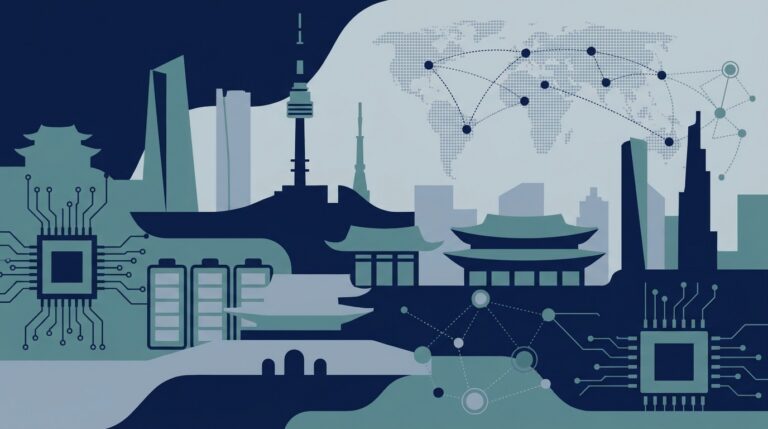
Phase 1: Why Tech Geopolitics Sounds So Fast in Korean
안녕하세요! 매일한글 에디터입니다. (Hello! This is the Daily Hangul Editor.) Picture this: you are sipping iced Americano in Pangyo Techno Valley while watching Korean evening news with colleagues. Suddenly, a K-drama-worthy headline flashes about US-China tech rivalry, domestic subsidies, and export controls hitting Korean chipmakers and EV battery giants. You know the English jargon, yet when everyone debates in fast C1 Korean, your mind freezes. Don’t worry—we built this guide from real feedback by advanced learners navigating Seoul boardrooms. Mastering these expressions lets you command high-stakes policy and business talks with genuine insider poise.
Phase 2: Deep Dive into 3 Core C1 Expressions
1. 공급망 재편 (gonggeupmang jaepyeon)
- Pronunciation: gong-geup-mang jae-pyeon (Think “gong” like a dinner gong, “geup” like “cup” with a tightened throat, “mang” like “mahng”, “jae” like “jeh”, and “pyeon” like “pyuhn” with rounded lips.)
- Meaning: Literally “supply-net re-knitting/reorganization.” In C1 business and policy Korean, it means strategic supply chain realignment—shifting where chips, minerals, and batteries are sourced and manufactured due to geopolitical pressure.
- K-Culture Moment: Picture a tense strategy briefing in a chaebol drama like Reborn Rich or Misaeng where an executive taps a world map showing Texas, Pyeongtaek, and Shenzhen while warning that ignoring this shift will sink quarterly earnings.
- Editor’s Insight: Unlike simple logistics changes (물류 변경, mullyu byeongyeong), 공급망 재편 (gonggeupmang jaepyeon) always carries an undertone of macro-level survival, national economic security, and Washington-Beijing friction.
- Situation Spectrum: Casual ⚠️ | Semi-formal ✅ | Formal ✅
- 🤔 Think About It: Notice the word 재편 (jaepyeon, reorganization) comes from the same root as editing or weaving a system anew. Does your native language frame supply chains more like mechanical “chains” or like a woven “network” (망, mang) that can be unraveled and re-knitted?
2. 수출 통제가 잇따르고 있어요 (suchul tongjega itttareugo isseoyo)
- Pronunciation: su-chul tong-je-ga it-tta-reu-go i-sseo-yo (“su” like “sue”, “chul” like “chool”, “tong-je” like “tong-jeh”, and “it-tta-reu-go” hits a crisp double-t snap like saying “it-ta” sharply.)
- Meaning: Literally “export controls are following one after another.” The real nuance is escalating, relentless waves of export restrictions—nothing is settled yet, and another regulatory shock could drop tomorrow.
- K-Culture Moment: You will hear anchorwomen on KBS or YTN evening news deliver this exact cadence with furrowed brows right after Washington announces new semiconductor equipment limits or Beijing restricts graphite and gallium exports.
- Editor’s Insight: The verb 잇따르다 (itttareuda) is C1 gold! Beginners say 계속 나와요 (gyesok nawayo, keeps coming out), which sounds childish in policy talks. Using 잇따르다 (itttareuda) signals that the measures are piling up in a chain reaction.
- Situation Spectrum: Casual 🚫 | Semi-formal ✅ | Formal ✅
- 🤔 Think About It: Korean media loves verbs of continuous momentum like 잇따르다 (itttareuda) to convey collective urgency. How does your culture report cascading trade sanctions—with dry legal distance or with dramatic momentum?
3. 자국 중심 보조금 경쟁 (jaguk jungsim bojogum gyeongjaeng)
- Pronunciation: ja-guk jung-sim bo-jo-geum gyeong-jaeng (“ja-guk” sounds like “jah-gook”, “jung-sim” like “joong-sheem”, “bo-jo-geum” like “boh-joh-gum”, “gyeong-jaeng” like “gyuhng-jeng”.)
- Meaning: Literally “own-country-centered subsidy competition.” In context, it captures subsidy-driven economic nationalism, such as the US CHIPS Act, the IRA, and rival state funding programs.
- K-Culture Moment: Think of an analytical panel on Korean economic YouTube channels (like SamproTV) where analysts joke darkly over coffee that global free trade is dead and only wallets backed by sovereign governments survive.
- Editor’s Insight: Calling a partner “selfish” directly violates Korean diplomatic tact. Saying 자국 중심 (jaguk jungsim, domestic-centered) lets you critique protectionist policies sharply while staying 100% professional and objective.
- Situation Spectrum: Casual ⚠️ | Semi-formal ✅ | Formal ✅
- 🤔 Think About It: The phrase 자국 (jaguk, one’s own country) avoids pointing fingers at a single nation by name while everyone in the room knows which superpowers are meant. Why do you think indirect framing carries more intellectual authority in Korean boardrooms?
Phase 3: Textbook Korean vs. Real Korean
Situation 1: Reacting to sudden US or Chinese export restrictions during an industry coffee chat
- 📖 Textbook Korean: 미·중 갈등으로 인해 반도체 수출 규제가 증가하여 우리 회사가 어려움을 겪고 있습니다. (Mi-Jung galdeungeuro inhae bandoche suchul gyujega jeunggahaeyeo uri hoesaga eoryeoumeul gyeokko itseumnida. — Due to US-China conflict, semiconductor export regulations have increased, so our company is experiencing difficulty.)
- 🗣️ Real Korean: 미·중 패권 다툼 통에 수출 통제가 연달아 터져서 지금 업계 전체가 눈치만 보고 있어요. (Mi-Jung paegwon datum tonge suchul tongjega yeondara teojyeoseo jigeum eopgye jeonchega nunchiman bogo isseoyo. — Amid the US-China hegemony clash, export controls keep bursting out back-to-back, so the whole industry is just watching each other’s moves right now.)
- 💡 Why the difference? Textbooks overuse passive causal connectors like ~로 인해 (~ro inhae) and generic words like 어려움 (eoryeoum). Real Korean executives and analysts use vivid imagery like 터지다 (teojida, to erupt/break out) and 눈치만 보다 (nunchiman boda, hesitantly reading the room) to capture geopolitical paralysis.
Situation 2: Discussing how domestic subsidies force factories to relocate
- 📖 Textbook Korean: 외국 정부가 보조금을 주어서 한국 기업들이 그 나라에 공장을 지어야 합니다. (Oeguk jeongbuga bojogumeul jueoseo Hanguk gieopdeuri geu narae gongjangeul jieoya hamnida. — Foreign governments give subsidies, so Korean companies must build factories in those countries.)
- 🗣️ Real Korean: 보조금 당근에 맞춰 현지 투자를 안 할 수가 없는 판국이에요. (Bojogum danggeune matcheo hyeonji tujareul an hal suga eopneun pangugieyo. — With the subsidy carrot dangling, it’s a situation where we simply have no choice but to invest locally.)
- 💡 Why the difference? Korean professionals blend policy terms like 현지 투자 (hyeonji tuja, local investment) with punchy idioms such as 당근 (danggeun, carrot as in carrot-and-stick) and 판국 (panguk, state of play on a chessboard), showing witty realism rather than dry translationese.
Phase 4: K-Culture Deep Dive & Non-Verbal Manners
4-1. Nunchi (눈치) & Gestures in Geopolitical Talks
When discussing US-China tech rivalry with Korean semiconductor or battery professionals, Nunchi (눈치, social situational awareness) is everything. Korea depends heavily on US technology and alliances while relying deeply on Chinese markets and critical battery minerals. Never force a Korean counterpart into a blunt “Whose side are you on?” corner! Instead, keep a calm, open posture, nod slowly with an empathetic "그렇죠, 정말 딜레마죠" (Geureochyo, jeongmal dillemajyo — Right, it really is a dilemma), and hold steady yet non-confrontational eye contact. Avoid pointing fingers or smirking when mentioning Washington or Beijing; lowering your voice slightly when naming specific governments signals seasoned diplomatic discretion.
4-2. Cultural Code Analysis: K-Drama Boardrooms & Crisis DNA
If you watch Korean corporate dramas like Reborn Rich (재벌집 막내아들) or office classics like Misaeng (미생), you will notice how Korean characters treat macroeconomic shifts not as abstract graphs, but as existential family survival. In Korean media and K-News culture, there is an unspoken cultural metaphor called "고래 싸움에 새우 등 터진다" (Gorae ssaume saeu deung teojinda — A shrimp’s back bursts in a fight between whales). Because Korea historically navigated between giant powers while building world-beating chip fabs and EV battery plants from scratch, talking about supply chain shocks triggers both intense anxiety and fierce pride—what Koreans playfully tease themselves about as "국뽕" (gukppong, patriotic hype) mixed with survivalist realism.
Phase 5: Real-Life Roleplay Scenario
Setting: A sleek 22nd-floor meeting lounge in Yeouido overlooking the Han River at dusk. Rain taps against the glass while neon signs flicker across Seoul’s financial district.
NPC: Team Leader Park Ji-hoon (박지훈 팀장님) — A sharp, caffeine-fueled battery strategy lead in his late 30s wearing a tailored charcoal blazer, balancing dry humor with razor-sharp market instincts.
- Park:
"요즘 미·중 기술 패권 경쟁 때문에 팀 분위기가 장난 아니에요."(Yojeum Mi-Jung gisul paegwon gyeongjaeng ttaemune tim bunwigiga jangnan anieyo. — These days, the team atmosphere is no joke because of the US-China tech hegemony race.)
🎭 Stage Direction: Sighs lightly while swirling his iced Americano and sliding a tablet toward you. -
You:
"맞아요, 자국 중심 공급망 재편을 위한 보조금 조건이 너무 까다로워졌잖아요."(Majayo, jaguk jungsim gonggeupmang jaepyeoneul wihan bojogum jogeoni neomu kkadarowojyeotjanayo. — Right, the subsidy conditions for domestic-centered supply chain realignment have become so strict.)
🎭 Stage Direction: Lean in slightly and tap the policy summary chart on the screen. -
Park:
"게다가 핵심 광물에 대한 수출 통제가 잇따르니까 원가 계산이 아예 안 서요."(Gedaga haeksim gwangmure daehan suchul tongjega itttareunikka wongga gyesani aye an seoyo. — On top of that, since export controls on critical minerals keep coming one after another, cost calculations don’t even add up anymore.)
🎭 Stage Direction: Rubs the back of his neck with a wry half-smile. -
You:
"그렇죠. 미국 보조금을 받자니 중국산 소재 비중을 줄여야 하는 진퇴양난이네요."(Geureochyo. Miguk bojogumeul batjani Jungguksan sojae bijungeul juryeoya haneun jintoeyangnanineyo. — Exactly. To receive US subsidies, you have to cut Chinese material ratios—it’s a classic Catch-22.)
🎭 Stage Direction: Mirror his pace thoughtfully, keeping your tone empathetic. -
Park:
"딱 그 표현이에요! 진퇴양난이죠. 그래서 저희도 공급망 다변화에 사활을 걸고 있어요."(Ttak geu pyohyeonieyo! Jintoeyangnanijyo. Geuraeseo jeohuido gonggeupmang dabyeonhwae sahwareul geolgo isseoyo. — That’s the exact expression! A total dilemma. That’s why we’re staking everything on supply chain diversification too.)
🎭 Stage Direction: Eyes light up slightly, appreciating your nuanced Korean idiom. -
You:
"단기간에 대체선을 찾기가 쉽지 않을 텐데, 내재화 속도는 어때요?"(Dangigane daecheseoneul chatgiga swipji aneul tende, naejaehwa sokdoneun eottaeyo? — Finding alternatives in the short term can’t be easy, so how is the pace of in-house localization?)
🎭 Stage Direction: Maintain attentive eye contact without interrupting. -
Park:
"솔직히 비용 부담이 크지만, 경제안보 차원에서 선택지가 없어요."(Soljikhi biyong budami keujiman, gyeongjeanbo chawoneseo seontaekjiga eopseoyo. — Honestly the cost burden is huge, but from an economic security standpoint, there’s no other option.)
🎭 Stage Direction: Shrugs calmly and checks his watch. -
You:
"결국 기술 초격차를 유지하면서 유연하게 대응하는 게 관건이겠네요."(Gyeolguk gisul chogyeokchareul yujihamyeonseo yuyeonhage daeeunghaneun ge gwangeonigenneyo. — Ultimately, maintaining an unbridgeable tech gap while responding flexibly will be the key.)
🎭 Stage Direction: Give a reassuring nod.
🔀 Interactive Branching Point
Team Leader Park grins and asks: "혹시 귀사 본사에서는 이 보조금 전쟁을 어떻게 보고 있어요?" (Hoksi gwisa bonsaeseoneun i bojogum jeonjaengeul eotteoke bogo isseoyo? — By any chance, how does your headquarters view this subsidy war?) How do you reply?
- Option A:
"단기 수익성보다 장기적인 공급망 안정성을 최우선으로 보고, 리스크 분산에 집중하고 있습니다."(Dangi suikseongboda janggijeogin gonggeupmang anjeongseongeul choeuseoneuro bogo, riseukeu bunsane jipjunghago itseumnida. — We prioritize long-term supply chain stability over short-term profitability and are focusing on risk diversification.)- Feedback (Best): Brilliant C1 executive diplomacy! You stayed strategic, avoided political finger-pointing, and used crisp business terms like
리스크 분산(risk diversification).
- Feedback (Best): Brilliant C1 executive diplomacy! You stayed strategic, avoided political finger-pointing, and used crisp business terms like
- Option B:
"저희는 그냥 돈 많이 주는 나라 편에 설 거예요. 비즈니스잖아요."(Jeohuineun geunyang don mani juneun nara pyeone seol geoyeyo. Bijeuniseujanayo. — We’ll just side with whichever country gives more money. It’s business, right?)- Feedback (Risk): Too blunt! While honest over late-night soju with close friends, saying
돈 많이 주는 나라 편(side with whoever pays more) in a Yeouido business setting sounds cynical and lacks diplomatic Nunchi.
- Feedback (Risk): Too blunt! While honest over late-night soju with close friends, saying
- Option C:
"글쎄요, 정치는 잘 모르겠고 저희 배터리 품질만 좋으면 팔리지 않을까요?"(Geulsseyo, jeongchineun jal moreugetgo jeohui baeteori pumjilman joeumyeon palliji aneulkkayo? — Well, I don’t really know politics, and won’t our batteries sell as long as quality is good?)- Feedback (Bad): Out of touch for C1! In today’s geoeconomic reality, ignoring export controls and subsidy rules signals naivety rather than confidence.
Phase 6: 10-Second Emotional Shadowing Drill
Read aloud in one smooth 10-second burst, hitting the / pauses and matching the emotional cue:
[😟 Gravely & urgently]미·중 기술 패권 경쟁 속에 / 자국 중심 공급망 재편을 위한 / 보조금과 수출 통제가 / 잇따르고 있어요. (Mi-Jung gisul paegwon gyeongjaeng soge / jaguk jungsim gonggeupmang jaepyeoneul wihan / bojogumgwa suchul tongjega / itttareugo isseoyo. — Amid US-China tech hegemony competition / domestic-centered supply chain realignment / subsidies and export controls / have proliferated.)[🤔 Analytical yet cautious]단기적인 비용 부담은 크지만 / 경제안보 차원에서 / 공급망 다변화가 불가피해요. (Dangijeogin biyong budameun keujiman / gyeongjeanbo chawoneseo / gonggeupmang dabyeonhwaga bulgapihaeyo. — Although the short-term cost burden is heavy / from an economic security perspective / supply chain diversification is unavoidable.)[😤 Determined & resilient]결국 흔들리지 않는 / 기술 초격차만이 / 유일한 해법이에요. (Gyeolguk heundeulliji anneun / gisul chogyeokchamani / yuilhan haebeobieyo. — Ultimately, an unshakable / super-gap in technology alone / is the only solution.)
Phase 7: K-Culture Mini Dictionary
- 경제안보 (gyeongjeanbo) | Economic Security | Once used only by defense think tanks, this term is now heard daily in Korean cafés and boardrooms whenever chipmakers or battery plants are discussed as national strategic assets.
- 초격차 (chogyeokcha) | Super-gap (Unbridgeable Technological Lead) | Coined in Korean semiconductor culture (famously associated with Samsung), it describes maintaining a lead so wide that rivals cannot catch up even with massive state subsidies.
- 핵심 광물 (haeksim gwangmul) | Critical Minerals | Essential inputs like lithium, nickel, cobalt, and graphite. Used constantly in Korean EV battery discussions about reducing single-country reliance.
- 진퇴양난 (jintoeyangnan) | Catch-22 / Dilemma (Neither advance nor retreat is easy) | A classic four-character Sino-Korean idiom (
사자성어, saja-seongeo) that instantly elevates your C1 Korean when describing Korea’s squeeze between Washington and Beijing.
Phase 8: Survival Kit for Travelers
Visiting Seoul, Pangyo, or Pyeongtaek for tech conferences like SEMICON Korea or InterBattery? Keep these three phrases handy:
- “판교 테크노밸리 쪽으로 가 주세요.” (Pangyo Tekeunobaelli jjogeuro ga juseyo.) — “Please take me toward Pangyo Techno Valley.” Pro Tip: Many taxi drivers call it simply
판교(Pangyo), so adding the exact building name helps avoid circling the tech campus! - “오늘 전시회 네트워킹 세션은 어디서 열려요?” (Oneul jeonsihoe neteuwoking sesyeoneun eodiseo yeollyeoyo?) — “Where is today’s exhibition networking session held?” Pro Tip: At COEX in Gangnam, halls span multiple levels—always confirm the hall letter (
A홀,B홀) to save a 15-minute sprint in dress shoes. - “명함 한 장 주실 수 있을까요?” (Myeongham han jang jusil su isseulkkayo?) — “Could I have one of your business cards?” Pro Tip: Offer and receive business cards with both hands and read the person’s title before slipping it neatly into a cardholder—never shove it into your back pocket!
Editor’s Travel Note: Before touching down at Incheon Airport, Download the Naver Map App for real-time Korean transit since Google Maps walking and driving routes are restricted in Korea. Also Check SEMICON Korea official exhibition details if you plan to attend industry forums, and grab a physical T-money or Climate Card at any airport convenience store—tap it on subways and buses effortlessly, and note that contactless foreign credit cards still fail at some older kiosks, so keeping a little Korean won cash is a lifesaver.
Phase 9: One Step Deeper
In Korean society, geopolitics is rarely viewed as a distant chess match—it is felt viscerally at the dinner table. Because South Korea built its semiconductor and battery miracles without abundant natural resources, 위기 의식 (wigi uisik, crisis consciousness) acts as both a source of stress and an engine of astonishing agility. That is why high-level Korean language leans so heavily on collective urgency and balanced diplomacy: survival has always depended on reading global currents faster than anyone else while pulling together as one team.
💬 Your Turn: How do people in your home country talk about the global race for chips and EV batteries—is it framed as political rivalry, consumer prices, or national pride? Drop a comment below and share your perspective!
Phase 10: FAQ & Myth Busting
Q: Why do Koreans often say “우리나라” (urina-ra, our country) even when talking about global tech supply chains?
A: In Korean, 우리 (uri, we/our) expresses communal belonging rather than exclusionary nationalism. Saying 우리나라 반도체 산업 (urinara bandoche saneop, our country’s semiconductor industry) simply feels natural and emotionally connected to daily livelihoods.
Q: Is it polite to use “미국” (Miguk) and “중국” (Jungguk) directly in formal Korean business meetings?
A: Yes, naming the countries is grammatically fine, but C1 speakers often soften sharp criticism by framing policies conceptually—using 자국 중심 정책 (jaguk jungsim jeongchaek, domestic-centered policy) or 미·중 양국 (Mi-Jung yangguk, both the US and China) to sound balanced and objective.
Q: What is the difference between “규제” (gyuje) and “통제” (tongje) in tech trade news?
A: 규제 (gyuje) refers broadly to regulations or rules (such as safety or environmental standards), whereas 통제 (tongje) carries a much stronger nuance of strict state control or blocking—which is why 수출 통제 (suchul tongje) is used for export bans on advanced chips and equipment.
🚨 Common Mistakes Warning Board
- Mistake 1: Saying
미·중 싸움(Mi-Jung ssaum, US-China fight) in a presentation. Correct Action: Upgrade to미·중 기술 패권 경쟁(Mi-Jung gisul paegwon gyeongjaeng) for C1 professionalism. - Mistake 2: Translating “subsidy” literally as
지원금(jiwongeum, relief/grant money) in policy contexts. Correct Action: Use보조금(bojogum) when referring to industrial subsidies like the CHIPS Act. - Mistake 3: Using
바꾸다(bakkuda, to change) for supply chains. Correct Action: Use공급망 재편(gonggeupmang jaepyeon) or공급망 다변화(gonggeupmang dabyeonhwa, diversification).
Phase 11: Action Mission & Engagement
- 🥉 Bronze (Solo Practice): Record yourself reading the three Phase 6 shadowing lines twice—aim to hit
잇따르고 있어요(itttareugo isseoyo) cleanly without stumbling over the doubleㄸ. - 🥈 Silver (Social Share): Post one sentence on LinkedIn, X, or your study journal summarizing today’s theme using
공급망 재편(gonggeupmang jaepyeon) and tag a fellow Korean learner. - 🥇 Gold (Real-World Use): Next time you speak with a Korean colleague, tutor, or language partner, naturally drop
진퇴양난(jintoeyangnan) or기술 패권 경쟁(gisul paegwon gyeongjaeng) into your conversation!
🎮 K-Culture Mission: Open a Korean economic news clip on YouTube (search `
🎬 Watch Our Daily Videos! (Daily Hangul Official Instagram)
Review the expressions you learned in this article with our fun daily short videos! Check out native pronunciation and real-life nuances in action.
- Instagram @dailyhangul_en







