

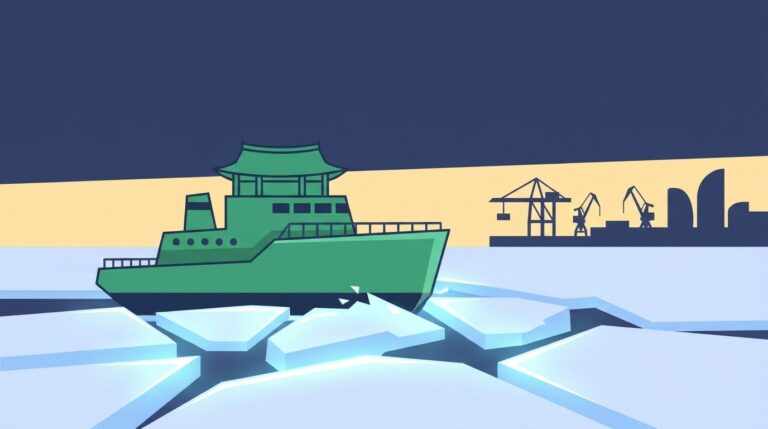
Phase 1: Caught in the Arctic Currents of a Korean Boardroom
안녕하세요! 매일한글 에디터입니다. (Annyeonghaseyo! Hello! I’m your Daily Hangul editor.) Picture yourself in a tense boardroom drama like Reborn Rich—except you’re actually sitting in a Busan shipyard briefing. Everything flows until a Korean director drops phrases about melting polar ice opening the Northern Sea Route (NSR), cutting Asia-Europe transit by over 30%, and pivoting to green ammonia vessels and icebreaking LNG carriers. Suddenly, your C2 fluency freezes! Based on real feedback from expat maritime analysts and diplomats, I built this guide to help you command high-stakes geopolitical and shipbuilding discussions effortlessly. Ready to navigate like a true insider?
Phase 2: Deep Dive into 3 Core C2 Expressions
1. 초격차 기술력을 선점하다 (Chogyeokcha gisullyeogeul seonjeomhada)
- Pronunciation: Chogyeokcha gisullyeogeul seonjeomhada (Sounds like choh-gyuhk-cha gee-sool-lyuh-geul sun-juhm-ha-da, with a crisp ‘juhm’ like ‘jump’ without the p)
- Meaning: Literally “to preemptively occupy super-gap technological capability.” In real boardrooms, it means establishing an insurmountable lead in cutting-edge sectors like green ammonia-fueled ships and icebreaking LNG carriers.
- K-Culture Moment: Think of the intense executive strategy briefings in K-dramas like Agency or Reborn Rich, where chaebol strategists slam a market report on the mahogany table to argue why rivals cannot catch up.
- Editor’s Insight: 초격차 (chogyeokcha / super-gap) is a uniquely Korean corporate power-word coined in the tech and shipbuilding sectors. Unlike 경쟁 우위 (gyeongjaeng uwi / competitive advantage), it implies leaving competitors so far behind that competition itself becomes irrelevant.
- Situation Spectrum: Casual 🚫 / Semi-formal ⚠️ / Formal ✅
- 🤔 Think About It: English business jargon loves “disruption” and “moats,” which focus on defense or breaking rules. Why do you think Korean industrial culture favors a spatial metaphor like “super-gap” (초격차) when discussing shipbuilding and energy transition?
2. 지정학적 요충지 (Jijeonghakjeok yochungji)
- Pronunciation: Jijeonghakjeok yochungji (Sounds like jee-jung-hak-juhk yoh-choong-jee, keeping the ‘uh’ open like ‘uh-oh’ and ‘yo’ crisp like ‘yo-yo’)
- Meaning: Literally “geopolitical strategic point.” Nuance-wise, it carries heavy historical and security weight—describing a chokepoint or hub like the Northern Sea Route (NSR) or Busan Port that dictates global supply-chain leverage.
- K-Culture Moment: Frequently heard on JTBC Newsroom specials or political thrillers like The Whirlwind when analysts debate how melting Arctic sea ice transforms East Asian maritime corridors.
- Editor’s Insight: Calling a port or sea lane a 거점 (geojeom / hub) sounds purely logistical. Calling it a 지정학적 요충지 (jijeonghakjeok yochungji) instantly signals that energy security, naval strategy, and national survival are on the table.
- Situation Spectrum: Casual 🚫 / Semi-formal ✅ / Formal ✅
- 🤔 Think About It: As a peninsula surrounded by ocean and geopolitical heavyweights, Korea views sea lanes as lifelines. How does your native language frame maritime corridors—as neutral trade highways or contested power arenas?
3. 물류 패권의 분수령 (Mullyu paegwonui bunsuryeong)
- Pronunciation: Mullyu paegwonui bunsuryeong (Sounds like mool-lyoo peh-gwun-eh boon-soo-ryuhng, where ‘ll’ glides smoothly like ‘will you’ blended fast)
- Meaning: Literally “a watershed moment for logistics hegemony.” Used when an environmental or infrastructural shift—like polar ice retreat cutting Asia-Europe voyages by over 30%—permanently redraws global maritime power.
- K-Culture Moment: Picture a seasoned investigative journalist in a drama like Argon delivering a grave closing monologue over satellite maps of Arctic icebreakers.
- Editor’s Insight: 분수령 (bunsuryeong) originally means a mountain ridge dividing river basins; in C2 Korean, it’s far more dramatic and irreversible than 전환점 (jeonhwanjeom / turning point). Pair it with 패권 (paegwon / hegemony), and you sound like a senior policy fellow in Seoul.
- Situation Spectrum: Casual 🚫 / Semi-formal ⚠️ / Formal ✅
- 🤔 Think About It: Notice how Korean pairs an ecological term (분수령, watershed) with a hard-power political term (패권, hegemony). How often do climate shifts and power politics merge into single idioms in your mother tongue?
Phase 3: Textbook Korean vs. Real Korean
Situation 1: Highlighting the 30% distance cut via the Northern Sea Route
- 📖 Textbook Korean: 기후 변화로 인해 북극항로가 열리면 아시아와 유럽 사이의 거리가 30% 이상 줄어들 것입니다. (Gihu byeonhwaro inhae bukgeukhangnoga yeollimyeon Asiawa Yureop saiui georiga samsip peosenteu isang jureodeul geosimnida. / If the Northern Sea Route opens due to climate change, the distance between Asia and Europe will decrease by over 30%.)
- 🗣️ Real Korean: 해빙이 빨라지면서 북극항로가 물류 거리를 30% 넘게 단축하는 게임 체인저로 부상했어요. (Haebingi ppallajimyeonseo bukgeukhangnoga mullyu georireul samsip peosenteu neomge danchukhaneun geim cheinjeoro busanghaesseoyo. / With sea ice melting faster, the Northern Sea Route has emerged as a game-changer slashing logistics distance by over 30%.)
- 💡 Why the difference? Textbook Korean stacks passive hypotheticals (~면 ~것입니다), which sound robotic in Seoul or Busan executive rooms. Real C2 speakers use 부상하다 (busanghada / to rise to prominence) and concise verbs like 단축하다 (danchukhada / to shorten) to project analytical urgency.
Situation 2: Warning about green ammonia toxicity and polar ice risks
- 📖 Textbook Korean: 친환경 암모니아 선박과 쇄빙선은 기술적으로 어렵고 위험한 점이 많습니다. (Chinhwangyeong ammonia seonbakgwa swaebingseoneun gisuljeogeuro eoryeopgo wiheomhan jeomi manseumnida. / Eco-friendly ammonia ships and icebreakers have many technically difficult and dangerous aspects.)
- 🗣️ Real Korean: 암모니아 추진선의 독성 제어와 극지 운항의 안전성 확보는 결코 녹록지 않은 과제죠. (Ammonia chujinseonui dokseong jeeowa geukji unhangui anjeonseong hwakboneun gyeolko noknokji aneun gwajejyo. / Controlling toxicity in ammonia-fueled vessels and securing safety in polar navigation are by no means easy tasks.)
- 💡 Why the difference? Saying “it’s difficult and dangerous” directly can sound naive or overly blunt to Korean engineers. Using 결코 녹록지 않다 (gyeolko noknokji anta / by no means easy or trivial) shows nuanced respect for the engineering hurdle without sounding defeatist.
Phase 4: K-Culture Deep Dive & Non-Verbal Manners
4-1. Nunchi (눈치) & Non-Verbal Etiquette in Maritime Briefings
In Geoje’s mega-shipyards or Busan’s maritime summits, nunchi (reading the room) matters as much as technical accuracy. When disputing projections on Northern Sea Route icebreaker demand, never interrupt a senior Korean executive mid-sentence or gesture sharply across the table with one finger. Instead, hold a calm, upright posture, wait a beat after they finish speaking to signal reflection, and tilt your head slightly while inhaling softly (아, 말씀하신 부분에 덧붙이자면… / A, malsseumhasin bubune deotbuchijamyeon… / Ah, to add to what you mentioned…). When exchanging technical dossiers or business cards, always use both hands and maintain brief, respectful eye contact before glancing at their title.
4-2. Cultural Code Analysis: K-Drama Boardrooms & Korea’s Maritime Pride
If you’ve watched Misaeng or Reborn Rich, you know Korean corporate culture treats global trade like a high-stakes chess match for national survival. That dramatic energy comes straight from Korea’s modern history as a 해양 강국 (haeyang gangguk / maritime powerhouse)—a resource-poor peninsula that built world-leading yards in Ulsan, Geoje, and Busan. Understanding that Koreans view green methanol/ammonia vessels and icebreaking LNG carriers not merely as steel hulls, but as symbols of national resilience (기술보국 / gisul boguk / serving the nation through technology), will immediately elevate how locals respond to your commentary.
Phase 5: Real-World Roleplay Scenario
Setting: A sleek 28th-floor conference lounge overlooking Busan’s North Port at twilight. Rain streaks the glass as cargo cranes glow below. You are negotiating a joint polar-logistics white paper with Director Han Ji-hoon (한지훈 상무), a sharp-tongued veteran strategist at a leading Korean shipbuilder.
- Director Han: 최근 북극해 해빙 속도가 예상보다 훨씬 빠르더군요. 우리 쪽 수주 전략도 전면 수정해야 할 시점 아닙니까? (Choegeun bukgeukhae haebing sokdoga yesangboda hwolssin ppareudeogunyo. Uri jjok suju jeollyakdo jeonmyeon sujeonghaeya hal sijeom animnikka? / The Arctic sea-ice melt has been much faster than expected lately. Isn’t it time we completely overhaul our order-book strategy too?)
🎭 Stage Direction: Director Han taps a tablet showing an Arctic shipping map, locking eyes with you to test your readiness. - You: 맞습니다, 상무님. 아시아-유럽 항로가 30% 이상 단축된다면 북극항로는 단순한 대안이 아니라 물류 패권의 분수령이 될 겁니다. (Matseumnida, sangmunim. Asia-Yureop hangnoga samsip peosenteu isang danchukdoendamyeon bukgeukhangnoneun dansunhan daeani anira mullyu paegwonui bunsuryeongi doel geomnida. / Indeed, Director. If the Asia-Europe route is cut by over 30%, the Northern Sea Route won’t be a mere alternative—it will be a watershed moment for maritime logistics hegemony.)
🎭 Stage Direction: You lean forward slightly, gesturing smoothly toward the map with an open palm. - Director Han: 허, 핵심을 정확히 짚으셨네요. 그런데 러시아 제재와 극지 환경 규제 때문에 선주사들이 선뜻 발주에 못 나서고 있지 않습니까? (Heo, haeksimeul jeonghwakhi jipeusyeotneyo. Geureonde Reosia jejewa geukji hwangyeong gyuje ttaemune seonjusadeuri seontteut baljue mot naseogo itji anseumnikka? / Huh, you hit the nail on the head. Still, due to Russian sanctions and polar environmental regulations, aren’t shipowners hesitating to place orders?)
🎭 Stage Direction: He leans back, folding his arms with a skeptical half-smile. - You: 바로 그 지점에서 친환경 암모니아·메탄올 추진 쇄빙선의 가치가 빛을 발합니다. 규제 리스크와 탄소 중립을 동시에 돌파하는 해법이니까요. (Baro geu jijeomeseo chinhwangyeong ammonia-metanol chujin swaebingseonui gachiga bicheul balhamnida. Gyuje riseukeuwa tanso jungnibeul dongsie dolpahaneun haebeobinikkayo. / That exact juncture is where eco-friendly ammonia and methanol-fueled icebreakers shine. They’re the solution that breaks through both regulatory risk and carbon neutrality simultaneously.)
🎭 Stage Direction: You maintain steady, composed eye contact, emphasizing '동시에 (simultaneously)'. - Director Han: 암모니아의 독성과 저온 취성 문제는 어떻고요? 말처럼 쉬운 기술이 아닙니다. (Ammoniaui dokseonggwa jeoon chwiseong munjeneun eotteokoyo? Malcheoreom swiun gisuri animnida. / And what about ammonia’s toxicity and cold-brittleness issues? It’s not as simple a technology as it sounds.)
🎭 Stage Direction: He raises an eyebrow, waiting to see if you crumble under technical scrutiny. - You: 전적으로 동의합니다. 결코 녹록지 않은 과제지만, 한국 조선소가 바로 그 초격차 기술력을 선점하고 있지 않습니까? (Jeonjeogeuro donguihamnida. Gyeolko noknokji aneun gwajejiman, Hanguk joseonsoga baro geu chogyeokcha gisullyeogeul seonjeomhago itji anseumnikka? / I completely agree. It’s by no means an easy challenge, yet aren’t Korean shipyards the very ones preemptively securing that super-gap technology?)
🎭 Stage Direction: You offer a respectful nod before smoothly turning his objection into a compliment on Korean engineering. - Director Han: 하하, 우리 조선소의 강점을 기가 막히게 아시네요. 하지만 운항 보험료와 쇄빙 에스코트 비용이 만만치 않을 텐데요. (Haha, uri joseonsoui gangjeomeul giga makhige asineyo. Hajiman unhang boheomnyowa swaebing eseukoteu biyongi manmanchi aneul tendeyo. / Haha, you certainly know our shipyard’s strengths inside out. Still, hull insurance and icebreaker escort fees won’t be cheap.)
🎭 Stage Direction: His expression softens into genuine engagement as he scribbles a note. - You: 단기 비용보다 장기적인 공급망 안보가 우선인 시대입니다. 이제 지정학적 요충지를 선점하는 쪽이 승기를 잡을 겁니다. (Dangi biyongboda jangijeogin gonggeupmang anboga useonin sidaeimnida. Ije jijeonghakjeok yochungjireul seonjeomhaneun jjogi seunggireul jabeul geomnida. / We live in an era where long-term supply-chain security outweighs short-term costs. Now, whoever secures this geopolitical chokepoint will seize the upper hand.)
🎭 Stage Direction: You conclude decisively, placing your pen down neatly beside your notebook.
🔀 Interactive Branching Point
Director Han pauses, clearly impressed, and asks: “그럼 우리 첫 공동 보고서의 부제를 어떻게 잡는 게 좋겠습니까? (Geureom uri cheot gongdong bogoseoui bujereul eotteoke jamneun ge jokesseumnikka? / So, how should we frame the subtitle of our first joint report?)” What do you reply?
- Choice A: “‘해빙이 여는 북극항로: 친환경 쇄빙 상선과 해상 물류 패권의 재편’으로 제안합니다.” (‘Haebingi yeoneun bukgeukhangno: chinhwangyeong swaebing sangseongwa haesang mullyu paegwonui jaepyeon’euro jeeanhamnida. / I propose ‘The Northern Sea Route Opened by Melting Ice: Green Icebreaking Vessels and the Realignment of Maritime Hegemony.’)
- Feedback (Best): Spot-on C2 register! The balanced noun-phrase structure (~이 여는 ~: ~과 ~의 재편) mirrors real Korean think-tank reports, impressing Director Han with both precision and gravitas.
- Choice B: “‘북극 바다가 녹아서 한국 배들이 대박 날 기회’라고 하면 눈에 확 띄지 않을까요?” (‘Bukgeuk badaga nogaseo Hanguk baedeuri daebak nal gihoe’rago hamyeon nune hwak ttuiji aneulkkayo? / Wouldn’t ‘A Jackpot Chance for Korean Ships Because the Arctic Ocean Is Melting’ catch people’s eyes?)
- Feedback (Bad): Ouch! Using slang like 대박 (daebak / jackpot) about polar ice melt sounds tone-deaf to climate urgency and wildly unprofessional in an executive summit.
- Choice C: “‘쇄빙 LNG선과 암모니아선의 기술적 비교 분석’ 정도로 무난하게 가시죠.” (‘Swaebing LNG-seongwa ammoniaseonui gisuljeok bigyo bunseok’ jeongdoro munanahage gasijyo. / Let’s play it safe with something like ‘A Technical Comparative Analysis of Icebreaking LNG and Ammonia Carriers.’)
- Feedback (Risk): Grammatically fine, but too narrow and dry! You miss the geopolitical hook (지정학적 변수) that Director Han specifically wanted to highlight.
Phase 6: 10-Second Emotional Shadowing Drill
Read these three power sentences aloud, pausing sharply at each / and matching the emotional cue:
[🧐 Analytically & Sharply]해빙이 가속화되면서 / 북극항로는 더 이상 미래의 가설이 아니라 / 냉엄한 지정학적 현실이 되었습니다. (Haebingi gasokhwadoemyeonseo / bukgeukhangnoneun deo isang miraeui gaseori anira / naengeomhan jijeonghakjeok hyeonsiri doeeotseumnida. / As sea-ice melt accelerates, the Northern Sea Route is no longer a future hypothesis, but a stark geopolitical reality.)[😤 Urgent & Persuasive]친환경 암모니아 추진선 분야에서 / 초격차를 선점하지 못하면 / 향후 해상 물류 주도권을 잃게 됩니다. (Chinhwangyeong ammonia chujinseon bunyaeseo / chogyeokchareul seonjeomhaji mothamyeon / hyanghu haesang mullyu judogwoneul ilke doemnida. / If we fail to preemptively secure a super-gap in green ammonia vessels, we will lose future maritime logistics leadership.)[🤝 Diplomatically & Confidently]기술적 난제는 결코 녹록지 않지만 / 바로 그 위기가 / 우리에게는 새로운 도약의 분수령입니다. (Gisuljeok nanjeneun gyeolko noknokji anchiman / baro geu wigiga / uriegeneun saeroun doyagui bunsuryeongimnida. / The technical hurdles are by no means trivial, yet that very crisis is our watershed moment for a new leap forward.)
Phase 7: K-Culture Mini Dictionary (4 Core Keywords)
- 친환경 암모니아 추진선 (Chinhwangyeong ammonia chujinseon) | Eco-friendly ammonia-propelled vessel | Used constantly in Korean financial news (한국경제, 매일경제) when covering zero-carbon ship orders by HD Hyundai or Hanwha Ocean.
- 쇄빙 액화천연가스 운반선 / 쇄빙 LNG선 (Swaebing LNG-seon) | Icebreaking LNG carrier | High-value specialty vessels capable of crushing thick Arctic sea ice independently; a flagship term symbolizing Korean shipbuilding supremacy.
- 해빙 가속화 (Haebing gasokhwa) | Accelerated sea-ice melt | Note the pronunciation trap: 해빙 means “sea ice” (海氷) OR “thawing/ice melt” (解氷) depending on context! In climate/NSR reports, 해빙 가속화 refers to melting polar ice.
- 해상 물류 패권 (Haesang mullyu paegwon) | Maritime logistics hegemony | A staple C2 geopolitical compound used in policy panels discussing how the NSR challenges traditional Suez Canal dominance.
Phase 8: Survival Kit for Travelers
Heading to Busan for a maritime conference or visiting Geoje’s coastal shipyards? Keep these three phrases handy:
- 현장 브리핑 자료를 공유해 주실 수 있을까요? (Hyeonjang beuriping jaryoreul gongyuhae jusil su isseulkkayo? / Could you share the on-site briefing materials?) — Pro Tip: Saying 공유해 주실 수 있을까요? instead of 주세요 (give me) preserves polished C2 rapport with harbor officials.
- 기상 악화로 선박 입출항 일정이 지연되나요? (Gisang akhwaro seonbak ipchulhang iljeongi jiyeondoenayo? / Are vessel arrival and departure schedules delayed due to bad weather?) — Pro Tip: Essential in Busan or coastal ports during typhoon or heavy fog seasons.
- 통역 부스 채널은 몇 번으로 맞추면 되나요? (Tongyeok buseu chaeneoreun myeot beoneuro matchumyeon doenayo? / Which channel should I tune the interpretation headset to?) — Pro Tip: Use 맞추다 (to tune/set) rather than 바꾸다 (to change) for effortless natural fluency.
✈️ Editor’s Travel Note
Before stepping off the KTX at Busan Station, make sure to Download Naver Map for Real-Time Busan Port Transit because Google Maps walking and ferry routes are limited in Korea, and Check Korea Meteorological Administration Marine Weather if you’re taking a coastal ferry toward Geoje. Grab a rechargeable T-money card at any convenience store (works on Busan Metro, buses, and taxis), and note that Korean summits almost always use KakaoTalk or QR digital badges for rapid schedule updates—so keeping roaming or an eSIM active is a lifesaver!
Phase 9: “One Step Deeper” (Thought Question)
In Korean society, maritime ambition is deeply intertwined with collective memory and geographical reality. Surrounded by sea on three sides and cut off overland to the north, South Korea effectively functions as an island in global trade—meaning 99.7% of its import-export volume moves by sea. This vulnerability fuels a unique cultural ethos often called 위기를 기회로 (wigireul gihoero / turning crisis into opportunity), where climate disruption and shifting geopolitics immediately trigger intense, coordinated mobilization across government ministries, shipyards, and research institutes. When Koreans discuss the Northern Sea Route or green ammonia vessels, they are rarely just talking about profit margins; they are negotiating national survival and future pride.
💬 Your Turn: How does your home country’s geography shape the way people talk about shipping, energy, or climate change? Share your thoughts in the comments—I’d love to compare notes with you!
Phase 10: FAQ & Myth-Busting
Q: Why does “해빙 (haebing)” mean both “sea ice” and “ice melting” in Korean?
A: They are homonyms from different Hanja! 해빙 (海氷) means ocean/sea ice, while 해빙 (解氷) means thawing or melting ice. Context tells you which one is meant—for example, 해빙 면적 감소 (reduction in sea-ice area) vs. 해빙기 안전 점검 (thawing-season safety inspection).
Q: Is “초격차 (chogyeokcha)” only used in semiconductor news, or is it natural in shipbuilding too?
A: It is completely natural—and heavily used—in Korean shipbuilding! Media and executives routinely apply 초격차 to Korea’s technological edge in eco-friendly ammonia/methanol engines and Arc7-class icebreaking LNG carriers.
Q: When addressing a senior Korean shipyard executive, should I use “사장님 (Sajangnim)” for everyone?
A: No! Using 사장님 casually can actually cause awkwardness in corporate settings because it sounds like you’re addressing a small shop owner or assuming the wrong rank. Always check their business card for exact titles like 상무님 (Sangmunim / Managing Director) or 전무님 (Jeonmunim / Senior Managing Director).
🚨 Common Mistakes Warning Board
- Translating “green ship” literally as 녹색 배 (noksaek bae): Sounds like a boat painted green! Correct Action: Always use 친환경 선박 (chinhwangyeong seonbak) or 탄소 중립 선박 (tanso jungnip seonbak).
- Confusing 쇄빙선 (swaebingseon / icebreaker) with 제빙기 (jebinggi / ice maker): A hilarious slip-up in casual chatter, but lethal to credibility in a pitch. Correct Action: Remember 쇄 (swae) means “to crush/shatter”—쇄빙선 is an ice-crushing ship.
- Using blunt English-style “No, that’s wrong” (아니요, 틀렸습니다) in a panel debate: Comes across as confrontational. Correct Action: Soften disagreement with 말씀하신 측면도 있지만, 다른 각도에서 보면… (Malsseumhasin cheungmyeondo itjiman, dareun gakdoeseo bomyeon… / While there is that aspect, viewed from another angle…).
Phase 11: Action Mission & Engagement
- 🥉 Bronze Mission (Solo Practice): Record yourself performing Phase 6’s 3 emotional shadowing lines using your phone’s voice memo, paying special attention to the crisp 초격차 (chogyeokcha) pronunciation.
- 🥈 Silver Mission (SNS Share): Post one takeaway from Phase 2 (like the difference between 거점 and 지정학적 요충지) on LinkedIn or X with
#DailyHanguland tag a colleague in logistics or energy. - 🥇 Gold Mission (Real-World Use): The next time you read a Korean news article on Naver or speak with a Korean colleague, drop 물류 패권의 분수령 (watershed moment for logistics hegemony) naturally into your commentary!
- 🎮 K-Culture Mission: Watch a Korean economic news clip on YouTube (like KBS 시사기획 창 or SBS Biz) covering 북극항로 or 친환경 선박 and spot at least two of today’s Phase 7 keywords in real-time subtitles!
Phase 12: Interactive Quiz Challenge
1. Situational Judgment
During a tense maritime panel in Seoul, a senior Korean director questions whether ammonia-propelled vessels can safely handle polar routes. Which response best balances C2 diplomacy and technical confidence?
* A) 아니요, 그건 예전 데이터라 완전히 틀렸어요. (Aniyo, geugeon yeojeon deteora wanjeonhi teullyeosseoyo.)
* B) 결코 녹록지 않은 과제지만, 관련 안전 기준과 초격차 기술이 빠르게 고도화되고 있습니다. (Gyeolko noknokji aneun gwajejiman, gwallyeon anjeon gijungwa chogyeokcha gisuri ppareuge godohwadoego itseumnida.)
* C) 암모니아 배는 그냥 대박 친환경적이라 무조건 성공합니다. (Ammonia baeneun geunyang daebak chinhwangyeongjeogira mujogeon seonggonghamnida.)
Click to reveal Answer & Explanation
Answer: B! Option A is overly confrontational and violates Korean boardroom nunchi, while Option C relies on casual slang (대박, 그냥) that undermines C2 executive credibility. Option B validates the director’s concern (결코 녹록지 않은 과제지만) before pivoting smoothly to Korea’s technological advancement.
2. Fill in the Blank
Complete this C2 headline: “아시아-유럽 거리를 30% 이상 단축하는 북극항로가 글로벌 [ ________ ]의 분수령으로 떠올랐다.” (The Northern Sea Route, which shortens Asia-Europe distance by over 30%, has emerged as a watershed moment for global [ ________ ].)
* Hint: Think of the Phase 2 expression meaning “logistics hegemony.”
Click to reveal Answer & Explanation
Answer: 물류 패권 (mullyu paegwon). Together, 물류 패권의 분수령 captures the seismic geopolitical shift triggered by melting Arctic ice and emerging polar trade corridors.
3. True or False Cultural Quiz
Statement: In Korean business briefings, calling a strategic sea lane a “지정학적 요충지 (jijeonghakjeok yochungji)” carries the exact same neutral tone as calling it a “물류 거점 (mullyu geojeom).”
Click to reveal Answer & Explanation
Answer: False! 물류 거점 is a neutral commercial/logistical term (logistics hub), whereas 지정학적 요충지 carries weighty geopolitical, national security, and strategic power implications.
🎬 Watch Our Daily Videos! (Daily Hangul Official Instagram)
Review the expressions you learned in this article with our fun daily short videos! Check out native pronunciation and real-life nuances in action.
- Instagram @dailyhangul_en






