

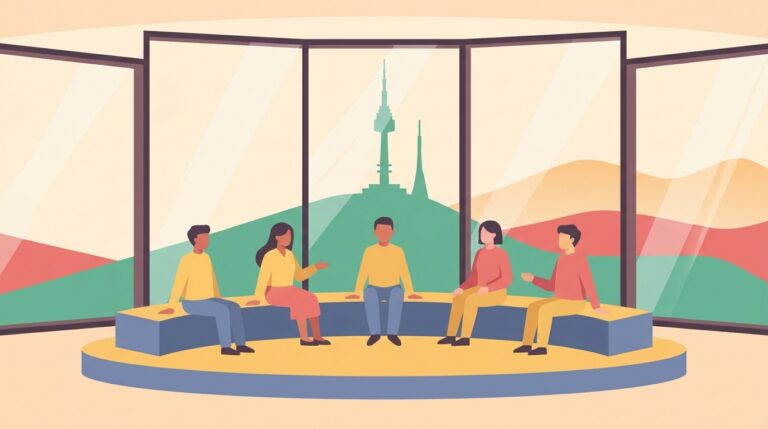
Phase 1: The Afternoon Stage — Empathy & Real Talk
안녕하세요! 매일한글 에디터입니다. (Hello! I’m your Daily Hangul Editor.) Picture this: it is 2:00 PM at COEX in Seoul. You are sitting center stage, gripping a microphone between four heavyweights: a university professor, a tech CEO, and two government officials. In K-dramas like Start-Up, panel moderators make debates look effortless. In reality? One clumsy interruption or wrong honorific can freeze the room! A C1 learner recently shared this exact nightmare with me after moderating an afternoon plenary. Built from real coaching feedback, this guide gives you the exact C1 Korean expressions and cultural nunchi to steer high-stakes panels with total grace.
Phase 2: Deep Dive into 3 Essential C1 Moderator Expressions
1. 산·학·관의 입장이 첨예하게 갈리는 지점인데, 고견을 여쭙고 싶습니다. (San-hak-gwan-ui ipjang-i cheomyehage gallineun jijeominde, gogyeoneul yeojjupgo sipseumnida.)
- Pronunciation: Sahn-hahk-gwahn-eh eep-jahng-ee chuhm-yeh-hah-geh gahl-lee-neun jee-juhm-een-deh, go-gyuhn-eul yuh-jjoop-go seep-seum-nee-dah. (Think of “gyuhn” in gogyeon as the “u” in “sun” with a quick “y” glide—short and crisp—and “jjoop” like “j” + “oop” in “hoop”.)
- Meaning: Literally, “This is a point where industry, academia, and government stances sharply divide, and I wish to inquire about your high opinion.” Practically, it means: “Since academia, industry, and government see this quite differently, I would love to invite your expert insight on this.”
- K-Culture Moment: You will hear this exact cadence on Korean current-affairs roundtables like JTBC’s Sseoljeon or during heated policy panels at the Seoul Digital Forum, right before the host pivots to a senior professor or former minister.
- Editor’s Insight: Using 첨예하다 (cheomyehada — sharp/acute) signals C1 mastery because it frames a conflict intellectually rather than emotionally. Pairing it with 고견 (gogyeon — esteemed opinion) and 여쭙다 (yeojjupda — humble form of asking) elevates your panelists’ status, making them eager to engage even on sensitive topics.
- Situation Spectrum: Casual 🚫 | Semi-formal ⚠️ | Formal ✅
- 🤔 Think About It: In English, moderators often say, “You two completely disagree—fight it out!” Why does Korean academic culture wrap sharp disagreement in hyper-humble nouns like gogyeon instead of calling it a “clash”?
2. 시간 관계상 논의의 초점을 잠시 좁혀 보겠습니다. (Sigan gwangyesang non-ui-ui chojeomeul jamsi jophyeo bogesseumnida.)
- Pronunciation: Shee-gahn gwahn-gyeh-sahng nohn-ee-eh cho-juhm-eul jahm-shee johp-hyuh bo-geh-sseum-nee-dah. (“Cho” sounds like “choke” without the k, and “juhm” rhymes with “gum”.)
- Meaning: Literally, “Due to time relations, let us narrow the focus of the discussion for a moment.” In real-world moderation: “In the interest of time, let’s zoom back in on our core question.”
- K-Culture Moment: Picture an afternoon plenary in a K-drama like Agency or Misaeng when an executive goes off on a 10-minute tangent about their company’s history, and the sharp lead moderator smoothly reclaims the floor without bruising anyone’s ego.
- Editor’s Insight: The magic word here is 잠시 (jamsi — briefly/for a moment). Even if you have no intention of returning to the speaker’s tangent, adding jamsi softens the redirection so it feels like a tactical pause rather than a hard shutdown.
- Situation Spectrum: Casual 🚫 | Semi-formal ✅ | Formal ✅
- 🤔 Think About It: Western moderators frequently check their watch and say, “We have 30 seconds left, wrap it up.” How might a Korean senior official react if you used that direct phrasing?
3. 앞선 발제와 맥락을 같이하는 말씀이신데요, 현장에서는 어떻게 체감하시나요? (Apseon baljewa maengnageul gachihaneun malsseumisindeyo, hyeonjang-eseoneun eotteoke chegamhasinayo?)
- Pronunciation: Ahp-suhn bahl-jeh-wah maeng-nahk-eul gah-chee-hah-neun mahl-sseum-ee-sheen-deh-yo, hyuhn-jahng-eh-suh-neun uh-ttuh-keh cheh-gahm-hah-shee-nah-yo? (“Cheh” is like “check” without the ck, and “gahm” is like “calm” with a hard g.)
- Meaning: Literally, “Those are words that share a context with the preceding presentation; how do you physically perceive this in the field?” Naturally: “That ties directly into the earlier keynote—how are you experiencing this on the ground in practice?”
- K-Culture Moment: Essential for bridging an ivory-tower keynote speaker with an industry CEO or startup founder, just like the Q&A judges in Start-Up pivoting from theory to market reality.
- Editor’s Insight: 체감하다 (chegamhada — to feel firsthand/experience on the ground) is a gold-standard C1 verb. It validates the academic’s theory (balje) while giving the industry or government practitioner full authority to share real-world friction.
- Situation Spectrum: Casual 🚫 | Semi-formal ✅ | Formal ✅
- 🤔 Think About It: Notice how Korean uses 맥락을 같이하다 (to share the same context) to connect two different people’s points. How do you build bridges between opposing sectors in your native language?
Phase 3: Textbook Korean vs. Real Korean
Situation 1: Stepping in when a panelist talks way too long
- 📖 Textbook Korean (교과서 한국어): 시간이 다 되었으니 그만 말씀해 주세요. (Sigani da doeeosseuni geuman malsseumhae juseyo.) — “Time is up, so please stop speaking.”
- 🗣️ Real Korean (진짜 한국어): 귀한 말씀 정말 감사드리며, 이어서 다른 패널분들의 고견도 들어보겠습니다. (Gwihan malsseum jeongmal gamsadeurimyeo, ieoseo dareun paeneolbundeul-ui gogyeondo deureobogesseumnida.) — “Thank you sincerely for those valuable remarks; next, let us also hear the insights of our other panelists.”
- 💡 Why the Difference? (왜 다를까?): Telling a senior professor or ministry director to “stop speaking” (geuman) is a major breach of chemyeon (saving face). Real Korean moderators never frame an interruption as “your time is over”; they frame it as “it’s time to honor the next speaker.”
Situation 2: Highlighting a clash between government regulation and industry speed
- 📖 Textbook Korean (교과서 한국어): 두 분의 의견이 서로 다릅니다. 왜 그렇습니까? (Du bun-ui uigyeoni seoro dareumnida. Wae geureoseumnikka?) — “Your two opinions are different. Why is that?”
- 🗣️ Real Korean (진짜 한국어): 규제의 취지와 현장의 속도감 사이에서 흥미로운 간극이 보이는데요, 이를 어떻게 좁힐 수 있을까요? (Gyujae-ui chwijowa hyeonjang-ui sokdogam saieseo heungmiroun gangeugi boineundeyo, ireul eotteoke jophil su isseulkkayo?) — “We see an intriguing gap between regulatory intent and industry pace—how might we bridge this?”
- 💡 Why the Difference? (왜 다를까?): Direct “why do you disagree?” questions sound like an interrogation. Korean public forums prioritize constructive harmony (inhwa), turning friction into an impersonal “gap” (gangeuk) that both sides can collaborate to solve.
Phase 4: K-Culture Deep Dive & Non-Verbal Manners
4-1. Nunchi (눈치) & Stage Gestures
On a Korean plenary stage, your hands speak before your microphone does. Never point a single index finger at a panelist when calling on them—instead, extend an open palm facing slightly upward (sonbadak) while bowing your head by about 15 degrees. When a speaker is nearing their time limit, avoid tapping your watch; instead, make calm 3-second eye contact with them and gently rest your hand on your notes, signaling with nunchi that you are preparing to transition. Whenever you accept a note from conference staff on stage, receive it with two hands—the audience notices!
4-2. Cultural Code Analysis: The Art of Titles in K-Media
If you watch Korean policy broadcasts or corporate K-dramas like Agency or Start-Up, you will notice that panelists almost never address one another by first name. Even in a lively debate, you must anchor your sentences with exact institutional titles: 교수님 (Gyosunim — Professor) for academia, 대표님 (Daepyonim — CEO) for industry, and 국장님 (Gukjangnim — Bureau Director) or 과장님 (Gwajangnim — Division Director) for government. Getting a government official’s exact rank right before the session starts is considered top-tier professionalism in Korea.
Phase 5: Interactive Roleplay Scenario
Setting: 2:15 PM inside a sleek glass conference hall in Songdo, Incheon. The afternoon plenary on “AI Governance & Smart Cities” is underway. You are the Moderator, seated with Prof. Kim (Academia), CEO Lee (AI Tech Industry), Director Park (Government Ministry), and Dr. Han (National Policy Research Institute).
- Moderator (You): 🎭 (Smiling warmly, gesturing with an open palm toward Prof. Kim) 오후 세션의 첫 질문으로, 학계에서 바라보는 AI 인재 양성의 시급성에 대해 김 교수님께 먼저 여쭙겠습니다. (Ohu sesyeon-ui cheot jilmuneuro, hakgye-eseo baraboneun AI injae yangseong-ui sigeupseong-e daehae Kim gyosunimkke meonjeo yeojjupgesseumnida.) — “For our afternoon session’s first question, I would like to ask Prof. Kim first about the urgency of AI talent cultivation from academia’s perspective.”
- Prof. Kim (Academia): 🎭 (Adjusting glasses, speaking calmly) 기초 연구 투자가 뒷받침되지 않으면 산업 경쟁력도 사상누각에 불과합니다. (Gicho yeongu tujaga dwitbatchimdoeji aneumyeon saneop gyeongjaengnyeokdo sasangnugag-e bulgwahamnida.) — “Without foundational research investment, industrial competitiveness is merely a castle built on sand.”
- Moderator (You): 🎭 (Nodding thoughtfully, shifting gaze toward CEO Lee) ‘사상누각’이라는 표현이 와닿습니다. 그렇다면 이 대표님, 현장에서는 인력난을 어떻게 돌파하고 계신가요? (‘Sasangnugak’-iraneun pyohyeoni wadaseumnida. Geureotamyeon I daepyonim, hyeonjang-eseoneun illyeongnaneul eotteoke dolpahago gyesingayo?) — “The phrase ‘castle on sand’ really resonates. CEO Lee, how are you breaking through the talent shortage on the ground?”
- CEO Lee (Industry): 🎭 (Leaning forward passionately, speaking fast) 사실 인력도 문제지만, 당장 규제 샌드박스가 너무 느려서 스타트업들이 해외로 나가는 게 더 큰 문제입니다. 지난주에도 저희가… (Sasil illyeokdo munjejiman, dangjang gyujae saendeubakseuga neomu neuryeoseo seutateu-eopdeuri haeoero naganeun ge deo keun munjeimnida. Jinanjuedo jeohuiga…) — “Actually, talent is an issue, but the bigger problem is that regulatory sandboxes are so slow that startups are leaving abroad. Just last week, we…”
- Moderator (You): 🎭 (Making gentle eye contact, raising an open hand slightly) 대표님, 현장의 절박함이 그대로 전해집니다. 바로 그 규제 속도에 대해 박 국장님의 입장을 들어볼까요? (Daepyonim, hyeonjang-ui jeolbakhami geudaero jeonhaejimnida. Baro geu gyujae sokdo-e daehae Bak gukjangnim-ui ipjangeul deureobolkkayo?) — “CEO Lee, the urgency from the field comes across clearly. Shall we hear Director Park’s stance on that exact regulatory pace?”
- Director Park (Government): 🎭 (Speaking in a measured, steady tone) 산업계의 속도감도 이해하지만, 국민 안전과 개인정보 보호라는 최소한의 안전장치는 타협할 수 없습니다. (Saneopgye-ui sokdogamdo ihaehajiman, gungmin anjeongwa gaeinjeongbo bohoraneun choesohan-ui anjeonjangchineun tahyeophal su eopseumnida.) — “We understand industry’s need for speed, yet minimum safeguards like public safety and data protection cannot be compromised.”
- Moderator (You): 🎭 (Looking toward the 4th panelist, Dr. Han) 혁신과 안전의 균형점을 찾는 것이 핵심이군요. 연구기관의 시각에서 한 박사님께서 해법을 짚어주시겠습니까? (Hyeoksingwa anjeon-ui gyunhyeongjeomeul chatneun geosi haeksimigunyo. Yeongugigwan-ui sigag-eseo Han baksanimkkeseo haebeobeul jipeojusigesseumnikka?) — “Finding the balance between innovation and safety is the crux. From a research institute perspective, Dr. Han, could you point out a solution?”
- Dr. Han (Research Institute): 🎭 (Referring to a tablet) 산·학·관이 공동으로 참여하는 단계별 실증 특례 모델을 도입한다면 두 마리 토끼를 잡을 수 있습니다. (San-hak-gwani gongdong-euro chamyeohaneun dangyebyeol siljeung teungnye modeureul doiphandamyeon du mari tokkireul jabeul su isseumnida.) — “If we introduce a phased regulatory-exemption pilot co-led by industry, academia, and government, we can catch both rabbits at once.”
🔀 Interactive Branching Point: When CEO Lee Goes Over Time!
Imagine Turn 5 hasn’t happened yet. CEO Lee is rambling on for three extra minutes about his company’s complaints, and Director Park looks visibly tense. How do you intervene?
- Option A: “대표님, 현장의 생생한 목소리 감사합니다. 방금 짚어주신 규제 이슈에 대해 정부 측 견해도 꼭 여쭙고 싶은데요, 박 국장님께 마이크를 넘기겠습니다.” (“CEO Lee, thank you for that vivid voice from the field. We must also hear the government’s view on the regulation issue you just raised, so I’ll pass the mic to Director Park.”)
- Feedback — BEST! ✅: You validated CEO Lee’s emotion (생생한 목소리), linked his keyword directly to the next speaker, and smoothly reclaimed control without a single negative word.
- Option B: “이 대표님, 죄송하지만 시간이 1분밖에 안 남아서 여기서 끊겠습니다. 다음 분 말씀하시죠.” (“CEO Lee, sorry, only 1 minute is left so I’ll cut you off here. Next speaker, please.”)
- Feedback — BAD! 🚫: Using 끊겠습니다 (“I will cut you off”) in a formal plenary makes the panel feel tense and embarrasses the CEO in front of his peers and the audience.
- Option C: “맞습니다! 저도 정부 규제가 너무 느리다고 생각합니다. 박 국장님, 왜 이렇게 늦으시죠?” (“That’s right! I also think government regulations are too slow. Director Park, why are you all so slow?”)
- Feedback — RISK! ⚠️: A moderator (jwajang) must maintain strict neutrality. Taking sides destroys your credibility with the government ministry and derails constructive dialogue.
Phase 6: 10-Second Emotional Shadowing Drill
Practice these out loud with the exact pauses (/) and vocal energy!
- [😊 Warmly & authoritatively]
학계와 산업계의 / 다리를 놓아주신 두 분께 감사드리며, / 이제 정책적 대안을 여쭙겠습니다.
(Hakgyewa saneopgye-ui / darireul noajusin du bunkke gamsadeurimyeo, / ije jeongchaekjeok daeaneul yeojjupgesseumnida.)
“Thanking both speakers for bridging academia and industry, I will now ask for policy alternatives.” - [🧐 Thoughtfully & neutrally]
두 입장이 / 팽팽히 맞서고 있습니다만, / 결국 지향점은 같지 않을까요?
(Du ipjang-i / paengpaenghi matseogo itseumnidaman, / gyeolguk jihyangjeomeun gatji aneulkkayo?)
“While both stances stand in tight tension, isn’t our ultimate destination the same?” - [✨ Crisp & decisive for closing]
열띤 토론으로 / 자리를 빛내주신 네 분의 패널께 / 큰 박수 부탁드립니다!
(Yeolttin toroneuro / jarireul bitnaejusin ne bun-ui paeneolkke / keun baksu butakdeurimnida!)
“Please give a big round of applause to our four panelists who graced this session with their passionate debate!”
Phase 7: K-Culture Mini Dictionary (4 Key Words)
- 산·학·관 (San-hak-gwan) | Translation: Industry, Academia, and Government | Usage: You will see this three-syllable abbreviation everywhere on Korean conference banners, R&D summits, and economic news. Adding 연 (yeon — research institutes) makes it 산·학·연·관 (San-hak-yeon-gwan)!
- 좌장 (Jwajang) | Translation: Panel Moderator / Session Chair | Usage: Literally “head of the seat.” Unlike a casual MC (sahoeja), a jwajang holds intellectual authority to synthesize arguments and maintain dignified equilibrium across expert panelists.
- 고견 (Gogyeon) | Translation: Esteemed Opinion / Wise Counsel | Usage: A high-level Sino-Korean honorific noun. Never use it for your own opinion—use it exclusively to flatter and invite input from respected experts.
- 의전 (Uijeon) | Translation: Official Protocol / Etiquette | Usage: Crucial whenever Korean government officials join a panel. It governs who walks onto the stage first, who sits closest to the center, and who gets introduced first.
Phase 8: Survival Kit for Conference Travelers in Korea
Top 3 Stage & Venue Survival Phrases
- 마이크 테스트 좀 부탁드립니다. (Maikeu teseuteu jom butakdeurimnida.) — “Could I please do a quick mic check?”
- Pro Tip: Arrive 20 minutes early before the afternoon session resumes to test your headset or handheld mic with the AV booth.
- 성함과 직함을 다시 한번 확인해도 될까요? (Seonghamgwa jikhameul dasi hanbeon hwaginhaedo doelkkayo?) — “May I double-check your full name and official title one more time?”
- Pro Tip: Mispronouncing a Korean panelist’s title or calling a Gukjangnim (Director) a Gwajangnim (Manager) is an instant nunchi blunder. Always verify in the green room!
- 통역 채널이 몇 번인지 안내 부탁드립니다. (Tongyeok chaeneori myeok beoninji annae butakdeurimnida.) — “Please let the audience know which channel is for simultaneous interpretation.”
- Pro Tip: At international conferences in Seoul, reminding the audience of the Korean/English earpiece channels at the start shows thoughtful leadership.
Editor’s Travel Note
Navigating Seoul’s massive convention centers like COEX or Songdo Convensia is a breeze once you have the right local tools. Before you land, be sure to Download the Naver Map App for English Turn-by-Turn Transit Routes, as standard global maps do not provide walking or subway routing in Korea. If you are taking the high-speed rail to Daejeon or Busan for an academic symposium, Book Your KTX High-Speed Train Tickets on Let’s Korail in advance. Finally, carry a slim cardholder with crisp business cards (명함 — myeongham): Korean experts love exchanging cards with both hands right before stepping onto the plenary stage!
Phase 9: One Step Deeper — The Moderator as a Social Architect
In many Western academic conferences, a panel moderator acts primarily as a referee—enforcing strict 3-minute timers and sparking provocative clashes to wake up the post-lunch crowd. In Korea, however, a moderator (jwajang) serves as a social architect protecting both 체면 (chemyeon — dignity/face) and 인화 (inhwa — interpersonal harmony). When four leaders from universities, corporations, and government ministries sit side by side, their words carry institutional weight beyond their personal views. By cushioning transitions with humble honorifics and framing disagreements as shared puzzles to solve, you create psychological safety for speakers to move past rehearsed talking points into genuine dialogue.
💬 Your Turn: Have you ever had to politely interrupt a senior speaker or bridge an awkward disagreement in a meeting? Tell us in the comments how you handled it—and which of today’s C1 Korean phrases you’d love to try next!
Phase 10: FAQ & Common Mistakes
Q: Can I use the polite “-요 (-yo)” ending instead of the formal “-습니다 (-seumnida)” ending when moderating a panel?
A: At an international plenary with government officials and senior academics, stick primarily to the formal -습니다 (-seumnida) ending (e.g., 여쭙겠습니다, 넘어가겠습니다) for clarity and gravitas. You can occasionally sprinkle in softer -요 (-yo) connectors like 말씀이신데요 or 보이는데요 to keep the atmosphere warm rather than robotic.
Q: In what order should I introduce the four panelists from academia, industry, and government?
A: Always ask the conference secretariat about 의전 (uijeon — protocol) beforehand! Generally, Korean conferences either follow alphabetical order (가나다순) to stay neutral, or give priority to senior government officials and elder academic chairs before industry executives.
Q: What is the polite Korean way to open Q&A to the audience when time is tight?
A: Say: “시간 관계상 플로어 질문은 두 분 정도만 받겠습니다. (Sigan gwangyesang peulloeo jilmuneun du bun jeongdoman batgesseumnida.)” — “Due to time constraints, we will take questions from just two people on the floor.” Note that Koreans call the audience area 플로어 (peulloeo — the floor)!
🚨 Common Mistakes Alert Board
- Mistake: Saying “다음 질문! (Daeum jilmun! — Next question!)” abruptly.
- Correct Action: Summarize one keyword from the previous answer first, then say “이어서 다음 질문으로 넘어가겠습니다. (Ieoseo daeum jilmuneuro neomeogagesseumnida.)”
- Mistake: Referring to a panelist as “그쪽 분 (geujjok bun — that person over there)” or “선생님 (seonsaengnim)” casually.
- Correct Action: Always address them by surname + exact title, such as 김 교수님 (Kim gyosunim) or 박 국장님 (Bak gukjangnim).
- Mistake: Translating “to agree with someone” literally as “당신 편을 들다” during moderation.
- Correct Action: Use the neutral academic phrase “앞선 의견과 맥락을 같이하다 (apseon uigyeongwa maengnageul gachihada — to share context with the prior view).”
Phase 11: Action Mission & Engagement
- 🥉 Bronze Mission (Solo Practice): Record yourself delivering Phase 6’s three shadowing lines in front of a mirror while practicing the 15-degree nod and open-palm gesture.
- 🥈 Silver Mission (Community Share): Share your favorite C1 connector phrase from Phase 2 on LinkedIn or X with a quick note about why chemyeon matters in international panels.
- 🥇 Gold Mission (Real-World Stage): Next time you attend a bilingual seminar or webinar, introduce one speaker or bridge one Q&A transition using 맥락을 같이하는 말씀 (maengnageul gachihaneun malsseum) or its English equivalent!
- 🎮 K-Culture Mission: Watch a Q&A or panel scene from a Korean drama like Start-Up (Demo Day scenes) or a clip from JTBC’s Differential Class (차이나는 클라스). Spot how the host uses “말씀이신데요” to steer guests smoothly without interrupting!
Phase 12: Interactive Quiz Challenge
1. Situational Judgment: Your government panelist has been speaking for 6 minutes, and you need to shift to the industry CEO. Which phrase is best?
A) 시간이 없으니 이제 그만 멈춰 주세요. (Sigani eopseuni ije geuman meomchwo juseyo.)
B) 귀한 말씀 감사드리며, 현장 산업계의 고견도 이어서 여쭙겠습니다. (Gwihan malsseum gamsadeurimyeo, hyeonjang saneopgye-ui gogyeondo ieoseo yeojjupgesseumnida.)
C) 국장님 이야기는 다 들었으니 대표님 말합시다. (Gukjangnim iyagineun da deureosseuni daepyonim malhapsida.)
Click to reveal Answer & Explanation for Q1
Correct Answer: B!
Option A is far too blunt and damages face (*chemyeon*). Option C sounds dismissive (“we’ve heard enough”). Option B honors the official’s remarks (*귀한 말씀*) and seamlessly pivots to the industry CEO using *고견*.
2. Fill-in-the-Blank: Complete the C1 phrase for narrowing a debate’s focus:
“시간 관계상 논의의 [ ____ ]을 잠시 좁혀 보겠습니다.” (Sigan gwangyesang non-ui-ui [ ____ ]-eul jamsi jophyeo bogesseumnida.)
Click to reveal Answer & Explanation for Q2
Correct Answer: 초점 (chojeom — focus/focal point)!
Full sentence: 시간 관계상 논의의 초점을 잠시 좁혀 보겠습니다. Notice that 초점 takes the object particle 을 because it ends in the final consonant ㅁ.
3. True or False (Cultural Etiquette): During a Korean panel discussion, pointing directly with one index finger at a professor is the clearest and most polite way to signal that it is their turn to speak.
Click to reveal Answer & Explanation for Q3
Correct Answer: FALSE!
Pointing a single finger at someone—especially a senior expert or official—is considered impolite in Korea. Always gesture with an open palm facing slightly upward!
🎬 Watch Our Daily Videos! (Daily Hangul Official Instagram)
Review the expressions you learned in this article with our fun daily short videos! Check out native pronunciation and real-life nuances in action.
- Instagram @dailyhangul_en







