

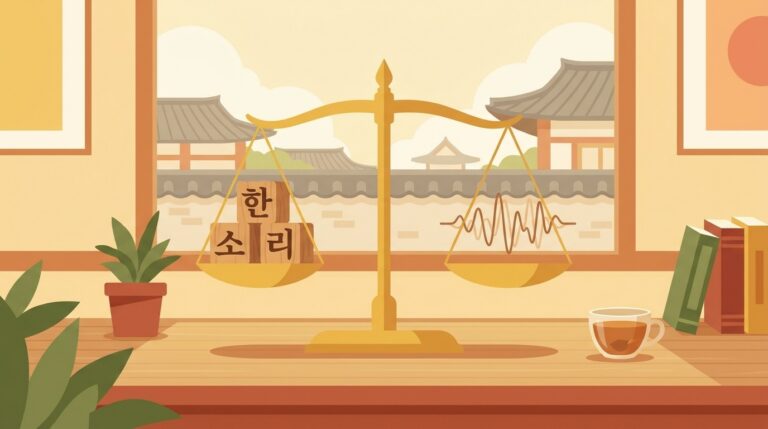
Phase 1: Empathy — The Moment Your C2 Fluency Hits a Spelling Wall
안녕하세요! 매일한글 에디터입니다. (Annyeonghaseyo! Hello, I am the Daily Hangul editor.) Picture yourself in a Seoul publishing house reviewing a K-drama script. The actor says ‘Gachi ga’, yet the page reads 같이 가 (gachi ga / let us go together), not 가치 가. Even for C2 learners, Korean orthography feels like a puzzle. Why preserve silent roots like 닭 (dak / chicken) instead of writing 닥? Based on years of coaching advanced students, this guide unlocks Article 1 of Hangeul Orthography: the golden ratio between sound and meaning that transforms messy spelling into native mastery.
Phase 2: Deep Dive into 3 Core C2 Orthography Expressions
1. 소리대로 적다 (Soridaero jeokda)
- Pronunciation: [Soridaero jeokda] — Sounds like so-ree-dae-ro juk-da, where juk is clipped short like the ju in ‘judge’ before an abrupt stop.
- Meaning: Literally ‘to write following the sound.’ In Korean linguistics, this represents 표음주의 (pyoeumjuui / phonemic writing)—transcribing a word exactly as its standard pronunciation flows off the tongue, especially when its original root has drifted away in meaning (like 넘어지다 [neomeojida / to fall] vs. 너머 [neomeo / beyond]).
- K-Culture Moment: In Korean variety shows like You Quiz on the Block, editors frequently add playful phonetic captions like 마시써 (masisseo) instead of 맛없어/맛있어 (masisseo / delicious) to mimic casual speech, instantly signaling an intimate, unscripted vibe.
- Editor’s Insight: At the C2 level, you know Hangeul is brilliant at recording sound, yet pure phonetic spelling creates chaos for readers. Notice how we write 하늘 (haneul / sky) and 구름 (gureum / cloud) purely by sound, because they cannot be broken down further. Whenever a word loses its transparent root connection—like 며칠 (myeochil / a few days), which is NOT 몇 일—Korean snaps back to 소리대로 적다 (soridaero jeokda).
- Situation Spectrum: Casual ✅ | Semi-formal ✅ | Formal ✅ (Used constantly in academic discourse, editorial meetings, and daily proofreading debates.)
- 🤔 Think About It: English retains historical spellings like ‘knight’ long after the sounds vanished, whereas Korean actively balances sound and logic. Which system slows down reading comprehension more in your native language?
2. 어법에 맞도록 하다 (Eobeobe matdorok hada)
- Pronunciation: [Eobeobe matdorok hada] — Sounds like uh-buh-beh mat-do-rok ha-da, with the first two vowels shaped like the u in ‘uh-oh’ and the t in mat stopping sharply without puffing air.
- Meaning: Literally ‘to make it conform to grammatical law.’ In orthography, this is 형태주의 (hyeongtaejuui / morphophonemic writing)—freezing the visual shape of roots and particles so readers recognize meaning instantaneously, even when pronunciation mutates (e.g., writing 꽃이 [kkochi / flower + subject marker] instead of 꼬치, which means skewer!).
- K-Culture Moment: Think of heated comment sections under K-Pop lyrics or webtoons where fans fiercely debate whether an idol meant 어떡해 (eotteokhae / what do I do) or 어떻게 (eotteoke / how). Confusing them breaks the grammar rule and changes the entire emotional intent of a ballad.
- Editor’s Insight: Imagine reading the English words ‘cats’ and ‘dogs’ spelled as ‘cats’ and ‘dogz’ just to match pronunciation. Your brain would stumble! Korean solves that by locking the stem’s shape. You hear 밤만 (bamman / only night) and 밥만 (bamman / only rice) identically in fast speech, yet preserving 밥 (bap / rice) lets your eyes decode the sentence in milliseconds.
- Situation Spectrum: Casual ⚠️ (Sounds slightly textbook unless joking about grammar) | Semi-formal ✅ | Formal ✅
- 🤔 Think About It: Does your mother tongue prioritize how a word sounds to the ear or how its root family looks to the eye when you scan a dense page?
3. 원형을 밝히어 적다 (Wonhyeong-eul balkieo jeokda)
- Pronunciation: [Wonhyeong-eul balkieo jeokda] — Sounds like wun-hyung-eul bal-kee-uh juk-da; note that 밝히어 merges smoothly into bal-kee-uh, similar to saying ‘ball key uh’ in one breath.
- Meaning: Literally ‘to write while illuminating the original form.’ It is the practical engine behind Article 1: keeping the dictionary base intact when suffixes attach, unless semantic drift has completely severed the tie to the root.
- K-Culture Moment: In courtroom or workplace K-Dramas like Extraordinary Attorney Woo, meticulous lawyers catch forged contracts or careless memos by spotting whether an affix was merged phonetically (like 드러나다 [deureonada / to be revealed], which drops the root 들다 because its meaning drifted) versus kept intact (like 들어나다 [deureonada / to carry out], retaining 들다 [deulda / to lift]).
- Editor’s Insight: This single rule explains the hardest C2 spelling traps: 맞히다 (machida / to guess right) vs. 맞추다 (matchuda / to adjust/match), and 부딪히다 (budichida / to get bumped) vs. 부딪치다 (buditchida / to collide forcefully). When the root’s core meaning is alive, illuminate it; when it turns idiomatic or opaque, let sound take the wheel.
- Situation Spectrum: Casual 🚫 (Too technical for casual chat) | Semi-formal ⚠️ | Formal ✅ (Essential for editors, translators, and TOPIK Level 6 writers)
- 🤔 Think About It: Why do Korean readers associate careful preservation of 원형 (wonhyeong / original form) with intellectual credibility and trustworthiness in business?
Phase 3: Textbook Korean vs. Real Korean
Even C2 speakers who recite Article 1 flawlessly can sound stiff if they talk about spelling errors like a linguist at a coffee shop. Here is how natives actually negotiate orthography in the wild.
Situation 1: Pointing out a friend’s spelling mistake in a KakaoTalk chat
- 📖 교과서 한국어 (Textbook Korean): “이 문장은 한글 맞춤법 제1장 제1항의 어법에 맞도록 적는 원칙에 위배됩니다.” (I munjang-eun Hangeul matchumbeop je1jang je1hang-ui eobeobe matdorok jeongneun wonchige wibaedoemnida. / This sentence violates the morphological principle of Article 1, Chapter 1 of Hangeul Orthography.)
- 🗣️ 진짜 한국어 (Real Korean): “야, 너 지금 소리 나는 대로 막 썼지? 어법 좀 챙겨!” (Ya, neo jigeum sori naneun daero mak sseotji? Eobeop jom chaenggyeo! / Hey, you just typed that straight how it sounds, didn’t you? Keep the grammar tidy!)
- 💡 왜 다를까? (Why the difference?) Korean friends gently tease each other using the phrase 소리 나는 대로 쓰다 (sori naneun daero sseuda / writing purely by ear) to call out sloppy texting—like writing 되요 instead of 돼요 (dwaeyo / it works)—without sounding pretentious or pedantic.
Situation 2: Discussing semantic drift in an editorial or translation meeting
- 📖 교과서 한국어 (Textbook Korean): “본 어휘는 본래의 어근과 의미적 거리가 멀어졌으므로 표음주의를 적용해야 합니다.” (Bon eohwineun bonnaeui eogeungwa uimijeok georiga meoreojyeosseumeuro pyoeumjuuireul jeokyonghaeya hamnida. / Since this lexical item has distanced itself semantically from its original root, phonemic spelling must be applied.)
- 🗣️ 진짜 한국어 (Real Korean): “이건 뜻이 완전히 딴판이라 원형 살리면 오히려 어색해요. 그냥 소리대로 가시죠.” (Igeon tteusi wanjeonhi ttanpanira wonhyeong sallimyeon ohiyeo eosaekhaeyo. Geunyang soridaero gasijyo. / Since the meaning is totally different now, keeping the root looks awkward. Let’s just go with the phonetic spelling.)
- 💡 왜 다를까? (Why the difference?) In Seoul agency offices, professionals replace stiff academic jargon with vivid metaphors like 살리다 (sallida / to keep alive) for preserving morphological roots and 딴판이다 (ttanpanida / completely different ballpark) for semantic divergence.
Phase 4: K-Culture Deep Dive & Non-Verbal Manners
4-1. 눈치 (Nunchi) & Non-Verbal Etiquette Around Language Correction
In Korean culture, correcting someone’s spelling in public is a delicate dance of 눈치 (nunchi / social awareness). Even if a senior colleague writes 왠지 (waenji / somehow) incorrectly as 웬지, directly saying “You violated Article 1” can cause loss of face (체면 [chemyeon]). Instead, savvy professionals soften their posture, tilt their head slightly with a warm smile, and frame corrections as a mutual check: “어, 이거 오타가 난 것 같은데 제가 한 번만 봐 드릴까요?” (Eo, igeo otaga nan geot gateunde jega han beonman bwa deurilkkayo? / Oh, it looks like there might be a small typo here—would you like me to give it a quick look?). Note the softened gesture: lightly tapping the edge of the screen or paper rather than pointing straight at the mistake.
4-2. Cultural Code Analysis: The Rise of ‘맞춤법 빌런’ (Matchumbeop Billeon / Orthography Villains) in K-Drama & Dating Culture
If you follow Korean dating shows like Transit Love (환승연애) or read modern web novels, you will spot a uniquely Korean cultural obsession: 맞춤법 (matchumbeop / spelling) as a barometer of attractiveness and intellect. Surveys in Korea regularly rank basic orthography blunders—such as writing 낳다 (nata / to give birth) instead of 낫다 (natda / to get better)—as top dating ‘icks’ (정떨어지는 순간 [jeongtteoreojineun sungan]). Why? Because Hangeul is celebrated nationwide as a scientific, logical script created by King Sejong. When someone ignores the balance of sound and meaning in Article 1, Koreans often subconsciously read it as a lack of care or reading habit—whereas using precise, nuanced spelling earns instant respect, even earning fluent foreigners stunned praise like “한국인보다 맞춤법이 더 정확하시네요!” (Hanguginboda matchumbeobi deo jeonghwakhasineyo! / Your spelling is more accurate than a native Korean’s!).
Phase 5: Interactive Roleplay Scenario
Setting: Inside a sleek, sunlit publishing house in Hapjeong, Seoul. Iced Americanos clink on the oak table as you and Team Lead Min-jun (민준 팀장님)—a razor-sharp yet supportive senior editor with round glasses—review the final galley proof of a bestselling essay collection before it goes to print.
Dialogue
- Min-jun: 🎭 Adjusting his glasses and pointing to line 14 with a fountain pen “이번 에세이 교정 보느라 고생 많았어요. 그런데 여기 ‘목걸이’는 어법에 맞게 잘 썼는데, 밑에 ‘귀걸이’랑 ‘코고리’는 왜 다를까요?” (Ibeon esei gyojeong boneura gosaeng manasseoyo. Geureonde yeogi ‘mokgeori’neun eobeobe matge jal sseonneunde, mite ‘gwigeori’rang ‘kogori’neun wae dareulkkayo? / Great job proofreading this essay. Now, ‘necklace’ here is spelled morphologically, so why do ‘earring’ and ‘nose ring’ below look different?)
- You: 🎭 Leaning in eagerly with a highlighter in hand “아, 그건 제1항의 두 원칙이 교차하는 지점이에요! ‘목걸이’는 ‘걸다’의 원형이 살아 있지만, ‘코고리’는 소리에 더 무게를 뒀잖아요.” (A, geugeon je1hang-ui du wonchigi gyochahaneun jijeomieyo! ‘Mokgeori’neun ‘geolda’ui wonhyeong-i sara itjiman, ‘kogori’neun sorie deo mugereul dwojjanhayo. / Ah, that is where the two principles of Article 1 intersect! ‘Mokgeori’ keeps the root ‘to hang’ alive, whereas ‘kogori’ puts the weight on sound.)
- Min-jun: 🎭 Nodding with an impressed grin “오, 정확해요! 그럼 이 작가분이 자주 헷갈리시는 ‘일체’하고 ‘일절’은 어떻게 정리했어요?” (O, jeonghwakhaeyo! Geureom i jakgabuni jaju hetgallisineun ‘ilche’hago ‘iljeol’eun eotteoke jeongnihaesseoyo? / Oh, spot on! Then how did you sort out ‘ilche’ and ‘iljeol’, which this author always mixes up?)
- You: 🎭 Flipping cleanly to page 42 “긍정문에서 ‘모두’라는 뜻일 땐 ‘일체(ilche)’로 살리고, 부정문에서 ‘전혀’라는 뜻일 땐 ‘일절(iljeol)’로 구분해 뒀습니다.” (Geungjeongmuneseo ‘modu’raneun tteusil ttaen ‘ilche’ro salligo, bujeongmuneseo ‘jeonhyeo’raneun tteusil ttaen ‘iljeol’lo gubunhae dwotseumnida. / In affirmative sentences meaning ‘all’, I kept ‘ilche’, and in negative sentences meaning ‘not at all’, I distinguished it as ‘iljeol’.)
- Min-jun: 🎭 Raising an eyebrow playfully as he spots one tricky sentence “완벽하네요. 어, 잠깐만요. 58페이지에 ‘바닷가 바람이 머리를 헤집고 드러난다’라고 되어 있는데, 이거 이대로 인쇄 넘겨도 될까요?” (Wanbyeokhaneyo. Eo, jamkkanmanyo. 58peijie ‘badatga barami meorireul hejipgo deureonanda’rago doeeo inneunde, igeo idaero inswae neomgyeodo doelkkayo? / Perfect. Oh, wait a second. On page 58 it says ‘the sea breeze ruffles the hair and is revealed/appears’—can we send this to print as is?)
- You: 🎭 Freezing mid-sip, scanning the verb ‘드러난다’ closely “잠시만요… 여기서 바람이 감정을 ‘드러낸다’는 건가요, 아니면 모래 속에 숨은 무언가가 ‘드러난다’는 건가요? 문맥상 비밀이 밝혀지는 거면 ‘드러나다(deureonada)’가 맞아요!” (Jamsimanyo… yeogiseo barami gamjeong-eul ‘deureonaenda’neun geongayo, animyeon morae soge sumeun mueongaga ‘deureonanda’neun geongayo? Munmaeksang bimiri balkyeojineun geomyeon ‘deureonada’ga majayo! / Hold on… does it mean the wind reveals emotions, or something hidden in the sand comes to light? Contextually, if a secret is revealed, ‘deureonada’ spelled phonetically is right!)
- Min-jun: 🎭 Laughing warmly and capping his pen “역시 C2 실력은 다르네요. ‘들다’의 본뜻에서 멀어졌으니까 원형을 밝히지 않고 소리대로 적는 거죠!” (Yeoksi C2 sillyeogeun dareuneyo. ‘Deulda’ui bontteuseseo meoreojyeosseunikka wonhyeong-eul balkiji anko soridaero jeongneun geojyo! / As expected, C2 skill is on another level. Because it drifted from the original meaning of ‘to enter/lift’, we write it phonetically without keeping the root!)
- You: 🎭 Smiling with relief, circling the final approval stamp “그럼 최종 교정본, 지금 바로 인쇄소로 넘기겠습니다!” (Geureom choejong gyojeongbon, jigeum baro inswaesoro neomgigesseumnida! / Then I will send the final proof to the printing house right away!)
🔀 Interactive Branching Point: What Happens When the Author Calls to Complain?
Suddenly, the author calls, insisting they want to keep the poetic typo “너머로 갔다” written as “넘어로 갔다” to emphasize the act of crossing over. How do you respond?
- Option A: “작가님, ‘넘다’의 뜻이 살아 있어서 ‘넘어’로 쓰신 의도는 충분히 공감합니다. 다만 표준 규범상 명사 ‘너머’는 어원을 떠나 소리대로 적기로 약속되어 있어, 독자의 가독성을 위해 교정을 권해 드립니다.” (Jakganim, ‘neomda’ui tteusi sara isseoseo ‘neomeo’ro sseusin uidoneun chungbunhi gonggamhamnida. Daman pyojun gyubeomsang myeongsa ‘neomeo’neun eowoneul tteona soridaero jeokgiro yaksokdoeeo isseo, dokjaui gadokseong-eul wihae gyojeong-eul gwonhae deurimnida.)
- Feedback (Best ✅): Masterful! You validate the author’s artistic intuition about the root verb 넘다 (neomda / to cross), then calmly invoke Article 1’s phonetic rule for the noun 너머 (neomeo / beyond) using reader readability as your diplomatic shield.
- Option B: “안 됩니다. 한글 맞춤법 제1항 위반이라 출판사 규정상 무조건 고쳐야 합니다.” (An doemnida. Hangeul matchumbeop je1hang wibanira chulpansa gyujeongsang mujogeon gochyeoya hamnida.)
- Feedback (Bad ❌): Linguistically accurate, socially disastrous! Being blunt without Nunchi triggers defensive pushback from writers and misses the collaborative tone of Korean publishing.
- Option C: “네, 작가님 작품이니까 시적 허용으로 보고 그냥 ‘넘어’로 가시죠!” (Ne, jakganim jakpuminikka sijeok heoyong-euro bogo geunyang ‘neomeo’ro gasijyo!)
- Feedback (Risk ⚠️): While poetic license (시적 허용 [sijeok heoyong]) exists in verse, leaving a glaring orthographic error in a prose essay risks damaging both the author’s credibility and the publisher’s reputation.
Phase 6: 10-Second Emotion Shadowing Drill
Read each line aloud within 10 seconds, hitting the / marks for crisp rhythm and matching the emotional cue!
- [🧐 Analytical & Curious]
“소리대로 적는 것도 / 중요하지만, / 어법에 맞도록 하는 게 / 핵심이죠!”
(Soridaero jeongneun geotdo / jungyohajiman, / eobeobe matdorok haneun ge / haeksimijyo! — Writing by sound matters too, / yet matching grammar / is the true core!) -
[😮 Realization & Aha Moment]
“아! / 그래서 ‘같이가’ 아니라 / ‘같이’라고 / 쓰는 거구나!”
(A! / Geuraeseo ‘gachiga’ anira / ‘gachi’rago / sseuneun geoguna! — Oh! / That is why / instead of ‘gachi’ phonetically, / we write ‘같이’!) -
[😎 Confident & Witty Pro]
“이 단어는 / 원형이 살아 있으니까 / 무조건 / 살려야 해요.”
(I daneoneun / wonhyeong-i sara isseunikka / mujogeon / sallyeoya haeyo. — Since this word’s / root is still alive, / we absolutely / have to preserve it.)
Phase 7: K-Culture Mini Dictionary (4 Key Terms)
- 표음주의 (Pyoeumjuui) | Phonemic Principle | Writing words faithfully to their spoken pronunciation. Used daily in linguistic debates and when explaining why foreign loanwords (외래어 [oeraeeo]) like 커피 (keopi / coffee) are transcribed purely by sound.
- 형태주의 (Hyeongtaejuui) | Morphophonemic Principle | Keeping root morphemes visually fixed regardless of sound shifts. Essential in business editing and legal drafting so terms like 법인 (beobin / corporation) never blur into phonetic ambiguity.
- 의미 분화 (Uimi bunhwa) | Semantic Divergence | The historical moment a derived word drifts away from its parent root’s meaning—like 노름 (noreum / gambling) splitting from 놀음 (noreum / playing). Understanding this unlocks why Article 1 switches from root-keeping to phonetic spelling.
- 교정·교열 (Gyojeong·Gyoyeol) | Proofreading & Copy-editing | The twin pillars of Korean publishing, media, and corporate PR. 교정 fixes typos against standard orthography, while 교열 ensures factual and grammatical logic across the text.
Phase 8: Survival Kit for Travelers & Seoul Explorers
Even if you are ordering street food or navigating subway signs, Article 1 pops up everywhere in Korea—especially in menus and warning signs!
Survival Expressions TOP 3
- “여기 ‘육개장’ 발음이 어떻게 돼요?” (Yeogi ‘yukgaejang’ bareumi eotteoke dwaeyo?)
- Pro Tip: Shows off high-level curiosity! Many visitors misspell or misread this spicy beef soup as 육계장 (thinking of 닭 계 / chicken), so asking about the standard form sparks great chats with restaurant owners.
- “이 간판은 소리 나는 대로 쓴 거예요?” (I ganpaneun sori naneun daero sseun geoyeyo?)
- Pro Tip: Traditional markets in Seoul are full of charming phonetic signs like 순대꾹 (sundaekkuk) instead of 순대국/순댓국 (sundaetguk / blood sausage soup). Asking this playfully delights local merchants.
- “띄어쓰기랑 맞춤법 한 번만 봐주실 수 있어요?” (Ttuieosseugirang matchumbeop han beonman bwajusil su isseoyo?)
- Pro Tip: Lifesaver when filling out a bank form, lease agreement, or university application in Korea.
Editor’s Travel Note
Before hitting the streets of Seoul or tackling an advanced Korean writing project, bookmark the official National Institute of Korean Language Standard Dictionary to verify whether a tricky compound word preserves its root or follows sound. For real-time navigation and spotting authentic shop signage on the go, Download the Naver Map App and pair it with a T-money transit card from any convenience store so your Seoul commute stays effortless.
Phase 9: One Step Deeper — Why Hangeul Refuses to Choose Just One Principle
At first glance, Article 1’s dual rule looks like a compromise, yet it actually mirrors Korean society’s deep respect for both harmony and clarity. If Hangeul relied solely on phonemic spelling, every conjugated verb would mutate wildly across sentences, forcing readers to decipher sound puzzles instead of absorbing ideas. Conversely, if it clung rigidly to ancient roots, modern speakers would struggle to connect living speech with fossils on the page. Just as Korea balances rapid technological innovation with centuries-old relational etiquette, Article 1 lets sound breathe while anchoring meaning in shared roots.
💬 Your Turn: Which Korean spelling rule still catches you off guard—even at an advanced level—and how does your native language handle the tug-of-war between sound and spelling? Share your thoughts in the comments below!
Phase 10: FAQ & Common Mistakes (FAQ Schema)
Q: Why does Article 1 say ‘standard language’ (표준어 [pyojuneo]) specifically instead of all Korean speech?
A: Regional dialects (방언 [bangeon]) vary significantly in vowel length, pitch, and consonant assimilation. To create a unified national literacy standard, Article 1 anchors spelling to educated contemporary Seoul speech (표준어 [pyojuneo]) before balancing sound and morphology.
Q: How can I quickly tell whether a compound word uses 표음주의 (phonemic) or 형태주의 (morphological) spelling?
A: Ask one simple C2 question: “Is the original root’s literal meaning still clearly felt in this word?” For example, 넘어지다 (neomeojida / to fall down) still feels tied to 넘다 (neomda / to topple over), so it keeps 넘; meanwhile, 넘어 -> 너머 (neomeo / the other side, beyond) became an independent noun of location, so it switches to 소리대로 적다 (phonetic spelling).
Q: Are words like 며칠 (myeochil / a few days) exceptions to Article 1?
A: Not an arbitrary exception—it is actually Article 1’s phonetic rule in action! Even though people assume 며칠 comes from 몇 (myeot / how many) + 일 (il / day), its pronunciation [며칠] lacks the expected [멷닐 -> 면닐] nasalization that 몇 + 일 would produce, proving its root boundary dissolved long ago.
🚨 Common Mistakes TOP 3 & Correct Actions
- Mistake: Writing 금세 (geumse / in no time) as 금새 because of confusion with 새 (interval).
- Correct Action: Remember it contracts 금시(今時) + 에, preserving the vowel ㅔ -> 금세 (geumse).
- Mistake: Confusing 어떻게 (eotteoke / how) with 어떡해 (eotteokhae / what should I do).
- Correct Action: Test if the word modifies a verb (adverb -> 어떻게) or finishes a clause as an action verb contracting 어떻게 해 (어떡해).
- Mistake: Preserving the root in 부치다 (buchida) vs. 붙이다 (buchida) blindly.
- Correct Action: Use 붙이다 whenever physical sticking or attaching is involved (우표를 붙이다 / sticking a stamp), and 부치다 when meaning drifts to mailing, flipping pancakes, or submitting bills (편지를 부치다 / sending a letter).
Phase 11: Action Mission & Engagement
- 🥉 Bronze Mission (Solo Practice): Write five minimal pairs showcasing Article 1’s split—such as 반드시 (bandeusi / certainly) vs. 반듯이 (bandeusi / straight)—and read them aloud while noting why one keeps its root and one follows sound.
- 🥈 Silver Mission (Community Share): Spot one hilarious phonetic typo in a K-Pop variety clip, Instagram meme, or Seoul street photo, and post a breakdown explaining how Article 1 applies.
- 🥇 Gold Mission (Real-World Use): Next time you chat with a Korean friend or tutor, smoothly drop the phrase “이건 원형이 살아 있어서 어법에 맞게 적어야 해요” (Igeon wonhyeong-i sara isseoseo eobeobe matge jeogeoya haeyo / Since the root is alive here, we should spell it morphologically) and watch their jaw drop.
- 🎮 K-Culture Mission: Watch 10 minutes of a Korean news broadcast alongside a fast-paced YouTube vlog. Tally how many times the vlog’s editor intentionally breaks 형태주의 (morphological spelling) for comedic 소리대로 (phonetic) captions!
Phase 12: Interactive Quiz Challenge
Test your C2 orthography instincts! Try answering all three before clicking the spoiler toggle.
Question 1 (Situational Judgment): You are proofreading an office email that says: “이번 회의에서는 안건을 붙이지 않기로 했습니다.” (We decided not to put the agenda item on the table at this meeting.) Is 붙이지 correct here?
* A) Yes, because you attach an agenda item to the meeting.
* B) No, it should be 부치지, because the meaning is abstractly submitting or bringing up a topic for discussion, severed from physical sticking.
Question 2 (Fill in the Blank): Fill in the right word for ‘cleanly / neatly’ derived from 깨끗하다: “방 청소를 ( _____ ) 해 놓았다.” (깨끗이 vs. 깨끗히)
Question 3 (True / False Cultural Quiz): True or False — Article 1 strictly forbids writing any Korean word phonetically if an ancient Chinese or pure Korean root exists somewhere in history.
🔍 Click to Reveal Answers & C2 Explanations
- Question 1 Answer: B — 부치지 (buchiji). If you chose A, watch out for semantic drift! Physical sticking takes 붙이다, whereas submitting an agenda item (안건을 부치다) has drifted far enough that Article 1 writes it phonetically as 부치다.
- Question 2 Answer: 깨끗이 (kkaekkeusi). Adverbs ending in -하다 stems generally attach -이 after ㅅ (like 깨끗하다 -> 깨끗이, 반듯하다 -> 반듯이), preserving the stem clean and readable.
- Question 3 Answer: False! When an ancient root’s meaning has completely drifted away from modern intuition—like 걸음 (georeum / step) vs. 거름 (georeum / fertilizer)—Article 1 deliberately switches to 소리대로 적다 (phonetic spelling) so modern readers are not misled by dead etymology.
🎬 Watch Our Daily Videos! (Daily Hangul Official Instagram)
Review the expressions you learned in this article with our fun daily short videos! Check out native pronunciation and real-life nuances in action.
- Instagram @dailyhangul_en







