

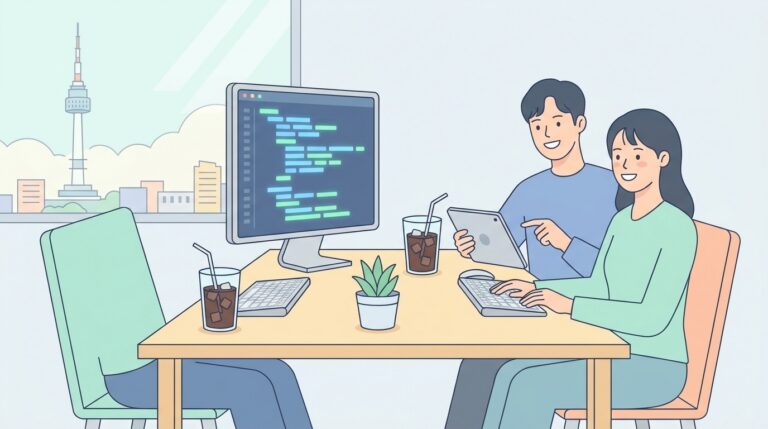
Phase 1: Why Korean Code Reviews Feel Different
안녕하세요! 매일한글 에디터입니다. (Annyeonghaseyo! Hello, I’m your Daily Hangul editor!) Imagine sitting in a bustling Pangyo office, Iced Americano in hand, staring at a tangled legacy payment module straight out of the K-drama Start-Up. After days of refactoring, build times fly and incidents drop by 90%! Thrilled, you open your team PR—only to freeze. How do you celebrate a huge tech debt win in Korean without sounding stiff or arrogant? Based on real feedback from foreign engineers in Seoul, this B2 guide gives you natural phrases and nunchi tips to shine in your next Korean code review!
Phase 2: 3 Essential Expressions Deep Dive
1. 꼬여 있던 코드를 깔끔하게 정리하다 (kkoyeo itdeon kodeureul kkalkkeumhage jeongnihada)
- Pronunciation: [kkoyeo itdeon kodeureul kkalkkeumhage jeongnihada] (Sound tip: Tense your throat slightly before the double “kk” like holding back a sneeze, and let “kkalkkeum” snap crisply like breaking a fresh wafer!)
- Meaning: Literal: “To neatly organize code that had been twisted.” | Real Nuance: “To untangle messy spaghetti code and make it clean and readable.”
- K-Culture Moment: Picture Nam Do-san in the K-drama Start-Up pulling an all-nighter with triangle kimbap before demo day, triumphantly cleaning up a chaotic algorithm right before launch.
- Editor’s Insight: Koreans use the verb 꼬이다 (kkoida, to get twisted/tangled) for everything from knotted earphones and bad luck to messy legacy architecture. Pairing it with 깔끔하게 (kkalkkeumhage, cleanly/crisply) creates an instant sense of visual satisfaction!
- Situation Spectrum: Casual ✅ (정리했어) / Semi-formal ✅ (정리했어요) / Formal ⚠️ (Swap for 구조를 개선했습니다 (gujoreul gaeseonhaetseumnida) in executive reports)
- 🤔 Think About It: Notice how Korean turns abstract software problems into physical threads that get “knotted” (꼬이다) and “untied” (풀다). What physical metaphors does your native language use when debugging?
2. 리팩토링하고 나니까 속도가 확 빨라졌어요 (ripaektoringhago nanikka sokdoga hwak ppallajyeosseoyo)
- Pronunciation: [ripaektoringhago nanikka sokdoga hwak ppallajyeosseoyo] (Sound tip: Burst out “hwak” quickly like a sudden gust of wind opening a door!)
- Meaning: Literal: “After finishing refactoring, the speed suddenly became fast.” | Real Nuance: “Once I refactored it, the build speed shot right up!”
- K-Culture Moment: Think of a Korean mukbang creator taking their first bite of spicy tteokbokki after waiting an hour—that immediate “whoa, worth it!” rush is captured by 확 (hwak).
- Editor’s Insight: At the B2 level, using ~고 나니까 (-go nanikka) instead of simple “after” (후에) highlights the emotional relief of comparing the painful “before” and the glorious “after.”
- Situation Spectrum: Casual ✅ (빨라졌어) / Semi-formal ✅ (빨라졌어요) / Formal ⚠️ (Replace 확 with 크게 (keuge, significantly) in formal slides)
- 🤔 Think About It: Why do Korean speakers sprinkle vivid sound-and-motion adverbs like 확 even into technical engineering updates? How does that change team rapport compared to dry English metrics?
3. 장애 발생률이 90%나 줄어들었어요 (jangae balsaengnyuri gusip-peuro-na jureodeureosseoyo)
- Pronunciation: [jangae balsaengnyuri gusip-peuro-na jureodeureosseoyo] (Sound tip: Notice 발생률 flows smoothly as “bal-ssaeng-nyul”—let your tongue glide into a soft humming “nyul” sound.)
- Meaning: Literal: “The failure occurrence rate decreased by 90%.” | Real Nuance: “Production incidents dropped by a whopping 90%!”
- K-Culture Moment: Imagine the dramatic variety-show sound effects and giant colorful captions on Infinite Challenge flashing “90%?!” across the screen when a contestant pulls off the impossible.
- Editor’s Insight: The secret weapon here is the tiny particle ~나 (-na) attached to 90%. It subtly tells your listeners, “Look how huge this impact is!” without you having to brag overtly.
- Situation Spectrum: Casual ✅ (줄어들었어) / Semi-formal ✅ (줄어들었어요) / Formal ✅ (줄어들었습니다)
- 🤔 Think About It: English needs extra adjectives like “a whopping” or “an impressive” to emphasize numbers, while Korean packs that emotion into a single syllable (~나). Which feels more modest yet impactful?
Phase 3: Textbook Korean vs. Real Korean
Situation 1: Suggesting a Refactor in a Teammate’s PR
- 📖 Textbook Korean: 이 코드는 수정이 필요합니다. (I kodeuneun sujeongi piryohamnida. – This code needs modification.)
- 🗣️ Real Korean: 이 부분 살짝만 다듬으면 더 깔끔할 것 같아요! (I bubun saljjangman dadeumeumyeon deo kkalkkeumhal geot gatayo! – If we polish this part just a tiny bit, I think it’ll be super clean!)
- 💡 Why is it different? Direct imperatives can feel blunt in Korean office culture. Softeners like 살짝만 (just a tiny bit) and ~것 같아요 (I think) protect team harmony (jeong, 정) while keeping code quality high.
Situation 2: Sharing Your Payment Module Speed Boost on Slack
- 📖 Textbook Korean: 빌드 성능이 매우 향상되었습니다. (Bildeu seongneungi maeu hyangsangdoeeotseumnida. – Build performance has greatly improved.)
- 🗣️ Real Korean: 빌드 체감 속도가 진짜 말도 안 되게 빨라졌어요! (Bildeu chegam sokdoga jinjja maldo an doege ppallajyeosseoyo! – The felt build speed got unbelievably fast!)
- 💡 Why is it different? Using 체감 속도 (perceived speed) and 말도 안 되게 (unbelievably) invites your teammates to share in your excitement rather than reading a robotic status report.
Phase 4: K-Culture Deep Dive & Non-Verbal Manners
4-1. Nunchi (눈치) & Body Language in Tech Reviews
When presenting a massive 90% incident drop in a Korean engineering team, nunchi (social awareness) is everything. Avoid pointing directly at messy legacy code on a teammate’s monitor with one finger—use an open palm to gesture toward the screen instead. When teammates praise your refactoring, give a slight nod, smile warmly, and share credit by saying 팀원분들이 도와주신 덕분에 (timwonbundeuri dowajusin deokbune – thanks to everyone’s help). Never throw the previous author under the bus; frame old code as “past constraints” rather than “someone’s mistake.”
4-2. Cultural Code Analysis: Pangyo’s Coffee & Chi-Maek Culture
In Korea’s Silicon Valley—Pangyo Techno Valley—and in tech K-dramas like Start-Up (스타트업), fierce debates over technical debt during afternoon PR reviews rarely stay tense for long. Why? Because Korean devs bridge technical friction with 아아 (a-a, Iced Americano) breaks and post-sprint 치맥 (chimaek, fried chicken and beer). Buying a round of coffee after merging a massive payment-module refactor is the ultimate unwritten cultural gesture of goodwill!
Phase 5: Real-Life Roleplay Scenario
Setting: A sunlit coffee bar inside a Pangyo tech office at 3:00 PM. The espresso machine hums softly as Min-jun (민준), your friendly Senior Tech Lead wearing a zip-up hoodie and holding an Iced Americano, walks over to congratulate you on merging the payment module PR.
- 민준 (Min-jun): 어, 저기요! 아까 올리신 결제 모듈 PR 봤어요. 진짜 고생 많으셨어요! (Eo, jeogiyo! Akka ollisin gyeolje modyul PR bwasseoyo. Jinjja gosaeng maneusyeosseoyo!) 🎭 leans against the counter with an impressed smile
- “Hey! I saw the payment module PR you put up earlier. You really worked hard on that!”
- 나 (You): 아니에요, 리뷰 꼼꼼하게 봐주셔서 감사해요! (Anieyo, ribyu kkomkkomhage bwajusyeoseo gamsahaeyo!) 🎭 waves both hands modestly
- “Not at all, thank you for reviewing it so thoroughly!”
- 민준 (Min-jun): 처음에 코드가 너무 복잡하게 얽혀 있어서 걱정이 많았거든요. (Cheoeume kodeuga neomu bokjapage eolkyeo isseoseo geokjeongi manatgeodeunyo.) 🎭 takes a sip of his Iced Americano
- “At first, I was really worried because the code was so tangled together.”
- 나 (You): 맞아요. 꼬여 있던 코드를 깔끔하게 정리하다 보니까 생각보다 시간이 좀 걸렸어요. (Majayo. Kkoyeo itdeon kodeureul kkalkkeumhage jeongnihada bonikka saenggakboda sigani jom geollyeosseoyo.) 🎭 nods empathetically
- “Right. As I was cleanly untangling the knotted code, it took a bit longer than expected.”
- 민준 (Min-jun): 그래도 보람 있네요. 아까 대시보드 보니까 빌드 속도도 빨라졌던데요? (Geuraedo boram inneyo. Akka daesibodeu bonikka bildeu sokdodo ppallajyeotdeondeyo?) 🎭 raises his eyebrows excitedly
- “Still, it paid off! Looking at the dashboard earlier, didn’t the build speed get faster too?”
- 나 (You): 네! 리팩토링하고 나니까 속도가 확 빨라졌어요. (Ne! Ripaektoringhago nanikka sokdoga hwak ppallajyeosseoyo.) 🎭 beams proudly
- “Yes! After refactoring, the speed shot right up.”
- 민준 (Min-jun): 대박! 혹시 프로덕션 장애 수치도 좀 내려갔나요? (Daebak! Hoksi peurodeoksyeon jangae suchido jom naeryeogannayo?) 🎭 leans in curiously
- “Awesome! By any chance, did the production incident numbers go down too?”
- 나 (You): 이번 주에 장애 발생률이 90%나 줄어들었어요! (Ibeon jue jangae balsaengnyuri gusip-peuro-na jureodeureosseoyo!) 🎭 holds up both hands happily
- “This week, production incidents dropped by a whopping 90%!”
🔀 Interactive Branching Point
Min-jun grins and asks: “솔직히 옛날 코드 보면서 좀 답답하지 않았어요? (Honestly, wasn’t it frustrating looking at the old code?)” How do you reply?
* Option A: “조금 복잡하긴 했는데, 덕분에 결제 흐름을 완벽히 이해하게 됐어요!” (Jogeum bokjapagin haenneunde, deokbune gyeolje heureumeul wanbyeoki ihaehage dwaesseoyo! – It was a bit complex, but thanks to that, I got to understand the payment flow completely!)
* Option B: “솔직히 누가 짰는지 몰라도 진짜 엉망이었어요.” (Soljiki nuga jjanneunji mollado jinjja eongmangieosseoyo. – Honestly, I don’t know who wrote it, but it was a total mess.)
* Option C: “네, 비효율적인 아키텍처가 매우 불만족스러웠습니다.” (Ne, bihyoyuljeogin akitekcheoga maeu bulmanjokseureowotseumnida. – Yes, the inefficient architecture was highly unsatisfactory.)
Feedback:
* Option A (Best!): Gold-standard B2 Korean! Using ~긴 했는데 (even though it was…) and 덕분에 (thanks to that) turns frustration into growth and protects anyone in the room who might have written that legacy code.
* Option B (Bad!): Ouch! Calling past work 엉망 (a total mess) kills team nunchi—Min-jun himself might have approved that code two years ago!
* Option C (Risk!): Way too stiff and cold for a casual coffee chat. You sound like an angry compliance report rather than a collaborative teammate.
Phase 6: 10-Second Emotion Shadowing Drill
Read these out loud, pausing briefly at every / to nail natural Korean rhythm:
[😌 Relieved & Proud]꼬여 있던 코드를 / 깔끔하게 정리하고 나니까 / 속이 다 시원해요! (Kkoyeo itdeon kodeureul / kkalkkeumhage jeongnihago nanikka / sogi da siwonhaeyo! – After neatly untangling the knotted code, I feel so refreshed!)[🥳 Excited in Stand-up]리팩토링하고 나니까 / 빌드 속도가 / 확 빨라졌어요! (Ripaektoringhago nanikka / bildeu sokdoga / hwak ppallajyeosseoyo! – After refactoring, the build speed shot right up!)[🤩 Amazed by Metrics]장애 발생률이 / 무려 90%나 / 줄어들었어요! (Jangae balsaengnyuri / muryeo gusip-peuro-na / jureodeureosseoyo! – Production incidents dropped by a whopping 90%!)
Phase 7: K-Culture Mini Dictionary
- 기술 부채 (gisul buchae) | Tech Debt | Used daily in sprint planning when debating whether to ship a quick feature or pause to clean up 기술 부채.
- 스파게티 코드 (seupageti kodeu) | Spaghetti Code | Universally understood Konglish in Korean dev teams for tangled, hard-to-trace logic.
- 장애 (jangae) | Service Outage / Production Incident | Far more urgent than a simple 버그 (beogeu, bug)—when 장애 hits Slack, everyone grabs their laptop immediately.
- 아아 (a-a) | Iced Americano | Korea’s unofficial national developer fuel, consumed even in freezing January snowstorms!
Phase 8: Survival Kit for Visiting Developers
Working remotely from a trendy Seoul cafe or visiting a Pangyo office? Keep these 3 phrases handy:
- 여기 와이파이 비밀번호가 어떻게 되나요? (Yeogi waipai bimilbeonhoga eotteoke doenayo? – What’s the Wi-Fi password here?) Pro Tip: Check the bottom of your paper receipt first—it’s often printed right there!
- 혹시 콘센트 있는 자리 있나요? (Hoksi konsenteu inneun jari innayo? – Do you happen to have a seat with a power outlet?) Pro Tip: Adding 혹시 (by any chance) makes any request instantly polite.
- 아이스 아메리카노 한 잔 주세요. (Aiseu amerikano han jan juseyo. – One Iced Americano, please.) Pro Tip: At kiosks, look for the 포장 (pojang, takeout) vs 매장 (maejang, dine-in) buttons.
Editor’s Travel Note: Before heading to Pangyo or Gangnam, grab the Naver Map App for Accurate Korea Transit since Google Maps walking routes don’t work well locally, and check the Kakao T Taxi App Setup Guide for cashless late-night rides after team dinners. Most cafes and buses accept contactless cards, Apple Pay (at major chains), or a rechargeable T-money card.
Phase 9: One Step Deeper — The Spirit of “Uri” (우리) in Code
In Korean society, the word 우리 (uri, we/our) carries tremendous weight—people say “our company” and even “our mom” instead of “my.” That same communal philosophy shapes Korean engineering teams: legacy bugs aren’t treated as “your messy code,” but as 우리가 함께 풀어야 할 숙제 (a puzzle we solve together). When you combine technical excellence with genuine humility (겸손, gyeomson), your 90% incident reduction doesn’t just make the system faster—it makes the whole team trust and cheer for you.
💬 Your Turn: How do developers in your country celebrate cleaning up massive tech debt? Drop a comment below and tell us your favorite refactoring victory story!
Phase 10: FAQ & Common Mistakes
Q: Can I use English tech terms like “PR,” “build,” and “refactoring” directly in Korean sentences?
A: Yes! Korean tech teams heavily use English/Konglish terms like 리팩토링 (ripaektoring), 빌드 (bildeu), 코드 리뷰 (kodeu ribyu), and 머지하다 (meojihada, to merge). Just pair them with Korean verbs like 하다 (to do) or 되다 (to become).
Q: Is it rude to use “~요 (-yo)” endings instead of “~습니다 (-seumnida)” in Slack?
A: Not at all! In modern Korean startups and tech companies, friendly 해요체 (-yo style) is the standard in Slack and PR comments, while 합니다체 (-seumnida) is mostly saved for formal release notes or company-wide announcements.
Q: What is the difference between “정리하다” and “수정하다” when talking about code?
A: 수정하다 (sujeonghada) means “to fix or edit” a specific bug, whereas 정리하다 (jeongnihada) implies organizing, decluttering, and improving the overall structure—perfect for refactoring!
🚨 Common Mistakes TOP 3
- Mistake: Saying “당신의 코드가 복잡해요” (Your code is complex). -> Correct Action: Never use “you” (당신)! Say “이 부분이 조금 복잡하네요” (This part is a bit complex) to critique the code, not the person.
- Mistake: Saying “에러가 90% 빠졌어요” (Errors fell out by 90%). -> Correct Action: Use 줄어들다 (jureodeulda, to decrease) for percentages and rates, not 빠지다.
- Mistake: Dropping honorifics completely in English-style “flat culture” offices without checking first. -> Correct Action: Even in companies using English nicknames, keep -요 (-yo) endings until teammates explicitly agree to speak casually (반말, banmal).
Phase 11: Action Mission & Engagement
- 🥉 Bronze (Solo Practice): Record yourself reading the 3 sentences in Phase 6 using your phone’s voice memo and compare your rhythm on 확 빨라졌어요!
- 🥈 Silver (Community Share): Share one Korean tech phrase you learned today on LinkedIn or X and tag
#DailyHangul#KoreanForDevs. - 🥇 Gold (Real-World Use): Next time you leave a PR comment or Slack update with a Korean colleague, slip in 깔끔해졌어요! (It got so clean!) or 고생하셨어요! (Great work!).
🎮 K-Culture Mission: Watch an episode of Start-Up (스타트업) or a Korean developer vlog on YouTube and try to catch 깔끔하다 (clean) or 꼬이다 (tangled) in the wild!
Phase 12: Interactive Quiz Challenge
1. Situation Judgment: Your coworker just cleaned up a chaotic authentication module. What is the warmest, most natural PR comment?
A) 수정이 필요합니다. (Modifications are needed.)
B) 코드가 진짜 깔끔해졌네요! 고생 많으셨습니다. (The code got really clean! Great job.)
C) 이 코드 누가 짰는지 엉망이었죠? (Whoever wrote this code made a mess, right?)
2. Fill in the Blank: Complete the sentence meaning “Production incidents dropped by a whopping 90%!”
장애 발생률이 90%(___) 줄어들었어요!
3. True or False (Culture): In Korean dev teams, saying “너의 코드 (your code)” during a critical PR review is seen as direct, helpful, and totally normal.
Click to reveal answers & explanations!
- 1. Answer: B — Complimenting cleanliness with 깔끔해지다 and thanking their effort (고생 많으셨습니다) builds instant camaraderie. (A is too cold; C violates team nunchi.)
- 2. Answer: 나 (na) — Attaching ~나 after “90%” emphasizes how impressively big that drop is!
- 3. Answer: False! — Korean code reviews focus on the code itself (이 부분, this part) rather than pointing at the author (너/당신) to preserve team harmony.
🎬 Watch Our Daily Videos! (Daily Hangul Official Instagram)
Review the expressions you learned in this article with our fun daily short videos! Check out native pronunciation and real-life nuances in action.
- Instagram @dailyhangul_en







