

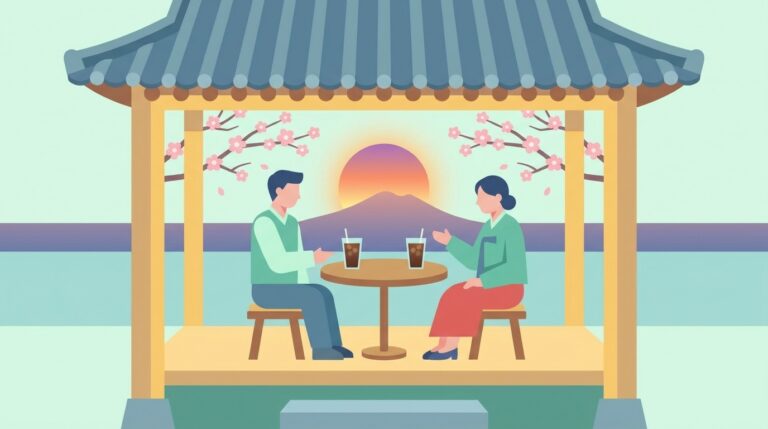
Phase 1: Empathy & Story Opening
Annyeonghaseyo! (안녕하세요!) I’m your Daily Hangul Editor. Imagine sitting in a cozy Seoul cafe on a blind date, just like a K-drama scene. You expect an awkward hour, but suddenly, three hours fly by! Then they smile and ask you out for a second date. Your heart races, right? Trust me, I once panicked and bowed 90 degrees like I was meeting my boss! Many A2 learners tell me they freeze at this happy moment because they only know stiff textbook lines. Based on real student feedback, today you will learn natural Korean phrases to accept that second date smoothly!
Phase 2: Top 3 Core Expressions Deep Dive
1. 시간 가는 줄 몰랐어요 (Sigan ganeun jul mollasseoyo)
- Pronunciation: See-gahn gah-neun jool mohl-lah-ssuh-yo. Think of “mohl-lah” like saying “mole-la” smoothly in one breath, and drop the final “yo” gently.
- Meaning: Literally “I didn’t know time was going.” In real life, it means “Time flew! I had such a good time that I didn’t notice the clock.”
- K-Culture Moment: Picture the classic Seoul rooftop or Hanok cafe scene in a rom-com drama like Business Proposal. The two leads start talking over iced Americanos in bright afternoon sun, and suddenly the streetlamps turn on outside.
- Editor’s Insight: This is the ultimate Korean green-light compliment! Saying this tells your date that you weren’t bored for even a second, without sounding overly dramatic.
- Situation Spectrum: Casual (시간 가는 줄 몰랐어) ✅ | Semi-formal (시간 가는 줄 몰랐어요) ✅ | Formal (시간 가는 줄 몰랐습니다) ⚠️ (Sounds a bit like a speech, best stick to -요!)
- 🤔 Think About It: In English, we often say “Time flies when you’re having fun.” In Korean, we focus on not even noticing time passing. How does your native language describe a moment so good you forget the clock?
2. 오늘 정말 즐거웠어요 (Oneul jeongmal jeulgeowosseoyo)
- Pronunciation: Oh-neul juhng-mahl jeul-guh-wuh-ssuh-yo. The “eu” in jeul sounds like the short “u” in “uh” when you’re slightly confused, with your lips relaxed and flat.
- Meaning: Literally “Today was really pleasant/joyful.” Actually means “I had a wonderful time with you today.”
- K-Culture Moment: Right outside the subway station at the end of a sogaeting (blind date), when both people stand under a warm streetlight before heading home.
- Editor’s Insight: Many beginners use jaemiisseosseoyo (재미있었어요 – it was fun), which is okay, but jeulgeowosseoyo (즐거웠어요) feels warmer, more polite, and slightly more romantic!
- Situation Spectrum: Casual (오늘 진짜 즐거웠어) ✅ | Semi-formal (오늘 정말 즐거웠어요) ✅ | Formal (오늘 정말 즐거웠습니다) ✅
- 🤔 Think About It: Notice that Koreans often drop the subject “I” or “you” here. Instead of saying “I had fun with you,” saying “Today was joyful” makes the good feeling a shared experience!
3. 다음에 또 만나요! (Daeume tto mannayo!)
- Pronunciation: Dah-eu-mae ttoh mahn-nah-yo! The “tt” in tto is sharp and bouncy, like the “t” in “stop” without any puff of air.
- Meaning: Literally “Let’s meet again next time!” Actually means “Yes! I’d love a second date!”
- K-Culture Moment: When a K-pop idol or drama character smiles brightly, waves with both hands near their chest, and hints that they definitely want to see the other person again.
- Editor’s Insight: Watch your tone here! If you say it quickly while walking away, it sounds like a polite goodbye. If you make warm eye contact, smile, and add kkok (꼭 – definitely), as in 다음에 꼭 또 만나요! (Daeume kkok tto mannayo!), it means a genuine second date.
- Situation Spectrum: Casual (다음에 또 보자!) ✅ | Semi-formal (다음에 또 만나요!) ✅ | Formal (다음에 다시 뵙겠습니다) 🚫 (Too businesslike for a date!)
- 🤔 Think About It: In some cultures, saying “Let’s hang out again sometime” can be just polite small talk. In Korea, after a 3-hour blind date, saying 또 만나요 (tto mannayo) with a bright smile is a clear signal of interest. How do people in your culture show they truly want a second date?
Phase 3: Textbook Korean vs. Real Korean
Situation 1: Saying you clicked well during the conversation
- 📖 Textbook Korean: 대화가 아주 잘 통했습니다. (Daehwaga aju jal tonghaetseumnida.) — “Our conversation communicated very well.”
- 🗣️ Real Korean: 말이 진짜 잘 통해요! (Mari jinjja jal tonghaeyo!) — “We totally click!”
- 💡 Why the difference? Textbook Korean sounds like a diplomatic meeting! Young Koreans swap the heavy word daehwa (대화 – conversation) for mal (말 – words/talk) and use jinjja (진짜 – really) to sound warm and authentic.
Situation 2: Responding when they ask for a second date
- 📖 Textbook Korean: 네, 두 번째 만남을 하고 싶습니다. (Ne, du beonjjae mannameul hago sipseumnida.) — “Yes, I would like to do a second meeting.”
- 🗣️ Real Korean: 저도 좋아요! 언제 볼까요? (Jeodo joayo! Eonje bolkkayo?) — “I’d love that! When should we meet?”
- 💡 Why the difference? Korean dating culture values clear enthusiasm when you like someone. Saying 저도 좋아요 (Jeodo joayo – I like it too) and immediately asking 언제 볼까요? (Eonje bolkkayo? – When shall we meet?) avoids awkward guessing games.
Phase 4: K-Culture Deep Dive & Non-Verbal Manners
4-1. Nunchi (눈치) & Gestures
On a Korean blind date, nunchi (social awareness) is everything!
* No Phone Checking: Putting your phone face-down on the table shows respect. Not looking at the clock for three hours is the strongest non-verbal sign that you’re having a great time.
* Chuimsae (추임새 – Active Listening): Koreans love warm reactions. Nod gently (끄덕끄덕 – kkeudeok-kkeudeok) and drop small reactions like 아, 진짜요? (A, jinjja-yo? – Oh, really?) or 대박! (Daebak! – Wow!). Lean slightly forward when they share a funny story about their ideal type.
* Eye Contact: Keep soft, friendly eye contact when smiling, and look away gently while sipping your drink so it feels cozy, not intense.
4-2. Cultural Code: The Magic of “Sogaeting” & “Aepeuteo”
In Korea, a sogaeting (소개팅 – blind date set up by a friend) usually starts at a pretty cafe for 1 to 2 hours. If there’s no spark, both people politely leave after finishing their coffee. So if you talk for three hours, congratulations—that is a huge green light! Often, a great 3-hour cafe chat leads right into dinner or an aepeuteo (애프터 – second date request). Just like in K-dramas, the person who asks for the second date usually sends a KakaoTalk message later that night to confirm they meant it!
Phase 5: Interactive Roleplay Scenario
Setting: A warm, fairy-lit cafe in Hongdae, Seoul. Soft indie music plays in the background, and the smell of roasted coffee fills the air. It’s 7:00 PM—you arrived at 4:00 PM!
NPC: Minjun (민준), a friendly 26-year-old web designer with glasses and an easygoing laugh.
- Minjun: 🎭 (Looks at his watch with wide, surprised eyes) 어? 벌써 7시예요! (Eo? Beolsseo ilgopsiyeyo!) — “Huh? It’s already 7 o’clock!”
- You: 🎭 (Laughs softly, shaking your head in disbelief) 정말요? 시간 가는 줄 몰랐어요! (Jeongmallyo? Sigan ganeun jul mollasseoyo!) — “Really? I didn’t notice time flying!”
- Minjun: 🎭 (Smiles warmly, leaning in a little) 저도요! 말이 진짜 잘 통해서 세 시간이나 지났네요. (Jeodoyo! Mari jinjja jal tonghaeseo se siganina jinatneyo.) — “Me too! Because we click so well, three whole hours passed.”
- You: 🎭 (Nods happily) 맞아요. 오늘 정말 즐거웠어요! (Majayo. Oneul jeongmal jeulgeowosseoyo!) — “Right. Today was really fun!”
- Minjun: 🎭 (Rubs the back of his neck shyly) 저기… 혹시 다음 주말에 시간 있어요? (Jeogi… hoksi daeum jumare sigan isseoyo?) — “Um… by any chance, do you have time next weekend?”
- You: 🎭 (Eyes brighten with a big smile) 네, 있어요! 왜요? (Ne, isseoyo! Waeyo?) — “Yes, I do! Why?”
- Minjun: 🎭 (Holds up his phone with KakaoTalk open) 우리 다음에 또 만나요! 맛있는 거 먹으러 가요. (Uri daeume tto mannayo! Masinneun geo meogeureo gayo.) — “Let’s meet again next time! Let’s go eat something delicious.”
🔀 Interactive Branching Point: How will you reply?
- Choice A: 저도 좋아요! 언제 볼까요? (Jeodo joayo! Eonje bolkkayo?) — “I’d love to! When should we meet?”
- Choice B: 아… 글쎄요. 생각 좀 해 볼게요. (A… geulsseyo. Saenggak jom hae bolgeyo.) — “Ah… well. I’ll think about it.”
- Choice C: 좋아요! 근데 제 이상형은 키 큰 사람이에요. (Joayo! Geunde je isanghyeongeun ki keun saramieyo.) — “Okay! By the way, my ideal type is a tall person.”
Feedback:
* Choice A (Best!): Smooth, warm, and clear! You matched his energy and opened the door to planning your second date right away.
* Choice B (Bad!): Ouch! Unless you truly aren’t interested, “I’ll think about it” sounds like a polite rejection in Korean dating culture.
* Choice C (Risky!): Saying “yes” is great, but suddenly dropping a physical requirement about your ideal type might make him feel tested or awkward right after he bravely asked you out!
Phase 6: 10-Second Emotional Shadowing Drill
Read each line aloud with the emotion tags! Pause briefly at every /.
[😲 Surprised and happy]어? / 벌써 / 세 시간이나 지났어요? (Eo? / Beolsseo / se siganina jinasseoyo?) — “Huh? Three hours passed already?”[😊 Warm and sincere]시간 가는 줄 / 몰랐어요! (Sigan ganeun jul / mollasseoyo!) — “I didn’t notice time flying!”[🥰 Bright and excited]오늘 / 정말 즐거웠어요! (Oneul / jeongmal jeulgeowosseoyo!) — “Today was really wonderful!”[😳 Shy but eager]저도 좋아요! / 다음에 / 꼭 또 만나요! (Jeodo joayo! / Daeume / kkok tto mannayo!) — “I’d love that! Let’s definitely meet again next time!”
Phase 7: K-Culture Mini Dictionary
- 소개팅 (Sogaeting) | Blind date set up by a friend | Used constantly in daily life! From sogae (introduction) + meeting. Friends often ask, “소개팅 어땠어? (Sogaeting eottaesseo? — How was the blind date?)”
- 애프터 (Aepeuteo) | Second date / follow-up invite | Comes from the English word “after.” You’ll hear phrases like “애프터 신청 받았어요! (Aepeuteo sincheong badasseoyo! — I got asked on a second date!)”
- 이상형 (Isanghyeong) | Ideal type | One of the top icebreaker topics on Korean dates and K-pop variety shows. “이상형이 뭐예요? (Isanghyeongi mwoyeyo? — What is your ideal type?)”
- 썸 (Sseom) | The flirting stage before dating | Short for “something.” If your second date goes great, you’re officially “썸 타는 사이 (sseom taneun sai — in a ‘some’ relationship)”!
Phase 8: Survival Kit for Travelers
Top 3 Survival Phrases for Post-Date Moments
- 카톡 아이디 뭐예요? (Katok aidi mwoyeyo?) — “What’s your KakaoTalk ID?” (Pro Tip: Koreans almost never use regular SMS texting; KakaoTalk is king for planning date two!)
- 제가 살게요! (Jega salgeyo!) — “I’ll pay!” (Pro Tip: On Korean dates, it’s super common for one person to buy dinner and the other to buy coffee/dessert, rather than splitting every single bill 50/50.)
- 조심히 들어가세요! (Josimhi deureogaseyo!) — “Get home safely!” (Pro Tip: Saying this at the subway station and texting “도착했어요? / Dochakaesseoyo? — Did you arrive?” later scores huge bonus points!)
Editor’s Travel Note
Before heading out on a date in Seoul, make sure to Download KakaoTalk for Staying in Touch in Korea so you don’t miss that sweet after-date message! Also, Download Naver Map App for Accurate Korean Directions because Google Maps doesn’t give walking routes well in Korea. Keep your T-money transit card charged—Seoul subways usually stop around midnight, so watch the clock if your 3-hour chat turns into dinner!
Phase 9: “One Step Deeper” (Culture Essay)
Even after laughing together for three hours and agreeing to a second date, you might notice something surprising in Korea: you and your date will likely keep using polite -yo (-요) endings! In English, dropping formality happens in five minutes, so keeping polite speech can feel distant at first. However, in Korean culture, keeping -yo early on shows sweet respect and leaves exciting room to grow closer step by step. Dropping into casual speech (반말 – banmal) usually happens later, often when you start dating or after someone asks nicely, “우리 말 놓을까요? (Uri mal noeulkkayo? — Shall we speak casually?)”
💬 Your Turn: How long is a normal first date in your country, and would you keep polite speech on date two? Share your story in the comments below!
Phase 10: FAQ & Myth Busting
Q: Is it weird if a blind date only lasts one hour in Korea?
A: Not necessarily! If someone is busy, one hour can happen. However, in Korean sogaeting culture, staying for 2 to 3 hours usually signals strong mutual interest.
Q: Does “다음에 밥 한번 먹어요 (Daeume bap hanbeon meogeoyo — Let’s eat sometime)” always mean a date?
A: Be careful! When said vaguely to a coworker or casual acquaintance, “let’s grab food sometime” can just be a polite Korean greeting. It means a real second date when they suggest a specific day, like “next weekend!”
Q: Should I ask about their “이상형 (isanghyeong – ideal type)” on the first date?
A: Yes! Asking about someone’s ideal type is a fun, totally normal icebreaker in Korea. Just keep it lighthearted and positive!
🚨 Common Mistakes Warning Board
- Mistake: Saying 시간이 없었어요 (Sigani eopseosseoyo) when you meant time flew. (This means “I had no time / I was busy”!)
Correct Action: Use 시간 가는 줄 몰랐어요 (Sigan ganeun jul mollasseoyo)! - Mistake: Dropping into casual speech (반말) suddenly after a great 3-hour talk without asking.
Correct Action: Stay with polite -요 (-yo) endings until you both agree to switch! - Mistake: Answering “I’ll think about it” out of shyness when they ask for a second date.
Correct Action: Smile brightly and say 저도 좋아요! (Jeodo joayo!) if you want to see them again!
Phase 11: Action Mission & Engagement
- 🥉 Bronze Mission (Solo Practice): Look in the mirror, smile like you just had the best coffee date ever, and say 시간 가는 줄 몰랐어요! (Sigan ganeun jul mollasseoyo!) three times.
- 🥈 Silver Mission (Share Online): Post your favorite phrase from Phase 2 on social media or share it with a study buddy, and ask them what their ideal K-drama date spot is!
- 🥇 Gold Mission (Real-Life Use): Next time you hang out with a Korean friend or language partner and time flies, surprise them by saying 오늘 정말 즐거웠어요! 다음에 또 만나요! (Today was really fun! Let’s meet again next time!)
🎮 K-Culture Mission
Watch a blind date or coffee shop scene in your favorite K-Drama (like Business Proposal or Crash Course in Romance) or a Korean dating show (like Single’s Inferno or Heart Signal). Listen carefully—can you catch anyone saying 통해요 (tonghaeyo), 즐거웠어요 (jeulgeowosseoyo), or 애프터 (aepeuteo)? Comment the show title when you spot one!
Phase 12: Interactive Quiz Challenge
Q1. Situational Judgment: Your Korean blind date smiles after three hours of chatting and asks, “우리 다음에 또 볼까요? (Uri daeume tto bolkkayo? — Shall we meet again next time?)” You really want to go! What is the best reply?
A) 네, 두 번째 만남을 수락합니다. (Ne, du beonjjae mannameul surakamnida.)
B) 저도 좋아요! 언제 볼까요? (Jeodo joayo! Eonje bolkkayo?)
C) 시간이 없었어요. (Sigani eopseosseoyo.)
Q2. Fill in the Blank: Complete the phrase meaning “I didn’t notice time flying!”
“시간 ______ 줄 몰랐어요!” (Sigan ______ jul mollasseoyo!)
Q3. True or False (Culture Quiz): In Korea, after talking for three hours on a great first date, you should immediately stop using -요 (-yo) polite endings without asking. (True / False)
Click here to check your answers and explanations!
- Q1 Answer: B! 저도 좋아요! 언제 볼까요? is warm, natural, and shows clear excitement. (Option A sounds like a robot accepting a legal contract, and Option C means “I didn’t have time,” which rejects the date!)
- Q2 Answer: 가는 (ganeun)! 시간 가는 줄 몰랐어요 literally means “I didn’t know time was going.”
- Q3 Answer: False! Keeping polite -요 (-yo) endings shows warmth and respect early on in Korean dating. Wait until you both agree to switch to casual speech (반말)!
🎬 Watch Our Daily Videos! (Daily Hangul Official Instagram)
Review the expressions you learned in this article with our fun daily short videos! Check out native pronunciation and real-life nuances in action.
- Instagram @dailyhangul_en







