

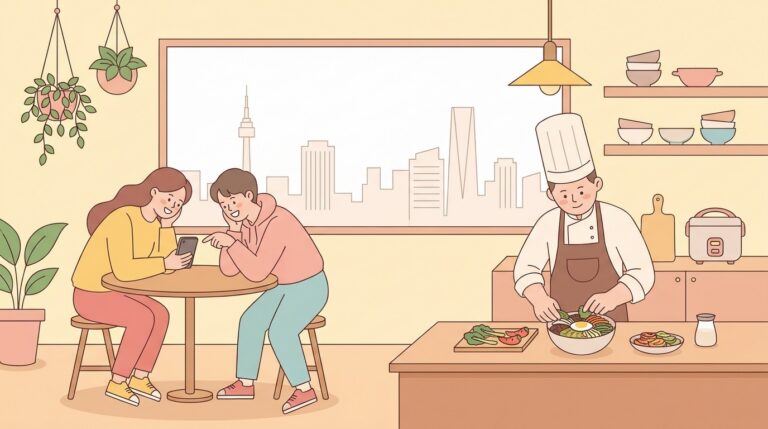
Phase 1: Why Are Seoul’s Chef Restaurants Harder to Book Than Concert Tickets?
안녕하세요! 매일한글 에디터입니다. (Annyeonghaseyo! Hello, I’m the Daily Hangul Editor!) Have you been binge-watching Korean cooking survival shows on Netflix or TVING lately? Watching charismatic chefs battle under intense timers makes everyone crave one thing: tasting their food in real life! The moment a show airs, those restaurants trigger a massive dining craze, with CatchTable reservations selling out in three seconds flat. Many of our B1 learners told us how heartbreaking it is to fly to Seoul only to face a fully booked screen or freeze up at the door trying to ask about walk-in waitlists. Based on real student stories, this guide gives you the exact Korean expressions to snag a table, handle waitlists, and sound like a true local foodie!
Phase 2: Deep Dive into 3 Essential Expressions
1. 예약이 꽉 찼어요 (Yeyagi kkwak chasseoyo)
- Pronunciation: Ye-ya-gi kkwak chas-seo-yo (Think of kkwak as a sharp, tense “kwahk” like squeezing a sponge tight, and chass like “chahs” in a fast breath.)
- Meaning: Literally “The reservations are packed/stuffed full.” In reality, it means “We are completely booked out.”
- K-Culture Moment: Just like when a celebrity chef wins a dramatic 1-on-1 match on a Netflix survival show, you excitedly call their restaurant the next morning, only to hear this dreaded phrase from the staff.
- Editor’s Insight: Unlike the plain textbook phrase “예약이 끝났어요” (reservations ended), adding the adverb 꽉 (kkwak – tightly/fully) adds vivid emphasis. You will also hear staff say “이미 마감됐어요” (Imi magamdwaesseoyo – It’s already closed) when CatchTable slots vanish in seconds.
- Situation Spectrum:
- Casual (to friends): 예약 꽉 찼대 (Yeyak kkwak chatdae) ✅
- Semi-formal (polite conversation/staff): 예약이 꽉 찼어요 (Yeyagi kkwak chasseoyo) ✅
- Formal (high-end dining announcement): 예약이 모두 마감되었습니다 (Yeyagi modu magamdoeeotseumnida) ⚠️ (Use this extra-polite version if you are the one hosting or making an official statement, though understanding it is key!)
- 🤔 Think About It: English says “booked solid” or “fully booked,” whereas Korean uses kkwak chada (to be packed tight like a full suitcase). How does your native language describe a space or schedule that has zero room left?
2. 현장 대기 걸 수 있나요? (Hyeonjang daegi geol su innayo?)
- Pronunciation: Hyeon-jang dae-gi geol su in-na-yo? (Hyeon sounds like “hyuhn” in one smooth syllable; in-na-yo links smoothly because of the consonant assimilation rule—never pronounce the ‘t’ in it separately!)
- Meaning: Literally “Can I hang an on-site wait?” Real nuance: “Can I put my name on the walk-in waitlist?”
- K-Culture Moment: Even when online reservations sell out in two seconds, true K-Foodies show up before opening hours (an “open run”) hoping to grab a counter seat at a TV chef’s bistro.
- Editor’s Insight: The verb 걸다 (geolda) means “to hang” or “to hook,” and Koreans pair it with waiting lists: 웨이팅 걸다 (weiting geolda) or 대기 걸다 (daegi geolda). In casual speech, people almost always say “웨이팅” (waiting), while “현장 대기” (on-site waiting) sounds clean, polite, and B1-level sharp.
- Situation Spectrum:
- Casual: 우리 웨이팅 걸자 (Uri weiting geolja) ✅
- Semi-formal: 현장 대기 걸 수 있나요? (Hyeonjang daegi geol su innayo?) ✅
- Formal: 현장 대기가 가능한지 여쭤봐도 될까요? (Hyeonjang daegiga ganeunghanji yeojjwobwado doelkkayo?) ✅
- 🤔 Think About It: In Korean, you “hang” your spot on a waitlist as if clipping your ticket onto a line. Why do you think visual, physical metaphors like “hanging” a reservation feel so natural in busy Korean dining culture?
3. 몇 초 만에 매진됐어요 (Myeot cho mane maejindwaesseoyo)
- Pronunciation: Myeot cho ma-ne mae-jin-dwaes-seo-yo (Myeot ends in a stopped ‘t’ sound like “myuht,” and cho sounds like “choh” as in “chocolate.”)
- Meaning: Literally “It was sold out within how many seconds.” Real nuance: “It sold out in just seconds!”
- K-Culture Moment: You’re chatting with your Korean friend over iced Americanos, complaining about how trying to book a famous chef’s restaurant felt harder than buying K-Pop concert tickets.
- Editor’s Insight: The pattern [Time] + 만에 (mane) expresses that something happened after or within that exact span of time. While 매진 (maejin) originally meant sold-out tickets or products, Koreans now use it playfully for hot chef tables too—calling the booking war “피켓팅” (piket-ting – bloody ticketing)!
- Situation Spectrum:
- Casual: 3초 만에 매진됐대! (Sam-cho mane maejindwaetdae!) ✅
- Semi-formal: 몇 초 만에 매진됐어요 (Myeot cho mane maejindwaesseoyo) ✅
- Formal: 몇 초 만에 예약이 마감되었습니다 (Myeot cho mane yeyagi magamdoeeotseumnida) ✅ (Note: use magam rather than maejin in strictly formal restaurant notices.)
- 🤔 Think About It: Koreans use concert and war metaphors (piket-ting, maejin) just to get dinner! Does your culture treat trendy restaurants like competitive events, or is dining seen as something purely relaxed?
Phase 3: Textbook Korean vs. Real Korean
Situation 1: Checking if a hot restaurant has an open table
- 📖 교과서 한국어 (Textbook Korean): 오늘 저녁에 빈자리가 있습니까? (Oneul jeonyeoge binjariga itseumnikka? — Are there empty seats this evening?)
- 🗣️ 진짜 한국어 (Real Korean): 혹시 오늘 취소 자리 나왔어요? (Hoksi oneul chwiso jari nawasseoyo? — By any chance, did a cancellation spot come up today?)
- 💡 왜 다를까? (Why the difference?): When a chef’s restaurant is trending from a survival show, asking if there’s an empty seat sounds naive—of course it’s full! Asking softly with 혹시 (hoksi – by any chance) about a 취소 자리 (chwiso jari – cancellation spot) shows you actually understand the local hype and softens the request.
Situation 2: Reacting to incredible food from a TV chef
- 📖 교과서 한국어 (Textbook Korean): 이 음식은 정말 맛있습니다. (I eumsigeun jeongmal masitseumnida. — This food is truly delicious.)
- 🗣️ 진짜 한국어 (Real Korean): 기다린 보람이 있네요! 완전 미쳤어요! (Gidarin borami inneyo! Wanjeon michyeosseoyo! — It was totally worth the wait! This is insanely good!)
- 💡 왜 다를까? (Why the difference?): After waiting two hours or fighting CatchTable bots, plain “delicious” isn’t enough! Using 보람이 있다 (borami itda – to be worthwhile) honors the wait and the chef’s effort, while “완전 미쳤어요” (literally “completely crazy”) is the ultimate compliment among friends and foodies (just save michyeosseoyo for peers, not your boss!).
Phase 4: K-Culture Deep Dive & Non-Verbal Manners
4-1. Nunchi (눈치) & Body Language at Hyped Restaurants
When you arrive at a chef’s packed bistro in Seongsu-dong or Hannam-dong, 눈치 (nunchi – social awareness) is your superpower. During peak turnover hours, staff are sprinting with hot plates. Never wave your arms wildly or shout across the room to ask about your table! Instead, wait calmly near the CatchTable tablet kiosk by the entrance, make brief eye contact with a staff member when their hands are free, give a slight 15-degree nod, and ask politely with “저기요, 혹시…” (Jeogiyo, hoksi… — Excuse me, by any chance…). Also, if there’s a line outside, stay tight against the building wall so you don’t block the sidewalk—Seoulites notice spatial courtesy immediately.
4-2. Culture Code: Why OTT Survival Shows Triggered a Gourmet Craze
Korean OTT platforms like Netflix and TVING didn’t just make entertaining cooking shows; they turned chefs into rockstars! In Korea’s fast-paced “빨리빨리” (ppalli-ppalli – hurry-hurry) society, food trends move at lightning speed. When a hidden master or fine-dining star shares their personal culinary philosophy on screen, viewers don’t just watch—they want to “경험 소비” (gyeongheom sobi – experience consumption), tasting the exact dish and posting an “인증샷” (injeung-syat – proof photo) on Instagram. Even convenience stores collaborate with survival show chefs within weeks, turning high-end gastronomy into an everyday pop-culture festival!
Phase 5: Real-Life Roleplay Scenario
Setting: Friday, 5:15 PM outside Bistro Hue, a tiny 12-seat restaurant in Euljiro run by a fan-favorite chef from a hit cooking survival show. Neon signs buzz above old printing shops, and savory garlic-butter aroma drifts from the door.
Characters: You (a hungry B1 Korean learner hoping for dinner) & Min-jun (the polite, slightly stressed restaurant manager holding an iPad).
- You: 저기요, 죄송한데 혹시 예약 없이 식사 가능할까요? (Jeogiyo, joesonghande hoksi yeyak eopsi siksa ganeunghalkkayo?) — 🎭 Stepping gently near the entrance with a warm smile. “Excuse me, I’m sorry to bother you, would it be possible to dine without a reservation?”
- Min-jun: 아, 손님. 죄송하지만 오늘 저녁은 캐치테이블 예약이 꽉 찼어요. (A, sonnim. Joesonghajiman oneul jeonyeogeun kaechiteibeul yeyagi kkwak chasseoyo.) — 🎭 Checking his iPad while apologizing politely. “Ah, guest. I’m sorry, but CatchTable reservations are completely full tonight.”
- You: 그렇군요! 방송 보고 너무 와 보고 싶었거든요. 혹시 현장 대기 걸 수 있나요? (Geureokunyo! Bangsong bogo neomu wa bogo sipeotgeodeunyo. Hoksi hyeonjang daegi geol su innayo?) — 🎭 Nodding with understanding, eyes hopeful. “I see! I really wanted to visit after watching the broadcast. By any chance, can I get on the walk-in waitlist?”
- Min-jun: 네, 바 자리는 선착순 웨이팅으로 받고 있어요. 앞에 태블릿에 번호 입력해 주시겠어요? (Ne, ba jarineun seonchaksun weitingeuro batgo isseoyo. Ape taebeullise beonho imnyeokhae jusigesseoyo?) — 🎭 Pointing toward a sleek white tablet stand by the door. “Yes, we take first-come, first-served waitlists for bar seats. Could you enter your number on the tablet in front?”
- You: 아, 제가 한국 전화번호가 없어서요. 혹시 이메일로 대기 등록이 되나요? (A, jega hanguk jeonhwabeonhoga eopseoseoyo. Hoksi imeillo daegi deungnogi doenayo?) — 🎭 Showing your foreign SIM phone politely. “Ah, I don’t have a Korean phone number. Can I register for the waitlist by email by any chance?”
- Min-jun: 아, 외국인 분이시군요! 그럼 제가 수기로 적어 드릴게요. 대기 시간은 40분 정도 걸릴 것 같아요. (A, oegugin bunisigunyo! Geureom jega sugiro jeogeo deurilgeyo. Daegi siganeun sasip-bun jeongdo geollil geot gatayo.) — 🎭 Smiling warmly and grabbing a notepad. “Ah, you’re a foreign visitor! Then I’ll write it down manually for you. The wait will probably take around 40 minutes.”
- You: 정말 감사합니다! 근처 카페에 있다가 시간 맞춰서 올게요. (Jeongmal gamsahamnida! Geuncheo kapee itdaga sigan matjwoseo olgeyo.) — 🎭 Bowing slightly in relief. “Thank you so much! I’ll stay at a nearby cafe and come back on time.”
- Min-jun: 네, 자리 나면 바로 연락드릴게요. 조금만 기다려 주세요! (Ne, jari namyeon baro yeollakdeurilgeyo. Jogeumman gidaryeo juseyo!) — 🎭 Opening the door smoothly as another dish leaves the kitchen. “Yes, I’ll contact you as soon as a seat opens. Please wait just a little!”
🔀 Interactive Branching Point: What happens next?
Min-jun calls out 35 minutes later that a counter seat opened up! How do you respond when you sit down and see the chef cooking right in front of you?
* A) “셰프님! 방송에서 본 거랑 똑같아요! 응원하고 있어요!” (Syepunim! Bangsongeseo bon georang ttokgatayo! Eungwonhago isseoyo! — “Chef! You look just like on the show! I’m rooting for you!”) -> 🌟 Best! Warm, respectful, and uses ~님 (-nim) properly. Chefs love genuine support without delaying their cooking.
* B) “여기 예약 몇 초 만에 매진됐잖아요. 근데 왜 이렇게 비싸요?” (Yeogi yeyak myeot cho mane maejindwaetjanayo. Geunde wae ireoke bissayo? — “Reservations sold out in seconds here. Wait, why is it so expensive?”) -> 🚫 Bad! Bringing up prices bluntly while the chef is plating right in front of you breaks nunchi and kills the atmosphere.
* C) “셰프님, 저랑 사진 한 장만 찍어 주시면 안 돼요? 지금 바로요!” (Syepunim, jeorang sajin han jangman jjigeo jusimyeon an dwaeyo? Jigeum baroyo! — “Chef, could you take a photo with me? Right now!”) -> ⚠️ Risk! Asking for a photo is common, but saying “right now” while they are holding hot pans during dinner rush is stressful. Always wait until you finish eating and ask politely!
Phase 6: 10-Second Emotion Shadowing Drill
Read aloud with the pauses (/) and match the emotional cues!
- [😮 Amazed & Dramatic]
“어제 예약하려다가 / 3초 만에 매진돼서 / 진짜 깜짝 놀랐어요!”
(Eoje yeyakharyeodaga / sam-cho mane maejindwaeseo / jinjja kkamjjak nolasseoyo! — I tried to book yesterday, and it sold out in 3 seconds, I was so shocked!) - [🥺 Hopeful & Polite]
“죄송한데 / 혹시 오늘 / 현장 대기 걸 수 있나요?”
(Joesonghande / hoksi oneul / hyeonjang daegi geol su innayo? — Excuse me, by any chance, can I join the walk-in waitlist today?) - [😊 Blissful & Satisfied]
“한 시간이나 기다렸지만 / 먹어 보니까 / 기다린 보람이 있네요!”
(Han siganina gidaryeotjiman / meogeo bonikka / gidarin borami inneyo! — I waited for a whole hour, but tasting it, it was totally worth the wait!)
Phase 7: K-Culture Mini Dictionary
- 캐치테이블 (Kaechiteibeul / CatchTable) | Translation: Korea’s #1 restaurant reservation & remote waitlist app | Usage: Essential in daily life and business dining; locals say “캐치테이블로 웨이팅 걸었어” (I joined the waitlist via CatchTable).
- 오픈런 (Opeunleon / Open Run) | Translation: Lining up right before a store or restaurant opens | Usage: Originally for luxury bags, now used daily for trending bakeries and TV chef restaurants.
- 맛집 (Matjip) | Translation: A famous, genuinely delicious restaurant (lit. “taste house”) | Usage: Used everywhere—from casual friend chats (“성수동 맛집 알아?”) to client lunches.
- 선착순 (Seonchaksun) | Translation: First-come, first-served | Usage: Seen on event posters, concert drops, and walk-in dining rules (“선착순 마감”).
Phase 8: Traveler’s Survival Kit
Top 3 Survival Phrases
- 대기 몇 팀 남았어요? (Daegi myeot tim namasseoyo?) — How many groups are ahead of me? Pro Tip: Ask this if your paper waitlist doesn’t have an app tracker.
- 포장도 되나요? (Pojangdo doenayo?) — Is takeout available too? Pro Tip: If dine-in seats are gone, some trendy chef bistros offer limited takeout menus!
- 시그니처 메뉴가 뭐예요? (Sigeunicheo menyuga mwoyeyo?) — What is your signature menu? Pro Tip: Usually it’s the exact dish that went viral on the survival show!
Editor’s Travel Note
Before landing in Incheon, make sure to Download the CatchTable Global App for English Reservations so you won’t need a Korean phone number for select partner restaurants, and Check Naver Map for Real-Time Seoul Restaurant Directions because Google Maps walking directions don’t work smoothly in Korea. For transit and easy dining payments, grab a T-money or WOWPASS card at the airport—most chef-run bistros accept international credit cards, though small traditional market stalls featured on shows may still prefer cash or Korean bank transfer.
Phase 9: One Step Deeper
Why do Koreans willingly wait two hours in winter just for one bowl of pasta or bibimbap made by a TV chef? In Korea, sharing a meal is never just about calories—it is a shared cultural language of 정 (jeong – warm connection) and belonging. When you taste a dish everyone watched being crafted under pressure on screen, you become part of the story yourself. Even the exhausting wait becomes a badge of shared passion among friends, turning a simple dinner into an unforgettable memory.
💬 Your Turn: Which Korean survival show dish made your mouth water the most, and how long would you wait in line to try it? Tell us in the comments!
Phase 10: FAQ & Common Mistakes
Q: Can I book CatchTable restaurants without a Korean phone number?
A: Yes! While the domestic Korean version of CatchTable requires local phone verification, the CatchTable Global app lets international travelers book and join remote waitlists using an email address or global login.
Q: What does “브레이크 타임” (Break Time) mean at Korean chef restaurants?
A: Many trendy chef-run spots close between lunch and dinner (usually 3:00 PM to 5:00 PM) to prep fresh ingredients. Always check Naver Map for 브레이크 타임 before heading over so you don’t arrive at a locked door!
Q: Should I tip the chef or server if the service and food were amazing?
A: No, Korea has zero tipping culture! Expressing sincere gratitude with “잘 먹었습니다!” (Jal meogeotseumnida — Thank you for the meal!) as you leave—or leaving a kind review online—is the warmest way to show appreciation.
🚨 Common Mistakes Warning Board
- Mistake: Saying “예약하고 싶어요” (I want to reserve) while standing at the door for an immediate table. -> Correct Action: Use “지금 자리 있어요?” (Do you have a seat right now?) or “현장 대기 걸 수 있나요?” (Can I join the walk-in waitlist?).
- Mistake: Asking for “1인분” (one serving) at spots that require a 2-person minimum. -> Correct Action: Ask “혼자 식사 가능한가요?” (Honja siksa ganeunghangayo? — Can I dine alone?) beforehand, as some chef bars or hotpot places don’t allow solo diners during peak hours.
- Mistake: Missing your waitlist call by 15 minutes and expecting your seat to stay saved. -> Correct Action: Return within 5–10 minutes of your alert! At hyped spots, “노쇼” (no-show) cancels your spot immediately.
Phase 11: Action Mission & Challenge
- 🥉 Bronze (Solo Practice): Record yourself saying all three Phase 6 shadowing sentences in one 10-second take—focus on the smooth in-na-yo sound!
- 🥈 Silver (Share Online): Share a screenshot or photo of your dream Korean dish on social media with the caption: “이거 먹으려면 오픈런 해야겠어요! (Gotta do an open run for this!)”
- 🥇 Gold (Real-World Use): Next time you visit a Korean restaurant (even in your hometown!), politely ask the staff “시그니처 메뉴가 뭐예요?” and say “잘 먹었습니다!” on your way out.
- 🎮 K-Culture Mission: Rewatch an episode of a Korean cooking survival show and listen closely—can you catch the judges or chefs saying 보람 (worthwhile), 마감 (closing/cutoff), or 인생 요리 (dish of a lifetime)?
Phase 12: Interactive Quiz Challenge
1. Situation Judgment: You arrive at a famous TV chef’s restaurant at 6:00 PM without a booking, and the manager says “예약이 꽉 찼어요.” What is the smartest, most natural B1 response?
* A) “지금 바로 1인분 주세요.”
* B) “아, 그렇군요. 혹시 현장 대기 걸 수 있나요?”
* C) “저는 외국인이라서 그냥 들어갈게요.”
Click to see Answer & Explanation for Q1
Correct Answer: B! Saying “혹시 현장 대기 걸 수 있나요?” politely accepts that reservations are full and asks if walk-in waitlisting is possible. Why others are wrong: Option A ignores that there are no tables, and Option C sounds rude and breaks dining etiquette.
2. Fill in the Blank: Complete the sentence to say “Reservations sold out in 5 seconds!”
“예약이 5초 ( ___ ) 매진됐어요!”
Click to see Answer & Explanation for Q2
Correct Answer: 만에 (mane). The pattern [Time] + 만에 means “within/in just [time].” Great job if you nailed it!
3. True or False Cultural Quiz: In Korea, if a restaurant uses a CatchTable waitlist tablet outside, it’s totally normal to leave your group waiting at a nearby cafe and return as soon as you get the alert, rather than standing outside the door.
Click to see Answer & Explanation for Q3
Correct Answer: True! Unlike traditional physical lines, smart waitlist systems exist so diners can relax at nearby cafes until their turn approaches—just make sure to return promptly within the time limit when notified!
🎬 Watch Our Daily Videos! (Daily Hangul Official Instagram)
Review the expressions you learned in this article with our fun daily short videos! Check out native pronunciation and real-life nuances in action.
- Instagram @dailyhangul_en







