

Phase 1: Empathy — Lost in Translation Among Fifty Amber Bottles
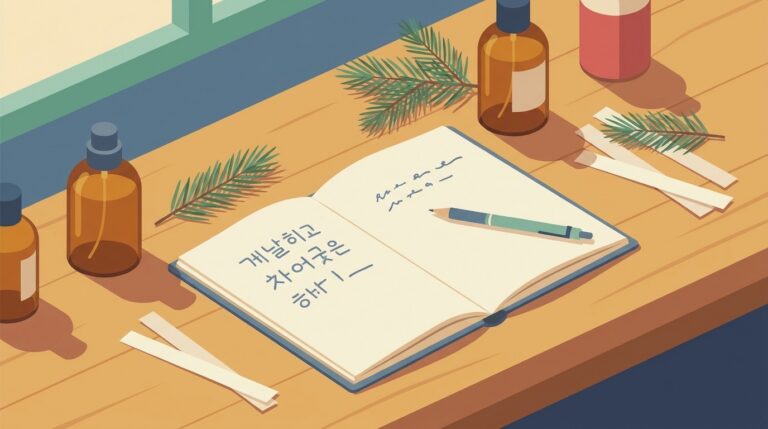
안녕하세요! 매일한글 에디터입니다. (Annyeonghaseyo! Hello, I’m your Daily Hangul Editor.) Picture this: you step into a sunlit niche perfumery in Seoul’s trendy Seongsu-dong. Before you sit fifty amber bottles and a fan of paper scent strips. You want to create a signature perfume evoking a calm, earthy forest walk after rain—a subtle, green woody musk. Yet when the perfumer asks what ratio you want, your Korean freezes at ‘It smells good!’ As a tutor who has guided dozens of B2 learners through real Seoul workshops, I know how frustrating it is when your vocabulary can’t match your taste. In this guide, based on real student feedback, you’ll master B2 sensory terms, note layering, and natural Korean nuance so you can blend your dream scent with confidence.
Phase 2: Deep Dive into Top 3 Core Expressions
1. 비 온 뒤 젖은 숲속 같은 느낌이에요 (Bi on dwi jeojeun supsok gateun neukkim-ieyo)
- Pronunciation: Bi on dwi jeojeun supsok gateun neukkim-ieyo (Sounds like “bee-ohn dwee juh-jeun soop-sohk gah-teun neu-kkeem-ee-eh-yo” — keep the “jeo” like the “u” in “up” and pause lightly after “supsok”).
- Meaning: Literally “It is a feeling like a wet forest after rain.” Naturally, it conveys an atmospheric, poetic mood board for your scent—combining damp soil, fresh moss, and cool air.
- K-Culture Moment: Think of a quiet, aesthetic scene in a K-Drama like Our Beloved Summer or a Korean indie perfume brand’s lookbook film where characters describe memories tied to weather rather than single ingredients.
- Editor’s Insight: In Korean niche perfumery, describing a scent through scenery (풍경, punggyeong) or atmosphere (분위기, bunwigi) communicates far more clearly to a perfumer than just listing raw materials like “pine” or “cedar.”
- Situation Spectrum: Casual ✅ / Semi-formal ✅ / Formal ✅ (Warm, expressive, and completely polite with -이에요).
- 🤔 Think About It: In English, we often jump straight to technical adjectives like “earthy” or “petrichor.” Why do Korean speakers so frequently anchor sensory experiences to weather and poetic scenes like “after the rain”?
2. 잔향이 은은하게 남아요 (Janhyang-i euneunhage namayo)
- Pronunciation: Janhyang-i euneunhage namayo (Sounds like “jahn-hyahng-ee eun-eun-hah-geh nah-mah-yo” — the “eu” in euneun sounds like the “oo” in “good” but with unrounded, flat lips).
- Meaning: Literally “The remaining scent stays softly.” In fragrance terms, this means “The dry-down / sillage lingers delicately without overpowering.”
- K-Culture Moment: You will hear this exact phrase constantly in Korean beauty YouTube “What’s in My Bag” videos by K-Pop idols or actors showing off their favorite hand creams and niche perfumes.
- Editor’s Insight: 은은하다 (euneunhada) is a golden Korean aesthetic keyword. While Western perfumes are sometimes praised as “beast mode” or bold, Korean fragrance culture prizes 은은함—a whisper of scent noticed only when someone leans in.
- Situation Spectrum: Casual ✅ (drop -요: 잔향이 은은하게 남아) / Semi-formal ✅ / Formal ✅ (잔향이 은은하게 남습니다).
- 🤔 Think About It: Does your native language view a “lingering” scent as positive or intrusive? Compare how “strong projection” versus “subtle dry-down” reflects social space in Korean culture.
3. 베이스 노트를 좀 더 묵직하게 잡아 주세요 (Beiseu noteureul jom deo mukjikhage jaba juseyo)
- Pronunciation: Beiseu noteureul jom deo mukjikhage jaba juseyo (Sounds like “beh-ee-seu noh-teu-reul johm duh mook-jeek-hah-geh jah-bah joo-seh-yo” — hit the “k” in muk cleanly before sliding into “jik”).
- Meaning: Literally “Please catch/hold the base note a bit more heavily.” In blending workshops, it means “Please anchor the formula with a deeper, richer base note” (like musk, sandalwood, or vetiver).
- K-Culture Moment: Picture a seasoned K-Beauty creator or barista-style perfumer in a Seongsu-dong atelier carefully adjusting drops with a glass pipette while discussing balance, much like adjusting espresso depth in a specialty café.
- Editor’s Insight: Using 묵직하다 (mukjikhada — weighty, grounded, deep) instead of 무겁다 (mugeopda — physically heavy/stuffy) shows true B2 mastery! And 잡다 (jabda) is the insider verb perfumers and chefs use for “setting/balancing” a flavor or scent profile.
- Situation Spectrum: Casual ⚠️ (too stiff with friends) / Semi-formal ✅ / Formal ✅ (Ideal when directing a specialist or perfumer).
- 🤔 Think About It: In English we “ground” or “anchor” a base note; in Korean we “catch/hold” (잡다) it heavily (묵직하게). Notice how both languages borrow physical weight metaphors to describe invisible smells!
Phase 3: Textbook Korean vs. Real Korean
Situation 1: Reacting to a sharp, overly citrusy Top Note on a scent strip
- 📖 Textbook Korean: 이 향수는 처음 냄새가 너무 강해서 제 취향이 아닙니다. (I hyangsuneun cheoeum naemsaega neomu ganghaeseo je chwihyang-i animnida. — “This perfume’s initial smell is too strong, so it is not my taste.”)
- 🗣️ Real Korean: 어, 이건 탑 노트가 좀 톡 쏘네요. 저한테는 살짝 호불호가 갈릴 것 같아요. (Eo, igeon tap noteuga jom tok ssoneyo. Jeohanteneun saljjak hobulhoga gallil geot gatayo. — “Oh, the top note on this one is a bit sharp/tingly. For me, it feels a bit polarizing.”)
- 💡 Why Is It Different?: Calling a perfume 냄새 (naemsae, smell) can sound slightly blunt or negative, whereas 향 (hyang) or 탑 노트 (tap noteu) sounds refined. Plus, Koreans softly cushion rejection using 호불호가 갈리다 (hobulhoga gallida — “likes and dislikes divide”) so the perfumer never feels awkward.
Situation 2: Asking to blend a calm, greenery woody-musk ratio
- 📖 Textbook Korean: 저는 나무 냄새와 풀 냄새가 나는 차분한 향을 섞고 싶습니다. (Jeoneun namu naemsaewa pul naemsaega naneun chabunhan hyang-eul seokko sipseumnida. — “I want to mix a calm scent that smells like wood and grass.”)
- 🗣️ Real Korean: 그리너리하면서도 차분한 우디 머스크 쪽으로 비율을 배합해 보고 싶어요. (Geurineorihamyeonseodo chabunhan udi meoseukeu jjogeuro biyureul baehaphae bogo sipeoyo. — “I’d like to try blending the ratio toward a greenery yet calm woody musk.”)
- 💡 Why Is It Different?: At B2 level in modern Seoul workshops, loanwords like 그리너리하다 (geurineorihada — fresh, leafy green) and 우디 머스크 (udi meoseukeu) paired with the precise verb 배합하다 (baehaphada — to formulate/blend ingredients) sound effortless and authentic.
Phase 4: K-Culture Deep Dive & Non-Verbal Manners
4-1. Nunchi (눈치) & Workshop Etiquette
- The Gentle Waft, Not the Deep Inhale: When handed a paper blotter (시향지, sihyangji), never press it straight against your nostrils! Hold it 3–5 centimeters away and gently wave it beneath your nose while taking short, light sniffs. Pure essential oils and high-concentration bases can numb your olfactory nerves instantly.
- The Coffee Bean Reset: Notice the small jar of roasted coffee beans (원두, wondu) on the table? After testing 5–6 strips, give the beans a brief sniff and take a sip of water to reset your nose before turning back to the perfumer with a thoughtful nod.
- Respecting the Space: Niche ateliers in Korea are quiet, meditative spaces. Speak in a calm voice (차분한 목소리, chabunhan moksori), handle glass pipettes (스포이드, seupoideu) with two hands if needed, and keep your labeled scent strips fanned neatly on the tray rather than scattering them.
4-2. Cultural Code Analysis: K-Beauty & Seongsu-dong “Scent Tourism”
Over the last few years, neighborhoods like Seongsu-dong and Hannam-dong have become global hubs for K-Scent culture. Inspired by homegrown niche houses like Tamburins, Nonfiction, and Granhand—and countless K-Dramas where a protagonist’s signature scent symbolizes their hidden personality—custom perfume workshops have exploded in popularity. In Korea, choosing a scent isn’t about smelling loudly expensive; it’s about curating an emotional narrative (서사, seosa). A “calm forest walk after rain” signals introspection, grounded elegance, and understated confidence—traits deeply admired in modern Korean aesthetics.
Phase 5: Real-Life Roleplay Scenario
Setting: A minimalist concrete-and-oak perfumery studio in Seongsu-dong, Seoul. Rain taps softly against the window.
NPC: Min-jun (민준), a soft-spoken, attentive Korean perfumer in a charcoal linen apron.
- Min-jun: 어서 오세요! 오늘 어떤 무드의 향을 만들어 보고 싶으세요? (Eoseo oseyo! Oneul eotteon mudeu-ui hyang-eul mandeureo bogo sipeuseyo? — “Welcome! What kind of mood would you like to create for your scent today?”) 🎭 Min-jun smiles warmly and slides a wooden tray holding dozens of paper scent strips toward you.
- You: 비 온 뒤 젖은 숲속을 걷는 듯한 차분하고 그리너리한 우디 머스크 향으로 배합해 보고 싶어요. (Bi on dwi jeojeun supsogeul geonneun deuthan chabunhago geurineorihan udi meoseukeu hyang-euro baehaphae bogo sipeoyo. — “I’d like to blend a calm, greenery woody-musk scent like walking through a wet forest after rain.”) 🎭 You gaze briefly at the rain outside, then trace your finger thoughtfully along the base-note shelf.
- Min-jun: 아, 너무 좋네요! 그럼 탑 노트에는 시원한 유칼립투스나 베르가못을 살짝 얹고, 미들에는 이끼 향을 넣어 볼까요? (A, neomu jonneyo! Geureom tap noteu-eneun siwonhan yukalliptuseuna bereugamoseul saljjak eonkko, mideureneun ikki hyang-eul neoheo bolkkayo? — “Ah, that sounds lovely! Then shall we layer a crisp eucalyptus or bergamot on the top note, and add an oakmoss scent in the middle?”) 🎭 He dips two blotters into amber bottles and fans them lightly in the air before handing them to you.
- You: 음, 유칼립투스는 첫 향이 좀 톡 쏘는데, 베르가못이 훨씬 부드럽게 어우러지네요. (Eum, yukalliptuseuneun cheot hyang-i jom tok ssoneunde, bereugamosi hwolssin budeureopge eoureojineyo. — “Hmm, eucalyptus has a sharp initial hit, whereas bergamot blends in much more smoothly.”) 🎭 You waft each strip gently below your nose and set the eucalyptus strip aside.
- Min-jun: 감각이 정말 좋으시네요. 그럼 베이스 노트는 샌달우드랑 화이트 머스크 중에 어떤 쪽이 더 끌리세요? (Gamgagi jeongmal joeusineyo. Geureom beiseu noteuneun saendarudeurang hwaiteu meoseukeu jung-e eotteon jjogi deo kkeulliseyo? — “You have a great nose! Then for the base note, which draws you more between sandalwood and white musk?”) 🎭 He holds up two slender bottles and offers a small jar of coffee beans to refresh your senses.
- You: 둘 다 매력적인데, 베이스 노트를 좀 더 묵직하게 잡고 싶어서 샌달우드 비중을 높이고 머스크를 살짝 더할게요. (Dul da maeryeokjeoginde, beiseu noteureul jom deo mukjikhage japgo sipeoseo saendarudeu bijung-eul nopigo meoseukeureul saljjak deohalgeyo. — “Both are charming, but since I want to anchor the base note a bit heavier, I’ll raise the sandalwood ratio and add a touch of musk.”) 🎭 You sniff the coffee beans briefly, nod decisively, and jot the drops down on your recipe sheet.
- Min-jun: 완벽한 비율이에요. 피부에 착 감기면서 잔향이 아주 은은하게 남을 거예요. (Wanbyeokhan biyurieyo. Pibue chak gamgimyeonseo janhyang-i aju euneunhage nameul geoyeyo. — “That’s a flawless ratio. It’ll wrap softly around your skin and leave a very subtle dry-down.”) 🎭 He slides a glass beaker and pipette toward you so you can begin blending.
- You: 감사합니다! 방금 배합한 레시피로 바로 만들어 볼게요. (Gamsahamnida! Banggeum baehaphan resipiro baro mandeureo bolgeyo. — “Thank you! I’ll go ahead and make it right away using the recipe we just formulated.”) 🎭 Carefully holding the pipette, you begin counting each drop with quiet excitement.
🔀 Interactive Branching Point: What Do You Say When Testing Your Final Blend?
Min-jun sprays a tiny mist of your finished blend onto your wrist. After 10 seconds, it feels slightly too sharp at the start and needs a softer woody finish. How do you respond?
- Option A: “시간이 지날수록 차분해지긴 하는데, 첫 향이 살짝 강해서 머스크를 한 방울만 더 보완해도 될까요?” (Sigan-i jinalsurok chabunhaejigin haneunde, cheot hyang-i saljjak ganghaeseo meoseukeureul han bang-ulman deo bowanhaedo doelkkayo? — “It calms down as time passes, though the opening is slightly strong—could we supplement it with just one more drop of musk?”)
- Feedback (Best ✅): Natural, nuanced B2 Korean! Using 보완하다 (bowanhada, to supplement/refine) and acknowledging how the scent evolves over time (시간이 지날수록) will impress any Korean perfumer.
- Option B: “이거 냄새 이상해요. 다시 처음부터 다 새로 해 주세요.” (Igeo naemsae isanghaeyo. Dasi cheoeumbuteo da saero hae juseyo. — “This smells weird. Redo the whole thing from the beginning.”)
- Feedback (Bad 🚫): Way too blunt and violates Korean nunchi! Saying 냄새 이상해요 hurts the collaborative vibe, and completely restarting wastes pricey raw oils without diagnosing which note is off.
- Option C: “향이 너무 진한 것 같긴 한데… 그냥 괜찮아요, 이대로 가져갈게요.” (Hyang-i neomu jinhan geot gatgin hande… geunyang gwaenchanayo, idaero gajyeogalgeyo. — “It feels a bit too heavy, but… it’s fine, I’ll just take it like this.”)
- Feedback (Risk ⚠️): Polite, yes, but workshops are designed for micro-adjustments! Korean perfumers genuinely expect your feedback before sealing the bottle, so don’t settle out of shyness.
Phase 6: 10-Second Emotional Shadowing Drill
Read aloud with rhythm! Pause briefly at / and lean into the emotional cue.
[😌 Calm & Poetic]
비 온 뒤 / 젖은 숲속을 걷는 듯한 / 차분한 향이에요.
(Bi on dwi / jeojeun supsogeul geonneun deuthan / chabunhan hyang-ieyo.)-
[🤔 Thoughtful & Discerning]
탑 노트는 산뜻한데 / 잔향이 아주 / 은은하게 남네요.
(Tap noteuneun santteuthande / janhyang-i aju / euneunhage namneyo.) -
[✨ Confident & Creative]
베이스 노트를 / 좀 더 묵직하게 잡아서 / 나만의 비율로 배합했어요.
(Beiseu noteureul / jom deo mukjikhage jabaseo / naman-ui biyullo baehaphaesseoyo.)
Phase 7: K-Culture Mini Dictionary (4 Core Keywords)
- 1. 시향지 (Sihyangji) | 2. Scent test strip / blotter | 3. Real-life / Business Usage: Used everywhere from department store beauty counters like Shinsegae to indie studios. You can politely ask staff, “시향지 하나 주실 수 있나요?” (Sihyangji hana jusil su innayo? — “Could I have a scent strip?”). Note that 블로터 (beulloteo) is also used by industry insiders.
- 1. 탑·미들·베이스 노트 (Tap·Mideul·Beiseu Noteu) | 2. Top, Middle (Heart), and Base Notes | 3. Real-life / Business Usage: Essential terminology in K-Beauty marketing and workshops. Korean product descriptions often refer to these as 첫 향 (cheot hyang — initial scent), 중간 향 (junggan hyang), and 잔향 (janhyang — dry-down).
- 1. 호불호 (Hobulho) | 2. Polarizing taste (likes vs. dislikes) | 3. Real-life / Business Usage: Short for 좋아하고 싫어함 (liking and disliking). Koreans use 호불호가 갈리다 (opinions divide) or 호불호 없는 향 (a universally crowd-pleasing scent) for perfumes, food, and movies alike.
- 1. 그리너리하다 (Geurineorihada) | 2. Fresh, leafy, green-scented | 3. Real-life / Business Usage: A trendy Konglish adjective borrowed by Seoul’s design and fragrance scene. Think crushed fig leaves, damp moss, rain-soaked bamboo, or fresh herbs—never overly sweet.
Phase 8: Survival Kit for Travelers
Top 3 Workshop Survival Phrases
- 이 향료랑 어울리는 미들 노트 추천해 주세요. (I hyangnyorang eoullineun mideul noteu chucheonhae juseyo. — “Please recommend a middle note that pairs well with this fragrance oil.”)
- Pro Tip: Hold up the bottle you already like when saying 이 향료 (this fragrance ingredient) so the perfumer immediately grasps your anchor note.
- 지속력이 어느 정도 되나요? (Jisoknyeogi eoneu jeongdo doenayo? — “How long does the longevity/lasting power hold?”)
- Pro Tip: Workshops let you choose concentration (부향률, buhyangnyul) such as Eau de Toilette vs. Eau de Parfum; asking this helps you decide how strong to mix!
- 숙성 기간은 얼마나 두어야 하나요? (Sukseong giganeun eolmana dueoya hanayo? — “How long should I let it mature/macerate?”)
- Pro Tip: Freshly blended perfumes usually need 1–2 weeks in a cool, dark spot (서늘하고 어두운 곳) for the alcohol and oils to marry smoothly.
Editor’s Travel Note
- Navigation & Bookings: Google Maps lacks full walking directions in Korea, so be sure to Download the Naver Map App for Seoul Workshop Routes before heading into Seongsu-dong’s winding alleys. Many boutique ateliers require advance reservations; you can Check the Creatrip Seoul Perfume Workshop Booking Guide if you don’t have a Korean phone number for Naver Booking.
- Payment & Transit: Almost every workshop accepts foreign credit cards (Visa/Mastercard) and Apple Pay, while the Seoul Climate Card or T-Money transit card makes hopping between Seongsu, Yeonnam, and Hannam fragrance districts effortless.
Phase 9: “One Step Deeper” — The Beauty of Euneunham (은은함)
Have you ever noticed how often Koreans praise a fragrance by saying 향이 차분하다 (hyang-i chabunhada — “the scent is calm”)? In Western fragrance culture, perfumes are frequently marketed as bold statements meant to command an entire room. In Korean aesthetic philosophy, shaped by centuries of valuing quiet harmony and 여백의 미 (yeobaek-ui mi — the beauty of empty space), overwhelming someone else’s sensory space is seen as lacking nunchi. Instead, the highest compliment a perfume can receive is that its 잔향 (dry-down) lingers subtly like damp pine trees after rain—discoverable, intimate, and deeply comforting.
- 💬 Your Turn: What kind of scenery or weather captures your ideal signature scent? Drop a comment trying out today’s Korean pattern (e.g., 비 온 뒤… 같은 느낌이에요!) and let’s practice together!
Phase 10: FAQ & Myth Busting
Q: Can I just say “냄새가 좋아요” (Naemsaega joayo) at a Korean perfume shop?
A: Grammatically yes, people will understand you, but culturally 냄새 (naemsae) leans neutral-to-negative (like “smell” or “odor”). Always upgrade to 향 (hyang) or 향기 (hyanggi) when complimenting perfumes, candles, or flowers—it instantly makes your Korean sound polished and natural.
Q: What is the difference between “시원하다” (siwonhada) and “상큼하다” (sangkeumhada) for top notes?
A: 상큼하다 describes bright, juicy citrus fruits like grapefruit, yuzu, or lemon. 시원하다 means cool, crisp, and airy—like peppermint, eucalyptus, ocean breeze, or wet forest air after rain.
Q: If I don’t know the exact Korean word for an ingredient like “vetiver” or “cedarwood,” will the perfumer understand English?
A: Yes! Korean perfumers use English-derived loanwords for almost all fragrance notes (베티버 betibeo, 시더우드 sideoudeu, 화이트 머스크 hwaiteu meoseukeu, 샌달우드 saendarudeu). Pair those loanwords with Korean sensory adjectives like 차분하다 or 묵직하다, and you’ll communicate effortlessly.
🚨 Common Mistakes Warning Board
- Mistake: Saying 무거운 향 (mugeoun hyang — “physically heavy scent”) when you want a deep base note. -> Correct Action: Use 묵직한 향 (mukjikhan hyang — “rich, grounded, weighty scent”) or 깊이감 있는 향 (gipigam inneun hyang — “scent with depth”).
- Mistake: Rubbing your wrists together after testing your blended perfume. -> Correct Action: Just let it dry naturally! Korean perfumers will gently remind you that friction crushes delicate top-note molecules (탑 노트가 날아가요 — the top notes evaporate).
- Mistake: Asking for “나무 냄새” (tree odor) or “풀 냄새” (grass smell). -> Correct Action: Elevate your phrasing to 우디한 향 (udihan hyang) and 그리너리한 향 (geurineorihan hyang) for instant atelier fluency.
Phase 11: Action Mission & Engagement
- 🥉 Bronze (Solo Practice): Look at a perfume or hand cream you own right now. Describe its top, middle, and base feel out loud in 3 Korean sentences using 차분하다, 은은하다, or 묵직하다.
- 🥈 Silver (SNS Share): Post a photo of your favorite rainy-day aesthetic or perfume bottle on Instagram/Threads and caption it with one Korean sensory line from Phase 2 (tag
#DailyHangul!). - 🥇 Gold (Real-Life Use): Next time you visit a Korean beauty store (like Olive Young, Tamburins, or a workshop), ask the staff for a 시향지 and describe one scent using 잔향이 은은하게 남네요!
🎮 K-Culture Mission: Search YouTube for “향수 추천” (hyangsu chucheon — perfume recommendations) or “왓츠인마이백 향수” (What’s in My Bag perfume) by your favorite K-Pop idol or Korean creator. Listen for how many times they say 잔향, 은은하다, 우디하다, or 호불호!
Phase 12: Interactive Quiz Challenge
1. Situational Judgment: You’re testing a forest-inspired base note on a blotter. It feels rich, grounded, and deep—just what you wanted! Which expression sounds most natural and B2-level to the perfumer?
A) “이거 완전 무거운 냄새예요!”
B) “와, 베이스 노트가 정말 묵직하고 차분하네요!”
C) “탑 노트가 너무 톡 쏴서 싫어요.”
Click to Check Answer & Wrong-Answer Feedback
Correct Answer: B) “와, 베이스 노트가 정말 묵직하고 차분하네요!” (Wa, beiseu noteuga jeongmal mukjikhago chabunhaneyo!)
Why A is wrong: 무거운 냄새 sounds uncomfortable or stuffy rather than richly grounded.
Why C is wrong: 톡 쏘다 describes sharp top notes (like citrus or pepper), not a calm, deep base note!
2. Fill in the Blank: Complete the sentence to say “The lingering scent stays softly.”
“시간이 지나도 ( _____ )이 은은하게 남아요.”
Click to Check Answer & Explanation
Correct Answer: 잔향 (janhyang — lingering scent / dry-down).
Note: Because 잔향 ends in the consonant ㅇ (batchim), it pairs with the subject marker -이 (잔향이).
3. True or False (Culture Quiz): In Korean perfume shops, praising a scent by calling it “냄새가 아주 강하다” (naemsaega aju ganghada — “the smell is very strong”) is considered the best compliment.
Click to Check Answer & Explanation
Correct Answer: False!
Explanation: First, use 향 (hyang) instead of 냄새 (naemsae) for pleasant fragrances. Second, Korean fragrance culture generally prefers 은은한 잔향 (a subtle dry-down) or 지속력이 좋다 (good longevity) rather than overpowering strength!
🎬 Watch Our Daily Videos! (Daily Hangul Official Instagram)
Review the expressions you learned in this article with our fun daily short videos! Check out native pronunciation and real-life nuances in action.
- Instagram @dailyhangul_en







