

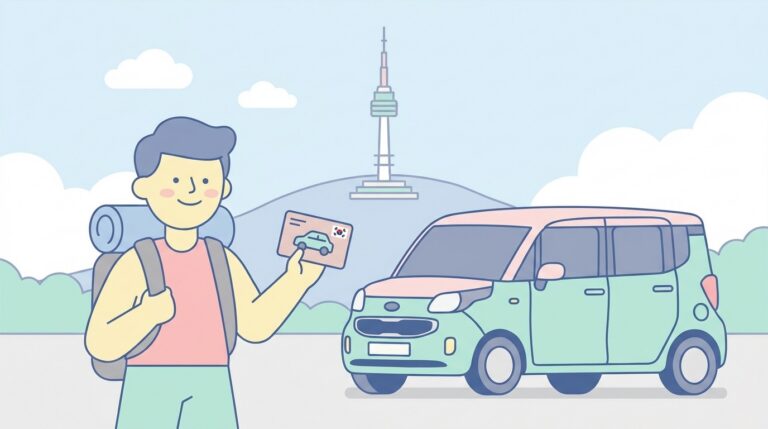
Phase 1: Why You Need This Guide
안녕하세요! 매일한글 에디터입니다. Imagine gearing up for a road trip after binge-watching Europe Outside Your Tent, only to panic at the counter of a Korean Driver’s License Examination Office (운전면허 시험장). You brought your foreign license for the aptitude test (적성검사) and exchange, but you are stressed about needing an International Driving Permit (IDP) for future trips abroad. Here is a game-changer: Korea offers an English-backed Korean driver’s license (영문 운전면허증) that lets you drive in dozens of countries without a separate IDP! Based on real feedback from expats who struggled with confusing forms, this B1 guide gives you the exact phrases to breeze through the counter with total confidence.
Phase 2: Top 3 Core Expressions Deep Dive
1. 영문 운전면허증으로 발급해 주세요 (Yeongmun unjeonmyeonheojeungeuro balgeuphae juseyo)
- Pronunciation: Yeong-mun un-jeon-myeon-heo-jeung-eu-ro bal-geup-hae ju-se-yo (Think of “yeong” like “young” with a rounded “uh”, “bal” like “ball”, and “geup” like “gup” in guppy, kept short without popping the P!)
- Meaning: Literally “Please issue it as an English driver’s license.” In practice, it means “I’d like the version with my details printed in English on the back.”
- K-Culture Moment: Just like the cast of Jinny’s Kitchen or Earth Arcade smoothly picking up rental cars overseas without extra paperwork, Koreans always request this dual-language card when renewing or exchanging licenses.
- Editor’s Insight: The verb 발급하다 (balgeuphada – to issue officially) sounds crisp and administrative. Using -(으)로 (-(eu)ro) specifies the format you want, signaling to the clerk right away that you know the exact option available.
- Situation Spectrum: Casual 🚫 | Semi-formal ✅ | Formal ✅
- 🤔 Think About It: In English, you might ask “Can I get the English version?” as a yes/no question. In Korean, using -아/어 주세요 (-a/eo juseyo) politely directs the action as a smooth request. How does framing requests as direct polite commands vs. permission questions feel in your native language?
2. 외국 면허증을 한국 면허증으로 교환하러 왔어요 (Oeguk myeonheojeungeul hanguk myeonheojeungeuro gyohwanhareo wasseoyo)
- Pronunciation: Oe-guk myeon-heo-jeung-eul han-guk myeon-heo-jeung-eu-ro gyo-hwan-ha-reo wa-sseo-yo (“Oe” sounds like “weh” in “wet”, “gyo” like “gyoza”, and “wasseoyo” flows smoothly like “wah-ssuh-yo”.)
- Meaning: Literally “I came to exchange a foreign license for a Korean license.” Real nuance: “I’m here to convert my home country’s driver’s license.”
- K-Culture Moment: Picture a heartfelt K-Drama relocation montage where the protagonist settles into Seoul, visits a government center, and politely announces their purpose at the desk to start a new chapter.
- Editor’s Insight: The grammar pattern -(으)러 오다 (-(eu)reo oda – to come in order to) is the ultimate B1 lifesaver at any Korean office. Note that 교환 (gyohwan) means “exchange,” which accurately reflects that many offices temporarily hold your foreign card during conversion!
- Situation Spectrum: Casual 🚫 | Semi-formal ✅ | Formal ✅
- 🤔 Think About It: Korean relies heavily on “purpose + came” (하러 왔어요 – hareo wasseoyo) at service counters rather than “I need to…” Why do you think stating your physical arrival and purpose feels more natural in Korean customer interactions?
3. 별도의 국제면허증 없이도 운전할 수 있나요? (Byeoldoui gukjemyeonheojeung eopsido unjeonhal su innayo?)
- Pronunciation: Byeol-do-ui guk-je-myeon-heo-jeung eop-si-do un-jeon-hal su in-na-yo? (“Byeol” rhymes with “girl” starting with a B+Y, “eop-si-do” sounds like “up-she-dough”, and “innayo” glides like “een-nah-yo”.)
- Meaning: Literally “Can I drive even without a separate international license?” Real nuance: “Does this card really let me skip getting an IDP?”
- K-Culture Moment: Imagine an episode of I Live Alone where a star excitedly plans a spontaneous weekend drive in Australia or the UK and double-checks the rules with a friend over iced Americano.
- Editor’s Insight: Adding -도 (-do – even/also) to 없이 (eopsi – without) emphasizes relief and disbelief—”Wait, even without that extra booklet?” Ending with -나요? (-nayo?) softens the question so you sound polite and genuinely curious rather than demanding.
- Situation Spectrum: Casual ⚠️ | Semi-formal ✅ | Formal ✅
- 🤔 Think About It: Korean packs “separate” (별도의 – byeoldoui) and “even without” (없이도 – eopsido) tightly before the verb. How does your language highlight that an extra step is no longer necessary?
Phase 3: Textbook Korean vs. Real Korean
Situation 1: Choosing the English-Backed Card
- 📖 교과서 한국어 (Textbook Korean): 저는 뒷면에 영어가 적힌 운전면허증을 신청하고 싶습니다. (Jeoneun dwinmyeone yeongeo-ga jeokhin unjeonmyeonheojeungeul sincheonghago sipseumnida. – I would like to apply for a driver’s license that has English written on the back.)
- 🗣️ 진짜 한국어 (Real Korean): 저, 영문 면허증으로 해 주세요! (Jeo, yeongmun myeonheojeungeuro hae juseyo! – Excuse me, please make it the English license!)
- 💡 왜 다를까? (Why the difference?): In fast-paced Korean administrative offices, nobody describes the card’s layout in full sentences! Clerks use the snappy compound 영문 면허증 (yeongmun myeonheojeung) and the versatile verb 해 주세요 (hae juseyo – please do it as…) to keep the line moving smoothly.
Situation 2: Asking Where to Take the Aptitude Test (Eye Exam)
- 📖 교과서 한국어 (Textbook Korean): 적성검사를 받으려면 어느 방으로 가야 합니까? (Jeokseonggeomsareul badeuryeomyeon eoneu bangeuro gaya hamnikka? – Which room must I go to in order to take the aptitude test?)
- 🗣️ 진짜 한국어 (Real Korean): 적성검사는 어디서 해요? (Jeokseonggeomsaneun eodiseo haeyo? – Where do I do the aptitude test?)
- 💡 왜 다를까? (Why the difference?): While -려면 -야 합니까 is great grammar practice, real life runs on efficiency. Using the topic marker -는 (-neun) plus 어디서 해요? (eodiseo haeyo? – where is it done?) is natural, polite, and instantly understood everywhere from hospitals to license centers.
Phase 4: K-Culture Deep Dive & Non-Verbal Manners
4-1. Nunchi (눈치) & Gestures at the License Office
Walking into a Korean 운전면허 시험장 (unjeonmyeonheo siheomjang – Driver’s License Examination Office) can feel intimidating, but mastering Nunchi makes you look like a local pro:
* Grab the Ticket First: Before approaching any counter, look for the kiosk or dispenser and pull a 번호표 (beonhopyo – waiting number ticket). Waiting calmly until your number chimes shows great civic nunchi.
* Two-Handed Document Handoff: When handing over your passport, ARC (Alien Registration Card), and foreign license, hold the stack with both hands (or support your right forearm with your left hand). It instantly earns warm smiles from busy staff.
* Quick Nod & Steady Pace: Give a light 15-degree nod when greeted. Korean public offices run on friendly ppalli-ppalli (빨리빨리 – fast efficiency), so keep your documents out of folders and ready to scan!
4-2. Cultural Code Analysis: K-Travel & The Joy of Hassle-Free Driving
In modern Korean travel culture—seen constantly in hit variety shows like Youth Over Flowers or Europe Outside Your Tent—spontaneous road trips are huge! Because Koreans love maximizing short holidays, standing in line for an IDP every year used to be a major headache. That is why the 영문 운전면허증 (English-backed license) became an instant hit after its introduction: one sleek plastic card in your wallet covers both domestic driving in Jeju Island and overseas adventures in over 60 participating countries!
Phase 5: Real-Life Roleplay Scenario
Setting: Tuesday morning at the Gangnam Driver’s License Examination Office. The air smells faintly of fresh paper, digital chimes ring gently in the background, and Officer Min-ji—efficient, sharp, and secretly super kind to foreigners—calls number 104.
- Officer Min-ji: 104번 손님, 어서 오세요! 어떤 업무로 오셨어요? (Baeksabeon sonnim, eoseo oseyo! Eotteon eommuro osyeosseoyo? – Guest 104, welcome! What service did you come for today?) 🎭 Looks up warmly from her dual monitor, hands ready to receive documents.
- You: 안녕하세요! 외국 면허증을 한국 면허증으로 교환하러 왔어요. (Annyeonghaseyo! Oeguk myeonheojeungeul hanguk myeonheojeungeuro gyohwanhareo wasseoyo. – Hello! I came to exchange my foreign license for a Korean one.) 🎭 Hands over passport, ARC, and foreign license using both hands.
- Officer Min-ji: 네, 서류 잘 챙겨 오셨네요. 먼저 지하 1층에서 적성검사 받고 오셔야 해요. (Ne, seoryu jal chaenggyeo osyeonneyo. Meonjeo jiha ilcheungeseo jeokseonggeomsa batgo osyeoya haeyo. – Yes, you brought all your documents well. First, you need to go to B1 to take the aptitude test and come back.) 🎭 Stamps a form briskly and points toward the elevator.
- You: 아, 적성검사는 시력검사만 하는 건가요? (A, jeokseonggeomsaneun siryeokgeomsaman haneun geongayo? – Oh, is the aptitude test just a vision test?) 🎭 Tilts head curiously while holding the stamped sheet.
- Officer Min-ji: 맞아요! 5분이면 끝나요. 아, 그리고 일반 국문으로 드릴까요, 영문으로 드릴까요? (Majayo! Obunimyeon kkeutnayo. A, geurigo ilban gungmuneuro deurilkkayo, yeongmuneuro deurilkkayo? – That’s right! It takes 5 minutes. Oh, and should I make it the standard Korean-only one or the English-backed one?) 🎭 Hovers her pen over two checkboxes on the application.
- You: 영문 운전면허증으로 발급해 주세요! (Yeongmun unjeonmyeonheojeungeuro balgeuphae juseyo! – Please issue it as the English-backed driver’s license!) 🎭 Smiles brightly and points eagerly to the English box.
- Officer Min-ji: 좋은 선택이에요! 별도의 국제면허증 없이도 협약된 여러 나라에서 운전할 수 있어요. (Joeun seontaegieyo! Byeoldoui gukjemyeonheojeung eopsido hyeobyakdoen yeoreo naraeseo unjeonhal su isseoyo. – Great choice! Without a separate IDP, you can drive in many participating countries.) 🎭 Clicks the checkbox and hands back a receipt.
- You: 정말 편하네요! 그럼 검사받고 바로 다시 올게요. (Jeongmal pyeonhaneyo! Geureom geomsabatgo baro dasi olgeyo. – That’s so convenient! Then I’ll take the test and come right back.) 🎭 Gives a polite nod and heads toward the stairs.
🔀 Interactive Branching Point
Right after you finish the 5-minute vision test, you return to the counter to pay the issuance fee (slightly higher for the English-backed card—around 10,000 KRW vs. 8,000 KRW for standard!). How do you respond when Officer Min-ji asks how you’ll pay?
* A) 카드로 결제할게요. 영수증도 부탁드려요! (Kadeuro gyeoljehalgeyo. Yeongsujeungdo butakdeuryeoyo! – I’ll pay by card. Receipt too, please!)
* B) 왜 더 비싸요? 그냥 싼 걸로 바꿔 줘. (Wae deo bissayo? Geunyang ssan geollo bakkwo jwo. – Why is it more expensive? Just switch it to the cheap one.)
* C) 카드 돼요? 현금 없는데… (Kadeu dwaeyo? Hyeonguem eomneunde… – Do you take cards? I don’t have cash…)
Feedback:
* Option A (Best ✅): Polite, natural, and crisp! Using -ㄹ게요 (-lgeyo) and 부탁드려요 (butakdeuryeoyo) shows top-tier B1 fluency and smooth office etiquette.
* Option B (Bad 🚫): Dropping into banmal (줘 – jwo) with a civil servant sounds rude and abrupt. Even if you change your mind, always keep -요 (-yo)!
* Option C (Risk ⚠️): Grammatically fine and understandable, though Korea is nearly cashless at government offices—so asking if cards work might get a surprised chuckle, and trailing off with -는데 (-neunde) sounds a bit flustered.
Phase 6: 10-Second Emotion Shadowing Drill
Read each line aloud with the rhythm slashes (/) and feel the emotion!
- [😊 Cheerful & Confident]
영문 운전면허증으로 / 발급해 주세요!
(Yeongmun unjeonmyeonheojeungeuro / balgeuphae juseyo! – Please issue it as an English-backed driver’s license!) -
[🤔 Curious & Polite]
별도의 국제면허증 없이도 / 운전할 수 있나요?
(Byeoldoui gukjemyeonheojeung eopsido / unjeonhal su innayo? – Can I drive without a separate international permit?) -
[😌 Relieved & Impressed]
아, 적성검사가 / 생각보다 진짜 빨리 끝나네요!
(A, jeokseonggeomsaga / saenggakboda jinjja ppalli kkeutnaneyo! – Oh, the aptitude test finishes way faster than I thought!)
Phase 7: K-Culture Mini Dictionary
- 적성검사 (jeokseonggeomsa) | Aptitude Test (Physical/Vision Check) | In Korea, this sounds intense like a career quiz, but for a license exchange or renewal, it usually just means a quick 5-minute vision check at the testing center’s basement clinic.
- 영문 운전면허증 (yeongmun unjeonmyeonheojeung) | English-Backed Driver’s License | A Korean driver’s license displaying your name, license class, and issue dates in English on the reverse side, accepted across 60+ countries.
- 국제운전면허증 (gukjeunjeonmyeonheojeung) | International Driving Permit (IDP) | The paper booklet valid for one year; you still need it for countries not yet on Korea’s English-license recognition list (like Japan or certain European nations).
- 번호표 (beonhopyo) | Queue Number Ticket | Essential survival noun in Korean banks, post offices, and license centers. Always grab one first (
번호표 뽑으세요 - Pull a ticket)!
Phase 8: Traveler’s Survival Kit
Top 3 Survival Expressions
- 여권하고 외국인등록증 여기 있어요. (Yeogwonhago oegugindeungnokjeung yeogi isseoyo. – Here are my passport and ARC.)
- Pro Tip: Keep your passport, ARC, original foreign license, and 3 passport-size photos (3.5×4.5cm) clipped together before stepping up.
- 어디로 가면 되나요? (Eodiro gamyeon doenayo? – Where should I go?)
- Pro Tip: Use this magic GPS phrase whenever you get lost between the photo booth, vision test room, and main counter.
- 오늘 바로 나오나요? (Oneul baro naonayo? – Does it come out right today?)
- Pro Tip: Spoiler: YES! Most Korean Driver’s License Examination Offices print your shiny new card in 15–30 minutes!
Editor’s Travel Note
- Navigate Like a Local: Google Maps struggles with walking and driving routes in Korea. Be sure to Download the Naver Map App for Korean Directions or Install KakaoMap for Real-Time Bus and Subway Routes before heading to your nearest examination center.
- Check Country Compatibility: Before flying abroad without an IDP, Verify the Korea Road Traffic Authority English License Country List because rules vary by destination (for example, the UK, Australia, Canada, and many US states accept it, while some countries still require an IDP).
- Payment Tip: Bring a Korean debit/credit card or T-money-linked card; the English-backed license issuance fee is roughly 10,000 KRW, plus around 6,000 KRW for the quick vision test.
Phase 9: One Step Deeper (Cultural Essay)
Have you ever wondered why getting a physical driver’s license in Korea takes 20 minutes instead of 4 weeks in the mail? In Korean society, administrative speed—often tied to ppalli-ppalli (빨리빨리) culture—isn’t about rushing carelessly; it is viewed as a form of respect for the citizen’s time. Behind the scenes, government offices connect ID databases, medical checks, and card printers seamlessly so you can walk out ready to drive that very afternoon. Even the creation of the 영문 운전면허증 reflects Korea’s hyper-practical mindset: why make millions of travelers carry an extra paper booklet when one smart card can do the job?
💬 Your Turn: How long does it take to get or exchange a driver’s license in your home country—and what surprised you most about Korean administrative speed? Drop your story in the comments!
Phase 10: FAQ & Common Mistakes
Q: Can I drive in EVERY country with the English-backed Korean driver’s license?
A: Not every country! While over 60 countries and territories (including Australia, the UK, Singapore, Canada, and participating US states) recognize it, major destinations like Japan and some EU nations still require a traditional paper IDP. Always verify your exact destination before your flight.
Q: Do I lose my home country’s driver’s license when I exchange it in Korea?
A: In many cases, the Korean Driver’s License Examination Office holds your foreign license temporarily and returns it when you show proof of a flight departing Korea—though rules depend on bilateral agreements with your specific country. Always ask politely: 제 원래 면허증은 나중에 돌려받나요? (Je wollae myeonheojeungeun najunge dollyeobannayo? – Do I get my original license back later?)
Q: What happens during the aptitude test (적성검사) for a foreign license exchange?
A: Don’t worry—there’s no driving course or written test if your country has a reciprocity agreement with Korea! Usually, 적성검사 simply means a quick 5-minute vision screening (reading numbers/letters with or without your glasses) and confirming basic physical fitness.
🚨 Common Mistakes TOP 3
- Mistake: Bringing an American-size 2×2 inch photo instead of Korean passport size (3.5 x 4.5 cm).
- Correct Action: Use the instant photo booth (
즉석 사진기 - jeukseok sajingi) right inside the Korean license center or visit a local studio beforehand.
- Correct Action: Use the instant photo booth (
- Mistake: Expecting your foreign license apostille/embassy verification to happen at the license center.
- Correct Action: Prepare your embassy notarization or apostille before visiting the 운전면허 시험장!
- Mistake: Saying 국제면허증 주세요 (Gukjemyeonheojeung juseyo – Give me an IDP) when you actually want the English-backed Korean license.
- Correct Action: Clearly say 영문 운전면허증으로 발급해 주세요 (Yeongmun unjeonmyeonheojeungeuro balgeuphae juseyo) so they print the dual-language card instead of issuing a 1-year paper booklet.
Phase 11: Action Mission & Engagement
- 🥉 Bronze Mission (Solo Practice): Record yourself on your phone saying all 3 Phase 2 expressions three times, focusing on smooth pronunciation of 영문 운전면허증 (yeongmun unjeonmyeonheojeung).
- 🥈 Silver Mission (Share & Connect): Screenshot your favorite phrase from Phase 3 and share it on Instagram Stories or with a fellow expat friend in Korea who hasn’t converted their license yet!
- 🥇 Gold Mission (Real-World Action): Visit your local 운전면허 시험장 (or even a Korean police station civil affairs desk) and use “영문 운전면허증으로 발급해 주세요” in real life!
- 🎮 K-Culture Mission: Watch a Korean travel variety show like Earth Arcade or Europe Outside Your Tent this week and spot the moment the cast checks into a rental car counter—listen closely for words like 면허증 (myeonheojeung) and 운전 (unjeon)!
Phase 12: Interactive Quiz Challenge
Quiz 1 (Situational Judgment): You want the Korean plastic driver’s license that has English printed on the back so you don’t need an IDP for your trip to Australia. What should you say to the clerk?
A) 국제면허증으로 바꿔 주세요. (Gukjemyeonheojeungeuro bakkwo juseyo.)
B) 영문 운전면허증으로 발급해 주세요. (Yeongmun unjeonmyeonheojeungeuro balgeuphae juseyo.)
C) 적성검사 필요 없어요. (Jeokseonggeomsa piryo eopseoyo.)
Check Answer & Explanation
Correct Answer: B! Saying 영문 운전면허증으로 발급해 주세요 specifically requests the English-backed Korean card. Option A asks for a separate 1-year paper IDP, and Option C wrongly claims you don’t need the aptitude test!
Quiz 2 (Fill in the Blank): Complete this polite sentence to ask where the vision check is:
“________는 어디서 해요?” (Where do I take the aptitude test?)
Check Answer & Explanation
Correct Answer: 적성검사 (jeokseonggeomsa)! Putting it together: 적성검사는 어디서 해요? (Jeokseonggeomsaneun eodiseo haeyo?) is the natural, everyday way Koreans ask at the center.
Quiz 3 (True / False Culture Quiz):
“Once you get an English-backed Korean driver’s license (영문 운전면허증), you can drive in every single country in the world without an International Driving Permit.”
Check Answer & Explanation
Correct Answer: False! While it works in over 60 participating countries (such as the UK, Australia, Canada, and many US states), some countries like Japan still require a paper IDP (국제운전면허증). Always check the official list before traveling!
🎬 Watch Our Daily Videos! (Daily Hangul Official Instagram)
Review the expressions you learned in this article with our fun daily short videos! Check out native pronunciation and real-life nuances in action.
- Instagram @dailyhangul_en







