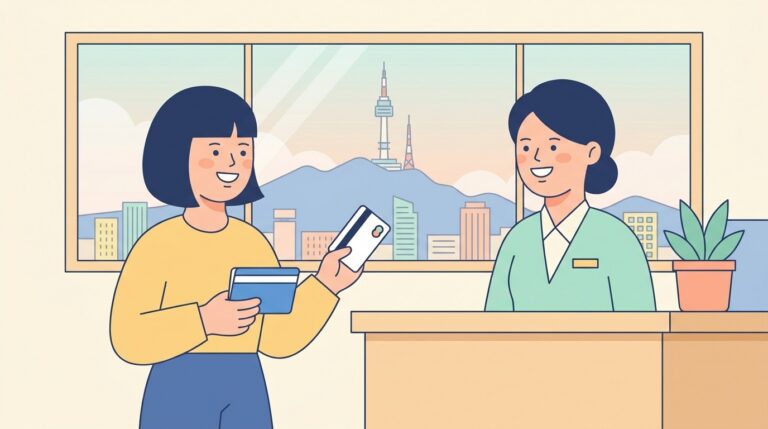
Phase 1: Why Korean Banks Feel Scary (And How to Conquer Them)
안녕하세요! 매일한글 에디터입니다. (Annyeonghaseyo! Maeil Hangeul editeo-imnida. – Hello! I’m your Daily Hangul Editor.) Have you ever watched a K-Drama like Business Proposal where the character celebrates their first paycheck? That used to be my dream in Seoul! Then I walked into a real Korean bank, pulled a paper number ticket, and froze when the clerk called me. Explaining that I needed one account for my salary and everyday living expenses felt impossible! Many Daily Hangul learners shared this exact struggle, so we created this A2 guide from real classroom feedback. Master these three easy phrases today, and you will open your bank account like a confident local!
Phase 2: Top 3 Essential Phrases Deep Dive
1. 통장 만들고 싶어요 (Tongjang mandeulgo sipeoyo)
- Pronunciation: Tong-jang man-deul-go si-peo-yo (Think: “tong” like a gong, “mahn-dool-go”, “shee-puh-yo” — soft and friendly!)
- Meaning: Literally “I want to make a bankbook.” Actually means “I want to open a bank account.”
- K-Culture Moment: Imagine the rookie intern in the hit drama Misaeng nervously walking into a bank on his first week at work to get ready for payday.
- Editor’s Insight: Textbooks love the word 계좌 (gyejwa – account), and Koreans say “bankbook” (통장 – tongjang) in everyday life! Even if everything is digital now, saying 통장 sounds 10x more natural.
- Situation Spectrum: Casual ⚠️ (drop 요: 통장 만들고 싶어) | Semi-formal ✅ | Formal ✅ (change to: 통장 만들고 싶습니다)
- 🤔 Think About It: Why do Koreans still say “make a book” when banking happens on smartphones? Does your language also keep old physical words for modern digital things?
2. 급여 통장이랑 입출금 통장이요 (Geubyeo tongjang-irang ipchulgeum tongjang-iyo)
- Pronunciation: Geub-yeo tong-jang-i-rang ip-chul-geum tong-jang-i-yo (Think: “goob-yuh” with a short “oo” like in “book”, “ee-rang”, “eep-chool-goom” — take a breath after 이랑!)
- Meaning: Literally “a salary bankbook and an in-and-out-money bankbook.” Actually means “a salary account and a checking account for everyday use.”
- K-Culture Moment: In Korean lifestyle vlogs, young workers love comparing which bank gives the best coffee coupons or zero transfer fees on their salary account.
- Editor’s Insight: Mentioning 급여 통장 (salary account) is a secret superpower! Many banks waive annoying ATM fees when your paycheck lands there. And remember, 입출금 통장 simply means a regular checking account where money goes in (입) and out (출) freely.
- Situation Spectrum: Casual ⚠️ | Semi-formal ✅ | Formal ✅
- 🤔 Think About It: In Korea, your paycheck account and daily spending account can actually be the same account with special benefits. How do people separate or combine money in your home country?
3. 체크카드도 발급해 주세요 (Chekeukadeudo balgeupae juseyo)
- Pronunciation: Che-keu-ka-deu-do bal-geup-hae ju-se-yo (Think: “check-oo-card-oo-doh” like English “check card” with soft “oo” sounds, “bahl-goop-heh joo-seh-yo”)
- Meaning: Literally “please also issue a check card.” Actually means “please give me a debit card too.”
- K-Culture Moment: Every time you see a K-Drama character tap their card at a convenience store for late-night ramyeon, they are usually using a 체크카드!
- Editor’s Insight: Watch out! If you say “debit card” in English, the bank clerk might pause in confusion. In Korea, debit cards are strictly called “check cards” (체크카드). Adding 도 (-do, “also”) politely bundles it with your new account.
- Situation Spectrum: Casual 🚫 (never drop polite endings with bank staff!) | Semi-formal ✅ | Formal ✅
- 🤔 Think About It: Why do you think Korea adopted the word “check card” instead of “debit card”? Borrowing English words and giving them a Korean twist (Konglish) is super common in Korean finance!
Phase 3: Textbook Korean vs. Real Korean
Situation 1: Explaining how you will use the account
- 📖 Textbook Korean: 생활비로 사용할 입출금 통장을 개설하고자 합니다. (Saenghwalbiro sayonghal ipchulgeum tongjangeul gaeseolhagoja hamnida. – I intend to open a checking account to use for living expenses.)
- 🗣️ Real Korean: 생활비로 쓸 입출금 통장 하나 만들고 싶어요. (Saenghwalbiro sseul ipchulgeum tongjang hana mandeulgo sipeoyo. – I want to open one checking account for living expenses.)
- 💡 Why the difference? Textbooks love formal Hanja words like 개설하다 (open) and 사용하다 (use), which make you sound like a legal contract! Real Koreans use 쓸 (to use) and 만들다 (to make) with 하나 (one) to sound warm and human.
Situation 2: Checking if you can get a card with the account
- 📖 Textbook Korean: 이 계좌와 연결된 체크카드를 발급받을 수 있습니까? (I gyejwawa yeongyeoldoen chekeukadeureul balgeupbadeul su itseumnikka? – Can I be issued a check card linked to this account?)
- 🗣️ Real Korean: 이걸로 체크카드도 같이 되죠? (Igeollo chekeukadeudo gachi doejyo? – I can get a debit card together with this too, right?)
- 💡 Why the difference? In busy Korean banks, people keep things short and friendly. Using 이걸로 (with this) and ~죠? (right?) invites the clerk to nod and say “Of course!”
Phase 4: K-Culture Deep Dive & Non-Verbal Manners
4-1. Nunchi (눈치) & Body Language at the Bank
Korean banks are calm, organized, and surprisingly quiet. First, never walk straight up to an empty desk! Look near the entrance for a kiosk that prints a 번호표 (beonhopyo – number ticket). Wait in the seating area until your number chimes and flashes on the big screen. When called, bow your head slightly and hand over your passport and Alien Registration Card (ARC) with both hands—this tiny gesture instantly wins respect and extra patience from the clerk!
4-2. Cultural Code: First Paycheck Pride & Cashless Korea
In K-Dramas and Korean society, opening your first salary account is a huge milestone into adulthood. Traditionally, Koreans used their first paycheck to buy warm red underwear (a symbol of good luck!) or treat their parents to Korean BBQ. Also, welcome to the world’s most cashless country! You won’t need heavy coins in Korea. When you ask for your 체크카드 (debit card), you can add a transit function (교통카드 – gyotongkadeu) right onto it so the same card pays for your morning coffee and your subway ride.
Phase 5: Real-Life Roleplay Scenario
Setting: A bright Tuesday morning at a bank branch in Seoul. Gentle classical music plays in the background.
NPC: Minji, a super-kind bank clerk wearing a neat navy suit and a pastel scarf.
- Minji: 어서 오세요, 손님. 어떤 일로 오셨어요? (Eoseo oseyo, sonnim. Eotteon illo osyeosseoyo? – Welcome. What brings you in today?) 🎭 Smiles warmly and looks up from her monitor.
- You: 안녕하세요. 통장 만들고 싶어요. (Annyeonghaseyo. Tongjang mandeulgo sipeoyo. – Hello. I want to open a bank account.) 🎭 Sits down and places your passport and ARC on the counter with two hands.
- Minji: 네, 어떤 통장 필요하세요? (Ne, eotteon tongjang piryohaseyo? – Yes, what kind of account do you need?) 🎭 Checks your ID carefully and types on her keyboard.
- You: 급여 통장이랑 평소 생활비로 쓸 입출금 통장이요. (Geubyeo tongjang-irang pyeongso saenghwalbiro sseul ipchulgeum tongjang-iyo. – A salary account and a checking account for everyday living expenses.) 🎭 Hands over your employment contract.
- Minji: 아, 그러면 하나로 같이 쓰셔도 돼요! (A, geureomyeon hanaro gachi sseushyeodo dwaeyo! – Oh, then you can use one account for both!) 🎭 Shows you an account brochure with a friendly nod.
- You: 아, 진짜요? 그럼 그렇게 해 주세요! (A, jinjjayo? Geureom geureoke hae juseyo! – Oh, really? Then please do it like that!) 🎭 Smiles with huge relief.
- Minji: 네. 체크카드도 필요하세요? (Ne. Chekeukadeudo piryohaseyo? – Yes. Do you need a debit card too?) 🎭 Holds up two sleek card designs.
- You: 네, 체크카드도 발급해 주세요. 교통카드도 넣어 주세요! (Ne, chekeukadeudo balgeupae juseyo. Gyotongkadeudo neoeo juseyo! – Yes, please issue a debit card too. Please add the transit card feature as well!) 🎭 Points happily at the cute card design.
🔀 Interactive Branching Point!
Minji slides a paper form across the desk and asks why you are opening the account (to prevent financial scams). How do you reply?
- Choice A: “월급 받으려고요.” (Wolgeup badeuryeogoyo. – To receive my salary.)
- Feedback (Best! 🌟): Clear, honest, and matches your contract! Minji happily approves your account.
- Choice B: “비밀이에요.” (Bimirieyo. – It’s a secret.)
- Feedback (Bad! ❌): Oh no! Korean banks have ultra-strict anti-scam rules. Joking that it’s a secret will immediately freeze the process.
- Choice C: “그냥요.” (Geunyangyo. – Just because.)
- Feedback (Risk! ⚠️): Too vague! Minji will look worried and ask you for three more documents to prove you aren’t being scammed.
Phase 6: 10-Second Emotion Shadowing Drill
Read out loud with energy! Pause briefly at every / mark.
- [😊 Hopeful and polite] 통장 / 만들고 / 싶어요. (Tongjang / mandeulgo / sipeoyo.)
- [💼 Proud and clear] 급여 통장이랑 / 생활비로 쓸 / 입출금 통장이요. (Geubyeo tongjang-irang / saenghwalbiro sseul / ipchulgeum tongjang-iyo.)
- [🤩 Excited for your new card] 체크카드도 / 발급해 / 주세요! (Chekeukadeudo / balgeupae / juseyo!)
Phase 7: K-Culture Mini Dictionary
- 입출금 통장 (Ipchulgeum tongjang) | Checking account | Your everyday workhorse account for rent, café runs, and sending money to friends after Korean BBQ.
- 급여 통장 (Geubyeo tongjang) | Salary account | Usually your normal checking account upgraded with “salary status” to unlock free ATM withdrawals and interest perks.
- 체크카드 (Chekeukadeu) | Debit card | Korea’s ultimate daily tool! You will tap it at convenience stores, cafes, and even subway gates.
- 비밀번호 (Bimilbeonho) | PIN / Password | At Korean bank counters and ATMs, this is a 4-digit code. Pro tip: Do not use your birthday or “1234”!
Phase 8: Survival Kit for Expats & Travelers
Top 3 Bank Survival Phrases
- 번호표 어디 있어요? (Beonhopyo eodi isseoyo?) — “Where is the number ticket machine?”
Pro Tip: Always grab your paper number before sitting down, or you might wait for an hour without being called! - 교통카드 돼요? (Gyotongkadeu dwaeyo?) — “Does it work as a transit card?”
Pro Tip: Say this when picking your card design so you never have to top up a separate T-money card. - 수수료 있어요? (Susuryo isseoyo?) — “Is there a fee?”
Pro Tip: Handy at ATMs late at night or when transferring money to another bank.
Editor’s Travel Note
Before heading out, Download Naver Map App to find the closest bank branch—Google Maps doesn’t show accurate walking routes in Korea! Also, watch the clock: most Korean banks close at 4:00 PM (and some even close at 3:30 PM). Always carry your passport, ARC, and employment certificate, and double-check rules on the Korea Immigration Service Guide if your ARC is still being processed.
Phase 9: One Step Deeper — Why So Many Questions?
If a Korean bank clerk asks you lots of questions—like where you live, where you work, and why you need a bank account—don’t feel offended! In recent years, Korea has fought hard against voice-phishing scams, so banks follow strict community-protection laws. Rather than distrusting you personally, the clerk is protecting both you and the banking system. Having your paperwork neatly ready shows great 눈치 (social awareness) and turns a strict check into a warm, welcoming interaction.
💬 Your Turn: Have you ever had a funny or nervous moment at a bank abroad? Share your story in the comments below—I read every single one!
Phase 10: FAQ & Common Mistakes
Q: Can I open a Korean bank account on a tourist visa?
A: Usually, no. Since anti-fraud laws tightened, most major Korean banks require an Alien Registration Card (ARC) and proof of residence or employment (like a job contract or university enrollment letter).
Q: Why did the clerk put a daily transfer limit on my new account?
A: Almost all new accounts in Korea start as a “limited account” (한도제한계좌 – handojehangyejwa) with a small daily transfer cap (around 300,000 to 1,000,000 KRW). Once you show your salary contract or pay a few bills, they happily lift the limit!
Q: Do I need two separate accounts for my salary and living expenses?
A: Nope! Most people use one single 입출금 통장 (checking account) as their 급여 통장 (salary account) and everyday spending account. It keeps things super simple!
🚨 Common Mistakes TOP 3
- Asking for a “debit card” in English: Clerks may think you want a rare international card or get confused. Correct Action: Always say 체크카드 (chekeukadeu)!
- Arriving at 4:15 PM: Unlike shops or cafes that stay open late, Korean banks shut their doors early. Correct Action: Arrive before 3:00 PM so you have plenty of time.
- Forgetting your Korean phone number: Korean banks link everything to a local phone number for text verification. Correct Action: Get your Korean SIM card and phone number before visiting the bank.
Phase 11: Action Mission & Engagement
- 🥉 Bronze Mission: Stand in front of your mirror and say all 3 key phrases from Phase 2 out loud three times using the 10-second shadowing pauses.
- 🥈 Silver Mission: Screenshot your favorite phrase from this guide and share it on Instagram or with your study buddy, tagging #DailyHangul!
- 🥇 Gold Mission: Next time you step into a Korean bank (or roleplay with a Korean tutor), greet them with “통장 만들고 싶어요” and remember to pass your ID with two hands!
- 🎮 K-Culture Mission: Watch an office K-Drama (like Misaeng or King the Land) or a Seoul daily vlog this week and spot someone tapping a 체크카드 at a cafe or convenience store!
Phase 12: Interactive Quiz Challenge
Test your new banking superpowers! Click the toggle below after you make your guesses.
1. Situation Judgment: You are at the counter and want a debit card linked to your new checking account. What is the BEST thing to say?
A) 데빗카드 주세요. (Debit card juseyo.)
B) 체크카드도 발급해 주세요. (Chekeukadeudo balgeupae juseyo.)
C) 통장 싫어요. (Tongjang sireoyo.)
2. Fill in the Blank:
“I want to open a salary account.” → ____ 통장 만들고 싶어요. (____ tongjang mandeulgo sipeoyo.)
3. True or False:
In Korea, most banks stay open until 6:00 PM on weekdays just like regular offices. (True / False)
👇 Click here to reveal the answers & explanations!
1. Answer: B) 체크카드도 발급해 주세요.
Feedback: If you picked A, remember “debit card” isn’t used in Korea—always say 체크카드! And C means “I hate bankbooks”—definitely don’t say that at a bank! 😂
2. Answer: 급여 (Geubyeo)
Explanation: 급여 통장 means salary account! Saying 급여 통장 만들고 싶어요 lets the clerk know you want an account for your paycheck.
3. Answer: False!
Explanation: Most Korean banks close around 4:00 PM (and sometimes 3:30 PM), so always go early in the day!
🎬 Watch Our Daily Videos! (Daily Hangul Official Instagram)
Review the expressions you learned in this article with our fun daily short videos! Check out native pronunciation and real-life nuances in action.
- Instagram @dailyhangul_en