

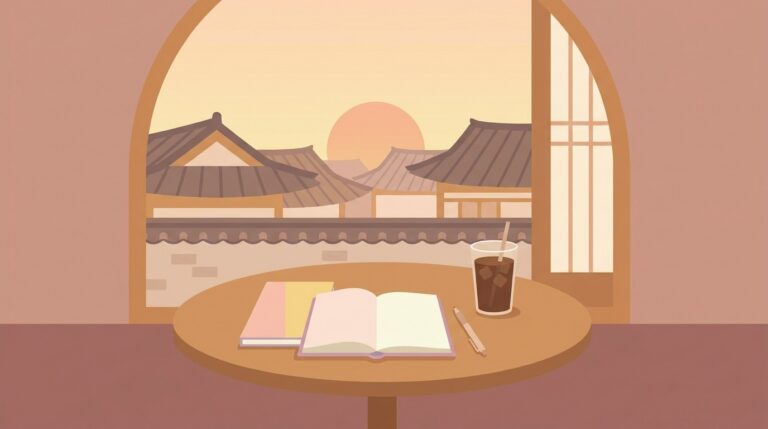
Phase 1: Why Korean Diaries Feel Scary (And How to Start Easy)
안녕하세요! 매일한글 에디터입니다. (Annyeonghaseyo! Maeil Hangeul editeoimnida.) Hello! I’m your Daily Hangul Editor. Ever bought a cute pastel notebook to start a Korean diary on Sunday, only to stare at the blank page for twenty minutes? You are not alone! Just like K-drama leads jotting down secrets in cozy Seoul cafes, journaling is a fun weekend hobby. Based on real feedback from hundreds of A1 beginners, today’s guide shares easy, bite-sized phrases so you can talk about your free time and write in Korean little by little—zero stress, maximum confidence!
Phase 2: Top 3 Key Expressions Deep Dive
1. 한국어 일기를 조금씩 써요 (Hangugeo ilgireul jogeumssik sseoyo)
- Pronunciation: Hahn-goo-guh il-gee-reul jo-geum-ssik ssuh-yo (Think of “sseo” like saying “sun” without the ‘n’, starting with a crisp, gentle snake-like “ss”!)
- Meaning: Literal: “I write a Korean diary little by little.” / Real Nuance: “I’m casually practicing Korean journaling bit by bit—nothing too serious yet!”
- K-Culture Moment: Imagine a cozy scene in a slice-of-life K-drama like Hospital Playlist or Hometown Cha-Cha-Cha, where a character sits on a wooden porch on a sunny Sunday, sipping iced tea and writing just two short lines in their notebook.
- Editor’s Insight: Adding 조금씩 (jogeumssik) is magic for beginners! It lowers expectations immediately, letting Korean friends know you are taking baby steps and proud of your steady effort.
- Situation Spectrum: Casual ✅ (drop 요) / Semi-formal ✅ (perfect!) / Formal ⚠️ (use 씁니다 sseumnida in speeches)
- 🤔 Think About It: In English, saying “I’m writing a diary” sounds complete on its own. Why do you think Koreans love adding words like “조금씩 (little by little)” when talking about new skills or hobbies?
2. 제 취미는 일기 쓰기예요 (Je chwimineun ilgi sseugiyeyo)
- Pronunciation: Jeh chwee-mee-neun il-gee sseu-gee-yeh-yo (Blend “ch” and “we” fast for “chwi”, and smile wide while saying “uh” for “sseu”!)
- Meaning: Literal: “My hobby is diary-writing.” / Real Nuance: A neat, polite self-introduction phrase when someone asks what you enjoy doing in your free time.
- K-Culture Moment: Think of an idol reality show or a K-Pop fan-sign event where a member introduces their quiet weekend routine to fans, holding up a cute character pen.
- Editor’s Insight: Turning a verb like 쓰다 (sseuda – to write) into a noun is super easy in Korean—just attach -기 (-gi)! So 일기 쓰기 (ilgi sseugi) becomes “diary writing,” ready to drop right into your hobby list.
- Situation Spectrum: Casual ⚠️ (use 내 취미는 nae chwimineun) / Semi-formal ✅ (great for new friends) / Formal ✅ (safe for classes or interviews)
- 🤔 Think About It: Many Western cultures treat hobbies as active sports or big projects. How does your culture view quiet solo hobbies like journaling compared to Korea?
3. 주말에 보통 집에서 쉬어요 (Jumare botong jibeseo swieoyo)
- Pronunciation: Joo-mah-reh bo-tong jee-beh-suh shwee-uh-yo (For “swieo”, say “shh” right into “we-uh” in one smooth breath!)
- Meaning: Literal: “On weekends, I usually rest at home.” / Real Nuance: “I’m a chill homebody on weekends—recharging in pajamas!”
- K-Culture Moment: Every Friday night vlog by Korean YouTubers features this vibe—ordering fried chicken, putting on a face mask, and relaxing indoors away from busy Seoul streets.
- Editor’s Insight: Don’t worry if you don’t have a fancy hobby! In Korea, “resting at home” (집에서 쉬어요 jibeseo swieoyo) is totally respected as a top-tier weekend activity.
- Situation Spectrum: Casual ✅ (drop 요) / Semi-formal ✅ (warm and natural) / Formal ⚠️ (use 쉽니다 swimnida)
- 🤔 Think About It: In English, people sometimes feel guilty saying “I did nothing all weekend.” Why does saying you rested at home feel so relatable and cozy in Korean?
Phase 3: Textbook Korean vs. Real Korean
Situation 1: Sharing your daily Korean practice
- 📖 Textbook Korean: 저는 매일 한국어로 일기를 씁니다. (Jeoneun maeil Hangugeoro ilgireul sseumnida.) — “I write a diary in Korean every day.”
- 🗣️ Real Korean: 저 요즘 한국어 일기 조금씩 써요! (Jeo yojeum Hangugeo ilgi jogeumssik sseoyo!) — “I’m writing a Korean diary little by little these days!”
- 💡 Why the difference? Textbooks love formal
-습니다endings and every single grammar particle. In real coffee-shop chats, Koreans drop extra particles and add 요즘 (yojeum – these days) to sound friendly and warm.
Situation 2: Asking about weekend hobbies
- 📖 Textbook Korean: 당신의 주말 취미는 무엇입니까? (Dangsinui jumal chwimineun mueosimnikka?) — “What is your weekend hobby?”
- 🗣️ Real Korean: 주말에 보통 뭐 해요? (Jumare botong mwo haeyo?) — “What do you usually do on weekends?”
- 💡 Why the difference? Asking directly for “your hobby” (
취미) can feel stiff, like a job interview! Koreans naturally ask what you usually do on weekends (주말에 보통 뭐 해요?) to start a relaxed conversation.
Phase 4: K-Culture Deep Dive & Non-Verbal Manners
4-1. Nunchi (눈치) & Gestures
When you tell a Korean friend 조금씩 써요 (jogeumssik sseoyo – I write little by little), try pinching your thumb and index finger close together—leaving just a tiny gap—with a gentle smile! This small gesture shows humble modesty, a huge green flag in Korean communication. And if you ever hand your open diary to a Korean tutor or older friend to check your sentences, lightly support the bottom of the notebook with both hands as a sweet sign of respect.
4-2. Culture Code: Korea’s “Dakku” (다꾸) Craze
In Korea, journaling isn’t just about grammar—it’s a booming K-Lifestyle trend called 다꾸 (dakku), short for 다이어리 꾸미기 (daieori kkumigi – diary decorating). Head into trendy stationery stores like Artbox or Kakao Friends on any Saturday afternoon, and you’ll see aisles of pastel stickers, masking tape, and glitter pens. Writing just two simple A1 sentences—like “오늘 커피 마셨어요 (Oneul keopi masyeosseoyo – I drank coffee today)”—and adding a cute sticker makes your Korean hobby addictive!
Phase 5: Real-Life Roleplay Scenario
Setting: A sunlit indie café in Yeonnam-dong, Seoul, filled with indie acoustic music and the smell of roasted coffee beans. Across the wooden table sits Minji (민지), a cheerful Korean university student carrying a tote bag bursting with colorful pens and stickers.
- Minji: 안녕하세요! 주말에 보통 뭐 해요? (Annyeonghaseyo! Jumare botong mwo haeyo?) — “Hello! What do you usually do on weekends?” 🎭 Minji leans forward curiously while stirring her iced latte.
- You: 저 주말에 보통 집에서 쉬어요. (Jeo jumare botong jibeseo swieoyo.) — “I usually rest at home on weekends.” 🎭 You smile warmly and hold your warm mug with both hands.
- Minji: 아, 진짜요? 저도 집순이예요! 취미가 뭐예요? (A, jinjjayo? Jeodo jipsuniyeyo! Chwimiga mwoyeyo?) — “Oh, really? I’m a homebody too! What’s your hobby?” 🎭 Minji’s eyes light up as she laughs softly.
- You: 제 취미는 일기 쓰기예요. (Je chwimineun ilgi sseugiyeyo.) — “My hobby is writing a diary.” 🎭 You shyly tap the cute pastel notebook sitting beside your cup.
- Minji: 우와, 멋져요! 한국어로 써요? (Uwa, meotjyeoyo! Hangugeoro sseoyo?) — “Whoa, that’s cool! Do you write in Korean?” 🎭 Minji points excitedly at your notebook.
- You: 네! 한국어 일기를 조금씩 써요. (Ne! Hangugeo ilgireul jogeumssik sseoyo.) — “Yes! I write a Korean diary little by little.” 🎭 You pinch your thumb and finger close together to show “just a little.”
- Minji: 대박! 스티커도 붙여요? 저 다꾸 좋아해요! (Daebak! Seutikeodo buchyeoyo? Jeo dakku johaeyo!) — “Awesome! Do you put stickers on too? I love diary decorating!” 🎭 Minji pulls a sheet of cute bear stickers out of her pouch.
- You: 와, 귀여워요! 저도 오늘 시작할래요! (Wa, gwiyeowoyo! Jeodo oneul sijakallaeyo!) — “Wow, so cute! I’ll start today too!” 🎭 You both giggle while picking out a smiling bear sticker.
🔀 Interactive Branching Point
Right after Turn 6, Minji asks: “일기에 주로 뭐 써요? (Ilgie juro mwo sseoyo? – What do you usually write in your diary?)” How do you reply?
* A: “오늘 날씨하고 제 기분을 써요! (Oneul nalssihago je gibuneul sseoyo! – I write today’s weather and my mood!)” 👉 Best! Simple, natural A1 Korean that keeps the warm café vibe flowing.
* B: “제 비밀을 다 써서 못 보여줘요. (Je bimireul da sseoseo mot boyeojwoyo. – I write all my secrets so I can’t show you.)” 👉 Risk! Funny with close friends, though a bit guarded if you just met.
* C: “당신은 내 일기를 읽지 마십시오. (Dangsineun nae ilgireul ikji masipsio. – You must not read my diary.)” 👉 Bad! Way too stiff and dramatic—sounds like a movie villain!
Phase 6: 10-Second Emotional Shadowing Drill
Read aloud smoothly, pausing briefly at each / and matching the emotion!
- [😊 Happy and proud] 제 취미는 / 일기 쓰기예요! (Je chwimineun / ilgi sseugiyeyo!) — “My hobby is / writing a diary!”
- [🥺 Shy and humble] 한국어 일기를 / 조금씩 써요. (Hangugeo ilgireul / jogeumssik sseoyo.) — “I write a Korean diary / little by little.”
- [✨ Relaxed and cozy] 주말에 보통 / 집에서 쉬어요. (Jumare botong / jibeseo swieoyo.) — “On weekends, I usually / rest at home.”
Phase 7: K-Culture Mini Dictionary
- 일기 (ilgi) | Diary / Journal | Used everywhere from elementary school homework to adult daily planners and K-drama plot twists.
- 다꾸 (dakku) | Diary decorating | Huge weekend hobby trend among Koreans who customize planners with stickers, stamps, and colored pens.
- 집순이 / 집돌이 (jipsuni / jipdori) | Homebody (female / male) | Affectionate slang for people whose favorite hobby is staying cozy indoors all weekend.
- 소확행 (sohwakhaeng) | Small but certain happiness | Describes tiny daily joys—like writing two lines in Korean over an iced coffee on Sunday morning.
Phase 8: Traveler’s Survival Kit
Top 3 Survival Phrases for Stationery Shops & Cafés
- 이 노트 얼마예요? (I noteu eolmayeyo?) — “How much is this notebook?” Pro Tip: Point gently at the notebook you want at Artbox or Daiso!
- 여기 와이파이 있어요? (Yeogi waipai isseoyo?) — “Is there Wi-Fi here?” Pro Tip: Essential when you want to look up a new Korean word for your diary at a café.
- 조금씩 배우고 있어요. (Jogeumssik baeugo isseoyo.) — “I’m learning little by little.” Pro Tip: Café baristas will smile and speak much more slowly for you!
Editor’s Travel Note
Before heading out to hunt for cute Korean notebooks in Hongdae or Myeongdong, make sure to Download Naver Map App for Seoul Navigation since Google Maps walking routes don’t work well in Korea. Need help translating a diary word on the spot? Keep Papago AI Korean Translator handy on your home screen. Almost every stationery store accepts international credit cards and T-money transit cards—just tap and go! And remember, in Korean cafés, always return your empty tray and mug to the Return (반납 ban-nap) counter before leaving.
Phase 9: One Step Deeper
In English-speaking cultures, people often celebrate big milestones—like finishing an entire book or writing pages every day. In Korea, however, quiet consistency known as 꾸준함 (kkujunham) is deeply admired. Saying 조금씩 써요 (I write little by little) isn’t an excuse; it’s a gentle promise to yourself that small steps matter. Whether it’s one Korean word or three shaky sentences about your lunch, your effort counts!
💬 Your Turn: What is ONE thing you did last weekend that you want to write in your Korean diary tonight? Drop a comment below—even one Korean word is awesome!
Phase 10: FAQ & Myth Busting
Q: How long should my Korean diary be as an A1 beginner?
A: Just 2 to 3 short sentences! Writing “오늘 날씨가 좋아요 (Oneul nalssiga joayo – The weather is nice today)” and “커피를 마셨어요 (Keopireul masyeosseoyo – I drank coffee)” is a total win.
Q: Can I mix English words into my Korean diary?
A: Yes! If you don’t know a noun yet, write the English word and use a Korean verb ending, then look up the Korean word later. Progress beats perfection!
Q: Do Koreans use 요 (yo) in personal diaries?
A: Actually, native speakers use plain diary form (-다 endings like 썼다), which you’ll learn later! At A1, using -요 (yo) endings like 써요 (sseoyo) is 100% fine and gives you awesome speaking practice too.
🚨 Common Mistakes Alert
- Mistake: Saying “취미는 일기예요 (Chwimimineun ilgiyeyo – My hobby is a diary).” 👉 Correct Action: Use 일기 쓰기예요 (ilgi sseugiyeyo – diary writing) so it describes the action, not the paper object!
- Mistake: Forgetting 에서 (eseo) in “집 쉬어요 (jip swieoyo).” 👉 Correct Action: Always attach 에서 (at) to the place where an action happens: 집에서 쉬어요 (jibeseo swieoyo)!
- Mistake: Writing paragraphs on Day 1 and burning out. 👉 Correct Action: Stick to the golden rule: 조금씩 (jogeumssik – little by little)!
Phase 11: Action Mission
- 🥉 Bronze Mission: Grab any notebook (or your phone’s notes app) and write today’s date plus ONE Korean sentence using 써요 (sseoyo).
- 🥈 Silver Mission: Take a photo of your mini Korean diary (bonus points for stickers!) and share it on Instagram or Threads with
#DailyHangul. - 🥇 Gold Mission: Tell a language partner or Korean tutor: “저 한국어 일기를 조금씩 써요! (Jeo Hangugeo ilgireul jogeumssik sseoyo!)”
- 🎮 K-Culture Mission: Watch a Korean YouTuber’s “Study With Me” or “Weekend Vlog” and listen carefully to spot the words 일기 (ilgi) or 다꾸 (dakku)!
Phase 12: Interactive Quiz Challenge
1. Situational Quiz: Your Korean friend asks what you usually do on weekends, and you love relaxing indoors. Which reply sounds most natural?
* A) 당신의 집은 어디입니까? (Dangsineui jibeun eodiimnikka?)
* B) 주말에 보통 집에서 쉬어요! (Jumare botong jibeseo swieoyo!)
* C) 일기를 읽지 마세요! (Ilgireul ikji maseyo!)
Click to reveal Answer & Explanation
Answer: B! “주말에 보통 집에서 쉬어요 (Jumare botong jibeseo swieoyo)” means “I usually rest at home on weekends.” Option A means “Where is your house?” (way too formal!) and Option C means “Don’t read my diary!”
2. Fill in the Blank: Complete the phrase meaning “I write a Korean diary little by little”:
한국어 일기를 ( ________ ) 써요.
Click to reveal Answer & Explanation
Answer: 조금씩 (jogeumssik)! Adding 조금씩 (little by little) is a warm, humble way to talk about practicing a new hobby.
3. True or False (Culture Quiz): In Korea, “다꾸 (dakku)” means writing a strict, formal essay about Korean grammar rules every morning.
Click to reveal Answer & Explanation
Answer: False! 다꾸 (dakku) is short for 다이어리 꾸미기 (daieori kkumigi), which means decorating your diary creatively with cute stickers, masking tape, and colorful pens!
🎬 Watch Our Daily Videos! (Daily Hangul Official Instagram)
Review the expressions you learned in this article with our fun daily short videos! Check out native pronunciation and real-life nuances in action.
- Instagram @dailyhangul_en






