

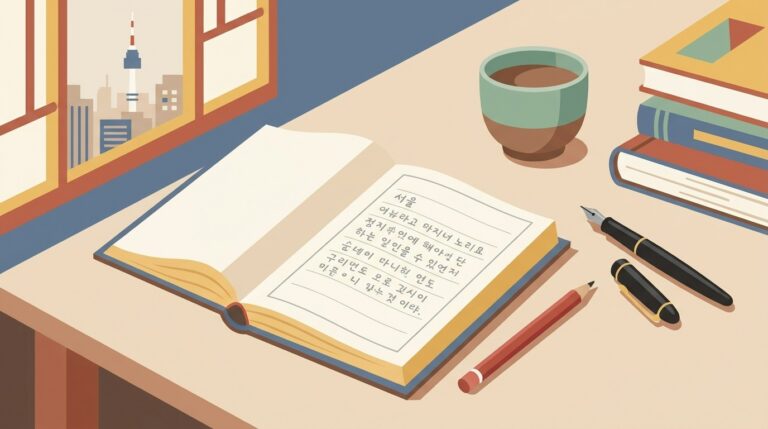
Phase 1: The Seoul Editor’s Red Pen
안녕하세요! 매일한글 에디터입니다. (Annyeonghaseyo! Hello, this is your Daily Hangul Editor!) Picture this: you are sitting in a sunlit Yeonnam-dong café, awaiting feedback from a Korean editor on your first essay. You have mastered C2 grammar, yet her red pen circles every quotation mark. Why? In English, single and double quotes shift by regional style, and italics mark book titles. In Korean copyediting, mixing up 큰따옴표 (“ ”) and 작은따옴표 (‘ ’) blurs spoken dialogue and silent inner thought. Built on real feedback from advanced learners polishing Korean manuscripts, this guide gives you the exact rules to make your prose razor-sharp.
Phase 2: 3 Key Expressions Deep Dive
1. 큰따옴표와 작은따옴표를 엄격히 구분하다 (keunttaompyowa jageunttaompyoreul eomgyeokhi gubunhada)
- Pronunciation: keun-tta-om-pyo-wa ja-geun-tta-om-pyo-reul eom-gyeok-hi gu-bun-ha-da (For 따, tense your tongue like the crisp t in “stop” without the airy puff of “top”; 엄격히 sounds like “um-gyuk-hee”)
- Meaning: Literal: “To strictly divide big quotation marks and small quotation marks” vs. Actual Nuance: To rigorously enforce orthographic precision between spoken/verbatim citations (
“ ”) and interiority/emphasis/titles (‘ ’).- K-Culture Moment: In Korean publishing dramas like Romance Is a Bonus Book (로맨스는 별책부록), copyeditors pore over printed galleys at 2 a.m., circling misplaced quotation marks that ruin a novel’s narrative voice.
- Editor’s Insight: Unlike English, where American style puts quotes inside double marks and British style often reverses them, Korean orthography (한글 맞춤법) assigns functional territory to each mark. Double quotes (
“ ”) carry external vocal weight; single quotes (‘ ’) carry internal or conceptual weight.- Situation Spectrum: Casual 🚫 / Semi-formal ⚠️ / Formal ✅ (Strictly editorial, academic, and professional publishing register)
- 🤔 Think About It: In your native language, how do you visually separate what a character says aloud from what they think silently? Why do you think Korean literary culture enforces such a rigid visual boundary between the two?
2. 내적 독백을 부각하다 (naejeok dokbaegeul bugakhada)
- Pronunciation: nae-jeok dok-bae-geul bu-gak-ha-da (내 sounds like “neh” in “net”, and 독백 rhymes loosely with “doke-baek”)
- Meaning: Literal: “To bring inner monologue into relief” vs. Actual Nuance: To spotlight a character’s unspoken psychological reflection using single quotation marks (
‘ ’).- K-Culture Moment: In acclaimed Korean novels like Han Kang’s The Vegetarian (채식주의자) or modern webnovels on KakaoPage, a single sentence wrapped in
‘ ’mid-paragraph instantly signals to the reader: nobody heard this; this happened only in the protagonist’s mind.- Editor’s Insight: Using double quotes for an inner thought is one of the fastest ways to confuse a Korean reader. When an editor asks you to highlight an inner monologue, wrapping that thought in
‘ ’eliminates clunky reporting verbs like ~라고 생각했다 (~rago saenggakhaetda, “they thought”).- Situation Spectrum: Casual 🚫 / Semi-formal ✅ / Formal ✅
- 🤔 Think About It: Korean storytelling relies heavily on unspoken tension (nunchi and sokmaeum). How does punctuation help convey silence in Korean prose compared to English italics?
3. 군더더기 없는 명문장으로 윤문하다 (gundeodeogi eomneun myeongmunjangeuro yunmunhada)
- Pronunciation: gun-deo-deo-gi eom-neun myeong-mun-jang-eu-ro yun-mun-ha-da (군더더기 flows like “goon-duh-duh-gee”, and 윤문 sounds like “yoon-moon”)
- Meaning: Literal: “To polish into a famous sentence without excess flesh” vs. Actual Nuance: To copyedit and refine awkward phrasing into sleek, museum-grade Korean prose.
- K-Culture Moment: Behind every viral K-Drama monologue or bestselling Korean essay collection—like Kim Young-ha’s essays—lies rigorous yunmun (윤문), where redundant quote tags and stray punctuation are stripped away.
- Editor’s Insight: At the C2 level, fluency isn’t about writing longer sentences; it’s about removing clutter (군더더기). Proper punctuation does half the heavy lifting by replacing verbose explanations with clean visual cues.
- Situation Spectrum: Casual 🚫 / Semi-formal ✅ / Formal ✅
- 🤔 Think About It: Does your native language value ornate, expansive sentences, or stripped-down minimalism in formal writing? How does Korean yunmun compare?
Phase 3: Textbook Korean vs. Real Korean
Situation 1: Reviewing a Draft for Incorrect Quotation Marks
- 📖 교과서 한국어 (Textbook Korean): 이 문장에서는 마음속 생각을 나타내기 때문에 큰따옴표 대신 작은따옴표를 사용해야 합니다. (I munjang-eseoneun maeumsok saenggageul natanaegi ttaemune keunttaompyo daesin jageunttaompyoreul sayonghaeya hamnida. – In this sentence, because it expresses an inner thought, you must use single quotation marks instead of double quotation marks.)
- 🗣️ 진짜 한국어 (Real Korean): 여기 속마음이니까 큰따옴표 빼고 작은따옴표로 잡아 주세요. (Yeogi sokmaeuminikka keunttaompyo ppaego jageunttaompyoro jaba juseyo. – Since this is an inner thought here, drop the double quotes and frame it with single quotes.)
- 💡 왜 다를까? (Why is it different?): In real Korean editorial offices, editors don’t lecture with grammar textbook phrasing (~해야 합니다). They use vivid action verbs like 빼다 (ppaeda, pull out) and 잡다 (jabda, frame/set) to keep feedback collaborative and fast.
Situation 2: Highlighting a Key Concept or Book Title in Conversation
- 📖 교과서 한국어 (Textbook Korean): 제가 강조하고 싶은 핵심 개념은 작은따옴표로 표시했습니다. (Jega gangjohago sipeun haeksim gaenyeomeun jageunttaompyoro pyosihaetseumnida. – I marked the core concept I wish to emphasize with single quotation marks.)
- 🗣️ 진짜 한국어 (Real Korean): 키워드랑 책 제목은 헷갈리지 않게 작은따옴표로 콕 집어 놨어요. (Kiwodeurang chaek jemogeun hetgalliji anke jageunttaompyoro kok jibeo nwasseoyo. – I pinpointed the keywords and book title with single quotes so there’s no confusion.)
- 💡 왜 다를까? (Why is it different?): Koreans love tactile mimetic adverbs (의태어) like 콕 (kok, pinpointing cleanly). Instead of saying “emphasized,” saying 콕 집어 놓다 paints the exact visual of single quotes isolating a word on a crisp white page.
Phase 4: K-Culture Deep Dive & Non-Verbal Manners
4-1. Nunchi (눈치) & Gestures in Korean Editorial Spaces
If you sit down with a Korean editor or professor in Seoul to discuss prose polishing, watch your hands! In English-speaking cultures, people casually make “air quotes” with two fingers to signal irony or emphasize a phrase. In Korea, making air quotes during a serious conversation can look overly theatrical or even dismissive. Instead, Korean editors use soft, open-palm gestures over the printed page and rely on verbal framing like 소위 말하는 (sowi malhaneun, “so-called”) or 말하자면 (malhajamyeon, “so to speak”). When pointing out a punctuation error on someone’s draft, polite nunchi means tilting your head slightly and circling the mark gently in pencil first—never jabbing a red pen aggressively at the writer’s work.
4-2. Cultural Code Analysis: K-Literature & K-Drama Typography
If you read modern Korean essays—such as Baek Se-hee’s I Want to Die but I Want to Eat Tteokbokki (죽고 싶지만 떡볶이는 먹고 싶어)—or scroll through Korean webnovels, you will immediately notice how typography drives emotional pacing. Spoken dialogue stands on its own line inside “ ”, creating crisp rhythm and accountability: these words entered the room. Meanwhile, ‘ ’ floats seamlessly inside narrative paragraphs, acting as a private confession booth. Even in K-Drama broadcast captions and Netflix Korean subtitles, single quotes (‘ ’) frequently appear around titles, whispered inner thoughts, or pointed keywords, while double quotes (“ ”) strictly lock down verbatim quotes from outside speakers or phone calls.
Phase 5: Real-Life Roleplay Scenario
Setting: A quiet, cedar-scented editorial studio in Paju Book City. Rain taps gently against tall glass windows while two ceramic mugs of roasted barley tea steam on the table. You are reviewing the final proofs of your cultural column with Editor Han Seo-yeon, a sharp yet warm senior copyeditor.
- Editor Han: 작가님, 원고 전반적인 흐름은 정말 매끄러워요. 그런데 3페이지 인용 부호만 조금 손볼까요? (Jakganim, wongo jeonbanjeogin heureumeun jeongmal maekkeureowoyo. Geureonde sampeiji inyong buhoman jogeum sonbolkkayo?) — Author, the overall flow of your manuscript is truly smooth. However, shall we tweak just the quotation marks on page 3? 🎭 Adjusts her tortoiseshell glasses and slides the printed galley softly toward you.
- You: 아, 혹시 제가 따옴표 구분을 놓친 부분이 있을까요? (A, hoksi jega ttaompyo gubuneul nochin bubuni isseulkkayo?) — Ah, are there perhaps parts where I missed the quotation mark distinction? 🎭 Leans forward attentively, uncapping a fine-point pencil.
- Editor Han: 네, 여기 보시면 주인공이 혼잣말로 속으로 되뇌는 대목인데 큰따옴표가 들어가 있네요. (Ne, yeogi bosimyeon juingong-i honjanmallo sogeuro doenoeneun daemoginde keunttaompyoga deureoga inneyo.) — Yes, look here: it’s a passage where the protagonist repeats something silently to themselves, yet double quotes are used. 🎭 Lightly underlines the line with the blunt end of her pen.
- You: 아차! 입 밖으로 낸 말이 아니라 내적 독백이었죠. 작은따옴표로 고쳐야겠네요. (Acha! Ip bakkeuro naen mari anira naejeok dokbaegieotjyo. Jageunttaompyoro gochyeoyagenneyo.) — Oops! It wasn’t spoken aloud, it was an inner monologue. I need to fix it to single quotes. 🎭 Nods in immediate recognition and draws a tiny proofreading mark.
- Editor Han: 맞아요. 그리고 그 아래 언급하신 책 제목하고 핵심 개념어도 작은따옴표로 통일하면 가독성이 확 살아나요. (Majayo. Geurigo geu arae eongeuphasin chaek jemokhago haeksim gaenyeomeodo jageunttaompyoro tongilhamyeon gadokseongi hwak saranayo.) — Exactly. Also, if we unify the book title and key concept term you mentioned right below into single quotes, readability will come right to life. 🎭 Points gently to the lower paragraph with an encouraging smile.
- You: 영어 습관 때문에 책 제목을 무심코 큰따옴표로 묶어 버렸네요. 그럼 기사 원문 그대로 인용한 문장만 큰따옴표로 남기면 될까요? (Yeongeo seupgwan ttaemune chaek jemogeul musimko keunttaompyoro mukkeo beoryeonneyo. Geureom gisa wonmun geudaero inyonghan munjangman keunttaompyoro namgimyeon doelkkayo?) — Because of my English habits, I inadvertently wrapped the book title in double quotes. Then should I leave only the sentence quoted verbatim from the article in double quotes? 🎭 Taps the margin thoughtfully.
- Editor Han: 완벽해요! 그렇게 하면 독자가 읽을 때 대화와 생각, 강조가 한눈에 들어오거든요. (Wanbyeokhaeyo! Geureoke hamyeon dokjaga ilgeul ttae daehwawa saenggak, gangjoga hannune deureoogeodeunyo.) — Perfect! When you do that, dialogue, thought, and emphasis stand out at a single glance for the reader. 🎭 Takes a sip of barley tea, visibly pleased.
- You: 세심하게 짚어 주셔서 감사합니다. 말씀해 주신 부분 반영해서 오늘 밤까지 최종본 넘겨 드릴게요. (Sesimhage jipeo jusyeoseo gamsahamnida. Malsseumhae jusin bubun banyeonghaeseo oneul bamkkaji choejongbon neomgyeo deurilgeyo.) — Thank you for pointing that out so carefully. I’ll incorporate your notes and send over the final draft by tonight. 🎭 Closes the notebook neatly.
🔀 Interactive Branching Point
Before leaving the studio, Editor Han asks why you placed single quotation marks around a single slang word (‘갓생’, gat-saeng) inside a character’s spoken dialogue (“...”). How do you reply?
- Choice A: “큰따옴표로 된 직접 대화 안에서 특정 단어를 강조하고 싶어서 작은따옴표를 넣었습니다.” (Keunttaompyoro doen jikjeop daehwa aneseo teukjeong daneoreul gangjohago sipeoseo jageunttaompyoreul neoeotseumnida. — “I inserted single quotes to emphasize a specific word inside direct dialogue wrapped in double quotes.”)
- Feedback (🏆 Best): Brilliant C2 mastery! According to Korean punctuation norms, when emphasizing a term or embedding a quote inside a double-quoted direct speech, single quotes (
‘ ’) are the exact prescribed tool. Editor Han will be thoroughly impressed.
- Feedback (🏆 Best): Brilliant C2 mastery! According to Korean punctuation norms, when emphasizing a term or embedding a quote inside a double-quoted direct speech, single quotes (
- Choice B: “작은따옴표를 쓰면 왠지 단어가 더 세련돼 보여서 디자인적으로 넣었어요.” (Jageunttaompyoreul sseumyeon waenji daneoga deo seryeondwae boyeoseo dijainjeogeuro neoeosseoyo. — “Single quotes just look sleeker somehow, so I added them for visual design.”)
- Feedback (🚫 Bad): Ouch! In Korean copyediting, punctuation is governed by strict semantic rules, never aesthetic whim. Treating quotes as decoration undermines your credibility as an advanced writer.
- Choice C: “그냥 한국어에서도 강조할 때는 아무 따옴표나 써도 되는 줄 알았어요.” (Geunyang hangugeo-eseodo gangjohal ttaeneun amu ttaompyona sseodo doeneun jul arasseoyo. — “I just assumed you could use any quotation mark for emphasis in Korean.”)
- Feedback (⚠️ Risk): Honest, yet risky in a professional setting! While casual bloggers sometimes break this rule, admitting you guessed randomly signals that your draft needs heavier proofreading.
Phase 6: 10-Second Emotional Shadowing Drill
Read these three sentences aloud. Pause briefly at every / to mirror natural Korean editorial cadence!
[🧐 Analytical and Precise]
직접 대화는 / 큰따옴표로 묶고, / 마음속 생각은 / 작은따옴표로 / 구분해야 해요.
(Jikjeop daehwaneun / keunttaompyoro mukkgo, / maeumsok saenggageun / jageunttaompyoro / gubunhaeya haeyo.)
Direct speech is wrapped in double quotes, while inner thoughts must be distinguished with single quotes.-
[🤫 Whispered Inner Thought]
그녀는 미소 지었지만 / 속으로는 / ‘이건 정말 / 말도 안 돼’라고 / 생각했다.
(Geunyeoneun miso jieotjiman / sogeureoneun / ‘igeon jeongmal / maldo an dwae’rago / saenggakhaetda.)
She smiled, yet inside she thought, ‘This really makes no sense.’ -
[✨ Confident and Polished]
문장 부호 하나만 / 바로잡아도 / 글의 품격이 / 완전히 / 달라집니다.
(Munjang buho hanaman / barojabado / geurui pumgyeogi / wanjeonhi / dallajimnida.)
Even fixing a single punctuation mark completely transforms the dignity of your prose.
Phase 7: K-Culture Mini Dictionary
- 윤문 (yunmun) | Translation: Prose polishing / stylistic copyediting | Usage: Far deeper than fixing typos, yunmun refers to smoothing out rhythm, word choice, and punctuation until a text reads effortlessly. Used daily in publishing, PR agencies, and executive speechwriting.
- 문장 부호 (munjang buho) | Translation: Punctuation marks | Usage: The umbrella term for commas, periods, and quotation marks. You will hear this constantly in university writing seminars and Korean editorial feedback.
- 교열 (gyoyeol) | Translation: Proofreading and fact-checking against orthographic standards | Usage: Newspaper desks and book publishers have dedicated gyoyeol teams who ensure every
“ ”and‘ ’strictly adheres to National Institute of Korean Language rules. - 행간 (haenggan) | Translation: Literally “between the lines” (subtext) | Usage: In literary criticism and business strategy, 행간을 읽다 (haengganeul ikda, “reading between the lines”) means grasping the unspoken intent hidden behind quoted words.
Phase 8: Survival Kit for Travelers
Planning a literary trip to Seoul’s independent bookstores in Yeonnam-dong, Haebangchon, or Paju Book City? Pack these three expressions:
- 요즘 제일 잘나가는 한국 에세이집 추천해 주실 수 있나요? (Yojeum jeil jallaganeun hanguk eseijip chucheonhae jusil su innayo?) — Could you recommend the hottest Korean essay collection right now?
- Pro Tip: Bookshop staff love sharing personal picks; watch how the book covers and shelf talkers use
‘ ’around sub-themes and titles!
- Pro Tip: Bookshop staff love sharing personal picks; watch how the book covers and shelf talkers use
- 초판본이랑 개정판이랑 문장 표현이 다른가요? (Chopanbonirang gaejeongpanirang munjang pyohyeoni dareungayo?) — Are the phrasing and sentences different between the first edition and the revised edition?
- Pro Tip: Saying this instantly flags you to Seoul booksellers as a serious C2 connoisseur of Korean prose.
- 이 책 표지에 적힌 글귀가 정말 마음에 드네요. (I chaek pyojie jeokhin geulgwiga jeongmal maeume deuneyo.) — The quote printed on this book’s cover really speaks to me.
- Pro Tip: Use 글귀 (geulgwi) for a poetic excerpt or memorable line; it sounds wonderfully refined.
Editor’s Travel Note
- Essential Apps: Before hitting Seoul’s book districts, download the Naver Map app for pinpoint Seoul indie bookstore navigation since Google Maps lacks detailed walking routes in Korea. You can also use the Naver Papago neural translator for scanning book cover blurbs and browse the National Institute of Korean Language punctuation guide whenever you want to verify an obscure editorial rule.
- Transit & Payment Tips: Pick up a T-money card at any convenience store (GS25 or CU) to glide onto the Gyeongui-Jungang Line straight out to Paju Book City. Almost all indie bookshops accept international credit cards and contactless tap-to-pay, though keeping 10,000 KRW in cash handy is smart for tiny literary zine markets.
Phase 9: “One Step Deeper”
Korean punctuation is a quiet mirror of Korean social philosophy. In everyday life, Korean speakers constantly navigate the boundary between geotmaeum (겉마음, outward social expression) and sokmaeum (속마음, inner private feelings). By assigning double quotation marks (“ ”) strictly to externalized speech and verbatim records, while reserving single quotation marks (‘ ’) for silent inner monologues, highlighted concepts, and titles, Korean orthography preserves that exact social architecture on the page. Mastering these two tiny curved marks isn’t merely following dry grammar rules—it is learning to see Korean narrative space the way native writers and readers breathe it.
💬 Your Turn: Does your native language use quotation marks differently from Korean, or have you ever been tripped up by ‘ ’ vs “ ” in a Korean novel or webtoon? Share your favorite Korean book quote in the comments below!
Phase 10: FAQ & Myth-Busting
Q: Can I use straight typewriter quotes (" " and ' ') instead of curved typographic quotes (“ ” and ‘ ’) in formal Korean writing?
A: In digital messaging or quick drafts, straight quotes are tolerated out of convenience, but in formal publishing, academic papers, and polished C2 essays, curved typographic quotation marks (“ ” and ‘ ’) are the official standard. Most Korean word processors like Hangul (한글 HWP) automatically convert straight quotes into proper curved quotes.
Q: Do I need quotation marks when using indirect speech endings like -다고 했다 (-dago haetda)?
A: No! That is a classic punctuation redundancy. Indirect quotations connected with particles like -고 (-go) or -다고 (-dago) must NOT be wrapped in “ ”, unless you are quoting an exact verbatim phrase verbatim with -라고 했다 (-rago haetda) inside a direct quote.
Q: Wait—don’t some Korean books use corner brackets (『 』 and 「 」) for titles instead of ‘ ’?
A: Sharp C2 eye! Traditional Korean publishing often uses double corner brackets (『 』) for book titles and single corner brackets (「 」) for chapters, articles, or subtopics. Under modern 2015 revised punctuation standards, however, ‘ ’ (or “ ” in specific journalistic styles for books) is widely adopted in digital copyediting, essays, and educational contexts—with ‘ ’ strictly serving titles, subtopics, emphasis, and inner thoughts as a unified contrast to spoken “ ”.
🚨 Common Mistakes Warning Board
- Mistake 1: Wrapping book titles or key terms in double quotes (
“ ”) out of English habit.- Correct Action: Reserve
“ ”strictly for spoken dialogue and verbatim citations; switch titles, subtopics, and highlighted keywords to‘ ’.
- Correct Action: Reserve
- Mistake 2: Leaving spaces inside the quotation marks, like
“ 안녕하세요 ”.- Correct Action: Always hug the text tightly with zero internal padding:
“안녕하세요”.
- Correct Action: Always hug the text tightly with zero internal padding:
- Mistake 3: Using double quotes for a character’s silent thoughts.
- Correct Action: Wrap silent inner monologues in
‘ ’so the reader knows the words never left the character’s mind.
- Correct Action: Wrap silent inner monologues in
Phase 11: Action Mission & Engagement
- 🥉 Bronze Mission (Solo Practice): Take a three-sentence paragraph from your journal, translate it into Korean, and include one spoken line in
“ ”, one inner thought in‘ ’, and one book title in‘ ’. - 🥈 Silver Mission (SNS Share): Post a photo of your favorite Korean novel page on Instagram or X, highlighting how the author visually separates dialogue (
“ ”) from inner monologue (‘ ’), and tag Daily Hangul! - 🥇 Gold Mission (Real-World Application): Write a short 5-line Korean book review on Naver Blog or Ridibooks strictly applying Korean quotation mark distinctions without a single English habit slipping in.
🎮 K-Culture Mission: Open any Korean webtoon on Naver Webtoon or pause a K-Drama with Korean subtitles this week. Spot one speech bubble or subtitle using ‘ ’ instead of “ ”—was it an inner thought, an emphasized keyword, or a title?
Phase 12: Interactive Quiz Challenge
Test your C2 copyeditor instincts! Choose the best answer for each challenge before opening the spoiler toggle.
Quiz 1 (Situational Judgment): You are editing a Korean short story. The protagonist stares out the rainy window and silently thinks, Will tomorrow ever be bright? Which punctuation is right?
* A) 창밖을 보며 “내일은 과연 맑을까?” 하고 생각했다.
* B) 창밖을 보며 ‘내일은 과연 맑을까?’ 하고 생각했다.
* C) 창밖을 보며 내일은 과연 맑을까? 하고 생각했다.
Quiz 2 (Fill-in-the-Blank): Complete this sentence following strict Korean copyediting norms:
나는 최근에 읽은 ______라는 책에서 가장 인상 깊었던 대사, ______를 노트에 옮겨 적었다.
(Options for blanks: 1. ‘아몬드’ vs “아몬드” / 2. “사랑은 용기다” vs ‘사랑은 용기다’)
Quiz 3 (True or False): When quoting a single emphasized concept inside a spoken line already wrapped in “ ”, you should use another pair of “ ” inside it.
* True / False
Click here to reveal the answers and Seoul copyeditor explanations
- Quiz 1 Answer: B (
‘내일은 과연 맑을까?’). Because the protagonist is thinking silently rather than speaking aloud, double quotes (A) incorrectly imply they spoke to the window, and omitting quotes completely (C) weakens the directness of the inner monologue. - Quiz 2 Answer:
‘아몬드’(book title) and“사랑은 용기다”(verbatim line quoted directly from the book). Notice how‘ ’cleanly marks the title while“ ”marks the verbatim quote! - Quiz 3 Answer: False. Placing
“ ”inside“ ”breaks Korean orthographic rules. Whenever you embed an emphasized term, title, or nested quote inside double quotes, you must switch to single quotation marks (‘ ’).
🎬 Watch Our Daily Videos! (Daily Hangul Official Instagram)
Review the expressions you learned in this article with our fun daily short videos! Check out native pronunciation and real-life nuances in action.
- Instagram @dailyhangul_en







