

Do Not Lift That Soup Bowl! Your Friendly Guide to Korean Table Manners
Phase 1: Welcome to the Korean Table!
안녕하세요! 매일한글 에디터입니다. (Annyeonghaseyo! Maeil Hangeul editeo-imnida. Hello, I am your Daily Hangul editor!)
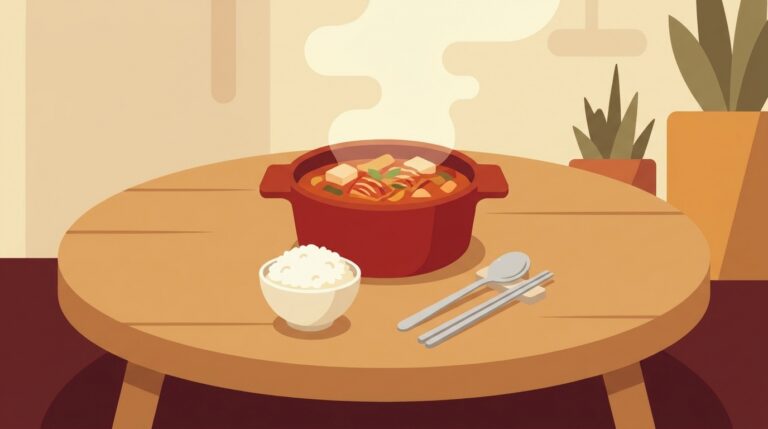
Imagine watching your favorite K-drama, seeing a bubbling pot of red kimchi stew, and finally sitting down in a cozy Seoul restaurant. You pick up the hot bowl to sip the broth, and your Korean friend suddenly freezes! Why? In Korea, lifting your soup or rice bowl is a big table faux pas. Instead, you always eat soup and stew with a spoon! Many of our A1 learners told us they felt nervous during their first Korean meal. By mastering these simple mealtime greetings and spoon manners today, you will dine with total confidence and earn instant smiles from locals!
Phase 2: Top 3 Core Expressions Deep Dive
1. 잘 먹겠습니다 (Jal meokgetseumnida)
- Pronunciation: Jal meok-get-sseum-ni-da (Sounds like “Jahl muhk-get-suhm-nee-dah” — “uh” as in “cup”).
- Meaning: Literally “I will eat well,” but the real nuance is “Thank you for the food, let’s enjoy this meal!”
- K-Culture Moment: In Korean variety shows like Running Man or 2 Days & 1 Night, the cast always claps their hands together and shouts this phrase happily before digging into a feast.
- Editor’s Insight: You say this not only to the person who cooked, but also to the friend who is paying, or even to restaurant staff! Wait until everyone has their food before saying it.
- Situation Spectrum: Casual ⚠️ (Use 잘 먹을게 [Jal meogeulge] with close friends) / Semi-formal ✅ / Formal ✅
- 🤔 Think About It: In English, we often tell others “Enjoy your meal,” focusing on the listener. In Korean, you state “I will eat well,” thanking the provider through your gratitude. How do you express thanks before eating in your language?
2. 숟가락으로 떠먹어요 (Sutgarageuro tteomeogeoyo)
- Pronunciation: Sut-ga-ra-geu-ro tteo-meo-geo-yo (Sounds like “Soot-gah-rah-guh-roh ttuh-muh-guh-yoh” — “tt” is a crisp, strong “t” sound without air).
- Meaning: Literally “Scoop and eat with a spoon,” used to explain or remind someone how to eat guk (soup) and jjigae (stew).
- K-Culture Moment: In the hit K-drama Extraordinary Attorney Woo, characters often share warm bowls of gimbap and udon or stew, carefully using their metal spoons to scoop broth instead of lifting the bowl.
- Editor’s Insight: Break it down easily: Sutgarak (숟가락) means spoon, -euro (으로) means “with/using,” and tteomeogeoyo (떠먹어요) means “scoop and eat.” Even if you just remember sutgarak (spoon), you are halfway there!
- Situation Spectrum: Casual ⚠️ (Drop the “yo” at the end with close friends) / Semi-formal ✅ / Formal ✅
- 🤔 Think About It: Many cultures lift soup bowls to sip the last drop or use chopsticks for solid bits in soup. Why do you think Korean culture keeps the bowl resting firmly on the table?
3. 잘 먹었습니다 (Jal meogeotseumnida)
- Pronunciation: Jal meo-geot-sseum-ni-da (Sounds like “Jahl muh-guht-suhm-nee-dah”).
- Meaning: Literally “I ate well,” meaning “Thank you for the delicious meal!”
- K-Culture Moment: After finishing a big family dinner in Reply 1988, everyone places their spoons neatly on the table and says this warmly to the parents who cooked.
- Editor’s Insight: Look at the tiny change from #1: get (future/will) becomes eot (past/did). Saying this to a small restaurant owner as you walk out the door will melt their heart!
- Situation Spectrum: Casual ⚠️ (Use 잘 먹었어 [Jal meogeosseo] with close friends) / Semi-formal ✅ / Formal ✅
- 🤔 Think About It: Saying thank you after eating is almost mandatory in Korea. Does your culture have a set phrase you say as soon as you put your utensils down?
Phase 3: Textbook Korean vs. Real Korean
Situation 1: Starting the Meal
- 📖 Textbook Korean: 맛있게 드세요. (Masitge deuseyo. — Please eat deliciously.)
- 🗣️ Real Korean: 잘 먹겠습니다! (Jal meokgetseumnida!) or to close friends: 맛있게 먹어! (Masitge meogeo! — Eat well!)
- 💡 Why is it different? Deuseyo is polite and often said by the host or waiter to the guest. As the diner, saying Jal meokgetseumnida shows active gratitude and kicks off the meal warmly!
Situation 2: Asking for a Spoon at a Diner
- 📖 Textbook Korean: 저에게 숟가락을 하나 주십시오. (Jeoege sutgarageul hana jusipsio. — Please give me one spoon.)
- 🗣️ Real Korean: 여기요! 숟가락 하나만 주세요! (Yeogiyo! Sutgarak hanaman juseyo! — Excuse me! Just one spoon, please!)
- 💡 Why is it different? Nobody uses the super-stiff -sipsio ending in a cozy neighborhood restaurant. Calling out cheerfully with “Yeogiyo!” (Here!) and adding “-man” (just) sounds friendly, natural, and polite.
Phase 4: K-Culture Deep Dive & Non-Verbal Manners
4-1. Nunchi (Social Awareness) & Gestures
When eating Korean soup or stew, your hands and eyes do a lot of polite talking:
* Keep Bowls Grounded: Leave your rice bowl and soup bowl on the table at all times. Lean slightly forward with your spoon instead of bringing the bowl up to your face.
* One Tool at a Time: Never hold your spoon and chopsticks in the same hand at once! Put your spoon down when picking up side dishes with chopsticks, and put your chopsticks down when scooping soup.
* Follow the Leader: Wait for the eldest person (or the host) to pick up their spoon first before you take your first bite.
4-2. Cultural Code: K-Food & Jeong (Warm Affection)
In Korea, meals are rarely about eating alone in silence. Guk (soup) is served individually, while Jjigae (stew) is often shared from one bubbling pot in the middle of the table! Scooping calmly with your own spoon—and making sure not to double-dip if you already licked it—is part of Korean Jeong (정, communal warmth and care). When you watch K-dramas like Hospital Playlist, notice how the five doctor friends gather around one pot of stew, clinking spoons and bonding after long shifts.
Phase 5: Practical Roleplay Scenario
Setting: A rainy evening in Hongdae, Seoul. You and your Korean buddy Minji sit at a wooden table in a cozy Kimchi-jjigae restaurant. Steam rises from a bright red stew pot, and the warm smell of garlic and sesame oil fills the air.
Characters: You (A1 Korean learner) & Minji (Your cheerful Korean best friend) & Imo (The friendly restaurant auntie)
- Imo: 🎭 (Places a sizzling stew pot and two bowls of white rice on the table) 맛있게 드세요! (Masitge deuseyo! — Enjoy your meal!)
- Minji: 🎭 (Smiles brightly at Imo) 감사합니다! (Gamsahamnida! — Thank you!)
- You: 🎭 (Puts hands together happily) 잘 먹겠습니다! (Jal meokgetseumnida! — I will eat well!)
- Minji: 🎭 (Pulls open the small drawer under the edge of the table) 여기 수저 있어! (Yeogi sujeo isseo! — Here are the spoons and chopsticks!)
- You: 🎭 (Takes a metal spoon) 아, 국은 숟가락으로 떠먹어요? (A, gugeun sutgarageuro tteomeogeoyo? — Oh, do you eat soup with a spoon?)
- Minji: 🎭 (Nods enthusiastically) 응! 그릇은 들지 마. 뜨거워! (Eung! Geureuseun deulji ma. Tteugeowo! — Yes! Don’t lift the bowl. It’s hot!)
- You: 🎭 (Scoops some broth carefully and blows on it) 음, 정말 맛있어요! (Eum, jeongmal masisseoyo! — Mmm, it’s really delicious!)
- Minji: 🎭 (Laughs happily) 다행이다! 천천히 먹어. (Dahaengida! Cheoncheonhi meogeo. — I’m glad! Eat slowly.)
🔀 Interactive Branching Point: Your First Bite!
Your rice and hot soup are right in front of you, and Minji hasn’t picked up her spoon yet. What do you do?
* Choice A: Wait for Minji to pick up her spoon, leave your bowl on the table, and gently scoop the soup with your spoon.
* Choice B: Pick up the hot metal rice bowl with both hands to bring it close to your chin and slurp the soup.
* Choice C: Stick your spoon upright straight into the middle of your white rice bowl while you blow your nose.
Feedback:
* Choice A (Best! ✅): Gold star! You waited for your companion, kept the bowl grounded, and used your spoon properly. Minji will be amazed by your nunchi!
* Choice B (Bad! ❌): Ouch! Korean metal bowls get super hot, and lifting your bowl to your mouth looks impolite in Korean dining culture.
* Choice C (Risk / Taboo! ⚠️): Big no-no! Sticking a spoon or chopsticks vertically into a bowl of rice looks just like incense sticks used in ancestral memorial rituals (jesa). Always rest your spoon flat on the table or on a napkin!
Phase 6: 10-Second Emotional Shadowing Drill
Read these out loud! Use the / mark to pause briefly and match the emotion.
- [😊 Excited & hungry] 잘 / 먹겠습니다! (Jal / meokgetseumnida! — I will eat well!)
- [💡 Curious & polite] 국은 / 숟가락으로 / 떠먹어요? (Gugeun / sutgarageuro / tteomeogeoyo? — Do you eat soup with a spoon?)
- [🙏 Warm & grateful] 잘 / 먹었습니다! (Jal / meogeotseumnida! — Thank you for the meal!)
Phase 7: K-Culture Mini Dictionary
- 국 (Guk) | Light Soup | A clear or mild broth served in individual bowls alongside rice. Always eaten with a spoon!
- 찌개 (Jjigae) | Hearty Stew | Thicker, richer, and often spicier than guk (like Kimchi-jjigae). Frequently shared in the center of the table.
- 수저 (Sujeo) | Spoon & Chopsticks Set | A single handy word combining sutgarak (spoon) and jeotgarak (chopsticks). Usually hidden in a drawer on the side of the table!
- 눈치 (Nunchi) | Reading the Room | Quietly noticing what others do—like waiting for elders to pick up their spoon first—so everyone feels comfortable.
Phase 8: Survival Kit for Travelers
Top 3 Survival Phrases
- 여기요! (Yeogiyo!) — “Excuse me!” Pro Tip: Raise one hand slightly and make eye contact when calling staff in a busy diner.
- 숟가락 주세요. (Sutgarak juseyo.) — “Please give me a spoon.” Pro Tip: Check the side drawer under your table before asking!
- 물 좀 주세요. (Mul jom juseyo.) — “Water, please.” Pro Tip: Look for a sign saying 셀프 (Selpeu / Self-service) near the water cooler—many diners have self-serve water!
Editor’s Travel Note
Getting around Seoul’s best jjigae spots is effortless with the right tools on your phone. Before your trip, be sure to Download Naver Map App for Korean Restaurants because Google Maps does not offer walking directions in South Korea, and Download Papago AI Translator for Menu Photos to snap instant translations of wall menus. Also, remember that most Korean diners accept international credit cards, and tipping is NOT expected—a cheerful “잘 먹었습니다! (Jal meogeotseumnida!)” is the best tip you can give!
Phase 9: One Step Deeper
Why does Korean culture care so much about keeping bowls on the table and using a spoon? Historically, Korean dining tables (bapsang) were low wooden tables where families sat cross-legged on heated ondol floors, sharing side dishes from the center. Keeping bowls stationary created a calm, dignified posture that separated human dining from how animals bend down or grab food, while sharing from central pots nurtured Jeong—the invisible thread of community. Even a tiny metal spoon carries centuries of respect, patience, and togetherness.
💬 Your Turn: What is one surprising table rule from your home country that visitors often get wrong? Drop a comment below—I would love to read it!
Phase 10: FAQ & Common Mistakes
Q: Can I use chopsticks to eat the vegetables or tofu inside my soup?
A: Yes! You can use chopsticks to pick up solid pieces like tofu, meat, or kimchi from your soup or stew, and use your spoon for the broth and rice.
Q: What if there are no spoons or chopsticks on top of the table?
A: Don’t panic! Look right underneath the edge of your table—most Korean restaurants have a built-in side drawer stocked with metal sujeo (spoons and chopsticks) and napkins.
Q: Is it rude to make slurping sounds when eating hot soup?
A: Making loud noises while chewing is polite to avoid, though gentle blowing on hot soup and quiet sipping from your spoon are totally normal.
🚨 Common Mistakes TOP 3
- Lifting the rice or soup bowl to your mouth. -> Correct Action: Keep all bowls flat on the table and bring the food to your mouth with your spoon.
- Sticking your spoon vertically into your rice. -> Correct Action: Rest your spoon flat on the table, on a spoon rest, or across the edge of the bowl.
- Eating before the eldest person at the table. -> Correct Action: Wait two seconds until the eldest person lifts their spoon, then happily say Jal meokgetseumnida!
Phase 11: Action Mission & Engagement
- 🥉 Bronze Mission: Stand in front of your mirror and say “잘 먹겠습니다! (Jal meokgetseumnida!)” and “잘 먹었습니다! (Jal meogeotseumnida!)” three times with a big smile.
- 🥈 Silver Mission: Take a photo of your soup or lunch today and post it on social media with the caption “Eating with a spoon! #DailyHangul #잘먹겠습니다”.
- 🥇 Gold Mission: Visit a local Korean restaurant, find the spoon, and say “잘 먹었습니다!” to the staff when you leave!
- 🎮 K-Culture Mission: Watch any eating scene in a K-drama or a Korean mukbang video tonight and spot how the host switches between their spoon and chopsticks!
Phase 12: Interactive Quiz Challenge
Test your new skills! Try answering before opening the spoiler box.
- Situation Judgment: You just finished a delicious bowl of Kimchi-jjigae at a restaurant in Seoul. What should you say to the owner as you walk out? (A: 잘 먹겠습니다 / B: 잘 먹었습니다 / C: 그릇 주세요)
- Fill in the Blank: In Korea, you eat soup and stew with a ______ (숟가락 / sutgarak), and you never lift the bowl.
- True or False: It is good manners to stick your spoon straight up in your rice bowl while taking a break.
Click here to reveal the answers and explanations!
- Answer: B — 잘 먹었습니다 (Jal meogeotseumnida)! (If you chose A, remember Jal meokgetseumnida is for BEFORE eating! C means “Please give me a bowl.”)
- Answer: Spoon (숟가락 / sutgarak). Great job!
- Answer: False! Never stick a spoon or chopsticks upright in rice, as it resembles ancestral memorial offerings. Always lay them flat!
🎬 Watch Our Daily Videos! (Daily Hangul Official Instagram)
Review the expressions you learned in this article with our fun daily short videos! Check out native pronunciation and real-life nuances in action.
- Instagram @dailyhangul_en







