

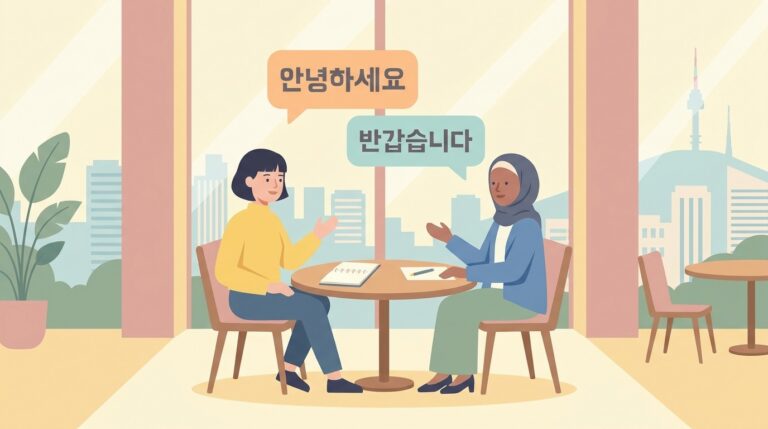
The Hidden Power Play in K-Dramas: Decoding Honorifics and Casual Speech
Phase 1: Empathy & The Subtitle Dilemma
안녕하세요! 매일한글 에디터입니다. (Annyeonghaseyo! It’s your Daily Hangul editor.)
Picture this: You are glued to the screen watching a high-stakes Korean survival show like Physical: 100 or The Devil’s Plan. Two contestants are sizing each other up. The English subtitle reads, “Hey, what did you just say to me?” but suddenly, the soundtrack cuts out, the background contestants gasp, and the atmosphere freezes solid. Why such a dramatic reaction over a simple question?
Here is the industry secret: the subtitles rarely capture the linguistic earthquake that just occurred. One contestant just intentionally dropped from polite honorifics (존댓말, jondaetmal) straight into raw, informal speech (반말, banmal). In Korean society, shifting speech levels without mutual agreement isn’t just a grammar choice—it’s a social declaration of dominance, intimacy, or war.
Over the past decade of coaching passionate K-drama fans and expats, I have seen so many learners miss half the psychological thriller unfolding on screen simply because subtitles flatten these nuanced power dynamics. Once you learn to spot these subtle linguistic shifts with your own ears, your K-drama and reality show binge-watching experience will instantly become twice as gripping and immersive!
Phase 2: Key Expressions Breakdown
1. 말씀 편하게 하세요 (Malsseum pyeonhage haseyo)
- Pronunciation: [Mahl-sseum pyeo-nha-geh ha-seh-yo] (Think: “Mahl” as in calm, “pyeon” like pure-on, “haseyo” like the familiar greeting)
- Meaning: Literal: “Please speak comfortably.” / Nuance: “Feel free to drop honorifics with me” or “You don’t need to be so stiff.”
- K-Culture Moment: In survival reality shows, older or higher-status competitors say this to younger allies during private strategy huddles to quickly break tension and build an alliance.
- Editor’s Insight: This phrase sounds very generous, but notice who offers it first. The person with higher social standing (older age, higher rank) must give permission before informal speech is unlocked.
- Situation Spectrum: Casual: ✅ | Semi-formal: ✅ | Formal: ⚠️
- 🤔 Think About It: In English, we drop formalities naturally by switching from “Mr. Kim” to “Minho.” Why does Korean require explicit verbal contracts to change conversational boundaries?
2. 지금 반말하시는 거예요? (Jigeum banmalhasineun geoyeyo?)
- Pronunciation: [Jee-geum bahn-mahl-ha-shee-neun geo-yeh-yo?] (Think: “Jee” like jeep, “bahn-mahl” with a crisp ‘m’)
- Meaning: Literal: “Are you speaking informally to me right now?” / Nuance: “Who do you think you are to talk down to me?”
- K-Culture Moment: The iconic confrontation line in OTT revenge dramas (The Glory, Bloodhounds) right before a physical altercation or emotional climax.
- Editor’s Insight: The irony of this sentence is brilliant: the speaker is using strictly polite grammar (
-요, -yo) while delivering a fierce, sharp warning. It creates chilling emotional friction. - Situation Spectrum: Casual: 🚫 | Semi-formal: ⚠️ | Formal: ✅ (Used as a defensive challenge)
- 🤔 Think About It: How does keeping your grammar polite while expressing pure outrage change the tone of a conflict compared to shouting slang?
3. 우리 말 놓을까요? (Uri mal noheulkkayo?)
- Pronunciation: [Oo-ree mahl no-heul-kkah-yo?] (Think: “Oo-ree” like ‘ooh-ree’, “noheul” sounds like ‘noh-eul’)
- Meaning: Literal: “Shall we put down our words?” / Nuance: “Shall we speak casually to each other as equals?”
- K-Culture Moment: In dating reality shows like Single’s Inferno, this is the golden turning point when two contestants confirm mutual romantic interest during a private dinner.
- Editor’s Insight: Notice the verb 놓다 (nohda – to put down/release). It metaphorically implies setting down the heavy social armor of honorific etiquette so two hearts can stand side by side.
- Situation Spectrum: Casual: ✅ | Semi-formal: ✅ | Formal: 🚫
- 🤔 Think About It: Can intimacy truly exist without equality in social relationships, or does etiquette protect personal space?
Phase 3: Textbook Korean vs. Real Korean
Situation 1: Calling out someone who crossed the boundary
- 📖 교과서 한국어 (Textbook): 화가 나셨습니까? (Hwaga nasyeotseumnikka? – Are you angry?)
- 🗣️ 진짜 한국어 (Real-life Native): 지금 선 넘으시네요. (Jigeum seon neomeusineyo. – You are crossing the line right now.)
- 💡 왜 다를까? (Why the difference?): Real Koreans rarely ask directly about emotional states in tense situations; instead, they reference invisible social borders (선, seon).
Situation 2: Suggesting to speak casually among peers
- 📖 교과서 한국어 (Textbook): 반말을 합시다. (Banmareul hapsida. – Let us use casual speech.)
- 🗣️ 진짜 한국어 (Real-life Native): 편하게 불러. (Pyeonhage bulleo. – Just call me casually/comfortably.)
- 💡 왜 다를까? (Why the difference?): Announcing “let’s use banmal” feels like an official court decree. Native speakers focus on the feeling of comfort (편하게, pyeonhage) rather than the linguistic category.
Phase 4: K-Culture Deep Dive & Non-Verbal Manners
4-1. 눈치 (Nunchi) & Micro-Expressions
When speech levels fluctuate in Korean media, keep your eyes on the physical stance:
1. The Chin Tilt (턱 치켜들기): When a character switches from jondaetmal to banmal offensively, their chin slightly tilts up, looking down their nose.
2. The Two-Hand Release: Notice the hands. During polite speech, hands are clasped near the stomach or holding drinks with both hands. The split second someone decides to drop honorifics, one hand usually slips into a pocket or rests casually on a hip.
4-2. Cultural Code: The Age-Inversion Dilemma
In survival shows like Culinary Class Wars or The Devil’s Plan, hierarchy faces a dramatic collision. A 24-year-old game mastermind might rank higher in the game than a 45-year-old industry veteran. How do they communicate?
They dance on a razor’s edge: the younger strategist will use ultra-polite honorific endings like -하십시오 (hasipsio) with humble body posture, yet weave assertive strategic directives into the message. Listening for this contrast between verbal deference and mental dominance is where the real entertainment lies.
Phase 5: Real-World Roleplay Scenario
Setting: A secluded lounge room inside a survival game show. You (Player 7) are negotiating an elimination immunity alliance with Min-woo (Player 3), a competitive veteran player who is 5 years older than you.
- Turn 1 (Min-woo): [🤝 Sitting down, leaning in with a smile] 우리 단둘이 이야기하는 건 처음이네요. (Uri danduri iyagihaneun geon cheoeumineyo. – It’s our first time talking just the two of us.)
- Turn 2 (You): [😊 Nodding politely] 네, 민우 씨. 이번 라운드 전략 때문에 꼭 상의하고 싶었어요. (Ne, Min-u ssi. Ibeon raundeu jeollyak ttaemune kkok sang-uihago sipeosseoyo. – Yes, Min-woo. I really wanted to discuss this round’s strategy with you.)
- Turn 3 (Min-woo): [😏 Smirking, relaxing his posture] 그래? 어차피 나이도 내가 위인데, 우리 말씀 편하게 할까? (Geurae? Eochapi naido naega wiinde, uri malsseum pyeonhage halkka? – Really? I’m older anyway, so shall we speak comfortably?)
- Turn 4 (You): [🤔 Pausing thoughtfully] 편하게 말씀하세요. 저는 아직 들을 준비가 더 필요해서요. (Pyeonhage malsseumhaseyo. Jeoneun ajik deureul junbiga deo piryohaeseoyo. – Please speak comfortably yourself. I still need to listen more carefully.)
- Turn 5 (Min-woo): [🤨 Raising an eyebrow] 뭐야, 선 긋는 거야? 팀 하자는 제안 아니었어? (Mwoya, seon geunneun geoya? Tim hajaneun jean anieosseo? – What, are you drawing a boundary? Wasn’t your proposal to be a team?)
- Turn 6 (You): [😐 Maintaining steady eye contact] 팀은 원하지만, 서로 존중하면서 플레이하고 싶습니다. (Timeun wonhajiman, seoro jonjunghamyeonseo peulle-ihago sipseumnida. – I want the team, but I prefer to play while respecting each other.)
- Turn 7 (Min-woo): [😮 Softening up, impressed] 허, 만만치 않네. 좋아, 존댓말 유지하지. 작전이 뭐야? (Heo, manmanchi anne. Joa, jondaetmal yujihaji. Jakjeoni mwoya? – Ha, you’re no pushover. Fine, let’s keep it polite. What’s the plan?)
- Turn 8 (You): [🤝 Offering a confident handshake] 후회하지 않으실 겁니다. (Huhoehaji aneusil geomnida. – You won’t regret this.)
🔀 Interactive Decision Point
If Min-woo suddenly snaps at Turn 3 and yells: “야, 너 몇 살이야?” (Ya, neo myeot sariya? – “Hey, how old are you?”), how do you react?
* Option A: “저 서른 살인데요. 왜 반말하세요?” (I am 30. Why are you speaking casually?)
* Outcome (Best): Calmly grounds the boundary without submitting or escalating excessively. Asserts equality.
* Option B: “야! 너나 잘해!” (Hey! Mind your own business!)
* Outcome (Bad): Total crash into immediate emotional brawl. You lose social leverage and look undisciplined.
* Option C: [Silence with bowed head] “죄송합니다…” (I am sorry…)
* Outcome (Risk): You instantly forfeit psychological ground, allowing him to dominate future alliance decisions.
Phase 6: 10-Second Emotion Shadowing Drill
Read aloud and practice matching the psychological cadence indicated by the slash / pauses:
- [😏 여유롭고 주도권을 쥐듯이 / Confident & subtly dominant]
우리 / 이제 말 / 편하게 놓을까요?
(Uri / ije mal / pyeonhage noheulkkayo?) -
[❄️ 차갑고 단호하게 경고하듯이 / Cold & stern warning]
방금 / 저한테 / 반말하신 건가요?
(Banggeum / jeohante / banmalhasin geon-gayo?) -
[🤝 정중하지만 단단한 태도로 / Polite yet unshakable firmness]
게임은 게임이지만 / 선은 / 넘지 마시죠.
(Geimeun geim-ijiman / seoneun / neomji masijo.)
Phase 7: K-Culture Mini Dictionary
- 서열 (Seoyeol) | Social Ranking & Pecking Order
- The unwritten positional hierarchy based on age, work tenure, or status that dictates communicative etiquette across Korean society.
- 반모 (Banmo) | Casual Speech Mode
- A wildly popular internet/Gen-Z slang abbreviation for 반말 모드 (banmal mode), frequently used on YouTube and TikTok live streams when creators permit fans to chat casually.
- 기싸움 (Gissaum) | Battle of Nerves / Silent Power Struggle
- The invisible psychological contest between two people testing each other’s boundaries and confidence without outright physical conflict.
- 선 넘다 (Seon neomda) | To Cross the Line
- An essential everyday idiom describing the moment someone breaches unspoken social decorum or personal comfort levels.
Phase 8: Viewer & Traveler Survival Kit
Top 3 Survival Phrases
- 말씀 낮추세요. (Malsseum natchuseyo.)
- Pronunciation: [Mahl-sseum naht-choo-seh-yo]
- Pro Tip: Use this respectful phrase when talking to elderly locals who hesitate to speak casually with you. It shows supreme cultural fluency.
- 존댓말이 아직 편해요. (Jondaetmari ajik pyeonhaeyo.)
- Pronunciation: [Jon-daet-mah-ree ah-jik pyeon-hae-yo]
- Pro Tip: Perfect polite escape phrase when an acquaintance asks to drop honorifics too early and you feel unprepared.
- 우리 동갑이네요! (Uri dong-gab-ineyo!)
- Pronunciation: [Oo-ree dong-gahb-ee-neh-yo]
- Pro Tip: “We’re the exact same birth year!”—the magical fast pass in Korea that immediately unlocks comfortable, warm friendship.
Editor’s Travel & Viewing Note
When watching series on platforms like TVING or Netflix, toggle Korean subtitles on alongside English! Track how character introductions always feature age calculations. And if you are traveling in Seoul, explore social gatherings using Meetup Seoul cultural exchange events or download Papago Translation App to cross-check formal honorific honorific honorific honorific verb conjugations on the go!
Phase 9: One Step Deeper (Reflection)
Honorifics in the Korean language are not a static relic of ancient Confucianism; they represent an active, breathing social radar. When a Korean native chooses between -요 (-yo) and a casual ending, they are calculating respect, physical proximity, age difference, professional rank, and current emotional temperature all in a millisecond. In Western media, character power shifts through vocal volume or biting wit. In Korean storytelling, the deadliest weapon is often a single dropped vowel.
💬 Your Turn: Have you ever noticed a sudden speech shift in your favorite K-drama? Which character’s switch gave you the absolute chills? Share in the comments below!
Phase 10: FAQ & Common Mistakes
Q: Can I speak banmal if the other person is younger than me?
A: Not automatically! In modern Korea, strangers and business associates always use honorifics regardless of age. Dropping to banmal uninvited simply because someone looks younger is considered rude and condescending.
Q: Why do romantic couples in K-dramas sometimes keep using honorifics?
A: Some couples deliberately maintain soft honorifics (존댓말 로맨스, jondaetmal romance) because it sustains mutual respect, mystery, and a unique form of gentle flirtation.
Q: What is the fastest way to recognize a switch to casual speech on TV?
A: Listen to the sentence endings. If sentences end abruptly without -요 (-yo) or -니다 (-nida)—such as ending in -어 (-eo), -지 (-ji), or -야 (-ya)—they have entered banmal territory!
🚨 Common Mistakes
- Mistake 1: Calling someone older just by their first name after dropping honorifics.
- Correction: Keep using affectionate titles like 언니 (eonni), 오빠 (oppa), or 형 (hyeong) alongside casual verb endings.
- Mistake 2: Assuming “speak comfortably” gives permission to swear or use slang.
- Correction: Friendly banmal still requires empathy and mutual care.
- Mistake 3: Dropping honorifics in front of your boss because you drink together after work.
- Correction: What happens at after-work drinks stays at drinks; revert to crisp honorifics back at the office the next morning!
Phase 11: Action Missions
- 🥉 Bronze Mission (Solo Shadowing): Practice saying “지금 반말하시는 거예요?” with three different facial expressions: shocked, smiling playfully, and dead serious in front of a mirror.
- 🥈 Silver Mission (Social Hunt): Rewatch an episode of your favorite Korean reality show and pinpoint the exact timestamp where two players negotiate their speech style. Post the quote in your study journal!
- 🥇 Gold Mission (Real Application): Next time you practice Korean with a language exchange partner of the same age, politely initiate friendship using: 우리 말 놓을까요? (Uri mal noheulkkayo?).
🎮 K-Culture Mission: Watch The Devil’s Plan Episode 1 or Culinary Class Wars and count how many times competitors navigate titles when addressing chefs or competitors with decades more experience!
Phase 12: Interactive Quiz Challenge
1. Situation Judgment
You are 25 years old at a casual university hobby club in Seoul. A 29-year-old senior member says to you with a warm smile, “편하게 말씀하세요!” How should you reply?
* A) “그래, 반가워!” (Yeah, nice to meet you!)
* B) “감사합니다, 선배님도 편하게 말씀해 주세요.” (Thank you, please feel free to speak comfortably too, senior.)
* C) “왜 저한테 존댓말 하세요?” (Why are you speaking honorifics to me?)
2. Fill-in-the-Blank
Complete the iconic dramatic boundary-setting line:
“지금 저한테 _________ 하시는 거예요?”
(Clue: The informal speech style!)
3. True or False
In Korean culture, once two people decide to switch to casual speech (banmal), they can never switch back to honorific speech under any circumstances.
* [ ] True
* [ ] False
👉 Click to reveal answers & explanations!
- Answer: B | Explanation: Even if an older peer invites you to speak comfortably, social etiquette requires younger members to maintain basic respect and invite the senior to drop formalities first.
- Answer: 반말 (Banmal) | Sentence: 지금 저한테 반말하시는 거예요? (Are you speaking informally to me right now?)
- Answer: False | Explanation: If a serious conflict breaks out or people transition into formal professional settings, individuals will purposefully revert to icy honorifics to restore social distance.
🎬 Watch Our Daily Videos! (Daily Hangul Official Instagram)
Review the expressions you learned in this article with our fun daily short videos! Check out native pronunciation and real-life nuances in action.
- Instagram @dailyhangul_en







