

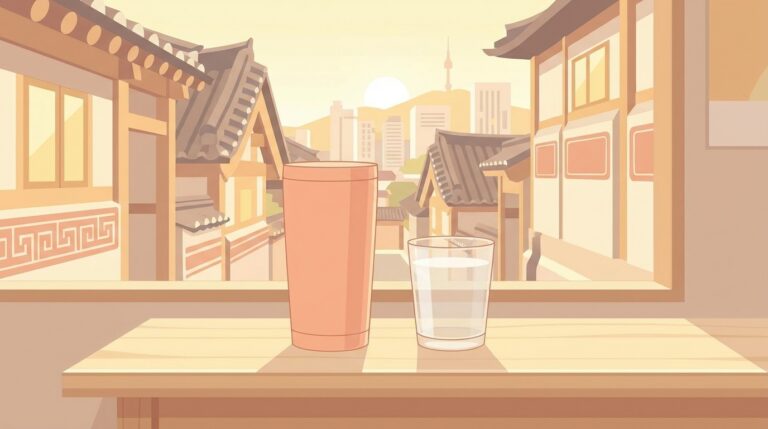
Phase 1: 공감 (Story-Driven Opening)
안녕하세요! 매일한글 에디터입니다. (Hello! This is your Daily Hangul editor.)
Picture this: You are sitting at a cozy cafe in Seongsu-dong or watching a cozy lifestyle vlog of your favorite K-pop idol or actor. On their desk, right next to their iPad and skincare mist, sits a giant, pastel-colored 1-liter tumbler decorated with cute stickers. In Korea, everyone from university students pulling all-nighters in Sinchon to stylish office workers in Yeouido seems obsessed with carrying their own tumbler. You will constantly hear people asking each other, “물 많이 마셨어요?” (Did you drink a lot of water?) or talking about their wellness routines.
Maybe you also want to build healthy habits—like drinking two liters of water every single day—and carry your favorite tumbler everywhere. But when a Korean friend or colleague smiles and asks, “어? 텀블러 무겁지 않아요?” (Oh, isn’t that tumbler heavy?), do you freeze, unsure how to say, “I’m trying to drink 2 liters of water daily!” without sounding like a robotic medical pamphlet?
Don’t worry at all. Today’s guide is designed from real classroom moments and student struggles. By the end of this post, you will be able to share your daily health routines, order drinks in your reusable bottle like a true local, and chat comfortably about self-care with native Korean speakers.
Phase 2: 핵심 표현 3선 심층 분석 (Top 3 Key Expressions)
1. 하루에 물을 2리터 이상 마시려고 해요. (Harue muleul i-riteo isang masiryeogo haeyo.)
- Pronunciation: Ha-ru-eh mul-eul ee-ree-teo ee-sang ma-see-ryeo-go hae-yo. (Sounds like: “Ha-roo” + “Liter” with a smooth Korean ‘r’ sound).
- Meaning: Literal: “In a day, water 2 liters or more I intend to drink.” / Nuance: “I am trying to drink more than two liters of water a day.”
- K-Culture Moment: You will hear this constantly in Korean celebrity “What’s in My Bag” videos or morning routine vlogs whenever someone pulls out a water tracker bottle.
- Editor’s Insight: The pattern
-려고 해요(-ryeogo haeyo) expresses intention or an ongoing personal goal (“I’m trying to / intending to”). It sounds much softer and more modest than saying “I will definitely do it!” - Situation Spectrum:
- Casual (반말): 하루에 물 2리터 이상 마시려고 해. (✅)
- Semi-formal (해요체): 하루에 물을 2리터 이상 마시려고 해요. (✅)
- Formal (하십시오체): 하루에 물을 2리터 이상 마시려고 합니다. (✅)
- 🤔 Think About It: In English, we often say “I try to stay hydrated.” Why do you think Korean speakers prefer specifying measurable units like “2리터” (two liters) or “물 8잔” (eight glasses of water) when discussing healthy habits?
2. 텀블러를 항상 들고 다녀요. (Teombeulleoreul hangsang deulgo danyeoyo.)
- Pronunciation: Teom-beul-leo-reul hang-sang deul-go da-nyeo-yo. (Analogy: “Tumbler” with a crisp Korean vowel, followed by “deul-go” which sounds like lifting something up).
- Meaning: Literal: “Tumbler always holding and coming/going.” / Nuance: “I always carry a tumbler around with me.”
- K-Culture Moment: Seen when an office worker in a K-drama heads out for a post-lunch stroll holding an iced americano in their reusable thermos.
- Editor’s Insight: In Korean, rather than just “가지고 있다” (to have), when you physically transport an item with you on a daily basis, native speakers use the compound verb “들고 다니다” (to carry/hold around).
- Situation Spectrum:
- Casual: 텀블러 항상 들고 다녀. (✅)
- Semi-formal: 텀블러를 항상 들고 다녀요. (✅)
- Formal: 텀블러를 항상 지참합니다. (⚠️ – slightly too stiff/bureaucratic for casual chats)
- 🤔 Think About It: Why does Korean emphasize the physical movement (holding and going around – 들고 다니다) instead of just stating simple possession like “I have a tumbler”?
3. 건강 챙기려면 수분 보충이 필수예요! (Geon-gang chaenggiryeomyeon subun bochungi pilssuyeyo!)
- Pronunciation: Geon-gang chaeng-gee-ryeo-myeon soo-boon bo-choong-ee peel-soo-yeh-yo!
- Meaning: Literal: “If you want to take care of health, moisture replenishment is a must!” / Nuance: “Staying hydrated is essential if you want to stay healthy!”
- K-Culture Moment: When beauty vloggers explain how they keep their skin glowing before applying cushion foundation.
- Editor’s Insight: The word “수분 보충” (hydration / water replenishment) is a favorite buzzword in Korean wellness, beauty, and health culture. Combined with “필수” (essential/must-have), it makes your Korean sound expressive and informed.
- Situation Spectrum:
- Casual: 건강 챙기려면 수분 보충 필수야! (✅)
- Semi-formal: 건강 챙기려면 수분 보충이 필수예요! (✅)
- Formal: 건강을 위해서는 수분 보충이 필수적입니다. (✅)
- 🤔 Think About It: Notice the verb “챙기다” (to take care of / pack). How does this word connect to the warm, attentive nature of Korean culture where taking care of oneself is seen as a duty?
Phase 3: 교과서 한국어 vs 진짜 한국어 (Textbook vs. Real Korean)
Situation 1: Telling someone you carry a water bottle
- 📖 교과서 한국어: 저는 매일 물병을 휴대합니다. (Jeoneun maeil mulbyeong-eul hyudaehamnida. – “I carry a water bottle every day.”)
- 🗣️ 진짜 한국어: 그냥 텀블러 들고 다녀요! (Geunyang teombeulleo deulgo danyeoyo! – “I just carry a tumbler around!”)
- 💡 왜 다를까? “휴대하다” (to carry/possess) is formal Sino-Korean vocabulary usually seen on warning signs or regulations. Real Koreans almost exclusively say “들고 다녀요” in daily conversations.
Situation 2: Talking about drinking lots of water
- 📖 교과서 한국어: 저는 다량의 물을 섭취하고 있습니다. (Jeoneun daryang-ui muleul seopchwihago itseumnida. – “I am consuming large quantities of water.”)
- 🗣️ 진짜 한국어: 물 많이 마시려고 노력 중이에요! (Mul mani masiryeogo noryeok jung-ieyo! – “I’m currently trying to drink lots of water!”)
- 💡 왜 다를까? “섭취” (ingestion/intake) belongs in medical reports. Native speakers use everyday action verbs with “~려고 노력 중이에요” (in the middle of trying to…). It feels genuine and approachable.
Phase 4: K-Culture 딥다이브 & 비언어적 매너 (K-Culture & Non-Verbal Manners)
4-1. 눈치 (Nunchi) & Gestures
- When refilling your tumbler at an office or gym water dispenser (정수기), take a quick look behind you. If someone is waiting with a small paper cup, smiling and saying “먼저 하세요” (Please go ahead) shows top-tier Korean Nunchi!
- If you bring your tumbler to a Korean cafe, present it with both hands or hold it gently toward the barista while ordering. Saying “텀블러에 담아주세요” (Please put it in my tumbler) gets you a standard eco-friendly discount (텀블러 할인), usually between 300 to 500 KRW!
4-2. Cultural Code: The “갓생” (Godsaeng) Lifestyle
In South Korea today, the trend of Godsaeng (갓생, combining “God” + “생/Life”, meaning living a hyper-productive, clean, healthy life) is huge. Young Koreans track their water intake, step counts, and daily vitamins using smartphone habit apps. Carrying an aesthetic tumbler isn’t just about drinking water; it’s a silent badge that says, “I take care of my body, I am mindful of the environment, and I take pride in my daily routine.”
Phase 5: 실전 롤플레이 시나리오 (Real Roleplay Scenario)
- Location: Modern office lounge in Pangyo, next to the sleek hot/cold water purifier.
- Character: Minji (NPC: A warm, health-conscious senior coworker who loves eco-friendly living).
- 민지: 어, 마이클 씨! 그 텀블러 엄청 크네요? (Eo, Maikeul ssi! Geu teombeulleo eomcheong keuneyo?)
- 🎭 행동 지문: 눈을 동그랗게 뜨며 1리터짜리 텀블러를 가리킨다. (Opens eyes wide and points at the 1-liter tumbler)
- “Oh, Michael! That tumbler is huge!”
- 나 (Learner): 네, 맞아요! 하루에 물을 2리터 이상 마시려고 들고 다녀요. (Ne, majayo! Harue muleul i-riteo isang masiryeogo deulgo danyeoyo.)
- 🎭 행동 지문: 쑥스러운 듯 웃으며 텀블러 뚜껑을 연다. (Smiles a bit shyly and opens the tumbler lid)
- “Yes, that’s right! I carry it around to drink more than 2 liters of water a day.”
- 민지: 와, 대단해요. 무겁지는 않아요? (Wa, daedanhaeyo. Mugeopjineun anayo?)
- 🎭 행동 지문: 고개를 갸웃하며 텀블러 무게를 가늠해본다. (Tilts head slightly, wondering about the weight)
- “Wow, impressive. Isn’t it heavy?”
- 나 (Learner): 조금 무겁긴 한데, 건강 챙기려면 필수예요! (Jogeum mugeopgin hande, geon-gang chaenggiryeomyeon pilssuyeyo!)
- 🎭 행동 지문: 가볍게 어깨를 으쓱하며 정수기 물을 받는다. (Shrugs lightly while dispensing water)
- “It’s a little heavy, but staying hydrated is essential for health!”
- 민지: 맞아요. 저도 요즘 커피만 마셔서 수분 보충이 필요해요. (Majayo. Jeodo yojeum keopiman masyeoseo subun bochungi piryohaeyo.)
- 🎭 행동 지문: 자기 손에 든 커피잔을 내려다보며 한숨을 쉰다. (Looks down at her coffee cup and sighs)
- “True. I’ve only been drinking coffee lately, so I really need hydration too.”
- 나 (Learner): 민지 씨도 오늘부터 물 많이 드세요! (Minji ssido oneulbuteo mul mani deuseyo!)
- 🎭 행동 지문: 따뜻한 눈빛으로 민지를 격려한다. (Encourages Minji with warm eye contact)
- “Minji, you should drink lots of water starting today too!”
- 민지: 그래야겠어요. 혹시 비타민도 챙겨 드세요? (Geuraeyagesseoyo. Hoksi bitamindo chaenggyeo deuseyo?)
- 🎭 행동 지문: 호기심 가득한 표정으로 질문한다. (Asks with a curious expression)
- “I should. By the way, do you take vitamins too?”
- 나 (Learner): 그럼요! 아침마다 비타민 꼭 챙겨 먹어요. (Geureomyo! Achimmada bitamin kkok chaenggyeo meogeoyo.)
- 🎭 행동 지문: 자신만만하게 고개를 끄덕인다. (Nods confidently)
- “Of course! I make sure to take my vitamins every morning.”
🔀 인터랙티브 분기점 (Interactive Choice)
When Minji asks if you take vitamins too, how do you respond?
- Choice A: “그럼요! 아침마다 비타민 꼭 챙겨 먹어요.” (Geureomyo! Achimmada bitamin kkok chaenggyeo meogeoyo.)
- 👉 Feedback [Best]: Natural, positive, and matches native conversational flow perfectly!
- Choice B: “저는 비타민 약품을 매일 복용합니다.” (Jeoneun bitamin yakpumeul maeil bogyonghamnida.)
- 👉 Feedback [Risk]: Grammatically correct, but sounds like a doctor speaking at a hospital symposium.
- Choice C: “안 먹어. 관심 없어.” (An meogeo. Gwansim eopseo.)
- 👉 Feedback [Bad]: Drops honorifics (반말) and sounds blunt and dismissive to a colleague.
Phase 6: 10초 감정 섀도잉 드릴 (10-Second Emotion Shadowing Drill)
Follow the pause markers / and embody the emotion tags:
[😊 밝고 활기차게 - Bright & Cheerful]- 하루에 물을 / 2리터 이상 마시려고 / 노력 중이에요! (Harue muleul / i-riteo isang masiryeogo / noryeok jung-ieyo!)
[😌 뿌듯하고 당당하게 - Proud & Grounded]- 그래서 텀블러를 / 항상 챙겨 다녀요. (Geuraeseo teombeulleoreul / hangsang chaenggyeo danyeoyo.)
[😉 친근하게 윙크하듯 - Friendly & Encouraging]- 우리 같이 / 물 많이 마시고 / 건강 챙겨요! (Uri gachi / mul mani masigo / geon-gang chaenggyeoyo!)
Phase 7: K-Culture 미니 사전 (Mini Dictionary)
- 갓생 (Godsaeng)
- Translation: God-tier productive life / Healthy self-care routine.
- Usage: Used widely on social media and among 20s-30s Koreans to describe waking up early, drinking water, exercising, and avoiding procrastination.
- 텀블러 할인 (Teombeulleo Harin)
- Translation: Tumbler discount.
- Usage: Standard cafe benefit in Korea. Franchises like Starbucks, Twosome Place, and Mega Coffee offer 100~500 won off when you order using your own reusable cup.
- 수분 보충 (Subun Bochung)
- Translation: Hydration / Moisture replenishment.
- Usage: Used in both skincare advertisements and daily chats when reminding friends not to drink only coffee all day.
- 비타민 챙기다 (Bitamin Chaenggida)
- Translation: To remember to take your vitamins.
- Usage: “챙기다” means not forgetting to look after something valuable. Asking “비타민 챙겼어?” is a classic way to show warmth and caring.
Phase 8: 여행자를 위한 생존 키트 (Traveler’s Survival Kit)
서바이벌 표현 TOP 3
- 텀블러에 담아주세요. (Teombeulleoe dama-juseyo.)
- Pro Tip: Say this right after ordering your coffee at any cafe counter to receive your drink in your bottle and get your discount.
- 여기에 정수기 있어요? (Yeogie jeongsugi isseoyo?)
- Pro Tip: Korea has clean, free water purifiers in almost every subway station waiting area, library, and airport terminal.
- 찬물 말고 미온수 나와요? (Chanmul malgo mionsu nawayo?)
- Pro Tip: If you prefer lukewarm water for digestion, ask for “미온수” (mi-on-su).
Editor’s Travel Note
When navigating Korea’s streets looking for health food stores (like Olive Young for supplements) or water refill spots, don’t rely on standard international maps which often lack indoor walking data. Check your route using 네이버 지도 앱 다운로드 for real-time storefront information and user reviews.
Phase 9: “한 발 더 깊이” (Cultural Insight)
In Korean society, asking someone about what they eat or how much water they drink is not intrusive; it is an act of deep affection called “정” (Jeong). The verb 챙기다 (chaenggida) is key here—it implies active care, guardianship, and affection. When a Korean tells you, “물 잘 챙겨 마셔요” (Make sure to drink enough water), they are treating you not merely as an acquaintance, but as someone whose well-being matters to their community.
💬 Your Turn: How many liters of water do you drink a day, and what kind of tumbler do you carry? Leave a comment below using today’s pattern: “하루에 물을 ___리터 마시려고 해요!”
Phase 10: FAQ & 오해 방지 (FAQ & Common Mistakes)
Q: Can I ask for free water refills at Korean restaurants?
A: Yes! Water at casual Korean dining places (식당) is almost always free. You will either get a chilled bottle placed at your table or see a sign saying “물은 셀프입니다” (Water is self-service), meaning you can fill your tumbler or cup at the dispenser yourself.
Q: How do I say “iced water” vs “hot water”?
A: Use “찬물” (chan-mul, cold water) or “차가운 물” (cha-ga-un mul), and “따뜻한 물” (tta-tteut-han mul, warm/hot water). Note that “뜨거운 물” means scalding hot water.
Q: Is it rude to drink water from my tumbler inside a Korean cafe?
A: Not at all, especially if you ordered something at the cafe. However, if you brought outside drinks like smoothies from another brand inside, that is frowned upon.
🚨 흔한 실수 (Common Mistakes) 경고판
- Mistake: Saying “텀블러를 걸어요” to mean carrying a tumbler.
- Correction: Use 들고 다녀요 (holding and moving around) or 가지고 다녀요.
- Mistake: Confusing “약 먹다” with “비타민 마시다”.
- Correction: In Korean, all pills (even vitamins) are taken with the verb 먹다 (to eat). Always say “비타민 먹어요”.
- Mistake: Forgetting to specify size units.
- Correction: Instead of saying “물 두 개 마셔요” (I drink two waters), say “물 2리터 마셔요” (two liters) or “물 두 잔 마셔요” (two cups).
Phase 11: 액션 미션 & 참여 유도 (Action Missions)
- 🥉 Bronze Mission (Solo Practice): Stand before a mirror with your water bottle. Say aloud three times: “하루에 물을 2리터 이상 마시려고 텀블러를 항상 들고 다녀요!”
- 🥈 Silver Mission (SNS Sharing): Take a picture of your favorite tumbler, post it on Instagram or Threads, and caption it with: “오늘도 수분 보충 완료! 💧 #매일한글 #갓생”
- 🥇 Gold Mission (Real Life Action): Visit a local cafe or convenience store and ask for warm water using: “따뜻한 물 부탁드려요” or “텀블러에 담아주세요!”
🎮 K-Culture Mission: Next time you watch a modern K-drama office scene, count how many tumblers appear on the characters’ desks. Spotting these small cultural details will boost your immersion!
Phase 12: 인터랙티브 퀴즈 챌린지 (Quiz Challenge)
1. Situational Judgment:
You are at an eco-friendly cafe in Hongdae. What is the most polite, natural way to ask the barista to make your iced latte in your reusable bottle?
* A) 텀블러 주시오.
* B) 텀블러에 담아주세요.
* C) 물통으로 커피를 이동해라.
2. Fill-in-the-Blank:
“건강을 지키려면 매일 충분한 ______ 보충이 필요해요.” (Hint: The Korean word for hydration/moisture)
3. True or False:
In Korea, taking vitamins in pill form is phrased using the verb “마시다” (to drink). (True / False)
👉 정답 확인하기 (Click to reveal answers & explanations!)
- 정답: B) 텀블러에 담아주세요. (Please put it in my tumbler. Option A is archaic Joseon-dynasty speech, while Option C is an awkward machine-translated command!)
- 정답: 수분 (Subun) (수분 보충 = hydration replenishment).
- 정답: False! (All medication and vitamin tablets use “먹다” [to eat], so you must say “비타민을 먹다”).
🎬 Watch Our Daily Videos! (Daily Hangul Official Instagram)
Review the expressions you learned in this article with our fun daily short videos! Check out native pronunciation and real-life nuances in action.
- Instagram @dailyhangul_en







