

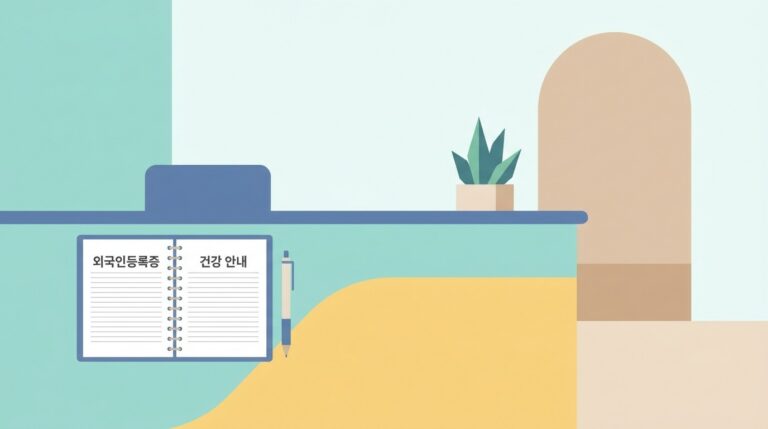
Being Enrolled in Korean Health Insurance Entitles You to a Free Checkup Every Two Years
Phase 1: Empathy (Story-Driven Opening)
안녕하세요! 매일한글 에디터입니다. (Hello! This is your Daily Hangul editor.)
Picture this: You open your mailbox in your Seoul officetel, and inside is a crisp, official envelope from 국민건강보험공단 (National Health Insurance Service – NHIS). Or perhaps your KakaoTalk buzzes with an alarming message titled [국민건강검진 안내] (National Health Screening Notice). Your heart skips a beat. Did I forget to pay my premium? Is my visa status in jeopardy? Did I do something wrong?
Take a deep breath! If you’ve watched K-dramas like Hospital Playlist or office slice-of-life series like Misaeng, you’ve probably seen busy employees suddenly grumbling about drinking terrible chalky solutions, starving for 12 hours, or asking each other, “Did you get your checkup done yet?”
Here is the golden truth: that notice isn’t a bill—it’s a gift! If you are registered under Korean National Health Insurance (whether as an employee, a local subscriber, or a dependent), you are legally entitled to a comprehensive free general health checkup every two years (or every year if you are in certain manual labor fields). Over the years, countless foreign residents have told me they threw this notice away for years simply because they couldn’t read the dense medical terms. Today, we’re changing that. Let’s unlock your rightful healthcare perks with zero awkwardness!
Phase 2: Core Expressions Deep Dive
Here are the three must-know expressions to navigate your checkup effortlessly.
1. 제가 올해 건강검진 대상자인가요? (Jega olhae geongang-geomjin daesangjain-gayo?)
- Pronunciation: [Je-ga ol-hae geon-gang geom-jin dae-sang-ja-in-ga-yo?] (Think: “Je” like general + “ol-hae” like all-day + “dae-sang-ja” sounding like day-sung-ja)
- Meaning: “Am I eligible for a health checkup this year?”
- K-Culture Moment: You walk up to an internal medicine clinic front desk in early autumn, hand over your Alien Registration Card (ARC), and ask this question politely.
- Editor’s Insight: The word 대상자 (daesangja) means “target person” or “eligible candidate.” In Korea, eligibility generally depends on your birth year. If the current year is even (e.g., 2024, 2026), people born in even years are eligible. If it’s an odd year (e.g., 2025), odd birth years are up!
- Situation Spectrum: Casual: ⚠️ (제가 올해 대상자야? – only to close friends) | Semi-formal: ✅ | Formal: ✅
- 🤔 Think About It: In many Western countries, preventative routine checkups require private doctor appointments and deductibles. Why do you think Korea’s public system automates eligibility by alternating birth years?
2. 2년에 한 번 무료로 받을 수 있어요. (I-nyeone han beon muryoro badeul su isseoyo.)
- Pronunciation: [I-nyeo-ne han beon mu-ryo-ro ba-deul su i-sseo-yo.] (Tip: “I-nyeon” rhymes with ‘neon’, and “muryo” sounds like moo-ryo)
- Meaning: “You can receive it for free once every two years.”
- K-Culture Moment: Explaining the system proudly to a newcomer expat friend over samgyeopsal, saving them hundreds of thousands of won.
- Editor’s Insight: Notice the structure: [Time period] + 에 한 번 (once per…). You will use this formula everywhere in daily Korean, from gym memberships to medication instructions: 하루에 두 번 (twice a day), 일주일에 한 번 (once a week).
- Situation Spectrum: Casual: ✅ (2년에 한 번 무료야) | Semi-formal: ✅ | Formal: ✅ (무료로 받으실 수 있습니다)
- 🤔 Think About It: Koreans love the word 무료 (muryo – free of charge) or 공짜 (gongjja – colloquial freebie). Notice how clear bureaucratic benefits are stated upfront to encourage preventive care.
3. 검진 전에 금식해야 하나요? (Geomjin jeone geumsik-haeya hanayo?)
- Pronunciation: [Geom-jin jeo-ne geum-sik-hae-ya ha-na-yo?] (Tip: “Geumsik” sounds sharp like ‘gum-seek’)
- Meaning: “Do I need to fast before the screening?”
- K-Culture Moment: Calling the clinic the afternoon before your scheduled morning exam to double-check whether your iced Americano routine is allowed (spoiler: it’s not!).
- Editor’s Insight: 금식 (geumsik) comes from Sino-Korean roots: 禁 (prohibit) + 食 (food/eat). Standard Korean health checkups require fasting from at least 9:00 PM the night before (roughly 8 to 12 hours) so blood sugar and liver panels remain accurate.
- Situation Spectrum: Casual: ⚠️ | Semi-formal: ✅ | Formal: ✅
- 🤔 Think About It: Notice how Korean creates functional terms by pairing single Sino-Korean syllables (금식 = fast; 금연 = no smoking; 금주 = no drinking). How does this compare to Latin prefixes in English?
Phase 3: Textbook Korean vs. Real Korean
Let’s upgrade your Korean from stiff robotic handbook phrases to the natural language spoken at clinic desks.
Situation 1: Confirming that the base exam costs 0 won
- 📖 교과서 한국어 (Textbook): 국민건강검진 기본 검사는 무료로 진행됩니까? (Gukmin-geongang-geomjin gibon geomsa-neun muryoro jinhaengdoebnikka? / “Is the general national health screening conducted free of charge?”)
- 🗣️ 진짜 한국어 (Real-life): 이거 본인 부담금 없는 거 맞죠? (Igeo bonin budamgeum eomneun geo matjyo? / “This doesn’t have any out-of-pocket copay, right?”)
- 💡 왜 다를까? (Why the difference?): In reality, native speakers use 본인 부담금 (bonin budamgeum – personal copay). Asking if there is a “copay” is more precise because clinics sometimes offer optional add-on scans (like ultrasounds) which do cost money.
Situation 2: Asking if you can just walk in today
- 📖 교과서 한국어 (Textbook): 사전 예약 없이 방문하여 검진을 받아도 됩니까? (Sajeon yeyak eopsi bangmunhayeo geomjineul badado doebnikka? / “May I visit and receive an exam without a prior reservation?”)
- 🗣️ 진짜 한국어 (Real-life): 혹시 오늘 당일 접수도 돼요? (Hoksi oneul dang-il jeopsudo dwaeyo? / “By any chance, do you accept walk-in registration today?”)
- 💡 왜 다를까? (Why the difference?): Real Koreans soften their requests with 혹시 (hoksi – by any chance) and use the business-casual noun 당일 접수 (dang-il jeopsu – same-day registration).
Phase 4: K-Culture Deep Dive & Non-verbal Manners
4-1. 눈치 (Nunchi) & Clinic Desk Etiquette
When arriving at an internal medicine clinic (내과 – naegwa) or designated health center (검진센터 – geomjin-ssenteo):
1. The Two-Handed ID Delivery: Hand over your Alien Registration Card or Korean health insurance card with both hands. Eye contact should be warm and polite, followed by a slight 15-degree bow.
2. The Honest Fasting Confession: If you accidentally sipped water or swallowed a mint in the morning, confess immediately: “아침에 물을 조금 마셨는데 괜찮아요?” (Achime mureul jogeum masyeonneunde gwaenchannayo? – I drank a little water this morning, is that okay?). In Korean medical culture, hiding small details disrupts the smooth rhythm of the clinic team.
4-2. The “End-of-the-Year Checkup Stampede”
In Korea, there is a cultural phenomenon known as 건강검진 대란 (Geongang-geomjin daeran – Health Checkup Chaos). Even though Koreans know they have the entire year to use their biennial benefit, roughly 40-50% of the population procrastinates until November and December! During these two months, clinic waiting rooms look like subway transfer stations at rush hour. If you want a smooth, peaceful 45-minute experience with zero waiting, book your visit between March and August.
Phase 5: Real-Life Roleplay Scenario
Setting: Front reception desk of Seoul Barun Internal Medicine Clinic (서울바른내과) in Sinchon on a Tuesday morning.
Characters: You (B1 Learner) and Nurse Min-ji (민지 – friendly and efficient receptionist).
- You: 안녕하세요! 국가건강검진 받으러 왔는데요. (Annyeonghaseyo! Gukga-geongang-geomjin badeureo wanneundeyo.)
🎭 [Smiling, placing Alien Registration Card on the desk counter with both hands]
“Hello! I came to get the national health checkup.” -
Min-ji: 네, 신분증 확인 도와드릴게요. 올해 짝수년도 출생자 대상이세요. (Ne, sinbunjeung hwagin dowadeurilgeyo. Olhae jjaksu-nyeondo chulsaengja daesang-iseyo.)
🎭 [Typing on computer, looking up with a pleasant nod]
“Yes, let me check your ID. This year is for people born in even years.” -
You: 네, 맞아요. 제가 올해 대상자 맞죠? (Ne, majayo. Jega olhae daesangja matjyo?)
🎭 [Nodding affirmatively]
“Yes, that’s right. I am eligible this year, correct?” -
Min-ji: 네, 일반건강검진 대상자 맞으시네요. 혹시 어젯밤 9시부터 금식하셨나요? (Ne, ilban-geongang-geomjin daesangja majeusineyo. Hoksi eojetbam ahopsibuteo geumsik-hasyeonnayo?)
🎭 [Looking attentively to check medical compliance]
“Yes, you are eligible for the general health exam. By any chance, have you fasted since 9 PM last night?” -
You: 네, 어제 저녁 8시 이후로 물도 안 마셨어요! (Ne, eoje jeonyeok yeodeolbi ihuro muldo an masyeosseoyo!)
🎭 [Patting chest proudly]
“Yes, I haven’t even had water since 8 PM yesterday!” -
Min-ji: 잘하셨어요! 기본 검사는 본인 부담금 0원 무료입니다. 문진표 먼저 작성해 주세요. (Jalhasyeosseoyo! Gibon geomsaneun bonin budamgeum yeong-won muryo-imnida. Munjinpyo meonjeo jakseonghae juseyo.)
🎭 [Hands over a medical questionnaire and a pen]
“Great job! The basic checkup has zero copay—it’s free. Please fill out this medical questionnaire first.” -
You: 혹시 위내시경 검사도 오늘 추가할 수 있나요? (Hoksi winaesigyeong geomsado oneul chugahal su innayo?)
🎭 [Tilting head inquisitively]
“By any chance, can I add an endoscopy exam today as well?” -
Min-ji: 오늘은 내시경 예약이 꽉 차서요, 기본 검사 끝나고 다음 주 예약으로 잡아드릴게요! (Oneureun naesigyeong yeyagi kkwak chasaeyo, gibon geomsa kkeunnago daeum ju yeyageuro jabadeurilgeyo!)
🎭 [Apologetic smile, pointing to digital calendar]
“Today the endoscopy slots are fully booked, so after your general screening, I’ll schedule you for next week!”
🔀 Interactive Decision Point!
Min-ji asks you: “문진표 작성하시다가 모르는 단어 있으시면 편하게 물어보세요.” (If there are words you don’t know on the questionnaire, feel free to ask.) How do you respond?
- Option A: “아, 괜찮아요. 파파고로 찍어서 볼게요!” (Ah, gwaenchannayo. Papagoro jjigeoseo bolgeyo! – “Ah, it’s fine. I’ll translate it with Papago photo scan!”)
- Option B: “야, 이거 한글 너무 어려우니까 네가 다 써줘.” (Ya, igeo hangeul neomu eoryeounikka nega da sseojwo. – “Hey, this Korean is too hard, you write it all for me.”)
- Option C: “네, 감사합니다! 모르는 항목 있으면 말씀드릴게요.” (Ne, gamsahamnida! Moreuneun hangmogi isseumyeon malsseumdeurilgeyo. – “Yes, thank you! If there are items I don’t know, I’ll let you know.”)
Feedback:
* Option A (Good Alternative): Totally understandable and self-reliant, but misses an opportunity to practice conversational clinic Korean!
* Option B (BAD / Social Catastrophe 🚨): Using 반말 (informal speech like ‘야’ and ‘네가’) to a medical professional will freeze the entire reception room in awkward horror.
* Option C (BEST 🏆): Polite, natural, and leaves the door open for cooperative communication. Min-ji will be delighted to guide you through terms like 음주 (drinking) and 가족력 (family medical history).
Phase 6: 10-Second Emotional Shadowing Drill
Speak out loud! Follow the rhythm breaks (/) and embody the emotional markers.
[😊 밝고 공손하게 - Bright and polite]
안녕하세요! / 제가 올해 / 건강검진 대상자인지 / 확인하러 왔어요.
(Annyeonghaseyo! / jega olhae / geongang-geomjin daesangjainji / hwaginhareo wasseoyo.)-
[🤔 진지하고 조심스럽게 - Inquiring and careful]
혹시 / 어제 물 마신 것도 / 검사에 영향이 있나요?
(Hoksi / eoje mul masin geotdo / geomsaye yeonghyangi innayo?) -
[🎉 안도하며 기분 좋게 - Relieved and pleased]
본인 부담금이 전혀 없다고요? / 정말 다행이네요!
(Bonin budamgeumi jeonhyeo eopttagoyo? / jeongmal dahaeng-ineyoe!)
Phase 7: K-Culture Mini Dictionary
| Term (Hangul + Romanization) | Translation | Real-Life Practical Usage |
|---|---|---|
| 1. 건강검진 (Geongang-geomjin) | Health screening / Medical checkup | The overarching term for statutory or corporate health screenings in Korea. |
| 2. 대상자 (Daesangja) | Eligible recipient / Candidate | Used in all government & NHIS services. You will hear: “대상자 조회를 해드릴게요” (Let me check your eligibility). |
| 3. 금식 (Geumsik) | Fasting (NPO) | Strictly mandatory before blood tests and endoscopies. Clinics often require 8–12 hours of total water and food abstinence. |
| 4. 본인 부담금 (Bonin budamgeum) | Out-of-pocket copay | The exact fee you must pay from your own pocket after health insurance coverage is applied. For national general screenings, this is usually 0%. |
Phase 8: Expat & Traveler Survival Kit
Top 3 Survival Phrases
- “건강보험공단 검진 지정 병원인가요?” (Geongang-boheom-gongdan geomjin jijeong byeong-won-in-gayo?)
Pro Tip: Not every small neighborhood clinic performs the national checkup. Use this phrase over the phone or at the door to verify they are an officially designated screening center. - “검진 결과는 우편으로 받나요, 모바일로 받나요?” (Geomjin gyeolgwaneun upyeoneuro bannayo, mobailleo bannayo?)
Pro Tip: You can choose whether your comprehensive health report arrives as a paper letter to your home or as a secure KakaoTalk PDF link. - “외국인 등록번호로 조회해 주세요.” (Oegukin deungnok-beonhoro johwoehae juseyo.)
Pro Tip: If they struggle to locate your file using your English Romanized name (which often gets inverted or truncated in databases), this phrase prompts them to search directly via your ARC number.
Editor’s Travel & Expat Note
- App Recommendation: Download the official The건강보험 (The Health Insurance NHIS App). Once logged in with your digital certificate (간편인증 via Toss or Kakao), navigate to 검진 대상자 조회 (Check Screening Eligibility). It will instantly tell you if you are eligible this year and show nearby certified hospitals on an interactive map.
- Timing Secret: Avoid Mondays and avoid the month of December. The best day to visit is a Thursday morning in May!
Phase 9: “One Step Deeper” (Cultural Reflection)
In South Korea, healthcare is not viewed purely as an individualized commercial product, but as a collective civic duty and a shared social contract. The Korean phrase “몸조리 잘하세요” (Take good care of your body) reflects an underlying belief that maintaining good health is both a kindness to yourself and a responsibility to your family and society. By funding biennial checkups for all citizens and foreign residents, the state practices aggressive preventative care—catching hypertension, diabetes, and early-stage cancer long before acute hospital care is needed. When you participate in this biennial ritual, you aren’t just getting free blood tests; you are taking part in one of Korea’s most successful social solidarity systems.
💬 Your Turn: Have you checked your birth year for this year? What is preventative healthcare like in your home country? Drop your thoughts in the comments below!
Phase 10: FAQ & Common Mistakes
Q: Can foreign students (D-2 visa) or working holiday makers (H-1) also receive this free checkup?
A: Yes! As long as you have been enrolled in National Health Insurance (which is now mandatory for foreign residents residing in Korea for more than 6 months), you are entitled to the exact same biennial general checkup as Korean citizens.
Q: What tests are included in the free basic general exam (일반건강검진)?
A: The free basic tier covers body measurements (height, weight, waist, BMI), vision and hearing tests, blood pressure, urine analysis (kidney health), chest X-ray (tuberculosis and lung check), and comprehensive blood tests (cholesterol, liver enzymes, blood glucose, anemia). Depending on age, depression screenings and cancer screenings (stomach endoscopy, cervical smear) are also subsidized or free!
Q: What happens if I miss my checkup year?
A: You won’t be deported or fined as an individual subscriber, but you forfeit that cycle’s free benefit until your next eligible year! However, if you are employed by a Korean company and fail to complete your mandatory checkup, the employer may face administrative penalties. If you missed your year due to being abroad, you can call the NHIS hotline (1577-1000, English press 7) and request to be rolled over to the current year as a 추가등록 (supplementary registration).
🚨 Common Mistakes Alert
- Drinking a sweet latte on the walk to the clinic:
Mistake: Thinking fasting only applies to solid food.
Correct Action: Keep absolute fasting for 8+ hours. Black coffee, juice, chewing gum, and cigarettes are all strictly forbidden before blood testing. - Forgetting to carry physical ID:
Mistake: Showing a photo of your ARC on your smartphone. Korean medical law strictly requires physical photo identification or official mobile resident verification. - Postponing until Christmas week:
Mistake: Waiting until December 28th and finding clinics with 4-hour queues that turn away walk-ins.
Phase 11: Action Missions
- 🥉 Bronze Mission (Solo Practice): Stand before a mirror and practice saying: “제가 올해 건강검진 대상자인지 확인해 주세요.” (Please check if I am eligible for a health checkup this year) three times smoothly within 10 seconds.
- 🥈 Silver Mission (Social Share): Look at your Alien Registration Card. Check the second digit of your birth year. Post in our comments or your Instagram story: “I’m born in an [odd/even] year, so my checkup is in [Year]! #DailyHangul”
- 🥇 Gold Mission (Real-Life Action): Open the Naver Map app, search for 건강검진 내과 (Health Checkup Internal Medicine) near your subway station, call or visit, and ask: “올해 일반검진 당일 접수 가능한가요?”
- 🎮 K-Culture Mission: Next time you watch a modern K-drama workplace scene, look for the little round white band-aid on a character’s inner elbow—that means they just came from their annual health screening blood draw!
Phase 12: Interactive Quiz Challenge
Test your knowledge before you head to the clinic!
- Situation Judgment: You were born in 1996. The current calendar year is 2025. Are you eligible for the regular biennial general checkup this year?
- A) Yes, because everyone gets it every single year.
- B) No, because 1996 is an even number and 2025 is an odd year.
- C) No, foreigners are never eligible.
- Fill in the blank: Before your morning health checkup, you must observe strictly not eating or drinking:
“검진 전에는 최소 8시간 동안 ______을/를 해야 합니다.” (금식 / 과식 / 간식) -
True or False: If you only take the standard government-mandated basic exam (일반건강검진), your personal copay (본인 부담금) at the cash register is 0 won.
- ( ) True
- ( ) False
👉 Click to reveal answers & explanations!
- Answer: B. Korean biennial checkups operate on an alternating even/odd year system. 1996 is an even year, so you were eligible in 2024 and will be eligible again in 2026. (Unless your workplace requires annual exams).
- Answer: 금식 (Geumsik – fasting). 과식 (Gwasik) means overeating, and 간식 (Gansik) means snacking!
- Answer: True. The core general health checkup under National Health Insurance is 100% funded by the state and your insurance fund. There is zero personal copay unless you choose optional paid tests like full MRIs or specialty sonograms.
Keep your health sharp and your Korean sharper! See you in the next unit of Daily Hangul!
🎬 Watch Our Daily Videos! (Daily Hangul Official Instagram)
Review the expressions you learned in this article with our fun daily short videos! Check out native pronunciation and real-life nuances in action.
- Instagram @dailyhangul_en







