

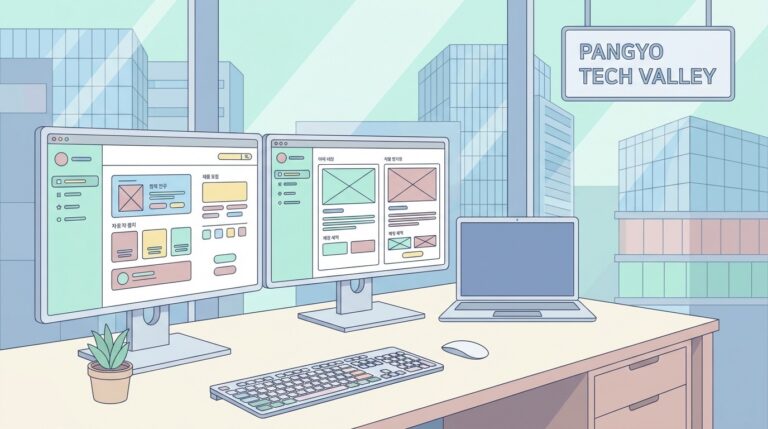
Phase 1: Empathy (Immersive Story Opening)
안녕하세요! 매일한글 에디터입니다. (Hello! I’m your Daily Hangul editor.)
Picture this: You are sitting in a sunlit glass conference room in Pangyo Techno Valley—Korea’s buzzing Silicon Valley—surrounded by developers sipping iced Americanos. Your team is sprinting toward a major product release, reminiscent of the high-stakes startup scenes from the hit K-drama Start-Up (스타트업). You open Figma to hand off your mobile app redesign to the frontend engineer. But the moment code inspection begins, chaos strikes.
“Wait, why is this button #FF5500, while the hover state is #FF5502, and the card border is #E5E5E5? Which hex code am I supposed to map to our global theme?” the developer asks, running a hand through their hair. If you have ever felt a cold sweat breaking out while trying to explain UI variables in Korean without sounding like a textbook robot, you are certainly not alone.
Many intermediate Korean learners know the basic vocabulary for “color” (색상 – saeksang) and “name” (이름 – ireum), but when stepping into real-world Korean tech hubs in Gangnam or Pangyo, literal translations fall apart. Shouting out hex codes creates a maintenance nightmare and developer friction. Learning how to pitch and coordinate standardized design tokens using role-oriented semantic naming—like Primary-500 or Surface-Background—transforms you from an outsider into a trusted, cross-functional partner. Based on actual handoff reviews and feedback from international professionals thriving in Korean tech teams, this guide equips you with the exact phrases, cultural etiquette, and diplomatic nuances to bridge design and engineering effortlessly.
Phase 2: Core Expressions Deep Dive
1. 단순히 색상 코드로 부르는 대신 역할 중심의 시맨틱 네이밍을 붙였어요
- Pronunciation: [Dansunhi saeksang kodeuro bureuneun daesin yeokhal jungsim-ui simaentik neimingeul buchyeosseoyo.] (Sounds like: dahn-soon-hee sake-sang co-deu-ro boo-reu-neun day-seen yoke-hahl joong-sheem-oo-ee see-maen-teek nay-meeng-eul boo-chyo-sso-yo)
- Meaning: Literal: “Instead of simply calling it by a color code, we attached role-centered semantic naming.” | Actual Nuance: “We replaced hardcoded hex values with role-based semantic design tokens to make the UI scalable and clear.”
- K-Culture Moment: In the drama Start-Up, when Nam Do-san’s developer team clashes with designers over user interface consistency, clear vocabulary determines whether they launch on time or pull an all-nighter eating convenience store ramyun.
- Editor’s Insight: The grammatical frame
~는 대신(에)(instead of doing X) paired with~을/를 붙이다(to attach/assign a label) is the gold standard in Korean agile scrums when justifying a design system refactor. - Situation Spectrum:
- Casual (반말): 단순히 색상 코드로 부르는 대신 역할 중심 시맨틱 네이밍을 붙였어. ⚠️ (Only with close peers of equal rank)
- Semi-formal (해요체): 단순히 색상 코드로 부르는 대신 역할 중심의 시맨틱 네이밍을 붙였어요. ✅ (Ideal for daily standups and Figma comments)
- Formal (하십시오체): 단순한 색상 코드 대신 역할 중심의 시맨틱 네이밍을 적용하였습니다. ✅ (Perfect for sprint reviews and documentation)
- 🤔 Think About It: In English, tech teams often use abrupt verbs like “We switched to tokens.” Why do Korean teams frequently prefer
붙이다(to attach) or적용하다(to apply), and what does this reflect about treating UI components as concrete objects?
2. 핸드오프할 때 싱크가 안 맞아서 컴포넌트를 표준화했어요
- Pronunciation: [Haendeueopeu-hal ttae singkeuga an maj-aseo keomponeonteureul pyojunhwahaesseoyo.] (Sounds like: hand-oh-peuh-hahl ttay seeng-keu-gah ahn mah-jah-soh com-poh-nuhn-teu-reul pyo-joon-hwah-hae-sso-yo)
- Meaning: Literal: “Because sync did not match during handoff, we standardized the components.” | Actual Nuance: “We standardized our components because design and dev were out of alignment during the handoff process.”
- K-Culture Moment: Heard across open-plan offices in Pangyo: a designer and developer huddled over a dual monitor setup, comparing Figma inspect mode with the React Storybook library.
- Editor’s Insight:
싱크가 안 맞다(to be out of sync) is an essential IT Konglish idiom. Rather than blaming a specific person, Korean tech professionals attribute errors to the “sync” itself to maintain smooth workplace harmony. - Situation Spectrum:
- Casual: 핸드오프할 때 싱크 안 맞아서 컴포넌트 표준화했어. ⚠️
- Semi-formal: 핸드오프할 때 싱크가 안 맞아서 컴포넌트를 표준화했어요. ✅
- Formal: 핸드오프 과정에서 싱크가 일치하지 않아 컴포넌트를 표준화하였습니다. ✅
- 🤔 Think About It: Notice how Korean speakers avoid saying “You implemented it wrong” and instead use “The sync didn’t match.” How does this indirect attribution preserve psychological safety in high-stress sprints?
3. 하드코딩하지 말고 디자인 토큰으로 맞춰 주세요
- Pronunciation: [Hadeukodinghaji malgo dijain tokeuneuro matchwo juseyo.] (Sounds like: hah-deu-co-deeng-hah-jee mahl-goh dee-jah-een toh-keun-oo-roh maht-chwo joo-say-yoh)
- Meaning: Literal: “Do not hardcode, and please align with design tokens.” | Actual Nuance: “Please avoid hardcoding values and bind them to our design tokens instead.”
- K-Culture Moment: A gentle Slack ping sent along with a pull request review link before merging a feature into production.
- Editor’s Insight: The construction
~하지 말고 ~해 주세요(Instead of doing A, please do B) provides clear instructions without sounding bossy, especially when paired with the collaborative verb맞추다(to align/match). - Situation Spectrum:
- Casual: 하드코딩하지 말고 토큰으로 맞춰 줘. 🚫 (Too blunt unless talking to your closest workplace friend)
- Semi-formal: 하드코딩하지 말고 디자인 토큰으로 맞춰 주세요. ✅ (Standard respectful peer communication)
- Formal: 하드코딩을 지양하고 디자인 토큰으로 매핑해 주시기 바랍니다. ✅ (Used in formal engineering guidelines)
- 🤔 Think About It: Compare the English imperative “Don’t hardcode values” with
하드코딩을 지양하다(refrain from hardcoding). How does Korean business language soften prohibitions?
Phase 3: Textbook Korean vs Real-World Korean
Scenario 1: Pointing out an inconsistent hex code
- 📖 교과서 한국어 (Textbook Style): 이 색상 코드가 명세서와 일치하지 않습니다. 수정해 주십시오. (I saeksang kodeuga myeongseseowa ilchihaji anseumnida. Sujeonghae jusipsio.) — This color code does not match the specification. Please revise it.
- 🗣️ 진짜 한국어 (Real-World Tech Style): 이거 토큰 값이랑 디자인 싱크가 좀 안 맞는 것 같아요. 한번 확인해 주실 수 있나요? (Igeo tokeun gaps-irang dijain singkeuga jom an manneun geot gat-ayo. Hanbeon hwag-inhae jusil su发布 innayo?) — Looks like this token value and the design are a bit out of sync. Could you take a quick look?
- 💡 왜 다를까? (Why the difference?): Korean IT culture relies heavily on “cushion words” (쿠션어) like
~것 같아요(it seems like) and좀(a little) to soften critique, avoiding direct blame even when a bug is obvious.
Scenario 2: Asking developers to use the shared UI library
- 📖 교과서 한국어 (Textbook Style): 새로 제작된 표준 라이브러리 요소를 활용하십시오. (Saero jejakdoen pyojun raibeureori yosoreul hwalyonghasipsio.) — Utilize the newly created standard library elements.
- 🗣️ 진짜 한국어 (Real-World Tech Style): 새로 공통 컴포넌트로 빼두었으니, 이거 가져다 쓰시면 돼요! (Saero gongtong keomponeonteuro bbaedu-eosseuni, igeo gajyeoda sseusimyeon dwaeyo!) — We extracted this into a shared component, so you can just grab and use it!
- 💡 왜 다를까? (Why the difference?): Natural Korean developers talk about modular components using dynamic action verbs like
빼두다(to separate out/extract) and가져다 쓰다(to grab and use), which feels warm and team-oriented.
Phase 4: K-Culture Deep Dive & Non-Verbal Manners
4-1. 눈치 (Nunchi) & Screen Etiquette in Handoff Meetings
When participating in a sprint handoff at a Korean tech company, non-verbal cues carry as much weight as your Figma structure:
* The Open-Palm Gesture: Never point at a developer’s monitor or Figma screen with a sharp index finger. Instead, gesture toward the screen with an open palm facing upward or slightly sideways. Pointing directly with a finger is perceived as accusatory.
* The Tilt-and-Nod Agreement: When a teammate explains why a semantic token breaks in React Native or Flutter, tilt your head slightly and offer rhythmic backchanneling nods accompanied by “아, 네네~” (Ah, yes-yes). This shows you are actively computing their technical constraints before pushing your design priorities.
* The Figma Pointer Dance: In live collaborative Figma files, avoid frantically circling a developer’s avatar with your cursor. Instead, click their spotlight gently and use high-contrast cursor chat: “혹시 이 토큰 확인 가능하신가요?” (Could you perhaps check this token?).
4-2. Culture Code: The “-Nim” (-님) Culture of Pangyo Valley
Unlike traditional Korean conglomerates (Chaebol) that rely on strict hierarchical titles like Bujang-nim (Department Head) or Daeri-nim (Assistant Manager), Korean tech unicorns (like Toss, Kakao, and Coupang) embrace horizontal communication. Everyone addresses each other using their name followed by -님 (e.g., “민호 님”, “Alex 님”) or even English nicknames.
However, do not mistake flat communication for informal speech! Even if you call your lead developer “Minho-nim” without a corporate title, you must consistently use semi-formal polite endings (해요체) such as ~해주세요 or ~인 것 같아요. Dropping into casual talk (Banmal) without an explicit agreement damages trust instantly.
Phase 5: Real-World Roleplay Scenario
Setting: 4:30 PM on a Thursday at a fast-growing Seongsu-dong startup. The team is preparing the v2.4 handoff.
Characters:
* Alex (알렉스): Product Designer who just completed tokenizing the design system.
* Min-ho (민호 님): Senior Frontend Developer who values clean, modular code.
Turn 1 (Alex): 민호 님, 이번 결제 화면 핸드오프 티켓 피그마에 올려두었어요. (Minho-nim, ibeon gyeolje hwamyeon haendeueopeu tiket pigeumae ollyeodu-eosseoyo.)
🎭 Action: Opens Figma and shares screen with a gentle smile.
“Minho-nim, I’ve uploaded the checkout screen handoff ticket to Figma.”
Turn 2 (Min-ho): 네, 알렉스 님! 확인해 볼게요… 어, 그런데 버튼 색상이 #FF5500이 아니라 Primary-500으로 되어 있네요? (Ne, Alex-nim! Hwag-inhae bolgeyo… eo, geureonde beoteun saeksang-i #FF5500i anira Primary-500euro doe-eo itneyo?)
🎭 Action: Squints at the inspector panel, adjusting his glasses.
“Yes, Alex! Let me check… Oh, but the button color is set to Primary-500 instead of #FF5500?”
Turn 3 (Alex): 네! 단순히 색상 코드로 부르는 대신 역할 중심의 시맨틱 네이밍을 붙였어요. 다크 모드 대응할 때 편하실 거예요. (Ne! Dansunhi saeksang kodeuro bureuneun daesin yeokhal jungsim-ui simaentik neimingeul buchyeosseoyo. Dakeu modeu daeeunghal ttae pyeonhasil geoyeyo.)
🎭 Action: Toggles the dark mode switch on the Figma frame to demonstrate token responsiveness.
“Yes! Instead of just calling it by a hex code, we applied role-focused semantic naming. It will make dark mode support much easier for you.”
Turn 4 (Min-ho): 아, 기존에 하드코딩된 값들 때문에 싱크 맞추기 번거로웠는데 훨씬 낫네요. (Ah, gijone hadeukodingdoen gapdeul ttaemune singkeu matchugi beongeorowonneunde hwolssin natneyo.)
🎭 Action: Nods with genuine relief and takes a sip of his iced coffee.
“Ah, keeping things in sync was troublesome due to hardcoded values before, but this is much better.”
Turn 5 (Alex): 다행이에요. 배경 컬러도 Surface-Background 토큰으로 맞춰 두었으니 공통 컴포넌트에서 그대로 불러오시면 돼요. (Dahaeng-ieyo. Baegyeong keolleodo Surface-Background tokeuneuro matchwo du-eosseuni gongtong keomponeonteu-eseo geudaero bulleo-osimyeon dwaeyo.)
🎭 Action: Highlights the component property panel with an open palm gesture.
“Glad to hear that. I’ve also mapped background colors to the Surface-Background token, so you can pull them directly from the shared components.”
Turn 6 (Min-ho): 좋습니다. 그럼 혹시 폰트 사이즈랑 간격 토큰도 시스템에 등록되어 있나요? (Jotseumnida. Geureom hoksi ponteu sa-ijeurang gangyeok tokendo siseteume deungrokdoe-eo innayo?)
🎭 Action: Scrolls through the global token styles list on the sidebar.
“Sounds great. By any chance, are the font sizes and spacing tokens also registered in the system?”
Turn 7 (Alex): 네, Spacing-16이랑 Body-Medium으로 다 표준화해 두었습니다! (Ne, Spacing-16irang Body-Mediumeuro da pyojunhwahae du-eotseumnida!)
🎭 Action: Sends the documentation link into the shared Slack channel.
“Yes, they are all standardized as Spacing-16 and Body-Medium!”
Turn 8 (Min-ho): 완벽하네요. 이번 스프린트는 야근 안 해도 되겠어요. 수고 많으셨어요! (Wanbyeokhaneyo. Ibeon seupeurinteuneun yageun an haedo doegetseoyo. Sugo maneusyeosseoyo!)
🎭 Action: Smiles broadly and types a thumbs-up emoji in Slack.
“Flawless. Looks like we won’t have to work overtime this sprint. Thank you for your great work!”
🔀 Interactive Decision Point
Suppose Min-ho asks: “What should we do if an older screen still has the old #FF5500 hex value?” How do you respond?
- Option A: “그건 레거시 코드니까 개발팀에서 알아서 토큰으로 바꿔 주세요.” (Geugeon regeosi kodeunikka gaebaltim-eseo araseo tokeuneuro bakkwo juseyo. – That’s legacy code, so dev team please handle changing it on your own.)
- Option B: “기존 코드는 다음 스프린트 때 리팩토링 티켓으로 빼서 같이 싱크 맞추는 건 어떨까요?” (Gijon kodeuneun da-eum seupeurinteu ttae ripaektoring tikeseuro bbaeseo gachi singkeu matchuneun geon eotteolkkayo? – How about we spin off existing code into a refactoring ticket next sprint and align the sync together?)
- Option C: “그냥 코드 무시하고 피그마대로만 개발해 주세요.” (Geunyang kodeu musihago pigeumadaeroman gaebalhae juseyo. – Just ignore the code and develop strictly according to Figma.)
Feedback Breakdown:
* Option A (Bad ❌): Blaming the dev team with 알아서 하세요 (do it yourself) destroys rapport and sounds dismissive.
* Option B (Best ✅): Using 같이 싱크 맞추는 건 어떨까요? (How about we align sync together?) demonstrates stellar collaborative spirit and agile maturity.
* Option C (Risk ⚠️): Ignoring legacy constraints creates technical debt and sounds authoritarian.
Phase 6: 10-Second Emotional Shadowing Drill
Practice these lines out loud. Pay special attention to the pause markers (/) and emotional tone cues!
[😊 Confident & Professional]
단순히 색상 코드로 부르는 대신 / 역할 중심의 시맨틱 네이밍을 / 붙였어요.
(Dansunhi saeksang kodeuro bureuneun daesin / yeokhal jungsim-ui simaentik neimingeul / buchyeosseoyo.)-
[🤝 Collaborative & Softening]
핸드오프할 때 / 싱크가 좀 안 맞을 수 있어서 / 컴포넌트를 미리 표준화해 두었어요.
(Haendeueopeu-hal ttae / singkeuga jom an majeul su isseoseo / keomponeonteureul miri pyojunhwahae du-eosseoyo.) -
[🤔 Suggestive & Considerate]
하드코딩하지 말고 / 이번에 정의한 디자인 토큰으로 / 맞춰 주실 수 있나요?
(Hadeukodinghaji malgo / ibeone jeong-uihan dijain tokeuneuro / matchwo jusil su innayo?)
Phase 7: K-Culture Mini Dictionary
-
싱크를 맞추다 (Singkeureul matchuda)
Literal: To adjust synchronization.
Usage: Used ubiquitously in Korean tech workplaces for aligning design files with production code, setting up expectations, or having a quick sync meeting (e.g., “스프린트 전에 싱크 한번 맞춰요”). -
공통 컴포넌트 (Gongtong keomponeonteu)
Literal: Common / shared component.
Usage: Refers to standardized UI elements like global buttons, inputs, and modals reused across frontend repos. -
하드코딩 (Hadeukoding)
Literal: Hardcoding.
Usage: Highly discouraged in Korean tech teams. Saying “하드코딩을 피하다” (to avoid hardcoding) shows engineering maturity. -
티켓을 빼다 (Tikeseul bbaeda)
Literal: To pull out a ticket.
Usage: Agile project management slang meaning to carve out a dedicated Jira or Linear task for a backlog item.
Phase 8: Expat Tech Survival Kit
Top 3 Survival Tech Phrases
-
피그마 링크 최신화해 두었습니다!
(Pigeuma ringkeu choesinhwahae du-eotseumnida!)
Pro Tip: Drop this in Slack right after updating frames so devs don’t inspect stale files. -
혹시 이 토큰 값 코드로 이미 구현되어 있나요?
(Hoksi i tokeun gap kodeuro imi guhyeondoe-eo innayo?)
Pro Tip: Asking with혹시(by any chance) prevents sounding like you are testing their codebase knowledge. -
다음 배포 전까지 싱크 맞춰 놓을게요.
(Da-eum baepo jeonkkaji singkeu matchwo noheulgeyo.)
Pro Tip: A reassuring sentence that builds huge credibility before release milestones.
Editor’s Travel & Remote Work Note
Working remotely or visiting tech offices in Seoul?
* When navigating to startup hubs in Seongsu, Yeoksam, or Pangyo, foreign map apps frequently lag or show outdated storefronts. Make sure to consult the 네이버 지도 앱 다운로드 (Naver Map App Download) to find co-working cafes and startup incubators accurately.
* Most shared co-working spaces (like FastFive or Sparkplus) use automated Korean kiosk check-ins; look for the button saying 방문자 등록 (Visitor Registration).
Phase 9: “One Step Deeper” (Cultural Reflection)
In Korean corporate communication, clarity is celebrated, but pure bluntness is considered careless. Even in modern IT startups where flat culture (수평 문화) reigns and people drop formal job titles, language retains an architecture of respect known as 쿠션어 (Cushion Language). Notice how Korean designers rarely declare: “You implemented the wrong hex code.” Instead, they say: “It seems like the sync between our tokens and the code didn’t quite match.” By externalizing the error onto the abstract concept of “the sync” (싱크), teams protect individual face (체면) and maintain uninterrupted momentum during two-week sprints. Language is not just an interface for logic; in Korea, it is an operating system for collective focus.
💬 Your Turn: Does your native language have special ways to soften criticism when reporting bugs or design discrepancies? Share your thoughts in the comments below!
Phase 10: FAQ & Avoiding Misunderstandings
Q: Can I just speak English when discussing tokens like “Primary-500” in Korean teams?
A: Yes, token names like Primary-500 or Surface-Background are read in English or naturalized Konglish (프라이머리 오백, 서피스 백그라운드). However, wrap them in Korean grammatical particles (~으로, ~을/를) and polite verbs (e.g., Primary-500으로 변경해 주세요) so the sentence flows naturally.
Q: Why do Korean designers say “빼두다” (extract) instead of “만들다” (create) for components?
A: While 만들다 means simply to create, 빼두다 implies deliberately isolating an element from a specific screen and placing it into a reusable global library. It shows an understanding of modular architecture.
Q: Is it rude to reject a developer’s request during handoff?
A: Not if you use conditional cushioning! Instead of “안 돼요” (No, you can’t), say: “그렇게 하면 다른 컴포넌트와 싱크가 깨질 수 있어서, 토큰 기반으로 가는 게 좋을 것 같아요.” (Doing that might break sync with other components, so sticking with tokens would be better.)
🚨 Common Mistakes (흔한 실수)
- Calling hex codes by color names instead of tokens: Don’t say “빨간색 버튼으로 해주세요” (Make it a red button). Use “
Error-500토큰으로 지정해 주세요” (Assign it theError-500token). - Using 반말 (informal speech) because the company uses English nicknames: Even if calling your colleague “Jason”, never drop your
~요verb endings unless you have explicitly agreed to speak casually outside of work. - Omitting the “~것 같아요” cushion: Saying “색상이 틀렸습니다” (The color is wrong) sounds harsh. Always soften it to “색상이 좀 다른 것 같아요” (The color seems a bit different).
Phase 11: Action Missions
- 🥉 Bronze Mission (Solo Practice): Read the 3 emotional shadowing sentences in Phase 6 three times each in front of your mirror, adjusting your tone from confident to collaborative.
- 🥈 Silver Mission (Community Sharing): Write a mock Slack update in Korean announcing that you standardized font sizes into
Body-Largeand share it with your language partner or in the comments. - 🥇 Gold Mission (Real-World Application): In your next Figma file or tech meetup, use the phrase
싱크 맞추다or역할 중심의 시맨틱 네이밍with a Korean teammate or acquaintance. - 🎮 K-Culture Mission: Watch Episode 5 of the K-drama Start-Up and note how the engineers and designers navigate technical disagreements during their hackathon pitch.
Phase 12: Interactive Quiz Challenge
1. Situational Judgment
Which phrase is the most natural and polite way for a designer to ask a developer to avoid raw hex codes?
* A) 왜 아직도 #FF5500으로 하드코딩하고 있어요?
* B) 하드코딩하지 말고 이번에 정의한 시맨틱 토큰으로 맞춰 주실 수 있나요?
* C) 색상 코드가 마음에 안 드니까 그냥 다시 개발해 주세요.
2. Fill-in-the-Blank
Complete the sentence to mean: “Instead of just calling it a color code, we attached role-focused semantic naming.”
단순히 색상 코드로 부르는 (_____) 역할 중심의 시맨틱 네이밍을 붙였어요.
3. True / False Cultural Quiz
- Q: In Pangyo startups where employees use English names and
-님, it is acceptable to use casual talk (반말) during sprint handoff meetings. (True / False)
Click here to check answers & explanations!
- Correct Answer: B
Explanation: Option B uses cushion phrasing (~맞춰 주실 수 있나요?) and accurate design system terminology. Option A is accusatory, and Option C is unprofessional. -
Correct Answer: 대신에 (or 대신)
Explanation: The grammatical connective~는 대신(에)means “instead of [doing X]”. -
Correct Answer: False
Explanation: Horizontal-님culture still requires polite honorific speech (존댓말/해요체). Casual speech (반말) without permission is a major etiquette breach in Korean professional settings.
🎬 Watch Our Daily Videos! (Daily Hangul Official Instagram)
Review the expressions you learned in this article with our fun daily short videos! Check out native pronunciation and real-life nuances in action.
- Instagram @dailyhangul_en







