

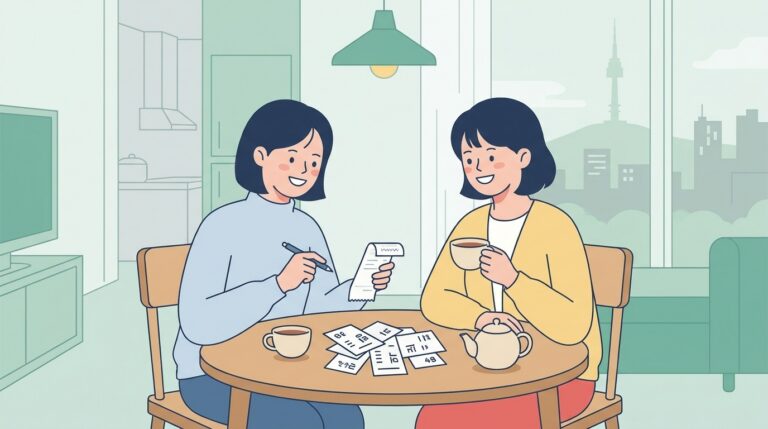
Finding Harmony Under One Roof: How to Talk Living Expenses and Roommate Life in Korea
Phase 1: 공감 (Empathy & The Warmth of Roommate Life)
안녕하세요! 매일한글 에디터입니다.
Imagine this: you have just moved into a shared house in Mapo-gu, Seoul. The autumn wind outside is biting cold, your family is thousands of miles away, and you are staring at a utility bill, completely puzzled by terms like gwanlibi (maintenance fees) and gas charges. In K-dramas like Age of Youth (청춘시대), living with housemates looks like an endless slumber party filled with midnight ramen. But in reality? Negotiating chores, sharing grocery receipts, and overcoming language barriers can feel downright intimidating.
Living with a housemate in Korea, however, often turns out to be the most comforting anchor of foreign life. When you find someone whose lifestyle clicks with yours, loneliness dissolves into cozy evenings sharing delivery chicken and laughing about your day. Based on hundreds of real coaching sessions with students living across Korea, this guide equips you with natural B1-level expressions to settle living costs effortlessly and express heartfelt gratitude to your Korean housemate—turning an awkward living arrangement into a genuine home away from home.
Phase 2: 핵심 표현 3선 심층 분석 (3 Core Expressions)
1. 마음이 잘 맞아요 (Maeumi jal majayo)
- Pronunciation: [Mae-um-i jal ma-ja-yo] (Think: “My-oom-ee” like “mind/heart”, “jal” like “gell”, “ma-ja-yo” like matching puzzle pieces)
- Meaning: Literal: “Our minds/hearts fit well together.” | Actual Nuance: “We really click,” or “We are on the exact same wavelength.”
- K-Culture Moment: Seen frequently in slice-of-life K-dramas when roommates realize they have the exact same sleeping habits and favorite comfort food.
- Editor’s Insight: In Korean, relationships are heavily rooted in maeum (heart/mind). Rather than simply saying “we have similar personalities” (성격이 비슷해요), saying your hearts fit (맞다) indicates an intuitive, seamless emotional harmony.
- Situation Spectrum: Casual ✅ | Semi-formal ✅ | Formal ⚠️
- 🤔 Think About It: In English, we say “we click” or “we get along.” Why do you think Korean expresses compatibility as minds “fitting” or interlocking together?
2. 덕분에 정말 든든해요 (Deokbune jeongmal deundeunhaeyo)
- Pronunciation: [Deok-bu-ne jeong-mal deun-deun-hae-yo] (Sounds like: “Duck-boo-neh jung-mahl doon-doon-hay-yo”)
- Meaning: Literal: “Thanks to you, I feel very robust/well-supported.” | Actual Nuance: “Thanks to you, I feel so safe, grounded, and reassured living here.”
- K-Culture Moment: Used whenever one roommate stays home with hot porridge when the other is sick, or walks the other back from the subway station late at night.
- Editor’s Insight: 든든하다 (Deundeunhada) originally describes a full stomach or a sturdy pillar. When used emotionally, it means feeling that you have someone reliable standing firmly behind you.
- Situation Spectrum: Casual ✅ | Semi-formal ✅ | Formal ✅
- 🤔 Think About It: Is there an equivalent word in your native language that bridges physical fullness and emotional reassurance?
3. 생활비는 엔분의 일로 정산해요 (Saenghwalbineun enbune illo jeongsanhaeyo)
- Pronunciation: [Saeng-hwal-bi-neun en-bun-ui il-lo jeong-san-hae-yo] (Sound analogy: “Sang-hwal-bee-noon N-boon-ay eel-lo jung-sahn-hay-yo”)
- Meaning: Literal: “Let us calculate the shared living expenses by 1/N.” | Actual Nuance: “Let’s split the common house bills evenly down the middle!”
- K-Culture Moment: At the end of every month in Korean reality shows, housemates sit around a dining table with KakaoPay or banking apps open to settle communal toilet paper, detergent, and Wi-Fi fees.
- Editor’s Insight: N분의 1 (N-bun-ui-il) is the universally understood Korean term for “going Dutch” or splitting equally among N people. Pairing it with 정산 (jeongsan – settlement/calculation) keeps financial discussions polite and crystal clear.
- Situation Spectrum: Casual ✅ | Semi-formal ✅ | Formal ⚠️
- 🤔 Think About It: How does your culture handle splitting money among flatmates? Is discussing exact amounts considered awkward or strictly practical?
Phase 3: 교과서 한국어 vs 진짜 한국어 (Textbook vs. Real-Life Korean)
Situation 1: Expressing that your roommate is a fantastic match
- 📖 교과서 한국어 (Textbook): “제 룸메이트와 저는 성격이 아주 잘 맞습니다.” (Je rumme-iteuwa jeoneun seonggyeogi aju jal matseumnida.)
- 🗣️ 진짜 한국어 (Real-Life): “우리 룸메랑 저랑 성향이 진짜 찰떡이에요!” (Uri rumme-rang jeorang seonghyangi jinjja chaltteog-ieyo!)
- 💡 왜 다를까? Koreans naturally abbreviate “룸메이트” to “룸메” (rum-me). The slang adjective 찰떡 (chaltteok – sticky rice cake) vividly implies you stick together perfectly without friction!
Situation 2: Proposing to split communal groceries
- 📖 교과서 한국어 (Textbook): “공동 생활비를 균등하게 분배하여 지불합시다.” (Gongdong saenghwalbireul gyundeunghage bunbae-hayeo jibulhapsida.)
- 🗣️ 진짜 한국어 (Real-Life): “공용 생활비는 깔끔하게 N분의 1로 정산해요!” (Gong-yong saenghwalbineun kkalkkeumhage enbune illo jeongsanhaeyo!)
- 💡 왜 다를까? Textbook language sounds like a corporate legal contract. Adding 깔끔하게 (kkalkkeumhage – cleanly/neatly) softens the money talk, framing fair sharing as considerate rather than stingy.
Phase 4: K-Culture 딥다이브 & 비언어적 매너 (Deep Dive & Non-Verbal Nuances)
4-1. 눈치 (Nunchi) & Polite Living Room Etiquette
- The Shared Snack Offer: When you purchase fruit or a bakery item, never take it straight into your bedroom without offering: “같이 드실래요?” (Gachi deusillaeyo? / “Would you like to share some?”). Even if they politely decline, the gesture builds instant camaraderie.
- Financial Transfers with Grace: When sending your monthly split cost via KakaoPay or Toss, include a cute thank-you sticker or write “이번 달도 수고했어요!” (Ibeon daldo sugohaesseoyo! / “Great work this month too!”) in the transfer note.
- Noise Sensitivity: Sound travels fast in Korean villas and officetels. Using soft indoor slippers (geosil-hwa) is considered an essential non-verbal sign of mutual respect.
4-2. Cultural Code Analysis: The Fridge Post-It Note Culture
In Korean shared houses (하우스메이트 문화), the communal refrigerator is the nerve center of social harmony. Rather than stern confrontations, Korean roommates use pastel sticky notes with friendly hand-drawn emoticons (^^, ㅠㅠ) to mark shared vs. private food items (e.g., “다 같이 드셔도 돼요! ^^” – “Feel free to eat together!”). Sharing meals from one communal pot—known historically as 한솥밥 (hansotbap)—transforms mere tenants into a modern kind of chosen family (식구 / sikgu).
Phase 5: 실전 롤플레이 시나리오 (Interactive Roleplay Scenario)
Setting: A cozy kitchen in an apartment near Sinchon at 9:30 PM. Your housemate, Minji (민지), is unpacking groceries and boiling warm barley tea.
- Turn 1 (Minji): “오늘 장 봐왔어요! 세제랑 쓰레기봉투 다 떨어졌길래 사 왔거든요.”
(Oneul jang bwawasseoyo! Sejerang sseuregibongtu da tteoreojyeotgilrae sa watgeodeunyo.)
🎭 Sets down two eco-bags and wipes her forehead with a friendly smile.
“I went grocery shopping today! We were out of detergent and trash bags, so I picked them up.” -
Turn 2 (You): “어머, 무거웠을 텐데 고생 많았어요! 영수증 보여주세요.”
(Eomeo, mugeoweosseul tende gosaeng manasseoyo! Yeongsujeung boyeojuseyo.)
🎭 Reaches out to take the heavy bag and places it on the counter.
“Oh no, that must have been heavy, thank you for your trouble! Please show me the receipt.” -
Turn 3 (Minji): “여기 영수증요! 총 3만 4천 원 나왔어요.”
(Yeogi yeongsujeung-yo! Chong saman sacheon-won nawasseoyo.)
🎭 Hands over the paper receipt while placing fresh milk in the fridge.
“Here is the receipt! It came to 34,000 won in total.” -
Turn 4 (You): “공용 물품이니까 바로 N분의 1로 정산해요. 만 7천 원씩 맞죠?”
(Gong-yong mulpum-inikka baro enbune illo jeongsanhaeyo. Man chilcheon-won-ssik matjyo?)
🎭 Pulls out phone banking app quickly to transfer the money without delay.
“Since they are shared items, let’s split it evenly 1/N right now. That’s 17,000 won each, right?” -
Turn 5 (Minji): “네, 맞아요! 바로 입금 알림 왔네요. 확인했어요, 고마워요.”
(Ne, majayo! Baro ipgeum allim wanneyo. Hwaginhaesseoyo, gomaweoyo.)
🎭 Pours two cups of steaming barley tea and hands one to you.
“Yes, that’s right! The deposit alert just popped up. Confirmed, thank you!” -
Turn 6 (You): “민지 씨랑 마음이 잘 맞아서 타지 생활이 외롭지 않아요.”
(Minji ssirang maeumi jal majaseo taji saenghwari oeropji anayo.)
🎭 Holds the warm tea cup with both hands and makes warm eye contact.
“Because our minds click so well, Minji, living away from home doesn’t feel lonely at all.” -
Turn 7 (Minji): “저야말로요! 마음 통하는 룸메 만나기 진짜 어려운데, 덕분에 저도 든든해요.”
(Jeoyamalloyo! Maeum tonghaneun rumme mannagi jinjja eoryeounde, deokbune jeodo deundeunhaeyo.)
🎭 Beams warmly, sitting down across the table.
“Same here! It’s so rare to find a housemate you truly connect with. Thanks to you, I feel so supported too.” -
Turn 8 (You): “우리 앞으로도 작은 문제 생기면 바로바로 편하게 이야기해요!”
(Uri apeurodo jageun munje saenggimyeon barobaro pyeonhage iyagihaeyo!)
🎭 Nods reassuringly and clinks tea mugs gently.
“Let’s continue to talk openly and comfortably whenever small things come up!”
🔀 Interactive Choice Point
Minji looks tired after cleaning up. How do you respond to close the evening?
- Choice A: “오늘 고생했으니까 제가 내일 아침 커피 쏠게요! 편히 쉬어요.” (Today was tiring, so I’ll treat you to morning coffee tomorrow! Rest comfortably.)
- Choice B: “돈 보냈으니까 영수증 버려도 되죠? 방에 들어갈게요.” (I sent the money so can I throw away the receipt? I’m going into my room.)
- Choice C: “방 청소는 주말에 제가 다 할 테니까 민지 씨는 손 하나 까딱하지 마세요!” (I will clean the entire room this weekend, don’t lift a single finger!)
Feedback:
* Choice A (Best!): Perfect empathy! Offering a minor treat shows you value her labor and deepens mutual affection without creating overwhelming pressure.
* Choice B (Bad): Extremely blunt and transactional. It makes you appear indifferent to the communal relationship.
* Choice C (Risk): Well-intended, but over-promising can lead to awkward guilt or reciprocal burden (부담 / budam) in Korean relationships.
Phase 6: 10초 감정 섀도잉 드릴 (Shadowing Drill)
Practice matching these real-life pitch variations! Focus on the emotional cues.
[😊 따뜻하고 안도하며]
“민지 씨 덕분에 / 타지 생활이 / 정말 든든해요.”
(Minji ssi deokbune / taji saenghwari / jeongmal deundeunhaeyo.)
Pause naturally after ‘deokbune’ to let the heartfelt appreciation breathe.-
[🤝 깔끔하고 다정하게]
“공용 물품이니까 / 깔끔하게 / N분의 1로 나눠요!”
(Gong-yong mulpum-inikka / kkalkkeumhage / enbune illo nanwoyo!)
Keep your voice light and upbeat on ‘kkalkkeumhage’ so finances never sound awkward. -
[💖 기쁘고 벅차오르며]
“우리 둘이 / 성향이 진짜 / 찰떡인 것 같아요!”
(Uri duri / seonghyangi jinjja / chaltteog-in geot gat-ayo!)
Emphasize ‘chaltteok’ with bouncy energy to share genuine happiness.
Phase 7: K-Culture 미니 사전 (Mini Dictionary)
- 룸메 (Rum-me) | Roommate / Housemate
Usage: Colloquial abbreviation of 룸메이트 used daily among university students and young professionals. - 정산 (Jeongsan) | Settlement / Expense Calculation
Usage: Used whenever utility fees, communal groceries, or dinner outings are divided up clearly. - 집들이 (Jipdeuri) | Housewarming Party
Usage: Inviting close friends over to celebrate your new apartment, where guests traditionally gift toilet paper (wishing fortune to unwind easily) or detergent (wishing bubbling wealth). - 식구 (Sikgu) | Family member / One who eats from the same pot
Usage: Hanja for “mouth that eats.” Often used metaphorically for close housemates who share dining routines regularly.
Phase 8: 여행자 & 체류자를 위한 생존 키트 (Survival Kit)
Top 3 Survival Expressions
- 공용이에요, 개인 거에요? (Gong-yong-ieyo, gae-in geo-eyo?)
Meaning: Is this for communal use, or personal?
Pro Tip: Use this before touching condiments or toiletries in a new shared flat. - 영수증 사진 찍어서 카톡으로 보내주실래요? (Yeongsujeung sajin jjigeoseo katog-euro bonaejusillaeyo?)
Meaning: Could you snap a photo of the receipt and send it via KakaoTalk?
Pro Tip: Keeps expense tracking transparent and prevents any financial misunderstandings. - 제가 먼저 채워둘게요! (Jega meonje chaewodulgeyo!)
Meaning: I’ll refill/restock it first!
Pro Tip: Perfect for communal items like paper towels or bottled water.
Editor’s Travel & Living Note
To handle shared housing finances like a Seoul local, make sure you complete your 카카오페이 송금 앱 설정 가이드 right after setting up your alien registration card (ARC). KakaoPay lets you split bills with a built-in “1/N 정산하기” tool with a single tap. For finding reliable shared houses in Seoul, check verified listings via 직방 앱 다운로드 or specialized coliving platforms like Celib.
Phase 9: “한 발 더 깊이” (Cultural Reflection)
In many Western cultures, a roommate is primarily a practical roommate: someone who pays 50% of the rent and respects physical personal boundaries. In Korea, living together inevitably taps into the cultural concept of 정 (Jeong)—the warm, sticky, unspoken bond that grows through shared daily space. While boundaries remain vital, asking about your housemate’s meal, sharing side dishes from your hometown, and treating the home as a shared sanctuary transforms mere co-existence into emotional solidarity.
💬 Your Turn: Have you ever shared an apartment with someone from a different background? What is the one house rule you think makes shared living peaceful? Share your thoughts below!
Phase 10: FAQ & 오해 방지 (FAQ Schema)
Q: Is it considered rude to ask for very small amounts (like 1,500 won) when splitting costs in Korea?
A: Not at all! Modern young Koreans prefer financial clarity. However, instead of demanding 1,500 won immediately via bank transfer, it is common to say: “1,500원은 다음번에 편의점 갈 때 생수 하나 사주세요!” (For the 1,500 won, just grab me a bottled water next time we stop by the convenience store!).
Q: Can I use “든든해요” toward my professor or manager at work?
A: Yes! When a superior or mentor guides you safely through a difficult project, saying “선배님(팀장님) 덕분에 이번 프로젝트가 정말 든든했습니다” sounds polite, loyal, and appreciative.
Q: What is the biggest taboo in Korean shared housing?
A: Throwing trash without sorting! Korea follows strict 분리수거 (bunri-sugeo) recycling laws with color-coded municipal bags (종량제 봉투). Failing to sort food waste (음식물 쓰레기) correctly can result in residential fines, making it the number one trigger for roommate conflict.
🚨 Common Mistakes Warning Board
- ❌ Mistake 1: Saying “우리 돈 반반 나눠요” in formal settings.
➡️ Correct Action: Use “생활비는 N분의 1로 정산해요” for a cleaner, modern nuance. - ❌ Mistake 2: Eating the last piece of delivery food without asking.
➡️ Correct Action: Always ask: “더 안 드세요? 제가 먹어도 될까요?” (Not having more? May I eat it?). - ❌ Mistake 3: Staying completely silent inside your personal room when your housemate enters the house.
➡️ Correct Action: Give a light, cheerful greeting through the door: “오셨어요~?” or “왔어~?” (You’re back?).
Phase 11: 액션 미션 & 참여 유도 (Action Missions)
- 🥉 Bronze Mission: Practice saying “마음이 잘 맞아서 정말 든든해요!” out loud 3 times in front of the mirror with a warm, genuine smile.
- 🥈 Silver Mission: Write a mock fridge note in Korean asking to split kitchen paper towel costs: “공용 키친타월 샀어요! N분의 1로 정산 부탁드려요 ^^”.
- 🥇 Gold Mission: Use “N분의 1로 정산해요” the next time you split a meal or cafe receipt with a Korean-speaking friend or study partner.
- 🎮 K-Culture Mission: Watch an episode of the drama Hello, My Twenties! (청춘시대) and spot how the five housemates resolve their communal living issues.
Phase 12: 인터랙티브 퀴즈 챌린지 (Quiz Challenge)
Q1. Situation Assessment: Your housemate brought home a box of Korean peaches from their hometown. What is the most culturally warm response?
1. “얼마예요? 제 몫을 N분의 1로 계산할게요.”
2. “우와, 맛있겠어요! 잘 먹을게요, 정말 고마워요.”
3. “전 과일 별로 안 좋아하니까 냉장고에 넣지 마세요.”
Q2. Fill in the Blank:
“타지 생활이 외로웠는데, 성향이 잘 통하는 룸메를 만나서 마음이 정말 ( ).”
Hint: It means feeling emotionally supported, safe, and robust.
Q3. True or False:
In modern Korean culture, asking to split communal detergent or trash bags evenly (N분의 1) is considered stingy and inappropriate among close friends.
(True / False)
👉 Click to reveal answers & explanations!
- A1: 2번 (“우와, 맛있겠어요! 잘 먹을게요, 정말 고마워요.”) – Hometown gifts (선물/나눔) are expressions of warm Jeong, not items to calculate financially.
- A2: 든든해요 (deundeunhaeyo) – Expresses feeling reassured and backed by a reliable companion.
- A3: False – Clear expense settlement (깔끔한 정산) is considered modern, polite, and respectful roommate hygiene across Korea!
🎬 Watch Our Daily Videos! (Daily Hangul Official Instagram)
Review the expressions you learned in this article with our fun daily short videos! Check out native pronunciation and real-life nuances in action.
- Instagram @dailyhangul_en







