

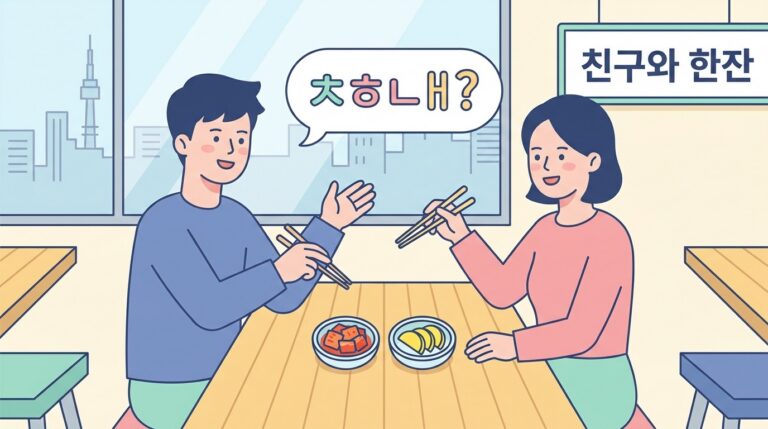
Kimchi vs. Danmuji: How to Master Korean Balance Games and MZ Slang at Any Gathering
Phase 1: Empathy & Story Opening
안녕하세요! 매일한글 에디터입니다. (Hello! This is your Daily Hangul editor.)
Imagine this scene: You are sitting at a bustling pocha (street pub) in Hongdae with your Korean friends. The table is packed with crispy Korean fried chicken, sizzling tteokbokki, and ice-cold drinks. Everyone is laughing, but suddenly, the conversation dies down for a split second. You want to say something lively, but textbook phrases like “날씨가 참 좋습니다” (The weather is very nice) feel way too stiff. Suddenly, your Korean friend slams their cup gently on the table, leans in with intense theatrical seriousness, and asks: “평생 김치만 먹기 대 평생 단무지만 먹기, 당신의 선택은?” (Pyeong-saeng gim-chi-man meok-gi dae pyeong-saeng dan-mu-ji-man meok-gi, dang-sin-ui seon-taek-eun? / Eating only kimchi for life vs. only pickled radish for life—what is your choice?).
Instantly, the table erupts! One friend screams in agony, another debates the medicinal virtues of fermented cabbage, and someone insists yellow pickled radish is the only side dish you need with ramen. If you freeze because you don’t know the slang to respond, you miss out on one of Korea’s most beloved social traditions: the Balance Game (밸런스 게임).
As someone who has guided hundreds of Korean learners from awkward observers to the life of the party, I can promise you this: Korean MZ party culture doesn’t care if your grammar is flawless. They care about your reaction, your passion, and your banter! In this guide, tailored specifically for A2 elementary learners, you will master the playful buzzwords and toasts that will instantly break the ice at any gathering.
Phase 2: Top 3 Essential Expressions for Korean Balance Games
1. 밸런스 게임 하자! (Bael-leon-seu ge-im ha-ja!)
- Pronunciation: [Bael-leon-seu ge-im ha-ja!] (Sounds like: “Balance game ha-ja!” with a punchy bounce on ha-ja)
- Meaning: Literal: “Let’s do a balance game!” | Actual Nuance: “Hey, let’s play ‘Would You Rather!'”
- K-Culture Moment: Watch any behind-the-scenes video of your favorite K-pop idols waiting in dressing rooms. Within ten minutes, someone invariably claps their hands and shouts this line to kill boredom.
- Editor’s Insight: In Korea, a ‘Balance Game’ pits two equally painful, absurd, or delightful choices against each other. Saying this immediately marks you as someone who knows how modern Koreans hang out.
- Situation Spectrum: Casual: ✅ | Semi-formal: ⚠️ (with close coworkers during casual lunch) | Formal: 🚫
- 🤔 Think About It: In English, we ask “Would you rather…?” framing it as a hypothetical condition. Koreans call it a “balance” game because the options must be weighed equally on psychological scales!
2. 닥전이지! (Dak-jeon-i-ji!)
- Pronunciation: [Dak-jeon-i-ji!] (Rhymes closely with “Doc-john-ee-jee”)
- Meaning: Literal: “Definitely the former!” | Actual Nuance: “Obviously option A! There’s no contest!”
- K-Culture Moment: On popular YouTube web variety shows like Workman or Going Seventeen, when given a debate like “Kimchi vs. Danmuji,” guests slam their choice down shouting this exact word.
- Editor’s Insight: This is modern youth slang. The word dak comes from an emphatic slang contraction meaning “without question/no debate”, and jeon means the first option (전/former). If you prefer option B, you simply swap it to 닥후이지! (Dak-hu-i-ji! – Definitely option B!).
- Situation Spectrum: Casual: ✅ | Semi-formal: ⚠️ | Formal: 🚫
- 🤔 Think About It: Notice how fast-paced Korean street slang is! Koreans love portmanteaus (blended words) that compress four words of hesitation into a single punchy exclamation.
3. 둘 다 싫은데! (Dul da sil-eun-de!)
- Pronunciation: [Dul da shi-reun-de!] (Sounds like: “Dool dah shee-reun-day” with a playful whining intonation)
- Meaning: Literal: “I dislike both…” | Actual Nuance: “Ugh, both options are horrible! Don’t make me pick!”
- K-Culture Moment: Classic reaction in K-dramas when a character is asked to choose between working overtime on Christmas or going on a blind date with their grumpy boss.
- Editor’s Insight: The ending -데 (-de) leaves your sentence trailing off softly. It shows you are agonizing over the decision, which is exactly the entertainment value of a balance game.
- Situation Spectrum: Casual: ✅ | Semi-formal: ✅ (spoken playfully) | Formal: 🚫
- 🤔 Think About It: Expressing refusal in Korean often relies on trailing sentence endings rather than a blunt “No”. How does trailing off soften awkward dilemmas in your culture?
Phase 3: Textbook Korean vs. Real-World Korean
Situation 1: Pressing your friend to hurry up and make a pick
- 📖 교과서 한국어 (Textbook): 어느 쪽을 고르시겠습니까? (Eo-neu jjok-eul go-reu-si-gess-seup-ni-kka? – “Which side will you choose?”)
- 🗣️ 진짜 한국어 (Real Korean): 닥전이야, 닥후야? 빨리 골라 봐! (Dak-jeon-i-ya, dak-hu-ya? Ppal-li gol-la bwa! – “Option A or Option B? Hurry up and pick!”)
- 💡 왜 다를까? (Why the difference?): Textbook phrases treat dinner table fun like an academic questionnaire. Real Koreans create humorous peer pressure with short contractions and rhythmic challenges.
Situation 2: Reacting to an absurd condition
- 📖 교과서 한국어 (Textbook): 그것은 너무 극단적인 상황입니다. (Geu-geos-eun neo-mu geuk-dan-jeok-in sang-hwang-im-ni-da. – “That is an overly extreme situation.”)
- 🗣️ 진짜 한국어 (Real Korean): 와, 이건 진짜 말도 안 돼! (Wa, i-geon jin-jja mal-do an dwae! – “Wow, this is totally ridiculous!”)
- 💡 왜 다를까? (Why the difference?): Slang and party talk thrive on emotive hyperbole. 말도 안 돼 (It doesn’t even make words/sense) captures immediate shock 100 times better than formal evaluation.
Phase 4: K-Culture Deep Dive & Non-Verbal Manners
4-1. Nunchi & Physical Gestures: The Art of the Debate
In Korean party games, half the communication happens without words. When presented with the dilemma of “Kimchi vs. Danmuji”:
* The Balancing Hand Scale: Hold both hands out in front of your chest, palms facing up, bobbing them up and down like balance scales while your eyes dart between them.
* The Chopstick Pause: If you are eating, suspend your chopsticks mid-air, furrow your brow dramatically, and let out an agonized “아… 잠깐만!” (Ah… wait a second!). Korean humor cherishes dramatic sincerity in trivial arguments.
* Eye Contact (Nunchi): Don’t just stare at the speaker. Glance across the table to see who is nodding. Finding an ally who shares your food tastes forms an instant bond!
4-2. Cultural Code: Why Food Debates Matter in Korea
Why is “Kimchi vs. Danmuji” such an explosive dilemma?
In Korea, food is identity and emotional comfort. Kimchi is spicy, garlicky, complex, and deeply tied to home cooking; Danmuji is crisp, sweet, tangy, and the indispensable sidekick to late-night delivery foods like Jajangmyeon and Kimbap. Stripping away one forever feels like losing a piece of your daily routine.
From debates like Tangsuyuk (sweet and sour pork: dipping sauce vs. pouring sauce) to Mint Chocolate, Korean MZ culture uses these low-stakes dilemmas to bond without discussing divisive topics like politics or work stress.
Phase 5: Real-Life Roleplay Scenario
Setting: A brightly lit Pocha in Hongdae on Friday night. The table has cold beer, ramyeon, and seasoned fried chicken.
Characters:
* Minji: Your high-energy Korean classmate who loves party games.
* You (Alex): An adventurous A2 learner excited to join the banter.
- Turn 1 (Minji):
🎭 Claps hands loudly and leans across the table with wide eyes
“알렉스! 심심한데 우리 밸런스 게임 하나만 하자!”
(Alex! Sim-sim-han-de u-ri bael-leon-seu ge-im ha-na-man ha-ja! / “Alex! I’m bored, let’s do just one balance game!”) -
Turn 2 (You):
🎭 Smiles warmly and nods enthusiastically
“좋아! 무슨 게임이야? 문제 내 봐!”
(Jo-ah! Mu-seun ge-im-i-ya? Mun-je nae bwa! / “Sounds good! What game is it? Give me the question!”) -
Turn 3 (Minji):
🎭 Puts on a mock-serious face, pointing left then right
“평생 김치만 먹기 대 평생 단무지만 먹기! 알렉스의 선택은?”
(Pyeong-saeng gim-chi-man meok-gi dae pyeong-saeng dan-mu-ji-man meok-gi! Alex-ui seon-taek-eun? / “Eating only kimchi for life vs. only danmuji for life! What’s your choice?”) -
Turn 4 (You):
🎭 Frowns dramatically and puts a hand to your cheek
“헐… 둘 다 싫은데! 너무 어려워!”
(Heol… dul da sil-eun-de! Neo-mu eo-ryeo-wo! / “OMG… I hate both! That’s too hard!”) -
Turn 5 (Minji):
🎭 Taps the table playfully with chopsticks
“기권은 없어! 닥전이야, 닥후야? 3초 준다! 삼, 이, 일!”
(Gi-gwon-eun eops-eo! Dak-jeon-i-ya, dak-hu-ya? Sam-cho jun-da! Sam, i, il! / “No giving up! Option A or Option B? 3 seconds! Three, two, one!”) -
Turn 6 (You):
🎭 Slams hand flat on the table with mock conviction
“나는 무조건 닥전이지! 김치 볶음밥 못 잃어!”
(Na-neun mu-jo-geon dak-jeon-i-ji! Gim-chi bok-keum-bap mot il-eo! / “I’m definitely option A! I can’t lose kimchi fried rice!”) -
Turn 7 (Minji):
🎭 Gasps with a burst of laughter and high-fives you
“와! 알렉스 진짜 한국인 다 됐네! 짠하자!”
(Wa! Alex jin-jja hanguk-in da dwaess-ne! Jjan-ha-ja! / “Whoa! Alex, you’ve basically become a real Korean! Let’s clink glasses!”) -
Turn 8 (You):
🎭 Raises glass and clinks with Minji
“좋아, 원샷! 다음 문제는 내가 낼게!”
(Jo-ah, won-syat! Da-eum mun-je-neun nae-ga nael-ge! / “Great, cheers! I’ll give the next question!”)
🔀 Interactive Choice Point
At Turn 6, what if you chose a different response?
* Option A (Best): “나는 무조건 닥전이지! 김치 없으면 라면 못 먹어!” (Na-neun mu-jo-geon dak-jeon-i-ji! Gim-chi eops-eu-myeon ra-myeon mot meok-eo! – I’m totally option A! I can’t eat ramyeon without kimchi!)
Feedback: Best! You used the authentic slang ‘닥전’ and gave a relatable cultural reason. Your Korean friends will cheer.
* Option B (Bad): “저는 둘 다 선택하고 싶지 않습니다.” (Jeo-neun dul da seon-taek-ha-go sip-ji an-seup-ni-da. – I do not wish to choose either.)
Feedback: Bad. This sounds like an official press release statement. It kills the party momentum instantly.
* Option C (Risk): “그냥 안 먹으면 안 돼?” (Geu-nyang an meok-eu-myeon an dwae? – Can’t I just not eat either?)
Feedback: Risk. While casual, trying to escape the rules of a balance game makes Koreans yell playfully: “반칙이야!” (That’s cheating!). Fun, but forces you back into a corner!
Phase 6: 10-Second Emotion Shadowing Drill
Practice reading these out loud with rhythm and authentic emotion. Break at the / marks!
[🤔 진지하고 깊이 고민하듯 - Serious & Agonizing]
“평생 김치 / 아니면 단무지? / 와, 이건 진짜 / 너무 어렵다!”
(Pyeong-saeng gim-chi / a-ni-myeon dan-mu-ji? / wa, i-geon jin-jja / neo-mu eo-ryeop-da!)-
[🔥 결의에 찬 목소리로 - Bold & Resolute]
“닥전이지! / 한국인은 밥 먹을 때 / 김치가 국룰이야!”
(Dak-jeon-i-ji! / han-guk-in-eun bap meok-eul ttae / gim-chi-ga gung-nul-i-ya!) -
[🤣 웃기면서 질색하듯 - Laughing with Mild Horror]
“둘 다 싫은데! / 단무지만 먹으면 / 너무 달잖아!”
(Dul da sil-eun-de! / dan-mu-ji-man meok-eu-myeon / neo-mu dal-jan-a!)
Phase 7: K-Culture Mini Dictionary
- 밸런스 게임 (Bael-leon-seu ge-im) | Noun | “Balance Game” (Korean Would-You-Rather). Used at team retreats, dating shows, and drinking parties to test chemistry.
- 닥전 / 닥후 (Dak-jeon / Dak-hu) | Slang | “Definitely the Former / Definitely the Latter”. Indispensable MZ buzzwords used whenever comparing two choices.
- 단무지 (Dan-mu-ji) | Noun | Yellow pickled radish. Known as the ultimate palette cleanser alongside black bean noodles and kimbap.
- 국룰 (Gung-nul) | Slang | “The Unwritten National Rule” (Short for 국민 룰). Refers to unquestioned food pairings or common-sense habits (e.g., eating fried rice after hot pot).
Phase 8: Traveler’s Survival Kit
Top 3 Survival Phrases for Party Encounters
- 건배사 하나 할게요! (Geon-bae-sa ha-na hal-ge-yo!)
- [Geon-bae-sa ha-na hal-ge-yo!]
- Pro Tip: Use this when the table is lively and you want to offer a short toast. Everyone will pause and smile at you.
- 짠할까요? (Jjan-hal-kka-yo?)
- [Jjan-hal-kka-yo?]
- Pro Tip: “Shall we clink glasses?” Perfect gentle icebreaker when sitting beside a quiet friend at a long table.
- 이거 완전 국룰이죠! (I-geo wan-jeon gung-nul-i-jyo!)
- [I-geo wan-jeon gung-nul-i-jyo!]
- Pro Tip: Say this when someone orders spicy ramyeon with kimchi, or drinks a soft drink right after fried chicken.
Editor’s Travel Note: Nightlife & Gathering Hacks
- When hopping between hot spots in Mapo or Gangnam, public buses stop around midnight. Always prepare ahead by completing your 네이버 지도 앱 다운로드 (Naver Map app download) to track late-night night buses (called ‘N-Buses’) or hail trusted taxis easily.
- In Korean group dinners (회식/모임), bills are almost rarely split item-by-item at the register. One person pays, and everyone sends their share later via bank transfer. Keep your KakaoPay or international credit card handy!
Phase 9: “One Step Deeper” (Cultural Reflection)
In Western debate styles, discussions often seek an intellectual winner or a logical consensus. In contrast, Korean “Balance Games” are rarely about arriving at the truth; they are an exercise in empathy and emotional communion (Jeong, 정). When Koreans argue fiercely whether they would rather live without kimchi or danmuji, they are sharing vulnerable glimpses into their daily comforts, childhood memories, and sense of humor. Taking a playful stance shows you care more about enjoying the present moment with your companions than being stiff and polite.
💬 Your Turn: If you were trapped on an island for the rest of your life, which would you pick: 닥전 (Only Kimchi) or 닥후 (Only Danmuji)? Tell us your reason in the comments below using Korean!
Phase 10: FAQ & Avoiding Misunderstandings
Q: Can I say “닥전” or “닥후” to my boss or professor at dinner?
A: Absolutely not! The syllable ‘닥’ originates from an aggressive slang root (닥치다, to shut up). While in youth culture it simply means “without a doubt”, using it with elders or supervisors is rude. With senior company members, stick to: “저는 전자가 더 좋습니다!” (Jeo-neun jeon-ja-ga deo jo-seup-ni-da. – “I prefer the former!”).
Q: What if I genuinely can’t choose between the two options in a balance game?
A: Don’t just sit in silence. You can shout “와, 진짜 밸런스 붕괴다!” (Wa, jin-jja bael-leon-seu bung-goe-da! – “Whoa, this balance is completely destroyed / so uneven!”) or “선택 못 하겠어!” (Seon-taek mot ha-gess-eo! – “I can’t choose!”).
Q: Is Danmuji really eaten that much in Korea?
A: Yes! While Kimchi is the national staple, Danmuji is vital for specific comfort foods: Kimbap, Jajangmyeon, Bunsik ramyeon, and Tonkatsu. Without Danmuji, millions of Koreans would feel a tragic crunch deficit!
🚨 Common Mistakes Warning Board
- Mistake: Pronouncing ‘짠’ (Jjan) too softly like English ‘Jan’.
- Correct Action: Make the ‘ㅉ’ sound tense, like the ‘zz’ in pizza. Say “짠!” sharply right as glasses touch!
- Mistake: Refusing to participate because the premise is “illogical”.
- Correct Action: The silliness is the whole point. Embrace the drama! Lean into the absurdity.
- Mistake: Using textbook formal honorifics during drinking games with peer friends.
- Correct Action: Switch to friendly 반말 (casual talk) or gentle 존댓말 with conversational endings like -네요 (-ne-yo) and -죠 (-jyo).
Phase 11: Action Missions & Community Practice
- 🥉 Bronze Mission (Solo Practice): Stand in front of the mirror, hold your hands up like scale plates, and recite the Turn 6 line: “나는 무조건 닥전이지!” with a confident grin.
- 🥈 Silver Mission (Social Share): Post an Instagram story or tweet with two food emojis and ask: “김치 vs 단무지, 닥전? 닥후? 골라 봐!” Tag a Korean-speaking friend to see their answer.
- 🥇 Gold Mission (Real-world Challenge): Next time you share a meal with a Korean speaker or tutor, bring up this dilemma using: “밸런스 게임 하나 해도 돼요?” (Bael-leon-seu ge-im ha-na hae-do dwae-yo?).
- 🎮 K-Culture Mission: Search for “아이돌 밸런스 게임” (Idol Balance Game) on YouTube. Watch 3 minutes of your favorite group playing and spot how many times they say 닥전, 골라, or 둘 다.
Phase 12: Interactive Quiz Challenge
1. Situation Judgment
You are hanging out with Korean friends your own age at a chicken pub. Your friend asks whether you prefer eating cold noodles in winter or hot stew in summer. You want to enthusiastically pick the first option using real youth slang. What do you say?
a) 저는 겨울 냉면을 먹는 편이 합리적이라고 사료됩니다.
b) 닥전이지! 이열치한 몰라?
c) 질문을 다시 해 주시겠습니까?
👉 Click to reveal answer & explanation
Answer: b)
Explanation: ‘닥전이지!’ (Definitely option A!) is the perfect natural slang for peers. Choice A is comically archaic and formal, while choice C sounds like a customer service test.
2. Fill in the Blank
Complete the iconic phrase meaning “Pick one quickly!”:
“닥전이야, 닥후야? 빨리 _____ 봐!”
👉 Click to reveal answer & explanation
Answer: 골라 (gol-la)
Explanation: ‘골라 봐’ comes from the verb ‘고르다’ (to choose/pick) + ‘-아/어 보다’ (to try doing). It translates to “Try choosing / Pick one!”
3. Culture True or False
Statement: In Korean social dinners, suggesting a ‘Balance Game’ is considered bad etiquette because it interrupts polite business talk.
👉 Click to reveal answer & explanation
Answer: False
Explanation: Balance games are widely embraced as one of the best icebreakers across age groups, especially among university students, young professionals, and friends at parties!
🎬 Watch Our Daily Videos! (Daily Hangul Official Instagram)
Review the expressions you learned in this article with our fun daily short videos! Check out native pronunciation and real-life nuances in action.
- Instagram @dailyhangul_en







