

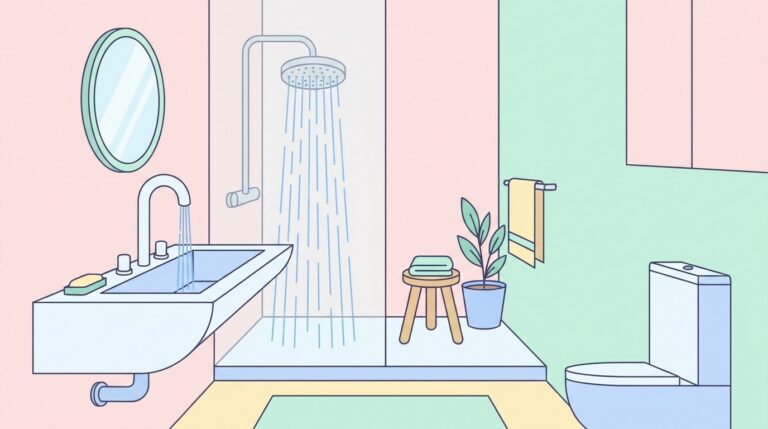
Phase 1: Empathy (Story-Driven Opening)
안녕하세요! 매일한글 에디터입니다. (Hello! This is your Daily Hangul editor.)
Have you ever watched a cozy K-Drama where the main character moves into an aesthetic Seoul studio apartment, hanging fairy lights and sipping iced Americano on their rooftop terrace? It looks heavenly—until real life hits. One of our former learners, Sarah from Canada, found what seemed to be her dream studio (oneroom) near Hongdae. The sunlight was gorgeous, the wallpaper was fresh, and the rent was reasonable. But on her very first night, she stepped into the shower, turned on the tap, and got nothing more than a sad, lukewarm trickle. To make matters worse, whenever her neighbor flushed the toilet, her shower water stopped entirely!
In Korea, especially in high-density multi-family buildings (villa or older officetel studios), low water pressure is a notorious hidden trap. Landlords won’t always warn you, and if you just politely nod and look at the wallpaper during your tour, you might sign a 1-year contract full of frustration. That’s why smart locals perform what we call the “Holy Trinity Test”: flushing the toilet while running the sink and shower at the exact same time. Today, I’ll walk you through the essential A2-level Korean expressions and cultural street smarts so you can inspect bathroom water pressure confidently and politely like a true Seoulite!
Phase 2: Core 3 Expressions In-Depth
1. 수압 확인해 봐도 돼요? (Suap hwaginhae bwado dwaeyo?)
- Pronunciation: [Su-ap hwa-gin-hae bwa-do dwae-yo?] (Think of “Sue” + “up” for 수압, sounding crisp and clean.)
- Meaning: Literal: “Is it okay even if I check the water pressure?” / Nuance: “May I check the water pressure, please?”
- K-Culture Moment: You will hear this frequently in reality variety shows like Where Is My Home (구해줘! 홈즈), where celebrity house hunters immediately head to the bathroom to inspect the pipes before praising the interior.
- Editor’s Insight: In Korean culture, jumping straight to turning on taps without asking can feel abrupt in an occupied home. Adding
~해 봐도 돼요?softens your request into a polite, considerate question. - Situation Spectrum:
- Casual (to friends): 수압 봐도 돼? (⚠️ Only with close peers)
- Semi-formal (to real estate agent): 수압 확인해 봐도 돼요? (✅ Recommended)
- Formal (business contract setting): 수압을 확인해 보아도 되겠습니까? (✅)
- 🤔 Think About It: In English, you might say “I’m going to check the water.” In Korean, asking for permission first (
~해도 돼요?) respects the boundaries of the current tenant or host.
2. 물을 같이 틀어볼게요. (Mureul gachi teureobolgeyo.)
- Pronunciation: [Mu-reul ga-chi teu-reo-bol-ge-yo] (“Gachi” sounds almost like “got-chee” with a soft ‘ch’.)
- Meaning: Literal: “I will try turning on the water together.” / Nuance: “I’ll turn on both the shower and sink taps at the same time.”
- K-Culture Moment: In Korean lifestyle vlogs (vlog), young renters moving into their first apartment always narrate this line right before turning all the taps on to test pipe capacity.
- Editor’s Insight: The particle
같이(together) here indicates simultaneous action. Saying this out loud signals to the agent that you know your rental checklist and won’t be easily fooled. - Situation Spectrum:
- Casual: 물 같이 틀어볼게. (⚠️)
- Semi-formal: 물을 같이 틀어볼게요. (✅ Perfect for room viewing)
- Formal: 물을 동시에 틀어보겠습니다. (✅ High formality)
- 🤔 Think About It: Notice how Korean speakers vocalize their intended actions beforehand (
~ㄹ게요). This creates a cooperative, harmonious atmosphere instead of surprising the other person.
3. 물이 시원하게 잘 나와요. (Muri siwonhage jal nawayo.)
- Pronunciation: [Mu-ri si-won-ha-ge jal na-wa-yo] (“Si-won” sounds like “sea” + “one”.)
- Meaning: Literal: “Water comes out coolly and well.” / Nuance: “The water pressure is strong and runs great!”
- K-Culture Moment: Often said with satisfaction in dramas when a character enjoys a refreshing shower after a hard working day.
- Editor’s Insight: While
시원하다literally means “cool/refreshing”, Koreans use it metaphorically to describe strong flow, unobstructed drainage, or even a deep relief. Saying물이 시원하게 나와요is the ultimate compliment for water pressure! - Situation Spectrum:
- Casual: 물 시원하게 잘 나온다! (⚠️ Talking to self or close friend)
- Semi-formal: 물이 시원하게 잘 나와요. (✅)
- Formal: 수압이 매우 양호합니다. (✅ Written inspection report)
- 🤔 Think About It: In your native tongue, do you describe water flow with temperature or emotional words? In Korean, siwonhada connects physical sensation directly with mental satisfaction.
Phase 3: Textbook Korean vs Real Korean
Situation 1: Asking if the water pressure is strong
- 📖 교과서 한국어 (Textbook Korean): 수압이 강합니까? (Suabi ganghamnikka?)
- 🗣️ 진짜 한국어 (Real-life Korean): 수압 세요? (Suap seyo?)
- 💡 왜 다를까?: While
강하다(strong) is grammatically accurate, real-world native speakers use the descriptive adjective세다(strong/forceful) when talking about daily physical forces like water, wind, or fire.
Situation 2: Announcing you will test the shower and toilet together
- 📖 교과서 한국어 (Textbook Korean): 변기와 샤워기를 동시에 작동시키겠습니다. (Byeong-giga syawogireul dongsie jakdongsigigesseumnida.)
- 🗣️ 진짜 한국어 (Real-life Korean): 변기 내리면서 샤워기도 틀어볼게요! (Byeong-gi naerimyeonseo syawogido teureobolgeyo!)
- 💡 왜 다를까?: Textbook phrases use stiff Sino-Korean words like
작동(operate). Native speakers prefer natural connective verbs like~면서(while doing…) and everyday verbs like내리다(flush) and틀다(turn on).
Phase 4: K-Culture Deep Dive & Non-verbal Manners
4-1. Nunchi & Bathroom Gestures
When touring a studio in Korea, remember that someone might still be living there before their lease ends. Do not barge into the bathroom and aggressively twist knobs!
* First, make polite eye contact with the real estate agent (b不動산 중개사님) and give a gentle nod.
* Point lightly toward the bathroom door and ask: 화장실 물 좀 틀어봐도 될까요? (Hwajangsil mul jom teureobwado doelkkayo? / May I run the bathroom water a bit?).
* When testing the shower, aim the showerhead downward toward the drain to prevent splashing the mirror or walls. Korean bathrooms are wet rooms (where the whole floor can get wet), but spraying someone’s toiletries is poor nunchi!
4-2. Cultural Code: The Truth Behind “Oktopbang” (Rooftop Rooms)
We all love K-dramas where the handsome protagonist sits outside their rooftop room (oktapbang) enjoying barbecue and Seoul city views. But here is the insider reality: rooftop units are located at the highest point of older low-rise buildings. Because they are closest to the water tank and farthest from street supply mains, their water pressure is often notoriously weak! Learning to test the sink, shower, and toilet simultaneously is the difference between living out a cinematic dream and enduring an everyday nightmare.
Phase 5: Real-World Roleplay Scenario
Setting: You are touring a modern 4th-floor studio near Sinchon with Agent Kim (김 중개사). The wallpaper is pristine, but you step into the bathroom to check the utilities.
- You: 중개사님, 화장실 물 한번 틀어봐도 돼요? (Junggaesanim, hwajangsil mul hanbeon teureobwado dwaeyo?)
- 🎭 Giving a friendly smile and pointing toward the bathroom door.
- Agent Kim: 네, 그럼요! 편하게 확인해 보세요. (Ne, geureomyo! Pyeonhage hwaginhae boseyo.)
- 🎭 Stepping aside welcomingly with a gesture toward the sink.
- You: 감사합니다. 세면대 물 먼저 틀어볼게요. (Gamsahamnida. Semyeondae mul meonjeo teureobolgeyo.)
- 🎭 Turning on the sink faucet to check the hot and cold stream.
- Agent Kim: 온수도 잘 나오는지 보세요. 보일러 금방 돕니다. (Onsudo jal naoneunji boseyo. Boilleo geumbang domnida.)
- 🎭 Leaning in to glance at the boiler indicator panel.
- You: 네, 따뜻한 물 잘 나오네요. 이제 샤워기랑 변기 물도 같이 내려볼게요. (Ne, ttatteutan mul jal naoneyo. Ije syawogirang byeong-gi muldo gachi naeryeobolgeyo.)
- 🎭 Holding the showerhead downward and flushing the toilet handle.
- Agent Kim: 하하, 역시 꼼꼼하시네요! 여기 수압 괜찮죠? (Haha, yeoksi kkomkkomhasineyo! Yeogi suap gwaenchantjyo?)
- 🎭 Chuckling with appreciation at your thorough inspection technique.
- You: 네! 동시에 틀어도 물이 시원하게 잘 나와요. (Ne! Dongsie teureodo muri siwonhage jal nawayo.)
- 🎭 Giving a confident thumbs-up while turning off the taps tightly.
- Agent Kim: 배수구 물 빠지는 것도 한번 보세요. 시원하게 쏙 빠집니다. (Baesugu mul ppajineun geotdo hanbeon boseyo. Siwonhage ssok ppajimnida.)
- 🎭 Pointing at the floor drain to verify clear drainage.
🔀 Interactive Branching Choice
You notice that while the toilet is refilling, the shower stream turns into a tiny trickle. What do you say?
- Option A: “변기 물 내리니까 샤워기 수압이 좀 약해지네요?” (Byeong-gi mul naerinikka syawogi suabi jom yakhaejineyo?)
- Outcome (Best Choice): Direct yet polite observation. The agent will acknowledge the issue and can check if a booster pump can be installed before signing.
- Option B: “여기 완전 별로예요. 다른 방 봐요.” (Yeogi wanjeon byeolloyeyo. Dareun bang bwayo.)
- Outcome (Bad Choice): Way too blunt. Korean agents take pride in their listings; sounding dismissive ruins your rapport.
- Option C: (Say nothing, turn off the water, and hope it fixes itself after moving in.)
- Outcome (Risk Choice): High regret! Landlords rarely replace plumbing lines once you sign the lease contract.
Phase 6: 10-Second Emotion Shadowing Drill
Practice reading these out loud with rhythm and authentic emotion!
[🧐 Careful & Polite]
화장실 / 물 좀 / 틀어봐도 돼요?
(Hwajangsil / mul jom / teureobwado dwaeyo?)-
[💪 Confident & Proactive]
샤워기랑 / 변기 물 / 같이 내려볼게요!
(Syawogirang / byeong-gi mul / gachi naeryeobolgeyo!) -
[😊 Relieved & Satisfied]
우와, / 수압이 / 진짜 시원하게 잘 나와요!
(Uwa, / suabi / jinjja siwonhage jal nawayo!)
Phase 7: K-Culture Mini Dictionary
- 수압 (Su-ap) | Water Pressure
Essential for housing. Often paired with세다(strong) or약하다(weak). High-floor studios require checking this first. - 배수구 (Bae-su-gu) | Drain / Water Outlet
Koreans check both incoming water pressure and outgoing drainage (배수). If the drain gurgles or drains slowly, hair clogs might be trapped inside. - 관리비 (Gwal-li-bi) | Maintenance Fee
Monthly apartment maintenance fee. Always verify whether water (수도세), internet, and building cleaning are bundled into this fixed cost. - 원룸 (Won-rum) | Studio Apartment
Konglish for a single-room apartment. Usually fully furnished with a washing machine, fridge, and induction stove.
Phase 8: Survival Kit for Travelers & Expats
Top 3 Survival Expressions
- 온수 잘 나와요? (Onsu jal nawayo?)
Pro Tip: Always turn the tap fully to the left (red dot) to verify hot water kicks in within 30 seconds! - 물 잘 빠져요? (Mul jal ppajyeoyo?)
Pro Tip: Tests drainage. Say this while watching the sink basin empty out. - 수압 조절 가능한가요? (Suap jojeol ganeunghangayo?)
Pro Tip: If pressure is slightly weak, ask if the main valve under the sink can be opened further.
Editor’s Travel Note
When hunting for studios or short-term rentals in Seoul, download local mobile apps instead of walking blindly. You can browse studio listings on Zigbang app or use Naver Real Estate to compare deposit (보증금) and monthly rent (월세) across neighborhoods before meeting a local realtor.
Phase 9: One Step Deeper (Reflective Essay)
In many Western countries, viewing an apartment is an individual transaction focused on square footage and amenities. In Korea, however, apartment living is deeply communal. Multi-unit villas share water pumps, septic tanks, and pipe lines. When you politely ask to test the water pressure and compliment the space with siwonhada, you show that you understand the interconnected realities of Korean urban living. You aren’t just an inspector; you are proving yourself to be a sensible, considerate future neighbor.
💬 Your Turn: Have you ever experienced terrible water pressure while traveling abroad or in your hometown? What is your personal must-check item when renting a room? Share your funny or horrifying stories in the comments below!
Phase 10: FAQ & Avoiding Misunderstandings
Q: Can I turn on the taps even if the current tenant is sitting right in the living room?
A: Yes, absolutely! It is standard practice in Korea. Just make sure to smile, give a slight bow, and say: 잠시 물 좀 확인하겠습니다 (Jamsi mul jom hwaginhagessumnida / I will check the water briefly).
Q: What should I do if the agent rushes me and says, “Everything works fine!”?
A: Stay calm and friendly, but do not skip it. Say: 그래도 제가 물만 10초만 틀어볼게요! (Geuraedo jega mulman sip-choman teureobolgeyo! / Still, let me run the water for just 10 seconds!). A good agent will respect your diligence.
Q: What if the water pressure is great in the sink, but weak in the shower?
A: Often the showerhead itself is clogged with lime deposits. You can ask: 샤워기 헤드만 교체해 주실 수 있나요? (Syawogi hedeuman gyochaehae jusil su innayo? / Could you replace the showerhead for me?).
🚨 Common Mistakes Warning Board
- ❌ Mistake 1: Testing only cold water.
✔️ Correct Action: Always turn the lever to hot water. Some older boilers drop water pressure when heating kicks in! - ❌ Mistake 2: Letting the shower splash onto dry toilet paper rolls.
✔️ Correct Action: Korean bathrooms rarely have separate glass shower stalls in small studios. Point the nozzle straight into the basin or floor drain. - ❌ Mistake 3: Forgetting to flush while the faucet runs.
✔️ Correct Action: Water pressure from a single faucet can be deceiving. Always flush the toilet to test simultaneous pipe capacity!
Phase 11: Action Missions
- 🥉 Bronze Mission (Solo Practice): Go to your own bathroom right now. Turn on the sink and say out loud three times: “수압 확인해 봐도 돼요?”
- 🥈 Silver Mission (Social Share): Share this guide with a friend who plans to study or work in Korea, and teach them the word 수압 (Su-ap).
- 🥇 Gold Mission (Real Life Application): Next time you visit a hotel, Airbnb, or apartment in Korea, execute the 3-way test (sink + shower + toilet) and evaluate if the water is 시원하게 나와요!
🎮 K-Culture Mission: Watch an episode of the Korean variety show Where Is My Home (구해줘! 홈즈). Count how many times the cast members check the water pressure or mention 수압!
Phase 12: Interactive Quiz Challenge
1. Situational Judgment: You enter the bathroom of a studio you like. What should you do first before touching the taps?
(A) Immediately start spraying water all over the floor.
(B) Ask politely: “화장실 물 좀 틀어봐도 돼요?”
(C) Complain to the landlord that the bathroom is too small.
2. Fill-in-the-Blank: Complete the phrase:
변기 내리면서 샤워기도 ______ 틀어볼게요. (I’ll turn on the shower together while flushing the toilet.)
[Hint: Sounds like got-chee!]
3. True or False: In Korean, the word 시원하다 can describe strong, refreshing water pressure. (True / False)
👉 Click to reveal answers & explanations!
- Answer: (B) – Politeness and nunchi are essential in Korea. Always ask permission before testing fixtures!
- Answer: 같이 (gachi) – Meaning “together” or simultaneously.
- Answer: True – While it literally means cool/refreshing, Koreans frequently say “물이 시원하게 나와요” to describe strong, satisfying water flow!
🎬 Watch Our Daily Videos! (Daily Hangul Official Instagram)
Review the expressions you learned in this article with our fun daily short videos! Check out native pronunciation and real-life nuances in action.
- Instagram @dailyhangul_en







