

Phase 1: Empathy & Story
안녕하세요! 매일한글 에디터입니다. (Hello! I’m your Daily Hangul editor.)
Picture this: You are on the final night of your dream trip to Seoul. You spent your afternoon sweeping through the vibrant alleys of Myeongdong and Hongdae, picking up adorable K-pop albums, trendy sheet masks, viral skincare serums, and bags of spicy instant noodles. But now, back in your hotel room, reality hits. Your suitcase zipper simply will not close!
No panic: sending an international parcel via Korea Post (우체국) or packing a sturdy cardboard box for the flight is a rite of passage for every traveler. You march into a sprawling 5-story Daiso or a gigantic E-Mart down the street to grab packing supplies. Yet, standing in front of endless aisles glowing under bright neon lights, your heart sinks. Where do they keep the heavy-duty tape? Stationary? Hardware? Household goods? You see a busy clerk stocking shelves, but you freeze because you don’t know the right words.
Don’t let stationery aisles become your travel nightmare! Today, we are learning the exact, natural, beginner-friendly Korean sentence to ask for heavy-duty box tape. Based on real feedback from dozens of our A1 beginner students who navigated Korean marts without breaking a sweat, this guide will turn your shopping confusion into an effortless, confident cultural win.
Phase 2: Core Expressions Deep Dive
Here are the 3 essential survival phrases you need when hunting for packing items:
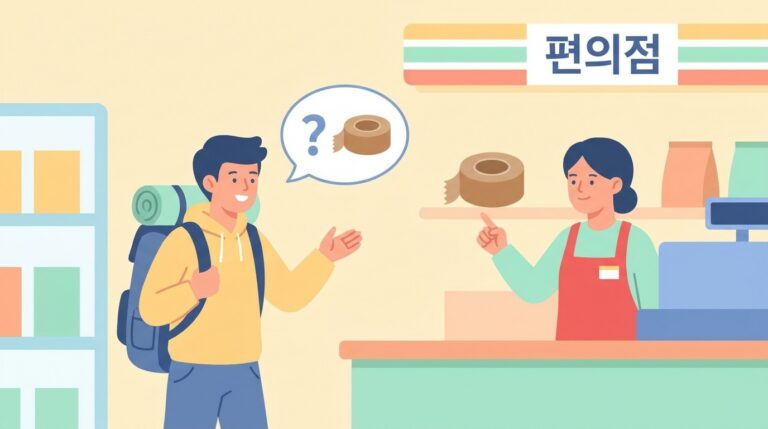
1. 박스 테이프 어디 있어요? (Bakseu te-i-peu eodi isseoyo?)
- Pronunciation: Bak-seu tay-ee-peu uh-dee ee-ssuh-yo? (Think of “box” said with a quick Korean pop: bak-seu, and tape as tay-ee-peu).
- Meaning: Literal: “Box tape where is?” | Natural: “Where is the packing/box tape?”
- K-Culture Moment: Remember those variety shows like I Live Alone (나 혼자 산다) where celebrities move into new apartments and frantically pack brown boxes? This is the exact phrase they mutter while pacing the aisles.
- Editor’s Insight: In Korean, regular thin tape is simply 스카치테이프 (seukachi te-i-peu / Scotch tape). If you want wide, brown or clear packing tape, you must say 박스 테이프 (bakseu te-i-peu).
- Situation Spectrum: Casual ⚠️ | Semi-formal ✅ | Formal ✅
- 🤔 Think About It: Notice how the word order puts the location question word (어디 / where) right before the verb (있어요 / exists). How does flipping the question word towards the end change your focus compared to English?
2. 가위도 있어요? (Gawido isseoyo?)
- Pronunciation: Gah-wee-doh ee-ssuh-yo? (Gah-wee rhymes with “kiwi”).
- Meaning: Literal: “Scissors also exist?” | Natural: “Do you also have scissors?”
- K-Culture Moment: Often spotted in Korean food vlogs where someone asks for meat-cutting scissors at a barbecue table, but here it saves your life when you need to cut tape.
- Editor’s Insight: The tiny particle -도 (-do) means “also” or “too.” Tacking it onto any noun instantly creates a polite, natural follow-up question without needing a long sentence.
- Situation Spectrum: Casual ⚠️ | Semi-formal ✅ | Formal ✅
- 🤔 Think About It: In English, you might say “Could you also show me where the scissors are?” Korean simplifies courtesy through intonation and clean particles. Isn’t it refreshing to say so much with just two words?
3. 저쪽에 있어요 (Jeojjoge isseoyo)
- Pronunciation: Juh-jjoh-gey ee-ssuh-yo? (Emphasize the crisp double-j sound jjoh).
- Meaning: Literal: “It is over in that direction.” | Natural: “It is over there.”
- K-Culture Moment: The classic department store or convenience store clerk response in Korean dramas when the main character dashes in looking for an umbrella during a sudden downpour.
- Editor’s Insight: This is what you will hear in response! The clerk will almost always point with two hands or an open palm while saying this.
- Situation Spectrum: Casual ⚠️ | Semi-formal ✅ | Formal ✅
- 🤔 Think About It: Korean distinguishes between “near the listener” (그쪽 / geujjok), “near the speaker” (이쪽 / ijjok), and “far from both” (저쪽 / jeojjok). Spatial awareness is woven right into the language!
Phase 3: Textbook Korean vs. Real Korean
Let’s bridge the gap between classroom theory and street-smart Korean.
Situation 1: Asking for Box Tape
- 📖 교과서 한국어 (Textbook Korean): 상자 포장용 테이프는 어느 진열대에 위치합니까? (Sangja pojang-yong te-i-peuneun eoneu jin-yeoldae-e wichi-hamnikka? – In which display stand is the adhesive tape for packaging boxes situated?)
- 🗣️ 진짜 한국어 (Real Korean): 박스 테이프 어디 있어요? (Bakseu te-i-peu eodi isseoyo? – Where’s the box tape?)
- 💡 왜 다를까? (Why is it different?): Textbooks love hyper-formal Sino-Korean nouns (위치 / wichi, 진열대 / jin-yeoldae). In modern supermarkets, native Koreans use loanwords like 박스 (box) and simple verbs like 있어요 (is/exists) for fast, smooth everyday communication.
Situation 2: Asking if Packing Supplies are Free
- 📖 교과서 한국어 (Textbook Korean): 포장 용품을 무상으로 이용할 수 있습니까? (Pojang yongpumeul musang-euro iyonghal su issumnikka? – May I utilize the packaging goods free of compensation?)
- 🗣️ 진짜 한국어 (Real Korean): 이거 써도 돼요? (Igeo sseodo dwaeyo? – Can I use this?)
- 💡 왜 다를까? (Why is it different?): Casual public areas prioritize speed. Pointing at the tape dispenser at a packing counter and asking “이거 써도 돼요?” gets an instant nod without confusing the staff with bureaucratic vocabulary.
Phase 4: K-Culture Deep Dive & Non-verbal Manners
4-1. 눈치 (Nunchi) & Gestures
When approaching a clerk in a Korean retail store:
1. Open Palm Direction: Never point your index finger directly at a clerk or an item. Instead, open your hand palm-up, angled at about 45 degrees, when referring to something.
2. The Polite Neck Bow: Before you speak, make brief eye contact, slightly lower your gaze, and give a gentle 15-degree head nod. Starting with a soft “저기요…” (Jeogiyo / Excuse me) softens the atmosphere immediately.
3. Screen Show-and-Tell: If your pronunciation wavers, don’t sweat! Show a picture of packing tape on your phone with both hands holding the device. Holding items with both hands is a foundational Korean gesture of respect.
4-2. Culture Code: The Mart “Self-Packing Station” (자율포장대)
If you visit large supermarkets in Korea like E-Mart, Homeplus, or Lotte Mart, you will witness a unique cultural staple: the 자율포장대 (Jayul Pojangdae / Autonomous Packing Counter).
Traditionally, large marts provided empty cardboard product boxes, green plastic strapping bands, and rolls of brown tape for free so shoppers could package their groceries instead of buying single-use plastic bags. To protect the environment, the Korean government phased out free tape and plastic string from these tables. Today, shoppers grab a free leftover box from the rack, but you are expected to bring your own tape or purchase a small roll at the cashier. Knowing how to ask for 박스 테이프 is literally your ticket to shipping your haul home!
Phase 5: Real-Life Roleplay Scenario
Setting: Daiso, Hongdae Station Branch (B1 Stationery Section). Fluorescent lights, upbeat K-pop playing softly in the background.
Characters:
* You (A1 Korean learner): Eager shopper clutching a souvenir mug and a cosmetic gift set.
* Min-jun (Store Clerk): Wearing a neat red Daiso apron, holding a handheld barcode scanner.
- Turn 1 (You):
저기요, 실례합니다.
(Jeogiyo, sillyehamnida.)
“Excuse me, pardon me.”
🎭 Softly tap your fingers together and offer a mini 15-degree bow. -
Turn 2 (Min-jun):
네, 고객님! 무엇을 도와드릴까요?
(Ne, gogaeknim! Mueoseul dowadeurilkkayo?)
“Yes, valued customer! How may I assist you?”
🎭 Pauses his handheld scanner and turns with an attentive smile. -
Turn 3 (You):
박스 테이프 어디 있어요?
(Bakseu te-i-peu eodi isseoyo?)
“Where is the box tape?”
🎭 Make a wide rectangular box shape with your two hands to gesture. -
Turn 4 (Min-jun):
아, 테이프요? 저쪽에 3번 통로로 가시면 돼요.
(A, te-i-peuyo? Jeojjoge sambeon tongnoro gasimyeon dwaeyo.)
“Ah, tape? It’s over that way in aisle 3.”
🎭 Extends his right hand with palm open toward the middle aisle. -
Turn 5 (You):
3번 통로요? 가위도 거기 있어요?
(Sambeon tongnoyo? Gawido geogi isseoyo?)
“Aisle 3? Are scissors there too?”
🎭 Tilts head slightly, eyes brightening. -
Turn 6 (Min-jun):
네, 테이프 바로 옆에 있어요.
(Ne, te-i-peu baro yeope isseoyo.)
“Yes, they are right next to the tape.”
🎭 Gives a brief, reassuring nod. -
Turn 7 (You):
감사합니다!
(Gamsahamnida!)
“Thank you!”
🎭 Smiles warmly and performs a polite two-second nod. -
Turn 8 (Min-jun):
좋은 하루 되세요!
(Joeun haru doeseyo!)
“Have a wonderful day!”
🎭 Returns to his inventory check.
🔀 Interactive Choice Point
You arrive at Aisle 3, but there are 20 different kinds of tape: colorful washi tape, thin transparent tape, double-sided tape, and thick yellow tape. You aren’t sure which one will hold heavy luggage. Min-jun walks past. What do you say?
- Option A: “야! 이거 박스에 붙여?” (Ya! Igeo bakseue buchyeo?)
- Option B: “이거 박스에 써도 돼요?” (Igeo bakseue sseodo dwaeyo?)
- Option C: “테이프가 나빠요.” (Te-i-peuga nappayo.)
Outcome & Feedback:
* Selection A [Risk 🚫]: “야 (Ya)” is extremely blunt slang used only with childhood friends. Shouting this at a store staff member will cause intense second-hand embarrassment!
* Selection B [Best ✅]: Perfect natural Korean! “Can I use this on a box?” Min-jun will happily check the thickness and say “네, 택배용으로 좋아요!” (Yes, great for parcels!).
* Selection C [Bad ⚠️]: This means “The tape is bad/evil.” It makes you sound frustrated with Daiso’s quality rather than asking for advice!
Phase 6: 10-Second Emotion Shadowing Drill
Practice these with feeling! Intonation in Korean expresses courtesy and warmth.
[😊 Politeness & Gentle Inquiry]
저기요… / 박스 테이프 / 어디 있어요?
(Jeogiyo… / bakseu te-i-peu / eodi isseoyo?)-
[🤔 Curious & Hopeful]
가위도 / 같이 / 있어요?
(Gawido / gachi / isseoyo?) -
[💖 Warm Gratitude]
감사합니다! / 저쪽이군요!
(Gamsahamnida! / jeojjog-igunyo!)
Phase 7: K-Culture Mini Dictionary
Here are 4 powerhouse words every shopper in Korea needs:
- 다이소 (Daiso): The undisputed king of affordable Korean everyday goods. Stores range from cozy 1-floor neighborhood shops to massive 12-story high-rises (like the one near Myeongdong Station). Nearly all items cost between 1,000 KRW (~$0.75) and 5,000 KRW (~$3.80).
- 택배 (Taekbae): Parcel delivery. Korea’s logistics system is world-renowned for its “dawn delivery.” If you need heavy-duty packaging, look for tape labeled 택배용 (for parcel shipment).
- 자율포장대 (Jayul Pojangdae): Supermarket self-packing station. Located right past the cash registers at big marts where you can assemble cardboard boxes to load your groceries.
- 뽁뽁이 (Bbokbboki): Bubble wrap! This is an onomatopoeic word derived from the sound bubbles make when you pop them (bbok-bbok). Daiso sells large rolls of 뽁뽁이 for delicate skincare bottles or ceramic souvenirs.
Phase 8: Traveler’s Survival Kit
Top 3 Survival Phrases for Marts
- 봉투 필요하세요? (Bongtu piryohaseyo?)
- Meaning: “Do you need a shopping bag?”
- Pro Tip: Cashiers will ask this 99% of the time. Reply “네, 주세요” (Ne, juseyo / Yes, please) or “아니요, 괜찮아요” (Aniyo, gwaenchanayo / No, I’m okay).
- 종이박스 어디 있어요? (Jongi-bakseu eodi isseoyo?)
- Meaning: “Where are the paper/cardboard boxes?”
- Pro Tip: Perfect if you need a clean box to pack gifts.
- 계산 어디서 해요? (Gyesan eodiseo haeyo?)
- Meaning: “Where do I pay / check out?”
- Pro Tip: Many city marts have separate zones for self-checkout kiosks.
Editor’s Travel Note
- App Tip: Google Maps does not provide walking routes in Korea. Make sure to consult our Naver Map navigation guide for Korea travel to easily find the nearest multi-floor Daiso or mart.
- Payment: Foreign credit cards (Visa/Mastercard) work seamlessly at Daiso and mart checkout kiosks. If the kiosk asks for 일시불 (ilsibul), don’t worry: it simply means “single full payment (no monthly installments).” Tap the screen and insert your card!
Phase 9: “한 발 더 깊이” (One Step Deeper)
In many Western cultures, shopping is fundamentally transactional: you find things yourself, pay, and exit without much interaction. In Korea, asking store employees questions is considered a normal, communal rhythm of the shopping experience.
Korean culture places immense value on 정 (Jeong / warm social connection) and efficiency (빨리빨리 / ppalli-ppalli). Store clerks will rarely be annoyed if you ask where an item is located; in fact, they will often leave their counter and personally escort you straight to the tape shelf. By learning simple Korean phrases rather than silently wandering the aisles for 30 minutes, you unlock this helpful side of Korean daily life.
💬 Your Turn: What is the most confusing item you’ve ever tried to locate in a foreign grocery store? Share your travel shopping stories in the comments below!
Phase 10: FAQ & Common Mistakes
Q: Can I use the packaging tape at the mart packing station for free?
A: In the past, yes! However, due to environmental regulations reducing single-use plastic tape and ropes, large marts (E-Mart, Lotte Mart, Homeplus) no longer provide free tape at the 자율포장대. You can take the cardboard boxes for free, but you should buy a 1,000 KRW roll of tape at the cash register to seal it.
Q: What is the difference between 스카치테이프 and 박스 테이프?
A: 스카치테이프 (Scotch tape) refers to standard, clear desk tape used for paper. It is too thin for cardboard boxes and will tear easily. Always ask for 박스 테이프 (box tape) or 박스테이프 when packing luggage or postal boxes.
Q: How do I say “heavy-duty” or “strong” tape?
A: You can add 강력 (gangnyeok / strong/powerful) in front: “강력 테이프 있어요?” (Gangnyeok te-i-peu isseoyo?). This guarantees you get reinforced duct tape or heavy packing tape.
🚨 Common Mistakes (흔한 실수)
- Mistake: Calling all tape “스티커 (seutikeo)”.
- Correct Action: A sticker is decorative. Tape is always 테이프 (te-i-peu).
- Mistake: Using informal speech (반말) like “테이프 어디야?” (Te-i-peu eodiya?) with clerks.
- Correct Action: Always finish your question with -있어요? (-isseoyo?) to show polite manners.
- Mistake: Looking for boxes in convenience stores (편의점).
- Correct Action: Convenience stores rarely give away boxes. Head to Daiso, an E-Mart Everyday, a local neighborhood supermarket (동네 마트), or the post office (우체국).
Phase 11: Action Missions
- 🥉 Bronze Mission (Solo Practice): Stand in front of your mirror with an imaginary box. Say out loud three times: “박스 테이프 어디 있어요?” with a friendly hand gesture.
- 🥈 Silver Mission (Social Share): Snap a photo of an item you packed in your room or luggage, post it to your Instagram story, and caption it: “박스 테이프 어디 있어요? #DailyHangul #LearnKorean”.
- 🥇 Gold Mission (Real World): Walk into your nearest Daiso or Asian supermarket. Find a staff member, ask the phrase in Korean, and successfully locate the stationery section!
- 🎮 K-Culture Mission: Watch any Korean travel vlog or moving episode of I Live Alone. Listen carefully for whenever someone says 어디 있어요? or 박스.
Phase 12: Interactive Quiz Challenge
Test your mart survival skills! Click each toggle to reveal the explanation.
Question 1 (Situation): You want to ask where the scissors are located. What is the most natural phrase?
- A) 가위 어디예요? (Gawi eodiyeyo?)
- B) 가위도 어디 있어요? (Gawido eodi isseoyo?)
- C) 가위 어디 있어요? (Gawi eodi isseoyo?)
Answer: C) 가위 어디 있어요?
Explanation: While A is understandable, “가위 어디 있어요?” (Where are scissors located?) is the most standard, natural question. B is slightly awkward because the particle -도 (also) is better suited for “가위도 있어요?” (Do you also have scissors?).
Question 2 (Fill in the Blank): Complete the sentence to ask: “Where is the box tape?”
👉 “박스 ______ 어디 있어요?”
- A) 가위 (gawi)
- B) 테이프 (te-i-peu)
- C) 상자 (sangja)
Answer: B) 테이프 (te-i-peu)
Explanation: 박스 (box) + 테이프 (tape) forms the compound term 박스 테이프 (box/packing tape)!
Question 3 (Culture True/False): At Korean hypermarts like E-Mart, free packing tape is always laid out generously on the self-packing tables.
- A) True
- B) False
Answer: B) False
Explanation: Due to eco-friendly government policies introduced to reduce plastic waste, marts provide free empty boxes, but free tape and plastic string have been eliminated from the self-packing counters. Always keep your own roll handy!
🎬 Watch Our Daily Videos! (Daily Hangul Official Instagram)
Review the expressions you learned in this article with our fun daily short videos! Check out native pronunciation and real-life nuances in action.
- Instagram @dailyhangul_en







