

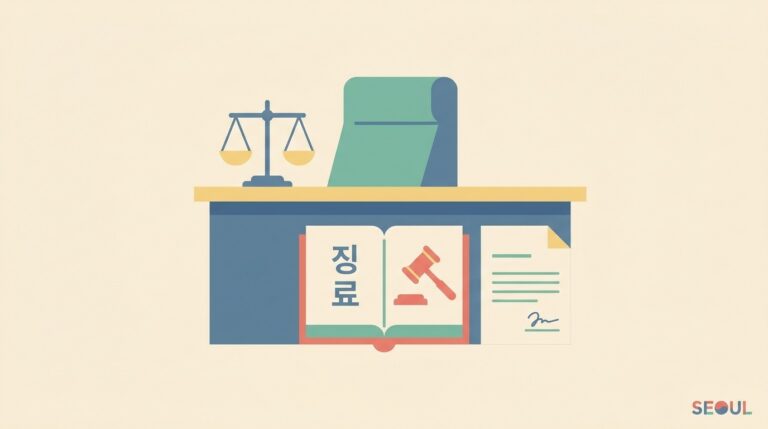
Overriding the Contract: How Korean Labor Law Safeguards Worker Dignity
Phase 1: Empathy (Story-Driven Opening)
안녕하세요! 매일한글 에디터입니다. (Hello! I’m your Daily Hangul editor.)
Picture this scene from a gripping K-drama like Awl (송곳) or Misaeng (미생): An ambitious foreign specialist or passionate junior associate sits in a sleek glass boardroom in Gangnam. Across the mahogany table, the HR director slides over an employment contract. Nestled in fine print on page four is a startling clause: “The employee voluntarily forfeits statutory overtime pay, and agrees that any dismissal shall not be disputed under the principle of freedom of contract.” Anxious to secure the position, the worker signs, rationalizing: “Well, pacta sunt servanda—freedom of contract governs business everywhere, right?”
Months later, working eighty-hour weeks without night-shift allowances or weekend premiums, exhaustion sets in. When raising the issue, the supervisor responds coldly: “You signed it freely. Contractual freedom means you consented.”
Here lies one of the most perilous traps for global professionals navigating South Korea’s employment sphere. In raw civil law, private autonomy (사적 자치) reigns supreme. However, in Korean jurisprudence, 개별적 근로관계법 (Individual Labor Law) acts as an uncompromising legal shield. It consciously steps in to curb unbridled contractual freedom by imposing 강행규정 (mandatory statutory minimums). Any clause negotiated below this legislative floor is instantly void (무효), automatically replaced by the protective provisions of the Labor Standards Act (근로기준법).
If you have ever felt powerless reading an asymmetrical agreement or struggled to express statutory legal limits during salary or contract negotiations, this masterclass is crafted for you. Drawn from real-world corporate expatriate counseling and Supreme Court precedents, this guide empowers you to articulate your statutory protections with authoritative, C2-level Korean proficiency.
Phase 2: Core Expressions Deep Dive
1. 강행규정 (Gang-haeng-gyu-jeong)
- Pronunciation: [Gang-haeng-gyu-jeong] (Think of ‘gang’ as in ‘gangway’, ‘haeng’ sounding like ‘hang’ with an open ‘e’, ‘gyu’ like ‘queue’, and ‘jeong’ like ‘jung’ in Carl Jung.)
- Meaning: Literal: Enforced compulsory regulation | Nuance: Mandatory statutory provision / Ius cogens of labor law that invalidates any contrary private agreements.
- K-Culture Moment: Seen in courtroom or corporate dramas like Hyena or Doctor Lawyer when a labor attorney slams down the statute book against predatory NDAs or waiver clauses.
- Editor’s Insight: Unlike 임의규정 (permissive/default rules which parties can contract out of), a 강행규정 admits zero contractual deviation to the worker’s detriment. If your contract says you waive severance pay (퇴직금 포기 각서), that specific clause is categorically nullified by operation of law.
- Situation Spectrum: Casual: 🚫 | Semi-formal: ⚠️ | Formal: ✅
- 🤔 Think About It: Does your home jurisdiction allow employees to contractually waive statutory labor protections in exchange for higher base remuneration? In Korea, why does the state prioritize human dignity over contractual autonomy?
2. 계약 자유의 원칙을 수정하다 (Gye-yak ja-yu-ui won-chik-eul su-jeong-ha-da)
- Pronunciation: [Gye-yak ja-yu-ui won-chik-eul su-jeong-ha-da] (Pronounce ‘gye’ like ‘gy-air’, ‘won-chik’ with a crisp ‘ch’ sound, and ‘su-jeong’ akin to ‘soo-jung’.)
- Meaning: Literal: To modify the principle of freedom of contract | Nuance: To legally supersede unfettered contractual liberty to prevent socio-economic subjugation.
- K-Culture Moment: A pivotal dialogue spoken by a labor inspector (근로감독관) reprimanding a predatory startup CEO attempting to bypass standard working hours.
- Editor’s Insight: This phrase represents the philosophical core of modern social welfare law (사회법) in Korea. It recognizes that formal legal equality between an employer and an isolated worker is an illusion unless rectified by substantive statutory intervention.
- Situation Spectrum: Casual: 🚫 | Semi-formal: ⚠️ | Formal: ✅
- 🤔 Think About It: Notice how the Korean verb 수정하다 (to modify/rectify) carries an ethical imperative rather than merely meaning ‘to alter’—it implies correcting a systemic imbalance.
3. 법률상 당연무효이다 (Beop-ryul-sang dang-yeon-mu-hyo-i-da)
- Pronunciation: [Beom-nyul-ssang dang-yeon-mu-hyo-i-da] (Due to consonant assimilation, ‘beop-ryul’ sounds like ‘beom-nyul’, followed by a tensed ‘ssang’.)
- Meaning: Literal: It is naturally void under the law | Nuance: It is ipso jure null and void without requiring a separate judicial declaration.
- K-Culture Moment: Frequently deployed in high-stakes negotiations in corporate dramas when an internal legal counsel warns executive leadership against executing illegal worker covenants.
- Editor’s Insight: In high-level labor disputes, do not simply say “이거 불법이에요” (This is illegal). Saying “근로기준법 위반으로 법률상 당연무효입니다” establishes uncontested legal authority, signaling that the substandard term does not bind you for a single second.
- Situation Spectrum: Casual: 🚫 | Semi-formal: ⚠️ | Formal: ✅
- 🤔 Think About It: How does invoking 당연 (naturally/as a matter of course) reflect the uncompromising firmness of the Korean legal order regarding core constitutional values?
Phase 3: Textbook Korean vs. Real Korean
Situation A: Explaining that an unfair contract clause has no legal effect
- 📖 교과서 한국어 (Textbook):
- 이 계약 조항은 근로기준법에 맞지 않아서 효력이 발생하지 않습니다. (I gyeyak johang-eun geunrogijunbeobe matji anaseo hyoryeogi balsaenghaji anseumnida.)
- “Because this contract clause does not conform to the Labor Standards Act, its effect does not arise.”
- 🗣️ 진짜 한국어 (Real-World High-Register C2):
- 근로기준법상 강행규정 위반이라 해당 특약은 당연무효 처분 대상입니다. (Geunrogijunbeopsang ganghaenggyujeong wiban-ira haedang teugyageun dang-yeonmuhyo cheobun daesang-imnida.)
- “As it violates mandatory statutory provisions under the Labor Standards Act, the special covenant in question is ipso jure null and void.”
- 💡 왜 다를까? (Contextual Rationale): Textbook Korean uses vague expressions (맞지 않아서), which invites management debate. Real legal Korean introduces exact doctrinal categories like 특약 (special covenant) and 당연무효 (automatic invalidity), shutting down spurious counter-arguments immediately.
Situation B: Pointing out that minimum statutory standards supersede individual consent
- 📖 교과서 한국어 (Textbook):
- 제가 서명했어도 법이 정한 최저 기준보다 낮으면 안 됩니다. (Jega seomyeonghaesseodo beobi jeonghan choejeo gijunboda najeumyeon an doemnida.)
- “Even if I signed, it cannot be lower than the minimum standard set by law.”
- 🗣️ 진짜 한국어 (Real-World High-Register C2):
- 개별 근로계약상의 합의보다 법정 최저 기준이 우선 적용되는 것이 원칙입니다. (Gaebyeol geunrogyeyaksang-ui hab-uiboda beopjeong choejeo gijuni useon jeok-yongdoeneun geosi wonchik-imnida.)
- “As a matter of primary doctrine, statutory minimum standards take precedence over any individual contractual agreement.”
- 💡 왜 다를까? (Contextual Rationale): Native corporate executives and legal counsels frame labor rights through structural legal hierarchy (우선 적용) rather than personal grievances (내가 서명했어도).
Phase 4: K-Culture Deep Dive & Non-Verbal Etiquette
4-1. Nunchi (눈치) & Strategic Demeanor in Contract Discussions
When navigating labor standards in Korea, direct blunt confrontation (“You are breaking the law!”) often triggers extreme institutional defensiveness and collective ostracization. Instead, practice legal 눈치 (situational acumen):
* The Non-Accusatory Gaze: When highlighting an invalid clause, point to the document on the table rather than looking the HR executive dead in the eye. Frame the illegality as a technical statutory oversight rather than personal malfeasance: “노무 관리상 리스크가 될 수 있는 조항이라 말씀드립니다” (I bring this up because this clause could pose an operational labor-management risk to the company).
* The Documented Pause: When handed an ambiguous supplementary agreement, do not sign on the spot under artificial social pressure. Place both hands calmly flat on the document, bow slightly, and utter: “면밀히 검토 후 서면으로 회신드리겠습니다” (I will review this thoroughly and reply in writing).
4-2. Cultural Code Analysis: Songgot (송곳) and Constitutional Labor Protections
In the acclaimed workplace drama Songgot (The Awl), a union organizer famously proclaims: “The law only protects those who awake to their rights.” In South Korea, individual labor law is rooted directly in Article 32 of the Constitution, which demands that working conditions be established by law to ensure “human dignity” (인간의 존엄성).
Historically, South Korea’s rapid economic miracle (한강의 기적) was built upon unyielding industrial sacrifice. In response, modern Korean jurisprudence constructed extraordinarily robust statutory defenses to protect employees against predatory employer dominance. When you invoke 강행규정, you are not merely quoting an administrative code; you are tapping into decades of democratic struggle that established labor protections as an inviolable baseline of Korean society.
Phase 5: Real-World Roleplay Scenario
Setting: A modern glass meeting room at a prominent tech conglomerate in Pangyo.
Characters:
* Director Park (박 이사): Veteran HR Director, smooth, authoritative, trying to enforce an unpaid overtime waiver.
* You (C2 Professional): Senior Systems Architect resolving an abusive contract amendment.
— dialogue starts —
Turn 1: Director Park
자, 이번 프로젝트가 워낙 촉박해서 포괄임금제 특약에 동의 서명을 해주셔야겠어요. 사적 자치 원칙상 당사자 합의만 있으면 전혀 문제없습니다. (Ja, ibeon peurojekteuga wonak chokbakhaeseo pogwal-imgeumje teugyage dong-ui seomyeong-eul haejusyeoyagesseoyo. Sajeok jachi wonchiksang dangsaja hab-uiman isseumyeon jeonhyeo munjeeopseumnida.)
“Well, since this project timeline is so tight, we need you to sign this comprehensive wage agreement waiver. Under the principle of private autonomy, there is no issue as long as both parties agree.”
🎭 행동 지문: Hands you a pen with a patronizing, confident smile.
Turn 2: You
이사님 말씀의 취지는 이해합니다만, 개별적 근로관계법은 계약 자유의 원칙을 수정하는 강행법규입니다. (Isanim malsseum-ui chwijineun ihaehamnidaman, gaebyeoljeok geunrogwangyebeobeun gyeyak jayu-ui wonchikeul sujeonghaneun ganghaengbeopgyu-imnida.)
“I understand your intent, Director Park, but individual labor law consists of mandatory statutes that modify raw freedom of contract.”
🎭 행동 지문: Sets the pen down gently on the contract without signing.
Turn 3: Director Park
아니, 업계 관행인데 너무 원칙만 따지시는 거 아닙니까? 본인이 자발적으로 동의해도 무효라는 건가요? (Ani, eopgye gwanhaeng-inde neomu wonchikman ttajisineun geo animnikka? Bon-ini jabbaljeogeuro dong-uihaedo muhyoraneun geongayo?)
“Come on, this is industry convention—aren’t you being overly rigid? Are you saying this is void even if you voluntarily consent?”
🎭 행동 지문: Leans back, crossing his arms with a furrowed brow.
Turn 4: You
네, 대법원 판례에 따르더라도 근로기준법상 기준에 미달하는 근로조건을 정한 계약은 그 부분에 한하여 당연무효입니다. (Ne, daebeobwon panryee ttareudeorado geunrogijunbeopsang gijune midalhaneun geunrojogeoneul jeonghan gyeyageun geu bubune hanhayeo dang-yeonmuhyo-imnida.)
“Yes, according to Supreme Court precedent, any contract setting working conditions below the Labor Standards Act threshold is ipso jure void in respect to that specific portion.”
🎭 행동 지문: Maintains steady, polite eye contact and speaks with measured calmness.
Turn 5: Director Park
그럼 그 무효가 된 부분은 어떻게 처리된다는 말입니까? 계약 전체가 깨지는 겁니까? (Geureom geu muhyoga doen bubuneun eotteoke cheoridoendaneun marimnikka? Gyeyak jeonchega kkaejineun geomnikka?)
“Then how is that invalidated portion handled? Does the entire contract become void?”
🎭 행동 지문: Uncrosses his arms, leaning forward with genuine curiosity and caution.
Turn 6: You
전체가 무효가 되는 것이 아니라, 무효로 된 부분은 법이 정한 최저 기준으로 즉시 대체됩니다. (Jeonchega muhyoga doeneun geosi anira, muhyoro doen bubuneun beobi jeonghan choejeo gijuneuro jeuksi daechedoemnida.)
“The entire contract does not become void; rather, the invalidated section is immediately superseded by the statutory minimum standard.”
🎭 행동 지문: Gestures slightly toward the statute reference on your tablet.
Turn 7: Director Park
결국 법정 통상임금 산정과 초과근로수당 지급 의무를 피할 수는 없다는 뜻이군요. (Gyeolguk beopjeong tongsang-imgeum sanjeong-gwa chogwageunrosudang jigeup uimureul pihal suneun eopdaneun tteus-igunyo.)
“So you’re saying we cannot evade the calculation of statutory ordinary wages and the obligation to pay overtime premiums after all.”
🎭 행동 지문: Sighs softly and retrieves the document to inspect the clause.
Turn 8: You
맞습니다. 적법한 보상 체계를 갖추는 것이 향후 노사 간의 신뢰와 기업의 법적 안정성을 위해서도 바람직합니다. (Masseumnida. Jeokbeophan bosang chegyereul gatchuneun geosi hyanghu nosa gan-ui sinroewa gieobui beopjeok anjeongseong-eul wihasaedo baramjikhamnida.)
“Precisely. Establishing a compliant compensation framework serves both mutual labor-management trust and the company’s long-term legal security.”
🎭 행동 지문: Offers a respectful, conciliatory nod.
— dialogue ends —
🔀 Interactive Decision Point
How would you handle Director Park if he pushed back further, insisting: “회사가 어려운데 이번만 양보해주면 안 됩니까?” (The company is struggling; can’t you yield just this once?)
- Option A: “노동청에 바로 진정 넣기 전에 조항 수정해 주십시오.” (Revise the clause before I file a formal petition with the Labor Office immediately.)
- Outcome: Risk. Creates an adversarial breach. In Korean corporate hierarchies, jumping straight to reporting agencies without exhausting internal legal framing leads to systemic workplace alienation.
- Option B: “회사의 고충은 이해하나, 법정 최저 기준을 잠탈하는 합의는 추후 형사처벌 위험까지 수반하므로 법정 테두리 내에서 대안을 모색해야 합니다.” (I understand the firm’s difficulties, but an agreement evading statutory minimums carries criminal liability risks; we must find alternatives within statutory boundaries.)
- Outcome: Best! Exceptional C2 mastery. It shifts the argument from an ego clash to risk mitigation for the executive, positioning you as an indispensable strategic advisor.
- Option C: “알겠습니다. 이번 한 번만 특별히 동의 서명해 드리겠습니다.” (Understood. I will make an exception and sign this time.)
- Outcome: Bad. Surrenders your legal rights and normalizes wage theft, setting an irreversible precedent of submissiveness.
Phase 6: 10-Second Emotional Shadowing Drill
Read each sentence aloud, respecting the rhythm stops (/) and internalizing the exact emotional register:
- [🛡️ With firm, quiet authority]
개별 근로계약은 / 계약 자유의 원칙보다 / 법정 최저 기준이 / 우선합니다.
(Gaebyeol geunrogyeyageun / gyeyak jayu-ui wonchikboda / beopjeong choejeo gijuni / useonhamnida.)
“Individual employment contracts / yield to statutory minimum standards / before the principle of contractual freedom.” -
[⚖️ Coldly analytical and unshakeable]
근로기준법상 강행규정에 미달하는 특약은 / 법률상 당연무효입니다.
(Geunrogijunbeopsang ganghaenggyujeong-e midalhaneun teugyageun / beomnyulssang dang-yeonmuhyo-imnida.)
“Any covenant falling short of the Labor Standards Act’s mandatory provisions / is null and void as a matter of law.” -
[🤝 Cooperative yet legally uncompromising]
합법적인 임금 가이드라인을 준수하는 것이 / 노사 상생의 첩경입니다.
(Hapbeopjeogin imgeum gaideurain-eul junsuhaneun geosi / nosa sangsaeng-ui cheopgyeong-imnida.)
“Complying with statutory wage guidelines / is the absolute shortcut to mutual labor-management coexistence.”
Phase 7: K-Culture Mini Dictionary
| Term (한글 + Romanization) | Precise Legal Translation | Real-World Workplace Context |
|---|---|---|
| 1. 사적 자치의 한계 (Sajeok jachi-ui han-gye) |
Limits of Private Autonomy | Used in high-level contract debates to establish that individual agreements cannot override constitutional social protections. |
| 2. 편면적 강행규정 (Pyeonmyeonjeok ganghaenggyujeong) |
Unilaterally Mandatory Rule | Reflects the doctrine that provisions can only be altered in favor of the employee; terms more beneficial than the law are valid, but inferior terms are void. |
| 3. 통상임금성 (Tongsang-imgeumsang) |
Ordinary Wage Qualification | The legal criteria (regularity, uniformity, fixed nature) determining whether bonuses or allowances must be included in overtime calculations. |
| 4. 성실교섭의무 (Seongsil-gyoseop-uimu) |
Duty to Bargain in Good Faith | An employer’s non-derogable obligation to engage sincerely with labor representatives without unreasonable delay or bad faith posturing. |
Phase 8: Expat & Professional Survival Kit
Top 3 Legal Survival Phrases
- 서면 명시 의무 위반입니다. (Seomyeon myeongsi uimu wiban-imnida.)
- Meaning: “This violates the obligation to specify terms in writing.”
- Pro Tip: Under Article 17 of the Labor Standards Act, core working conditions (wages, hours, holidays) must be documented in writing. If an employer gives vague verbal promises, use this exact line.
- 통상임금 산입 범위를 재검토해 주십시오. (Tongsang-imgeum san-ip beomwireul jae-geomtohae jusipsio.)
- Meaning: “Please re-examine the scope of items included in the ordinary wage calculation.”
- Pro Tip: Essential when dealing with annual incentive bonuses or fixed allowances excluded unlawfully from overtime rates.
- 해당 조항의 효력 유무에 관해 노무 자문을 요청하겠습니다. (Haedang johang-ui hyoryeok yumu-e gwanhae nomu jamun-eul yocheonghagetseumnida.)
- Meaning: “I will request labor counsel regarding the legal validity of the clause in question.”
- Pro Tip: The most professional, dignified way to stall signing without causing personal offense.
Editor’s Field Note: Legal Resources & Navigation
When encountering exploitative agreements, do not remain isolated. You can access free professional labor counseling through dedicated channels:
* Seek immediate professional assistance via the 서울시 노동권익센터 온라인 상담 예약 (Seoul Labor Rights Center Online Consultation) platform.
* If your dispute involves unpaid statutory allowances, file a structured complaint directly through the 고용노동부 민원마당 전자신고 포털 (Ministry of Employment and Labor E-Filing System).
Phase 9: “한 발 더 깊이” (One Step Deeper)
In Western common-law paradigms, the foundational premise of contract law often leans heavily on formal autonomy: two sovereign adults negotiate freely, and the court’s role is primarily to enforce what was inked. However, modern South Korean law operates through a distinct civil law lens infused with post-war constitutional solidarity. Article 32, Clause 3 of the Constitution explicitly mandates: “Standards of working conditions shall be determined by law in such a manner as to ensure human dignity.”
This single sentence subverts raw market contractualism. It acknowledges that when survival depends on a wage, an individual job-seeker can never negotiate on equal footing with a multi-million-dollar entity. Hence, individual labor law does not merely adjust contractual freedom; it morally domesticates it. In Korea, law is not a passive mirror of capital transactions, but an ethical architecture designed to prevent economic desperation from eroding fundamental human value.
💬 Your Turn: Does your home legal culture view an employment contract as a pure commercial instrument or as a constitutionally protected relationship? Share your perspectives in the comments below!
Phase 10: FAQ & Avoiding Misunderstandings
Q: If I signed a written agreement waiving my overtime pay, does my signature make it legally binding?
A: No. Article 15 of the Labor Standards Act explicitly provides that any portion of a labor contract that establishes working conditions falling short of statutory standards is null and void (당연무효). Your signature cannot breathe legal life into a clause invalidated by a mandatory statutory rule.
Q: If an illegal clause in my contract is declared void, does my whole contract get cancelled?
A: Absolutely not. Under the doctrine of partial invalidity (일부무효의 특칙), only the substandard clause is struck down. The rest of your employment contract remains fully valid, and the voided portion is automatically filled by the statutory standard established in the Labor Standards Act.
Q: Can an employer classify me as an independent contractor (3.3% tax freelancer) to avoid these mandatory protections?
A: No. The Korean Supreme Court consistently rules based on substantive reality (실질주의) rather than contractual label. If you are subject to the employer’s specific operational direction and supervision, you are legally a worker (근로기준법상 근로자), and all mandatory protections apply regardless of your tax classification.
🚨 Common Mistakes Alert Board
- ❌ Mistake 1: Believing you must honor verbal waivers of statutory leave.
- 👉 Correct Action: Statutory annual paid leave (연차유급휴가) is a mandatory entitlement. Verbal promises or unilateral employer guidelines waiving it are legally nonexistent.
- ❌ Mistake 2: Assuming “Comprehensive Wage System” (포괄임금제) covers infinite unrecorded labor.
- 👉 Correct Action: Even under valid comprehensive wage structures, actual working hours that exceed the agreed overtime cap must be remunerated with statutory premiums.
- ❌ Mistake 3: Shouting emotional complaints (“이건 갑질이에요!”) during formal contractual audits.
- 👉 Correct Action: Ground every assertion in objective statutory articles: “근로기준법 제15조에 위배되는 조항입니다” (This clause contravenes Article 15 of the Labor Standards Act).
Phase 11: Action Missions
- 🥉 Bronze Mission (Solo Shadowing): Practice saying the three sentences from Phase 6 aloud in front of a mirror until you can deliver them within 30 seconds without glancing at the romanization.
- 🥈 Silver Mission (Community Audit): Review an old employment agreement or a standard corporate contract. Identify one clause that attempts to limit statutory rights and write a 2-sentence formal Korean rebuttal using the term 강행규정.
- 🥇 Gold Mission (Real-world Scenario Application): In your next corporate meeting or mock legal exchange, use the phrase “법정 최저 기준이 우선 적용됩니다” when discussing contractual boundaries.
- 🎮 K-Culture Mission: Watch Episode 1 of the drama Awl (송곳) or the movie Cart (카트). Listen for the moment workers discover that their contracts cannot strip away their statutory labor rights, and transcribe the term 무효 when spoken!
Phase 12: Interactive Quiz Challenge
Quiz 1: Doctrinal Application
An employment contract states: “The employee agrees to receive 80% of the statutory minimum wage during their first year of regular, non-probationary employment.” What is the legal status of this clause in South Korea?
* A) Valid, because both parties consented under freedom of contract.
* B) Void only if the employee resigns within three months.
* C) Ipso jure void; the minimum wage rate automatically applies instead.
* D) The entire contract is dissolved immediately.
🔍 Click here for the Answer & Deep Explanation
Correct Answer: C
Explanation: Under Article 15 of the Labor Standards Act and the Minimum Wage Act (최저임금법), statutory standards are unilaterally mandatory (편면적 강행규정). The sub-minimum wage clause is automatically void (당연무효), and the legally mandated minimum wage immediately replaces it by law.
Quiz 2: Fill in the Blank
Complete the sentence using the appropriate C2-level legal terminology:
“개별적 근로관계법은 ( )의 원칙을 수정하여 근로자의 실질적 권익을 보장한다.”
* A) 죄형법정주의 (Principle of legality)
* B) 계약 자유 (Freedom of contract)
* C) 무죄 추정 (Presumption of innocence)
* D) 주식회사 (Joint-stock corporation)
🔍 Click here for the Answer & Deep Explanation
Correct Answer: B
Explanation: The sentence translates to: “Individual labor law modifies the principle of freedom of contract to guarantee the substantive rights and interests of workers.” Individual labor statutes consciously constrain raw contractual freedom (계약 자유의 원칙) to restore parity between employers and employees.
Quiz 3: True or False Cultural/Legal Check
Statement: In South Korea, if an employee signs a severance pay waiver (퇴직금 포기 각서) prior to retirement, the courts will uphold it under the civil principle of pacta sunt servanda.
* [ ] True
* [ ] False
🔍 Click here for the Answer & Deep Explanation
Correct Answer: False
Explanation: The right to claim severance pay (퇴직금 청구권) arises only upon retirement. The Supreme Court of Korea firmly holds that any pre-emptive waiver of severance pay executed during employment violates mandatory legal provisions and is categorically null and void (무효).
🎬 Watch Our Daily Videos! (Daily Hangul Official Instagram)
Review the expressions you learned in this article with our fun daily short videos! Check out native pronunciation and real-life nuances in action.
- Instagram @dailyhangul_en







