

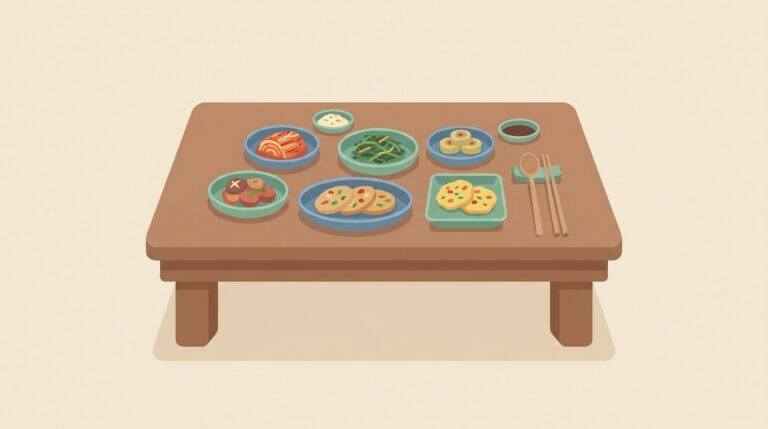
Don’t Touch Your Spoon Yet! The Ultimate Beginner Guide to Korean Table Etiquette
Phase 1: Empathy (Storytelling Opening)
안녕하세요! (Annyeonghaseyo!) I’m your Daily Hangul editor and your personal culture navigator.
Picture this: You are seated at a bustling restaurant in Seoul with your Korean host family or your company colleagues. The air is thick with the mouthwatering aroma of sizzling bulgogi and savory kimchi jjigae. Your stomach lets out an audible rumble. The waiter places the steaming bowls down, and on pure instinct, your hand reaches straight for your metal chopsticks. You’re just about to pluck that golden piece of meat—when suddenly, an awkward chill sweeps over the table. Everyone has their hands neatly folded in their laps. Your friend gives your elbow a gentle, frantic nudge under the table. What just happened?
You’ve just collided with one of the most sacred rules of Korean dining: never start eating until the oldest person at the table picks up their spoon. In Korea, eating is not a solo race to satisfy hunger; it is a communal dance of mutual respect and social harmony. If you don’t know the cues, mealtime can feel like walking through an etiquette minefield. But don’t worry! Having coached hundreds of foreign learners through their first Korean dinners, I’m here to give you the ultimate stress-free survival manual. By the end of this guide, you will sit down at any Korean table with total confidence and win over your hosts before you even swallow your first bite!
Phase 2: Three Core Expressions Deep Dive
1. 잘 먹겠습니다 (Jal meokkkessumnida)
- Pronunciation: [Jal meok-kkes-seum-ni-da] (Sounds like: “Jahl muck-get-seum-nee-dah”)
- Meaning: Literal: “I will eat well” vs. Actual Nuance: “Thank you for this meal / Bon appétit to myself with deep gratitude to the cook or host.”
- K-Culture Moment: In family dramas like Reply 1988, whenever a giant feast is served, the kids clap their hands together and enthusiastically shout this phrase before picking up their chopsticks.
- Editor’s Insight: Think of this as your green light. You announce this clearly to the room before taking your first bite. It tells everyone: “I recognize the effort put into this food!”
- Situation Spectrum: Casual ⚠️ (Use ‘Jal meogulge’ with close friends) / Semi-formal ✅ / Formal ✅
- 🤔 Think About It: In English, we usually say “Enjoy your meal” to others, but Korean shifts the focus to stating personal gratitude for the feast. Why do you think acknowledging your own gratefulness is so valued?
2. 먼저 드세요 (Meonjeo deuseyo)
- Pronunciation: [Meon-jeo deu-se-yo] (Sounds like: “Mun-juh duh-say-yo”)
- Meaning: Literal: “Please eat first” vs. Actual Nuance: “After you, please / Go right ahead and take the first bite.”
- K-Culture Moment: In workplace dramas like Misaeng, junior associates politely hold back and smile warmly, gesturing toward the department director to initiate the feast.
- Editor’s Insight: If an elder catches you hesitating and tells you to dig in, you can politely return the honor with this phrase. It proves you have top-tier manners!
- Situation Spectrum: Casual 🚫 (Too formal for same-age friends) / Semi-formal ✅ / Formal ✅
- 🤔 Think About It: How does intentionally delaying your gratification for someone else change the social bond between the diner and the host?
3. 잘 먹었습니다 (Jal meogeossumnida)
- Pronunciation: [Jal meo-geot-seum-ni-da] (Sounds like: “Jahl muh-gut-seum-nee-dah”)
- Meaning: Literal: “I have eaten well” vs. Actual Nuance: “Thank you for the wonderful meal / I am full and deeply thankful.”
- K-Culture Moment: In travel variety shows like Jinny’s Kitchen, guests always bow slightly and say this to the celebrity chefs before stepping away from the counter.
- Editor’s Insight: This closes the dining ritual. Put your utensils down, wipe your mouth, and say this to whoever cooked or picked up the bill. It’s the ultimate mark of being raised well.
- Situation Spectrum: Casual ⚠️ (Use ‘Jal meogeosseo’ with peers) / Semi-formal ✅ / Formal ✅
- 🤔 Think About It: Why does Korean culture place such heavy emphasis on vocalizing appreciation both before and after the meal?
Phase 3: Textbook Korean vs. Real-World Korean
Situation 1: Telling an Elder to Eat First
- 📖 교과서 한국어 (Textbook Korean): 식사를 시작하십시오. (Siksareul sijakhasipsio. – “Please commence your meal.”)
- 🗣️ 진짜 한국어 (Real-World Korean): 먼저 드세요! (Meonjeo deuseyo! – “Please go ahead and eat first!”)
- 💡 왜 다를까? (Why is it different?): Textbook phrases can sound like a formal robotic announcement at a state banquet. In everyday life, native speakers prefer warm, honorific conversational verbs like “드세요 (deuseyo)”.
Situation 2: Thanking a Close Friend for Buying You Tteokbokki
- 📖 교과서 한국어 (Textbook Korean): 대단히 감사합니다. (Daedanhi gamsahamnida. – “Thank you very much.”)
- 🗣️ 진짜 한국어 (Real-World Korean): 잘 먹었어! (Jal meogeosseo! – “Thanks for the food, that was awesome!”)
- 💡 왜 다를까? (Why is it different?): Using ultra-stiff formal honorifics with your buddies builds a strange emotional wall. Dropping down to friendly casual speech (반말 – banmal) signals authentic closeness.
Phase 4: K-Culture Deep Dive & Non-Verbal Manners
4-1. Nunchi (눈치) & Utensil Radar
At a Korean dining table, your eyes must be just as active as your mouth! Keep your hands resting politely on your lap or lightly against the table edge while the food is laid out. Watch the oldest person (or highest-ranking colleague) closely. The exact moment their spoon touches the food is your cue.
Also, keep your utensil balance in check: never hold your spoon and your chopsticks in the same hand at the same time. In Korea, you alternate cleanly—use your spoon for rice and soup, then set it down and pick up your chopsticks for side dishes.
4-2. Culture Code: Age Hierarchy and Communal Caring
Why is everyone waiting? In Korean Neo-Confucian tradition, sharing food is an act of communal love, not just fuel consumption. Elders spent decades working to provide for family and community. By waiting for them to lift their spoon first, you show that their life experience is valued. Modern Koreans are very relaxed with foreign travelers, but when you demonstrate this simple gesture without being asked, you instantly melt hearts.
Phase 5: Real-World Roleplay Scenario
Setting: A traditional wooden table inside a cozy Hanok restaurant in Insadong. You are having an authentic Korean barbecue dinner with your university language partner, Minho, and his warm-hearted father (Abeoji).
- Abeoji: 음식이 다 나왔네. 배고프지? (Eumsigi da nawanne. Baegopeuji? / “All the food is served. You must be starving!”)
🎭 Smiling warmly while gesturing toward the sizzling bulgogi - You: 네, 정말 맛있어 보여요! (Ne, jeongmal masisseo boyeoyo! / “Yes, it looks absolutely delicious!”)
🎭 Sitting up straight with hands folded politely on your lap - Minho: 아빠, 손님 먼저 드시라고 하세요. (Appa, sonnim meonjeo deusirago haseyo. / “Dad, tell our guest to dig in first.”)
🎭 Smiling and teasing his father playfully - Abeoji: 그래, 어서 먹어봐요! (Geurae, eoseo meogeobwayo! / “Of course, please go right ahead and eat!”)
🎭 Waving his hand gently toward your bowl - You: 아니에요, 어르신 먼저 드세요! (Anieyo, eoreusin meonjeo deuseyo! / “Oh no, please eat first, sir!”)
🎭 Bowing your head slightly with a respectful two-hand gesture - Abeoji: 하하! 예의가 정말 바르네. 그럼 내가 먼저 먹을게. (Haha! Yeuiga jeongmal bareune. Geureom naega meonjeo meogeulge. / “Haha! Such wonderful manners. Well then, I will take the first bite.”)
🎭 Picks up his silver spoon and takes a sip of warm stew - You: 잘 먹겠습니다! (Jal meokkkessumnida! / “Thank you for the meal!”)
🎭 Clasping hands together lightly, then picking up your spoon - Minho: 완벽했어! 잘 먹겠습니다! (Wanbyeokhaesseo! Jal meokkkessumnida! / “Nailed it! Let’s eat!”)
🎭 Giving you a stealthy thumbs-up under the table
🔀 Interactive Decision Point
When Abeoji says, “어서 먹어봐요!” (Go right ahead and eat!), what is your move?
- Option A: Immediately grab a rib with your bare hands and bite into it while saying “Thanks!”.
- Feedback (Bad): Ouch! You violated both utensil manners and the elder hierarchy. The table falls into stunned silence.
- Option B: Smile, bow slightly, and say “아니에요, 먼저 드세요!” while waiting for him to pick up his spoon.
- Feedback (Best): Flawless victory! You displayed impeccable Nunchi and genuine cultural grace. Abeoji will brag about you for days.
- Option C: Freeze in terror, stay dead silent, and stare unblinkingly at Abeoji’s spoon until he moves.
- Feedback (Risk): While you didn’t break rules, the cold silence creates uncomfortable tension. A warm verbal deference is always better!
Phase 6: 10-Second Emotion Shadowing Drill
Practice these lines out loud! The slashes (/) represent natural micro-pauses in Korean speech.
[🙏 Polite, clear, and humble]
잘 / 먹겠습니다! (Jal / meokkkessumnida!) – “I will enjoy this meal!”-
[😊 Smiling warmly with courteous care]
먼저 / 드세요. (Meonjeo / deuseyo.) – *”Please, after you.” -
[😋 Satisfied, patting stomach with heartfelt gratitude]
정말 / 잘 / 먹었습니다! (Jeongmal / jal / meogeossumnida!) – “I truly ate so well!”
Phase 7: K-Culture Mini Dictionary
- 수저 (Sujeo) | Spoon and Chopsticks set
A portmanteau of Sutgarak (spoon) and Jeotgarak (chopsticks). Setting out the sujeo on napkins for everyone at the table is the quickest way to show considerate Korean table manners. - 눈치 (Nunchi) | Social radar / Situational awareness
The unspoken art of reading other people’s body language and the vibe of the room. At meals, nunchi is knowing when to drink, when to eat, and when to pass dishes. - 반찬 (Banchan) | Shared side dishes
The array of complimentary communal small plates—from kimchi to seasoned spinach—that accompany every Korean meal. - 어르신 (Eoreusin) | Respected senior / Elder
An honorific title used to refer to senior citizens with deep, heartfelt respect.
Phase 8: Traveler’s Survival Kit
Essential Restaurant Phrases TOP 3
- 물 좀 주세요 (Mul jom juseyo) – “Could we please have some water?”
Pro Tip: In many casual Korean eateries, water is self-service (물은 셀프 – muleun selpeu). Look for water coolers and metal cups near the back! - 여기요! (Yeogiyo!) – “Excuse me over here!”
Pro Tip: Don’t wave meekly. Call this out clearly or press the little call bell installed on the corner of the table. - 맛있어요! (Masisseoyo!) – “It’s delicious!”
Pro Tip: Say this to the restaurant owner (Imo / Sajangnim) when they ask how the food is—you might get complimentary soda (“Service”)!
Editor’s Travel Note
Always check the slide-out drawers under the table! In 90% of modern Korean dining spots, you won’t see cutlery on the tabletop. Pull open the drawer on the right side of your seat to find napkins, spoons, and chopsticks. Planning your culinary road trip? Don’t rely on Google Maps in Korea—make sure to check our step-by-step Naver Map application navigation guide to find hidden local restaurants and check subway exits accurately.
Phase 9: “One Step Deeper” (Reflective Essay)
In Western dining, individualism reigns: everyone orders their own separate plate, gets billed individually, and can chew whenever they please. Korean dining, however, is built upon 우리 (Uri – “Us/We”) and 정 (Jeong – “Deep emotional bonding”).
When a table waits for the elder to raise the first spoon, the group synchronizes into a single unit. It acknowledges that eating together is a shared ceremony of kinship. By slowing down for just five seconds, eating stops being an instinctive animal habit and becomes a beautiful human connection.
💬 Your Turn: Does your home culture have a strict rule about who starts eating first, or is it a free-for-all? What table custom surprised you most when visiting another country? Share your stories in the comments below!
Phase 10: FAQ & Common Mistakes
Q: What if an elder repeatedly insists, “No, really, eat before it gets cold!”?
A: If they tell you once, politely defer with “먼저 드세요”. But if they urge you two or three times, accept gracefully! Smile, bow your head slightly, say “감사합니다, 잘 먹겠습니다!”, and take your first bite. Refusing too many times can actually make the elder uncomfortable.
Q: Can I pick up my rice bowl to eat like in Japan or China?
A: No! In Korea, lifting your rice or soup bowl off the table is traditionally considered bad luck or unrefined. Leave your bowl resting flat on the table, and bring your spoon up to your mouth instead.
Q: Should I finish eating at the same speed as others?
A: Yes! Try to pace yourself with the elders at the table. If you gulp your food down like lightning, they may feel rushed. If you finish early, rest your spoon neatly beside your bowl and chat casually until they finish.
🚨 Common Mistakes Alert
- Mistake 1: Sticking chopsticks vertically into white rice.
Correct Action: Never do this! Upright chopsticks mimic funeral incense sticks burned for ancestors. Always lay them flat across a utensil rest or beside your bowl. - Mistake 2: Holding the spoon and chopsticks in one hand simultaneously.
Correct Action: Use one tool at a time. Put down the spoon before picking up your chopsticks. - Mistake 3: Blowing your nose loudly at the dining table.
Correct Action: Spicy Korean soups can make your nose run. Sniffling or gently dabbing with a napkin is fine, but if you need a real blow, excuse yourself to the restroom.
Phase 11: Action Mission & Community Challenge
- 🥉 Bronze Mission (Solo Practice): Before your very next meal (even if you’re eating instant ramen alone in your kitchen!), sit upright, place your hands together, and say “잘 먹겠습니다!” aloud with genuine enthusiasm.
- 🥈 Silver Mission (Social Connection): Snap a quick picture of your next meal, upload it to your social media, and caption it: “잘 먹겠습니다! Practicing Korean meal etiquette with @DailyHangul”.
- 🥇 Gold Mission (Real Life Action): The next time you dine out with an older friend, parent, or colleague, deliberately hold your hands in your lap, gesture with a smile, and say: “먼저 드세요!”.
- 🎮 K-Culture Mission: Watch any episode of a Korean food reality show (like Three Meals a Day or Street Food Fighter). Pause the video the moment the food hits the table, and spot the exact second the youngest cast member says “잘 먹겠습니다”!
Phase 12: Interactive Quiz Challenge
Test your dining street-smarts! Answer the questions below, then check your answers inside the toggles.
1. Situational Judgment:
You are eating hot Kimchi Jjigae with your Korean company manager. The food is bubbling, and you are starving. What should you do first?
* A) Blow on the soup and take a quick spoonful while it is piping hot.
* B) Set up the spoons and napkins for everyone, wait for your manager to take the first spoonful, say “잘 먹겠습니다”, and then eat.
* C) Pick up the whole pot and serve yourself the largest piece of pork.
2. Fill-in-the-Blank:
Complete the respectful phrase said immediately after finishing a meal:
“정말 잘 ____________!”
3. True or False:
In Korea, it is considered polite to lift your rice bowl off the table with your left hand while shoveling rice with chopsticks.
👉 Click here for Answers & Explanations!
- 1. Answer: B!
Explanation: Setting out the utensils (수저) earns major bonus points, and waiting for the senior colleague ensures you maintain perfect office harmony! - 2. Answer: 먹었습니다 (meogeossumnida)!
Explanation: “잘 먹었습니다” represents the past-tense gratitude of having eaten well. - 3. Answer: False!
Explanation: Unlike Japan or China, bowls stay firmly placed on the table in Korea. Use your spoon to bring the rice up to you!
🎬 Watch Our Daily Videos! (Daily Hangul Official Instagram)
Review the expressions you learned in this article with our fun daily short videos! Check out native pronunciation and real-life nuances in action.
- Instagram @dailyhangul_en







