

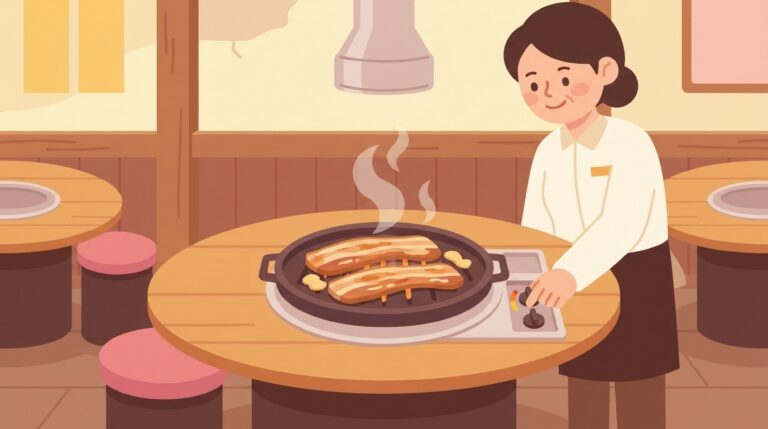
Master K-BBQ Heat Control: How to Ask Staff to Turn Down the Fire Like a Local
Phase 1: Empathy & Real-World Scene
안녕하세요! (Annyeonghaseyo!) I’m your Daily Hangul editor and local culture navigator.
Picture this: You are sitting at a bustling Korean barbecue restaurant in Hongdae on a Friday night. The air is filled with the irresistible aroma of sizzling pork belly and toasted sesame oil. Your stomach rumbles in anticipation. But suddenly, yellow flames leap through the iron grill grate! Thick smoke begins billowing toward the ceiling, and your expensive cuts of samgyeopsal (pork belly) are turning pitch-black right before your eyes. You desperately want to turn the heat down, but the dial under the table looks complicated, or worse, it is a traditional charcoal pit with no visible switches. You see the restaurant staff running past with trays full of side dishes, and your mind goes blank. How do you politely ask for help without causing a scene?
Many of our beginner students panic in this exact situation, freezing up while their dinner burns. This practical guide is crafted directly from student feedback and 10 years of eating out in Seoul. By learning one key phrase today, you will rescue your dinner, gain instant respect from the restaurant staff, and experience the smooth confidence of a true Seoul insider.
Phase 2: Top 3 Core Expressions in Depth
1. 불이 너무 센 것 같은데 조금만 줄여 주세요
- Hangul & English: 불이 너무 센 것 같은데 조금만 줄여 주세요 (The fire seems too strong, so please turn it down a little bit)
- Pronunciation: Bul-i neomu sen geot gateunde jogeum-man jul-yeo juseyo (Sound tip: Bul sounds like “bull”, jul-yeo sounds like “jewel-yeo”)
- Meaning: Literal: “The fire seems very strong, please reduce just a bit.” | Real Nuance: “Excuse me, the grill is getting a bit too hot, could you help us turn down the heat?”
- K-Culture Moment: You will hear this frequently in food variety shows and K-dramas whenever characters grill meat and try to avoid scorching delicate cuts of marinated galbi.
- Editor’s Insight: Notice the ending -ㄴ 것 같은데 (-n geot gateunde, “it seems like”). In Korean social culture, stating a problem directly as an absolute fact (“The fire is too strong!”) can sound demanding. Softening it with “it seems like” makes your request polite, gentle, and cooperative.
- Situation Spectrum: Casual ⚠️ | Semi-formal ✅ | Formal ✅
- 🤔 Think About It: In English, we often say “Could you turn this down?” but Koreans cushion the observation first: “It seems hot, so please…”. How does framing observations as possibilities rather than hard complaints change the mood between customers and staff?
2. 불판 좀 갈아 주세요
- Hangul & English: 불판 좀 갈아 주세요 (Please change the grill pan)
- Pronunciation: Bulpan jom gara juseyo (Sound tip: Bulpan sounds like “bull-pahn”, gara rhymes with “Zara”)
- Meaning: Literal: “Grill pan a little replace please.” | Real Nuance: “Could we get a fresh grill plate, please?”
- K-Culture Moment: Seen in almost every K-BBQ scene, especially after sweet marinades like bulgogi or marinated ribs leave black residue on the metal.
- Editor’s Insight: The word 좀 (jom, literally “a little”) acts as a magic lubricant in Korean requests. Placing jom before a verb instantly removes any pushy tone.
- Situation Spectrum: Casual ⚠️ | Semi-formal ✅ | Formal ✅
- 🤔 Think About It: Why does adding a diminutive word like “a little” (jom) make service requests sound friendlier across diverse cultures?
3. 고기가 타고 있어요
- Hangul & English: 고기가 타고 있어요 (The meat is burning)
- Pronunciation: Gogiga tago isseoyo (Sound tip: Gogi sounds like “go-ghee”, tago sounds like “taco” with a soft ‘t’)
- Meaning: Literal: “Meat is burning.” | Real Nuance: “Help, our meat is getting burned!”
- K-Culture Moment: This is the universal exclamation friends shout across the table in sitcoms right before scrambling to rescue their food.
- Editor’s Insight: Use this when there is genuine urgency. It instantly alerts nearby staff to rush over with tongs and adjust the vent without you having to explain the mechanical details.
- Situation Spectrum: Casual ✅ | Semi-formal ✅ | Formal ⚠️
- 🤔 Think About It: When emergencies happen at a dining table, brief present-continuous sentences (-고 있어요) work faster than long formal explanations.
Phase 3: Textbook Korean vs. Real Korean
Situation 1: Asking to reduce the flame
- 📖 교과서 한국어 (Textbook Korean): 불을 줄이십시오 (Buleul jurisipsio) — “Reduce the fire.”
- 🗣️ 진짜 한국어 (Real Korean): 불이 너무 센 것 같은데 조금만 줄여 주세요 (Bul-i neomu sen geot gateunde jogeum-man jul-yeo juseyo) — “The fire seems a bit strong, could you turn it down a little?”
- 💡 왜 다를까? (Why is it different?): Imperative textbook forms like -십시오 sound like instructions from an instruction manual or a military drill. Real diners soften their requests with polite indirect markers.
Situation 2: Asking for a clean grill grate
- 📖 교과서 한국어 (Textbook Korean): 불판 교체를 요청합니다 (Bulpan gyoche-reul yocheong-hamnida) — “I request a grill plate replacement.”
- 🗣️ 진짜 한국어 (Real Korean): 사장님, 여기 불판 좀 갈아 주세요! (Sajangnim, yeogi bulpan jom gara juseyo!) — “Boss, could you please change our grill pan here?”
- 💡 왜 다를까? (Why is it different?): Real Korean dining relies on warm relational titles like Sajangnim (owner/boss) and natural, active verbs like 갈다 (galda, to swap/replace) rather than Sino-Korean corporate nouns like 교체 (gyoche).
Phase 4: K-Culture Deep Dive & Non-verbal Manners
4-1. 눈치 (Nunchi) & Table Gestures
At a traditional Korean BBQ place, knowing when and how to signal the staff is all about Nunchi (social awareness).
* Look for the Call Button first: Most modern Korean restaurants have a small plastic button (호출벨, hochool-bel) attached to the edge of the wooden table or the tissue dispenser. Press it once with a gentle click. It chimes “ding-dong” and flashes your table number on the kitchen board.
* If there is no button: Do not snap your fingers or yell loudly across the room. Make eye contact with a passing server, raise your hand slightly with your palm facing toward them at shoulder height, and softly call out: “저기요~” (Jeogiyo~, “Excuse me~”) or “사장님~” (Sajangnim~, “Boss~”).
* Don’t touch charcoal controls alone: If you have real charcoal (sutbul), the temperature is controlled by an airflow damper slider on the side of the table or an exhaust hood nozzle above the grill. Touching these without practice can cause ash to fly onto your food. Always let the staff handle it!
4-2. The Soul of Korean Barbecue Culture
In Korea, grilling meat is a collaborative performance. There is an unspoken rule of table camaraderie: one person usually operates the tongs (jipge) and scissors (gawi), while others pour water and arrange side dishes (banchan). Burning the meat is considered a culinary tragedy because high-grade domestic pork (Handon) and beef (Hanwoo) are prized for their juiciness (yukjeup). Asking to adjust the flame is not seen as demanding; rather, servers appreciate guests who care about grilling the meat correctly!
Phase 5: Real-World Roleplay Scenario
Setting: Jongno Sutbul Galbi, an authentic, nostalgic restaurant in central Seoul. Thick smoke vents hang from the ceiling, charcoal embers glow orange, and metal round tables clatter with soju glasses.
Characters:
* You: A hungry traveler visiting Seoul.
* Imo-nim (이모님): Mrs. Park, a warm, brisk restaurant “auntie” wearing a floral apron and wielding heavy grill tongs.
- Turn 1 (Imo-nim): 맛있게 드시고 계세요? 고기 잘 익고 있네요.
(Mas-issge deusigo gyeseyo? Gogi jal ikgo itneyo.)
“Are you enjoying the food? The meat is cooking nicely.”
🎭 Smiles warmly while checking the table with a quick glance -
Turn 2 (You): 네, 정말 맛있어요! 그런데 불이 너무 센 것 같은데 조금만 줄여 주세요.
(Ne, jeongmal mas-isseoyo! Geurende bul-i neomu sen geot gateunde jogeum-man jul-yeo juseyo.)
“Yes, it’s delicious! But the heat seems a bit strong, so please turn it down a little.”
🎭 Points gently toward the flaring edges of the grill -
Turn 3 (Imo-nim): 어머나, 기름이 떨어져서 불이 붙었네! 잠시만요, 환풍기 열어 줄게요.
(Eomeona, gireum-i tteoreojyeoseo bul-i buteotne! Jamsimanyo, hwanpunggi yeoreo julgeyo.)
“Oh my, the pork fat dripped and caught fire! One second, let me adjust the vent for you.”
🎭 Quickly adjusts the airflow lever underneath and shifts the meat to the edge -
Turn 4 (You): 휴, 다행이에요. 고기가 탈 뻔했어요.
(Hyu, dahaeng-ieyo. Gogiga tal ppeonhaesseoyo.)
“Phew, what a relief. The meat almost burned.”
🎭 Exhales with a relieved smile -
Turn 5 (Imo-nim): 불판이 조금 탔으니까 깨끗한 걸로 갈아 줄게요!
(Bulpan-i jogeum taseunikka kkaekkeut-han geollo gara julgeyo!)
“The grill plate is a bit scorched, so I’ll swap it for a clean one!”
🎭 Uses two metal hooks to lift the hot grill plate and slides in a fresh one -
Turn 6 (You): 감사합니다! 불판 갈아 주셔서 훨씬 좋아요.
(Gamsahamnida! Bulpan gara jusyeoseo hwolssin joayo.)
“Thank you! It’s so much better with the clean grill.”
🎭 Gives a polite head nod of appreciation -
Turn 7 (Imo-nim): 이제 약한 불에서 은은하게 구워 드세요. 마늘도 올려 드릴게!
(Ije yak-han bul-eseo euneun-hage guwo deuseyo. Maneul-do ollyeo deurilge!)
“Now grill it gently over low heat. Let me put some garlic slices on the grill for you too!”
🎭 Dumps a small bowl of sliced garlic onto the fresh plate -
Turn 8 (You): 친절하게 도와주셔서 감사합니다, 이모님!
(Chinjeol-hage dowajusyeoseo gamsahamnida, Imo-nim!)
“Thank you for kindly helping us, Imo-nim!”
🎭 Picks up chopsticks with renewed excitement
🔀 Interactive Choice Point
The fat from your pork belly suddenly causes a large flare-up of flames on the grill! What do you do?
- Choice A: Stand up, grab the water pitcher from the table, and pour water onto the charcoal grill to put out the fire yourself.
- Choice B: Press the table bell or make eye contact with the server and say: “저기요, 불이 너무 센 것 같은데 조금만 줄여 주세요!” (Jeogiyo, bul-i neomu sen geot gateunde jogeum-man jul-yeo juseyo!)
- Choice C: Panic quietly, slide all the meat off the grill into your rice bowl, and wait for the flames to burn out naturally.
--- Outcome Feedback ---
- Choice A [HIGH RISK 🚫]: NEVER pour drinking water onto charcoal grills! It creates an explosion of scorching steam and sends hot ash flying over you, neighboring guests, and your food.
- Choice B [BEST ✅]: Perfect! The staff will swiftly adjust the air vent dampers or slide in an ice cube/briquette ring to quell the flames safely without spoiling your meal.
- Choice C [BAD ⚠️]: Your cooked meat will turn cold and greasy in your bowl, and the empty grill plate will smoke heavily, filling the restaurant with burnt fumes.
Phase 6: 10-Second Emotion Shadowing Drill
Practice speaking these phrases with rhythmic pauses (/) and natural emotion!
[🥺 Worried & Polite]
불이 / 너무 센 것 같은데 / 조금만 / 줄여 주세요.
(Bul-i / neomu sen geot gateunde / jogeum-man / jul-yeo juseyo.)
“The fire / seems too strong / just a little bit / please turn it down.”-
[🙋 Confident & Friendly]
사장님, / 여기 / 불판 좀 / 갈아 주세요!
(Sajangnim, / yeogi / bulpan jom / gara juseyo!)
“Boss, / here / the grill plate / please replace!” -
[😊 Relieved & Delighted]
와, / 이제 / 딱 좋아요! / 감사합니다.
(Wa, / ije / ttak joayo! / Gamsahamnida.)
“Wow, / now / it’s just right! / Thank you.”
Phase 7: K-Culture Mini Dictionary
-
불판 (Bulpan)
Translation: Grill pan / barbecue grate.
Insight: Refers to any metal or stone surface used on the table grill. You will frequently hear patrons say “Bulpan gara juseyo” between cooking rounds. -
숯불 (Sutbul)
Translation: Charcoal fire / charcoal embers.
Insight: Signifies authentic wood charcoal dining. Restaurants advertising Sutbul Gui (숯불구이) are known for smoky, premium barbecue flavors. -
이모님 (Imo-nim)
Translation: Auntie (Honorific title for middle-aged female restaurant staff).
Insight: Literally “maternal aunt.” Using Imo-nim instead of cold corporate titles establishes instant, affectionate rapport in casual Korean eateries. -
육즙 (Yukjeup)
Translation: Meat juices / succulence.
Insight: A treasured culinary buzzword in Korea. Cooking meat at the right temperature ensures you preserve the yukjeup, avoiding dry or leathery cuts.
Phase 8: Traveler’s Survival Kit
Top 3 Survival Phrases for K-BBQ
- 불 좀 줄여 주세요 (Bul jom jul-yeo juseyo) — “Please turn down the fire a bit.”
Pro Tip: The ultra-short version of today’s core expression for when you need help fast. - 불판 갈아 주세요 (Bulpan gara juseyo) — “Please change the grill plate.”
Pro Tip: Always ask for this before putting fresh, unseasoned meat on a grill that previously had sweet marinade. - 삼겹살 2인분 더 주세요 (Samgyeopsal i-inbun deo juseyo) — “Please give us 2 more portions of pork belly.”
Pro Tip: Most BBQ joints require meat orders in portions called inbun (인분).
Editor’s Travel Note
- Finding Authentic BBQ Spots: Don’t rely on generic search engines when hunting for Seoul’s best meat spots. Use the localized Naver Map app navigation to search for “숯불 삼겹살 맛집” (sutbul samgyeopsal matjib). Look for spots with high review counts and check recent visitor photos to verify table grill quality!
- Payment & Tipping: There is zero tipping culture in South Korea. The price on the menu includes all services, side dish refills, and grill replacements.
Phase 9: Step Deeper (Cultural Reflection)
In Korean communication, certainty is often softened to show respect for the person you are speaking with. By saying -는 것 같아요 (“it seems like…”) instead of a direct declaration, you leave room for harmony and mutual agreement. In a shared dining space, treating the restaurant staff as partners in your meal creates an atmosphere of warm hospitality known as Jeong (정). When you soften your speech at the dining table, you aren’t just ordering food; you are participating in a communal culinary tradition.
💬 Your Turn: In your home culture, do you usually adjust restaurant equipment yourself, or do you always call a server? Share your favorite dining etiquette differences in the comments below!
Phase 10: FAQ & Common Mistakes
Q: Can I manually turn the knobs under the BBQ table myself?
A: If it is an electric or simple portable gas stove (부르스타, bureusuta), gently turning the front dial is totally fine. However, if the table has built-in gas with a complex safety ignition or uses real charcoal embers (sutbul), always ask the staff. Charcoal systems use vacuum exhaust vents that can spark if adjusted improperly.
Q: How many times can I ask to change the grill plate (bulpan)?
A: As many times as needed! There is no extra charge for changing the grill plate in South Korea. Staff actually prefer changing it so their meat tastes good and their tables do not smoke excessively.
Q: What is the polite title to call male servers in a BBQ place?
A: If the staff member is a younger man, call him 저기요 (Jeogiyo, “Excuse me”) or 직원분 (Jig-won-bun). For a middle-aged or senior man, use 사장님 (Sajangnim, “Boss/Owner”). Avoid using casual slang like Hyeong or Oppa with staff.
🚨 Common Mistakes Board
- Mistake 1: Grabbing the table water bottle to douse grill flames.
Correct Action: Never pour liquid onto the grill! Move the meat to the edge of the grill and alert the staff: “불이 너무 세요!” (Bul-i neomu seyo!). - Mistake 2: Flipping the meat every five seconds out of nervousness.
Correct Action: Let the bottom sear golden brown before flipping so the meat stays juicy and doesn’t stick to the cold grill. - Mistake 3: Cutting raw meat immediately after it lands on the grill.
Correct Action: Raw pork and beef are tough to cut with scissors. Wait until the meat is halfway cooked and firm before slicing it into bite-sized strips.
Phase 11: Action Missions & Community Engagement
- 🥉 Bronze Mission (Solo Shadowing): Stand in front of your mirror and repeat “불이 너무 센 것 같은데 조금만 줄여 주세요” 5 times with a gentle smile and a slight hand gesture.
- 🥈 Silver Mission (Social Share): Snap your next barbecue meal, post it on your Instagram or Threads, and caption it with your new vocabulary: #불판 (#bulpan) and #삼겹살 (#samgyeopsal)!
- 🥇 Gold Mission (Live Action): Visit a local Korean restaurant this weekend. Press the call bell or politely address the server using “사장님, 불판 좀 갈아 주세요!” to request a fresh grill.
- 🎮 K-Culture Mission: Watch an episode of a foodie K-drama (like Let’s Eat or Weightlifting Fairy Kim Bok-joo). Count how many times the characters ask for more meat or interact with the grill staff!
Phase 12: Interactive Quiz Challenge
Test your real-world K-BBQ fluency! Select your answers before revealing the solution toggles.
Q1. Situation Judgment
Your pork belly is starting to burn over high heat, and your grill plate is covered in black residue. What is the most natural, polite phrase to address the staff?
* (A) 불 꺼라! (Bul kkeora!)
* (B) 불이 너무 센 것 같은데 불판 좀 갈아 주세요. (Bul-i neomu sen geot gateunde bulpan jom gara juseyo.)
* (C) 물을 불판에 부어 주세요. (Muleul bulpane bueo juseyo.)
Q2. Fill-in-the-Blank
Complete the sentence to politely ask the server to reduce the heat:
“불이 너무 센 것 같은데 조금만 ______ 주세요.”
* (A) 먹어 (meogeo)
* (B) 줄여 (jul-yeo)
* (C) 닫아 (dada)
Q3. True or False Cultural Quiz
True or False: In Korean barbecue restaurants, guests are expected to clean and wipe the burnt grill plates with napkins before leaving the restaurant.
👉 Click to reveal answers & explanations!
- Q1 Answer: (B)
Explanation: (B) combines the polite softening grammar (-ㄴ 것 같은데) with the natural request for a new grill (불판 좀 갈아 주세요). Option (A) is rude, informal speech, and Option (C) instructs someone to pour water onto the fire, which is dangerous! - Q2 Answer: (B) 줄여 (jul-yeo)
Explanation: The base verb 줄이다 (jurida) means “to reduce/lower”. In the polite imperative form with -어 주세요, it becomes 줄여 주세요 (jul-yeo juseyo). - Q3 Answer: False
Explanation: You should never wipe the hot metal grates with paper napkins (they can melt or catch fire). Restaurant staff collect the grates and wash them with specialized equipment.
🎬 Watch Our Daily Videos! (Daily Hangul Official Instagram)
Review the expressions you learned in this article with our fun daily short videos! Check out native pronunciation and real-life nuances in action.
- Instagram @dailyhangul_en







