

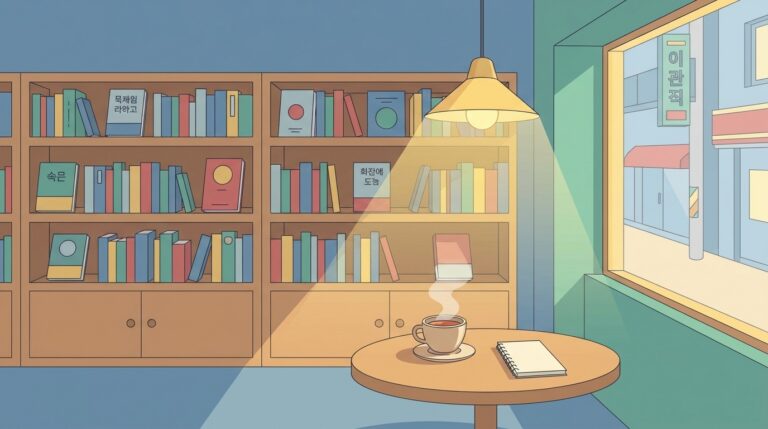
Finding Comfort in the Ordinary: How to Share Personal Essays at a Korean Indie Book Talk
Phase 1: Empathy (Immersive Story Opening)
안녕하세요! 매일한글 에디터입니다.
Picture this: It is a rainy Friday evening in a tucked-away alley of Mangwon-dong, Seoul. You push open the creaky wooden door of a neighborhood indie bookstore (dongne chaekbang). The aroma of roasted barley tea and aged paper greets you. Around a communal oak table lit by a soft lamp, seven people sit clutching handmade zines. The author, who recently published a memoir about quitting a corporate marketing job to document neighborhood stray cats, reads a passage aloud. Someone whispers, “완전 제 얘기 같아요 (Wanjeon je yaegi gat-ayo – That sounds completely like my story).”
Then, the gaze shifts warmly around the circle. It is your turn to share. Your heart starts pounding. You think, Is my story about missing my grandmother’s kimchi jjigae too mundane? Shouldn’t I discuss grand literary themes? In Korea’s vibrant independent publishing and essay scene, the answer is a resounding no. The hyper-competitive pace of modern Korean society has created an immense craving for the quiet, raw, and intimately mundane. The most personal confessions—navigating post-resignation burnout, cataloging neighborhood alley cats, or deciphering an heirloom soup recipe—are precisely what strike the deepest chord.
Many of our intermediate (B2) learners tell us they feel trapped between stiff academic phrases and superficial textbook small talk. This guide is crafted directly from real workshop feedback gathered across Seoul’s independent literary spaces. By the end of this guide, you will possess the emotional vocabulary, non-verbal etiquette, and conversational nuance to share your inner world authentically in Korean.
Phase 2: Core Expressions Deep Dive
1. 지극히 개인적인 이야기 (Jigeukhi gaeinjeogin iyagi)
- Pronunciation: [Ji-geuk-hi gae-in-jeok-in i-ya-gi] (Sounds like “jee-geuk-hee” with a light breath on the ‘h’, followed by “geh-in-jeok-in ee-ya-gee”)
- Meaning: “An intimately personal story” (Literal: “An extremely personal tale”).
- K-Culture Moment: Frequently used by indie essayists on platforms like Brunch or during book talks at independent bookstores in Yeonnam-dong when explaining why they wrote about daily mundanities rather than grand achievements.
- Editor’s Insight: 지극히 (jigeukhi) carries a much more contemplative, sincere weight than everyday adverbs like 너무 (neomu) or 진짜 (jinjja). Pairing it with 개인적인 이야기 demonstrates emotional maturity and vulnerability.
- Situation Spectrum: Casual ⚠️ | Semi-formal ✅ | Formal ✅
- 🤔 Think About It: In your native culture, do people value vulnerability in public writing groups, or is there pressure to sound authoritative? Why do you think modern Koreans seek comfort in hyper-specific personal narratives?
2. 잔잔한 위로를 받다 (Janjanhan wiro-reul batda)
- Pronunciation: [Jan-jan-han wi-ro-reul bat-da] (Pronounce “jan-jan-han” softly like raindrops pattering on a window pane, “wee-ro-reul baht-dah”)
- Meaning: “To receive quiet, gentle comfort” (Opposed to loud encouragement or dramatic cheering).
- K-Culture Moment: Often featured in book reviews of calming bestsellers like I Want to Die but I Want to Eat Tteokbokki or reflections on slice-of-life healing dramas like My Liberation Notes.
- Editor’s Insight: Korean has many words for solace, but 잔잔한 위로 evokes calm water without ripples. It describes the comfort that doesn’t preach or give unsolicited advice (kkondae behavior), but simply sits beside you.
- Situation Spectrum: Casual ✅ | Semi-formal ✅ | Formal ✅
- 🤔 Think About It: How does “quiet comfort” differ from “cheering someone up” in your language? Does your native tongue have a single adjective that blends calmness with consolation?
3. 마음 한구석이 몽글몽글해지다 (Maeum hanguseogi monggeul-monggeulhaejida)
- Pronunciation: [Ma-eum han-gu-seok-i mong-geul-mong-geul-hae-ji-da] (Roll “mong-geul-mong-geul” in your mouth like soft, freshly steamed dumplings)
- Meaning: “To feel a warm, fuzzy softness in a corner of one’s heart”.
- K-Culture Moment: A sensational mimetic phrase across Korean social media, book clubs, and vlog voiceovers when witnessing wholesome moments—like an elderly couple sharing an umbrella or a stray cat sleeping in a sunlit patch.
- Editor’s Insight: 몽글몽글 (monggeul-monggeul) mimics something soft, puffy, and cloud-like. It elevates your Korean from textbook grammar to vivid, native-level emotional expression.
- Situation Spectrum: Casual ✅ | Semi-formal ✅ | Formal ⚠️
- 🤔 Think About It: Onomatopoeia and mimetic words (uiseong-eo / uitae-eo) are central to Korean emotional expression. What physical sensations does your culture associate with tenderness?
Phase 3: Textbook Korean vs. Real Korean
Situation 1: Telling an author that their mundane story felt like your own
- 📖 교과서 한국어 (Textbook Korean):
“이 책은 저에게 깊은 감명을 주었습니다.”
(I chaeg-eun jeo-ege gipeun gammyeong-eul jueossseumnida. / This book gave me a deep impression.) - 🗣️ 진짜 한국어 (Real Korean):
“읽는 내내 완전 제 얘기 같아서 코끝이 찡했어요.”
(Ilngneun naenae wanjeon je yaegi gat-aseo kokkeuchi jjinghaesseoyo. / The whole time I was reading, it felt so much like my own story that my nose prickled with tears.) - 💡 왜 다를까? (Why is it different?):
“깊은 감명을 주다” sounds like an academic essay review written in 1995. Real book talk attendees use somatic, bodily metaphors like 코끝이 찡하다 (the prickling sensation in the nose right before crying) to convey genuine resonance.
Situation 2: Explaining why everyday diaries bring relief
- 📖 교과서 한국어 (Textbook Korean):
“사소한 일상이 매우 가치 있습니다.”
(Sasohan ilsang-i maeu gachi itseumnida. / Trivial daily life is very valuable.) - 🗣️ 진짜 한국어 (Real Korean):
“이런 소소한 일상이 주는 힘이 생각보다 되게 크더라고요.”
(Ireon sosohan ilsang-i juneun him-i saenggakboda doege keudeoragoyo. / The strength that these small, ordinary moments provide is actually so much bigger than I thought.) - 💡 왜 다를까? (Why is it different?):
사소하다 carries a slight nuance of “negligible or petty.” Modern speakers favor 소소하다 (small, simple, modest) combined with retrospective experiential endings like -더라고요 (-deoragoyo), which makes personal insights sound humble rather than self-righteous.
Phase 4: K-Culture Deep Dive & Non-Verbal Manners
4-1. 눈치 (Nunchi) & Etiquette in Korean Book Clubs
In an indie book talk or writing circle (geulsseugi mo-im), the spatial dynamic is intentionally compact. Emotional vulnerability requires specific non-verbal mindfulness:
* The Empathetic Gaze: Do not stare unblinkingly into someone’s eyes while they confess struggles like burnout or loneliness; it feels interrogative. Instead, cast your gaze slightly downward toward your notebook or tea cup, nodding slowly (kkeudeok-kkeudeok).
* Two-Handed Beverage Hold: When listening intently, hold your mug with both hands close to your chest. This body language signals emotional openness and warmth.
* The Soft Inhaled Reaction: Instead of loudly interjecting “Oh no!” or “Right!”, softly draw in a quick breath through your teeth with a gentle “아… (Ah…)” or “맞아요… (Maj-ayo…)”. It validates the speaker without derailing their rhythm.
4-2. Cultural Code: The Rise of Independent Zines & “Micro-Comfort”
Why are books about cat-watching and grandma’s culinary tips dominating Hongdae and Euljiro bookshops? In South Korea’s fast-paced society, traditional milestones (marriage, home ownership, corporate promotions) have generated collective psychological exhaustion. Independent publishing (dongnip chulpan) emerged as a cultural sanctuary. Readers no longer seek grandiose life lectures from celebrated professors; they crave 공감 (gonggam – empathetic resonance) from someone who is stumbling through life just like them. When you share your own humble writing, you are participating in a major healing counter-culture.
Phase 5: Real-World Roleplay Scenario
Setting: Dal-baeng-i Seojae (Snail Study), a subterranean independent bookstore in Mangwon-dong. Rain patters against the street level transom window. Warm jazz plays softly.
Characters:
* 민지 (Minji): Author and host. Quitted a design firm last year; published an essay titled My Alley Cat Chronicles.
* You (학습자): An intermediate Korean speaker attending your first Korean essay reading circle.
- 민지: 이번 챕터는 제가 퇴사하고 매일 길고양이 밥을 챙겨주며 썼던 일기예요. 너무 사소해서 책에 넣을지 고민했거든요.
(Ibeon chaepteo-neun jega toesa-hago maeil gilgoyangi bab-eul chaenggyeojumyeo sseotdeon ilgi-yeyo. Neomu sasohaeseo chaege neoheulji gominhaetgeodeunyo.)
“This chapter is a diary I kept while feeding stray cats every day after quitting my job. I hesitated to include it because it felt so trivial.”
🎭 Smiles bashfully, gently stroking the edge of her paperback book. -
You: 아니에요, 작가님. 지극히 개인적인 이야기인데도 오히려 마음 깊이 와닿았어요.
(Anieyo, jakganim. Jigeukhi gaeinjeogin iyagi-indedo ohiryeo maeum gipi wada-asseoyo.)
“Not at all, writer-nim. Even though it is an intimately personal story, it resonated deep inside my heart all the more.”
🎭 Leans forward slightly, speaking in a warm, subdued tone. -
민지: 어머, 정말요? 어떤 부분에서 그렇게 느끼셨어요?
(Eomeo, jeongmalyo? Eotteon bubun-eseo geureohge neukkisyeosseoyo?)
“Oh, really? Which part made you feel that way?”
🎭 Tilts her head with genuine curiosity and a relieved smile. -
You: 비 오는 날 처마 밑에 웅크린 고양이를 보며 느끼셨던 불안감이요. 저도 한국에 처음 왔을 때 그랬거든요.
(Bi oneun nal cheoma mite ungkeurin goyang-ireul bomyeo neukkisyeotdeon buran-gam-iyo. Jeodo hangug-e cheoeum wasseul ttae geuraetgeodeunyo.)
“The anxiety you felt watching the cat huddled under the eaves on a rainy day. I felt the exact same way when I first arrived in Korea.”
🎭 Places a hand over your heart with a subtle, nostalgic nod. -
민지: 맞아요. 남들 눈엔 그냥 길고양이일 뿐인데, 그 순간엔 꼭 거울 속 내 모습 같더라고요.
(Maj-ayo. Namdeul nun-en geunyang gilgoyangi-il ppun-inde, geu sungan-en kkok geoul sok nae moseup gatdeoragoyo.)
“Exactly. To others, it’s just an alley cat, but in that moment, it felt just like seeing myself in the mirror.”
🎭 Exhales softly, her eyes crinkling in deep shared understanding. -
You: 글을 읽는 내내 마음 한구석이 몽글몽글해지면서 큰 위로를 받았어요.
(Geureul ilngneun naenae maeum hanguseogi monggeul-monggeulhaejimyeonseo keun wiro-reul bad-asseoyo.)
“While reading the piece, a corner of my heart turned warm and fuzzy, and I received such comfort.”
🎭 Glances around the circle; the other attendees nod in agreement. -
민지: 그렇게 말씀해 주시니 제가 책을 낸 보람이 있네요. 혹시 참여자분께서도 요즘 쓰고 계신 사소한 이야기가 있나요?
(Geureohge malsseumhae jusini jega chaegeul naen boram-i itneyo. Hoksi cham-yeojabunkkeseodo yojeum sseugo gyesin sasohan iyagiga itnayo?)
“Hearing you say that makes publishing this book so worthwhile. Do you happen to have a small story you are writing these days?”
🎭 Invites you into the conversation with open palms. -
You: 네, 저도 할머니의 된장찌개 레시피를 복원하면서 겪은 방황기를 짧게 끄적여보고 있어요.
(Ne, jeodo halmeoni-ui doenjangjjigae resipi-reul bogwonhamyeonseo gyeokkeun banghwanggi-reul jjalpge kkeujeogyeobogo isseoyo.)
“Yes, I’ve also been jotting down a short reflection about my own wandering phase while trying to recreate my grandmother’s soybean paste stew recipe.”
🎭 Opens your handwritten notebook with a confident, humble smile.
🔀 Interactive Branching Moment
Minji looks delighted and says: “할머니의 된장찌개요? 제목만 들어도 눈물 날 것 같아요! 어떤 마음으로 쓰기 시작하셨어요?” (Grandmother’s stew? Just hearing the title brings tears! With what feeling did you begin writing?)
- Option A: “그냥 배고파서 썼는데요. 별생각 없었어요.” (Geunyang baegopaseo sseotneundeyo. Byeolsaenggak eopseosseoyo. / I just wrote it because I was hungry. I didn’t think much of it.)
- Option B: “할머니 손맛을 흉내 내다 보니까, 타국 생활의 외로움이 조금씩 옅어지는 기분이 들더라고요.” (Halmeoni sonmaseul hyungnae naeda bonikka, taguk saenghwal-ui oeroumi jogeumssik yeoteojineun gibuni deuldeoragoyo. / Trying to imitate my grandmother’s cooking, I felt the loneliness of living abroad slowly fade away.)
- Option C: “된장찌개는 한국의 전통 발효 식품으로서 영양학적 가치가 매우 뛰어납니다.” (Doenjangjjigaeneun hanguk-ui jeontong balhyo sikpum-eoroseo yeongyanghakjeok gachiga maeu ttwieonamnida. / Doenjang stew is a traditional Korean fermented food that has superior nutritional value.)
Feedback:
* Choice A (Risk): While self-deprecating humor is appreciated, shutting down the emotional thread dismisses the vulnerability the group just cultivated.
* Choice B (Best): Perfect! It bridges sensory memory (grandma’s cooking) with emotional introspection (loneliness in a foreign country), hitting the exact aesthetic of contemporary Korean personal essays.
* Choice C (Bad): Sounds like a Wikipedia entry or a food science presentation! In a literary book talk, emotional truth always trumps factual data.
Phase 6: 10-Second Emotional Shadowing Drill
Read each sentence aloud, respecting the rhythm breaks marked by / and embodying the emotional stage direction.
[🥺 덤덤하지만 가슴 찡하게 / Understated yet touching]
남들에게는 / 사소해 보일지 몰라도, / 저에겐 참 눈물겨운 순간이었어요.
(Namdeul-egeneun / sasohae boilji mollado, / jeo-egen cham nunmulgyeoun sungan-ieosseoyo.)
“It might look trivial to others, / but to me, / it was a moment close to tears.”-
[🌿 담담하게 위로를 건네며 / Calmly delivering quiet solace]
완벽하지 않아도 괜찮다는 말이 / 그날따라 / 잔잔한 위로로 다가왔어요.
(Wanbyeokhaji anado gwaenchanta-neun mari / geunalttara / janjanhan wiro-ro dagawasseoyo.)
“The reassurance that it’s okay not to be perfect / felt especially on that day / like a gentle comfort.” -
[☕ 따뜻하고 벅찬 감정으로 / Warm and emotionally full]
책장을 덮고 나니 / 마음 한구석이 / 몽글몽글 따뜻해지더라고요.
(Chaekjang-eul deopgo nani / maeum hanguseogi / monggeul-monggeul ttatteuthaejideoragoyo.)
“After closing the book, / a corner of my heart / turned soft, fuzzy, and warm.”
Phase 7: K-Culture Mini Dictionary
- 독립출판 (Dongnipchulpan) | Independent Publishing
- Meaning: Bypassing major commercial publishers to self-print, bind, and distribute books directly through indie bookstores or platforms like Tumblbug. It symbolizes raw creative autonomy.
- 소확행 (Sohwakhaeng) | Small but Certain Happiness
- Meaning: Derived from Haruki Murakami’s essay, this term became a mega-trend in Korea. It celebrates finding joy in simple acts—like peeling a tangerine under warm covers or listening to rain while sipping coffee.
- 공감대 (Gonggamdae) | Common Ground / Band of Empathy
- Meaning: Refers to an emotional bridge connecting different people through shared life experiences. Used in phrases like “공감대를 형성하다” (to build mutual empathy).
- 힐링 에세이 (Hilling ese-i) | Healing Essay
- Meaning: A wildly popular Korean publishing genre centered on self-acceptance, coping with burnout, quiet solitude, and gentle human relationships.
Phase 8: Traveler’s Survival Kit
Top 3 Survival Phrases for Bookstore Visits
- “혹시 이 책갈피나 굿즈도 같이 구매할 수 있나요?”
(Hoksi i chaekgalpina gutjeudo gachi gumaehal su itnayo?)
“Could I possibly purchase this bookmark or merchandise as well?”
Pro Tip: Indie bookshops often produce limited-edition brass bookmarks, fabric book covers, or risograph postcards that make incredible keepsakes. - “오늘 진행하는 북토크에 현장 참여 가능한가요?”
(Oneul jinhaenghaneun buktokeu-e hyeonjang cham-yeo ganeunghangayo?)
“Is it possible to join today’s book talk on-site as a walk-in?”
Pro Tip: Most book talks require advance Naver reservations, but last-minute cancellations (no-show) frequently open up one or two spots. - “사장님, 요즘 이 책방에서 가장 사랑받는 에세이 한 권만 추천해 주시겠어요?”
(Sajangnim, yojeum i chaekbang-eseo gajang sarangbanneun ese-i han gwonman chucheonhae jusigesseoyo?)
“Owner-nim, could you recommend just one essay that is most beloved in this bookstore lately?”
Pro Tip: Bookstore owners love this thoughtful question; it builds instant rapport.
Editor’s Travel Note: Indie Bookstore Hopping
- Essential Navigation: Avoid Google Maps in Korea as it lacks walking path accuracy. Instead, use the Naver Map app download to search for “독립서점” (independent bookstore) or “동네책방” (neighborhood bookshop).
- Where to Go: Visit Seochon (near Gyeongbokgung) for poetic, contemplative bookshops, or Mangwon-dong for artsy, cozy essay-heavy spots.
- Payment Manners: Many neighborhood bookstores are run by solo proprietors. While credit cards are widely accepted, using a domestic debit card or local simple pay options is always appreciated for small purchases under 5,000 KRW.
Phase 9: “한 발 더 깊이” (One Step Deeper: Thought Reflection)
Why does a society known for high-speed tech and hyper-efficiency produce millions of readers who weep over essays about feeding alley cats or boiling soybean paste stew? In Korean culture, the concept of 정 (Jeong)—the invisible sticky affection binding people together—has historically been rooted in collective neighborhood life. As rapid urbanization led to apartment living and isolated single-person households (il-in gagu), this everyday warmth eroded. Reading and writing personal essays at an independent bookstore is not merely a leisure activity; it is a quiet, collective ritual to reconstruct Jeong on a micro-scale.
💬 Your Turn: What is one tiny, ordinary moment from your daily life in your home country—or during your stay in Korea—that brought you unexpected comfort? Tell us in the comments using at least one phrase you learned today!
Phase 10: FAQ & Common Mistakes
Q: Can a non-native Korean speaker really join a local neighborhood book talk without causing awkwardness?
A: Absolutely! Korean indie book spaces pride themselves on inclusivity and warmth. As long as you listen actively and respect the quiet atmosphere, attendees and authors find foreign perspectives on everyday Korean life utterly fascinating and deeply moving.
Q: What is the difference between 사소하다 (sasohada) and 소소하다 (sosohada)?
A: While dictionaries list them similarly, 사소하다 carries a connotation of being “trivial, minor, or insignificant” (sometimes slightly negative, as in 사소한 말다툼 – petty argument). 소소하다, on the other hand, carries a positive, cozy warmth meaning “modest, small, and pleasantly unpretentious” (as in 소소한 행복 – small happiness).
Q: Should I use formal 존댓말 (jondaenmal) or informal 반말 (banmal) when writing my personal essay in Korean?
A: When writing essays meant for readers, the standard literary style is actually the neutral plain form (해라체 / -다, -었다), which reads like a thoughtful internal monologue. However, when speaking about your essay in a book talk circle, always address the group using polite 해요체 (-haeyo) or formal 하십시오체 (-hasipsio).
🚨 Common Mistakes Alert
- Overusing “감동받았어요” (Gamdongbad-asseoyo): While not grammatically wrong, repeating “I was so moved” sounds generic.
- Correct Action: Say “마음 깊이 와닿았어요” (It touched the depths of my heart) or “여운이 오래 남아요” (The lingering resonance stays with me for a long time).
- Calling an essay author “선생님” in a casual indie space: While polite, calling a young zine author 선생님 creates unnecessary social distance.
- Correct Action: Use “작가님” (Jakganim – Writer-nim), which is both respectful and community-friendly.
- Dismissing your own stories as “재미없다” (boring): Learners often say “제 이야기는 재미없지만…”. In Korean essay culture, vulnerability is valued over excitement.
- Correct Action: Say “지극히 평범한 이야기이지만…” (Although it’s an extremely ordinary story…).
Phase 11: Action Mission & Engagement
- 🥉 Bronze Mission (Solo Practice): Write a 3-sentence diary entry in your notebook about something tiny that happened today (e.g., finding your favorite snack in stock, watching autumn leaves fall) using the phrase “소소한 일상”.
- 🥈 Silver Mission (Social Share): Snap a photo of your favorite Korean book or a cozy cafe table, post it on Instagram or Threads, and write: “오늘 마음 한구석이 몽글몽글해지는 책을 발견했어요. 🌿”
- 🥇 Gold Mission (Real-world Challenge): Walk into an independent bookstore in Korea (or browse an indie bookstore’s Instagram account online), leave a comment for a local author, or attend a weekend book reading event!
🎮 K-Culture Detective Mission: Search the hashtag #독립출판 or #동네책방 on Instagram. Find one indie book title that features an animal, food, or daily routine, and analyze why that humble topic resonated with readers!
Phase 12: Interactive Quiz Challenge
1. Situation Judgment Quiz
You are sitting in an intimate 6-person writing club in Seochon. A participant shares an essay about struggling with feeling like a failure after leaving their job. Which response demonstrates the best emotional etiquette and natural Korean phrasing?
* (A) “왜 퇴사하셨어요? 요즘 취업 시장이 힘든데 참 안타깝네요.”
* (B) “저도 비슷한 방황기를 겪어서 그런지, 글을 듣는 내내 잔잔한 위로를 받았어요.”
* (C) “다음에는 성공한 사람들의 자기계발서를 읽어보시는 것을 추천합니다.”
2. Fill-in-the-Blank Quiz
Complete the sentence to convey a warm, fuzzy feeling in your heart:
“할머니가 손수 적어주신 삐뚤빼뚤한 요리 쪽지를 발견하고는 마음 한구석이 (___________)해졌어요.”
* Hints: [몽글몽글 / 헐레벌떡 / 티격태격]
3. True / False Cultural Insight
- Q: In contemporary Korean indie publishing, writing about hyper-specific, mundane private life events is considered self-indulgent and generally avoided by readers.
(True / False)
Click here to reveal the answers and explanations!
- Answer: (B)
- Explanation: Choice (B) honors the speaker’s vulnerability with 잔잔한 위로 without judging their career choices (unlike A) or giving unwanted life lectures (kkondae advice like C).
- Answer: 몽글몽글
- Explanation: 몽글몽글 captures that tender, warm, cloud-like feeling in your chest. 헐레벌떡 means in a frantic rush, and 티격태격 means bickering playfully.
- Answer: False
- Explanation: Completely false! The core appeal of modern Korean independent publishing and essays lies precisely in hyper-personal, raw, mundane vulnerability, which counters the crushing pressures of perfectionism.
- Explanation: Completely false! The core appeal of modern Korean independent publishing and essays lies precisely in hyper-personal, raw, mundane vulnerability, which counters the crushing pressures of perfectionism.
🎬 Watch Our Daily Videos! (Daily Hangul Official Instagram)
Review the expressions you learned in this article with our fun daily short videos! Check out native pronunciation and real-life nuances in action.
- Instagram @dailyhangul_en







