

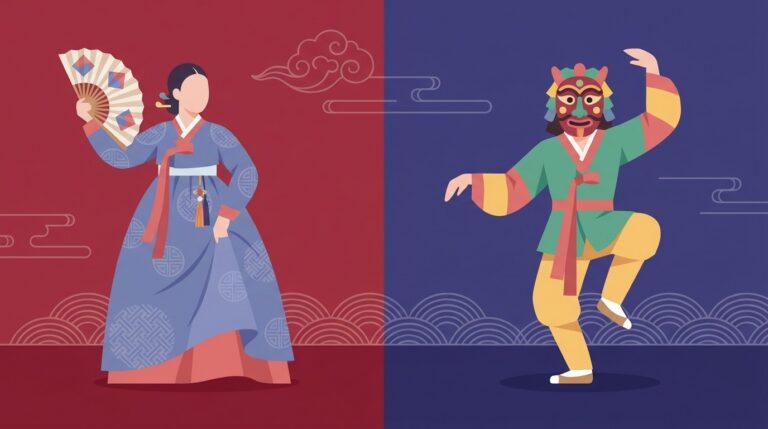
안녕하세요! 매일한글 에디터입니다.
Have you ever watched an episode of Mr. Sunshine, Jeongnyeon: The Star Is Born, or even a gritty dark comedy by Bong Joon-ho, and found yourself laughing out loud just seconds after wiping away hot tears? If you have, you didn’t just witness dramatic mood swings—you tasted the philosophical marrow of traditional Korean performing arts. Many advanced learners tell me, “Teacher, when I listen to Simcheongga or watch Bongsan Talchum, the hero will be wailing in wretched poverty, and suddenly a clown drops an absurd joke about flatulence or corrupt officials! Isn’t that emotionally contradictory?”
It feels contradictory only if you evaluate it through classical Western poetics, where tragedy and comedy are segregated into distinct theatrical realms. In the Korean worldview, however, pure, unmitigated grief is suffocating. To survive historical hardships, our ancestors mastered the alchemy of intertwining bijangmi (비장미, tragic pathos) with golgyemi (골계미, comic satire). They did not laugh because they forgot their agony; they laughed precisely so that their agony wouldn’t swallow them whole. In this C2 masterclass, we will delve into the lexical tapestry and cultural psychology behind this aesthetic genius, enabling you to articulate and debate high-level artistic nuances like a native literary critic.
Phase 2: Core Expressions Deep Dive
1. 슬픔을 웃음으로 승화시키다 (Seulpeumeul useumeuro seunghwasikida)
- Pronunciation: [Seul-peu-meul u-seu-meu-ro seung-hwa-si-ki-da] (Think of seung-hwa like a gentle chime ascending upward into the sky).
- Meaning: Literally “to sublimate sorrow into laughter.” Nuance: Transforming visceral pain, historical trauma, or personal grief into transcendent, life-affirming humor.
- K-Culture Moment: Used by cultural critics analyzing masterpieces like Jeongnyeon: The Star Is Born or classic Pansori epics like Heungbuga, where devastating hunger is immediately followed by self-deprecating banter.
- Editor’s Insight: The Sino-Korean verb seunghwa (昇華) is purely C2—it denotes physical chemical sublimation (solid directly to gas) applied to spiritual maturity. It implies overcoming despair rather than merely repressing it.
- Situation Spectrum: Casual ⚠️ | Semi-formal ✅ | Formal ✅
- 🤔 Think About It: In your native culture, is intense mourning treated with solemn silence, or is satirical humor welcomed as a coping mechanism at the crossroads of tragedy?
2. 뼈 때리는 해학과 풍자 (Bpyeo ttaerineun hae-hak-gwa pung-ja)
- Pronunciation: [Bpyeo ttae-ri-neun hae-hak-gwa pung-ja] (Bpyeo snaps briskly like bone; hae-hak glides soft and warm).
- Meaning: Literally “Bone-hitting humor and satire.” Nuance: Searing, profoundly insightful social commentary wrapped in rustic wit that pierces through the listener’s core.
- K-Culture Moment: Frequently invoked in historical drama reviews when a commoner character playfully mocks a corrupt nobleman (yangban) during a communal mask dance (Talchum).
- Editor’s Insight: While pungja (풍자/諷刺) sharpens the blade of political critique, haehak (해학/諧謔) cushions the blow with unconditional human warmth. Koreans rarely deploy mockery without underlying affection for humanity.
- Situation Spectrum: Casual ✅ | Semi-formal ✅ | Formal ✅
- 🤔 Think About It: Why do you think disenfranchised commoners throughout Joseon history chose masked theatrical satire over violent revolt to confront the ruling class?
3. 비장미와 골계미가 절묘하게 교차하다 (Bijangmiwa golgyemiga jeolmyohage gyo-chahada)
- Pronunciation: [Bi-jang-mi-wa gol-gye-mi-ga jeol-myo-ha-ge gyo-cha-ha-da] (Rhythmic cadence matching the beat of the traditional drum, buk).
- Meaning: Literally “Tragic grandeur and comic farce intersect exquisitely.” Nuance: Highlighting the seamless aesthetic oscillation between devastating emotional catharsis and gut-busting comic relief.
- K-Culture Moment: High-brow academic roundtables discussing how Bong Joon-ho balances destitute tragedy with surreal slapstick in Parasite.
- Editor’s Insight: Bijangmi elevates the soul through noble endurance of suffering, whereas golgyemi dismantles aristocratic hierarchy by revealing universal human absurdity. When these two harmonize, it defines the zenith of Korean dramaturgy.
- Situation Spectrum: Casual 🚫 | Semi-formal ✅ | Formal ✅
- 🤔 Think About It: Does modern K-content achieve global resonance because it refuses to let viewers settle into either purely tragic or purely comic complacency?
Phase 3: Textbook Korean vs. Real Korean
Situation 1: Critiquing a tragic scene laced with hilarious moments
- 📖 Textbook Korean: 이 연극은 매우 슬픈 상황이지만 관객을 웃게 만드는 유머가 포함되어 있습니다. (I yeongeugeun maeu seulpeun sanghwang-ijiman gwangaegeul utge mandeuneun yumeoga pohamdoeeo itseumnida. – “This play is a very sad situation, but it includes humor that makes the audience laugh.”)
- 🗣️ Real Korean (C2): 단순한 신파를 넘어서, 처절한 비극 속에서도 기어코 해학을 터뜨리는 연출이 실로 압권이네요. (Dansunhan sinpareul neomeoseo, cheojeolhan bigeuk sogeseodo gieoko haehageul teotteurineun yeonchuri sillo ap-gwon-ineyo. – “Transcending mundane melodrama, the directorial choice to obstinately detonate witty humor amidst raw tragedy is truly sensational.”)
- 💡 Why the difference? Advanced Korean speakers eschew bland adjectives like 슬프다 (sad) or 웃기다 (funny), opting instead for conceptual terms like 신파 (cheap tear-jerker) and evocative dynamic verbs like 해학을 터뜨리다 (detonate humor).
Situation 2: Commenting on the resilience of commoners in historical media
- 📖 Textbook Korean: 옛날 서민들은 힘든 삶을 유머러스한 태도로 극복했습니다. (Yennal seomindeureun himdeun salmeul yumeoreoseuhan taedoro geukbokhaesseumnida. – “Old commoners overcame their difficult lives with a humorous attitude.”)
- 🗣️ Real Korean (C2): 한(恨)의 늪에 침잠하지 않고, 흥(興)의 에너지로 부조리한 세상을 비틀어낸 민중의 저력이 엿보입니다. (Han-ui neupe chimjamhaji anko, heung-ui eneojiro bujorihan sesangeul biteureonaen minjung-ui jeoryeogi yeotboimnida. – “One glimpses the latent power of the grassroots populace, who refused to sink into the swamp of sorrow, instead twisting an absurd world through ecstatic vigor.”)
- 💡 Why the difference? C2 Korean requires pairing cultural archetypes—here, contrasting Han (the heavy, accumulated sorrow of existence) with Heung (the spontaneous kinetic ecstasy that disarms it).
Phase 4: K-Culture Deep Dive & Non-Verbal Manners
4-1. Nunchi & Gestural Etiquette in Traditional Performance
When attending a traditional Pansori recital or an outdoor Madangnori (mask dance courtyard play), sitting stiffly like an opera patron will ruin the atmosphere for both you and the performer (sorikkun).
* The Bodily Release: Korean performance art shatters the “fourth wall.” The audience is an active co-creator. When the performer hits a devastating melodic bend (sigimsae), lean forward slightly with knitted brows, acknowledging the shared weight of Han.
* The Instant Pivot: When the drummer (gosu) or performer suddenly cracks an outrageous ribald joke, instantly abandon your tragic solemnity! Throw your hands up slightly and join the collective roar of laughter. Suppressing your amusement out of perceived decorum displays poor nunchi—it strands the performer in an awkward vacuum.
4-2. Cultural Code Analysis: The Alchemy of Han into Heung
Why did Joseon peasants gather under the moonlight wearing grotesquely distorted paper masks? Mask dances such as Bongsan Talchum feature characters like Malttugi—a servant who ruthlessly roasts his bumbling, aristocratic masters using witty double entendres. In the same vein, in the Pansori Simcheongga, the blind father mourning his sacrificed daughter is suddenly surrounded by comedic buffoons who swindle him, prompting bitter smiles.
This aesthetic dynamic reveals the Korean collective defense mechanism: Haewon-sangsaeng (해원상생, resolving grievances to live together in mutual harmony). Rather than fostering destructive vengeance, sorrow is liquefied into laughter. It is this exact ancestral DNA that makes modern Korean content—from Squid Game to historical webtoons—uniquely adept at alternating between crushing dread and brilliant satire in the blink of an eye.
Phase 5: Real-Life Roleplay Scenario
Setting: A backstage salon at the National Theater of Korea after a landmark experimental Pansori performance of Heungbuga.
Characters:
* Master Park (박 명창): A venerable 70-year-old Pansori national treasure.
* Elena (학습자): A C2 foreign scholar researching Korean traditional dramaturgy.
Master Park: 오늘 공연, 외국인 학자 눈에는 어찌 보였소? 가난에 찌든 대목치고는 판이 너무 소란스러웠지? (Oneul gong-yeon, oegukin hakja nuneneun eojji boyeotsso? Ganane jjideun daemokchigoneun pani neomu soranseureowotji?)
🎭 [온화하지만 깊이를 떠보는 날카로운 눈빛으로 차를 따르며]
“How did today’s performance look to the eyes of a foreign scholar? For a passage steeped in wretched poverty, was the stage perhaps too noisy and turbulent?”
Elena: 천만에요, 명창님. 자식들이 굶어 죽어가는 비극의 절정에서 터져 나온 박 타는 대목의 익살이야말로 진정한 압권이었습니다. (Cheonmaneyo, myeongchangnim. Jasikdeuri gulmeo jugeoganeun bigeugui jeoljeong-eseo teojyeo naon bak taneun daemogui iksariyammalo jinjeonghan ap-gwon-i-eosseumnida.)
🎭 [두 손으로 찻잔을 받쳐 들며, 진지하면서도 벅찬 표정으로]
“Far from it, Master. The slapstick humor in the gourd-sawing passage, bursting out right at the peak of tragedy where his children were starving, was the true highlight.”
Master Park: 허허, 그래? 서양 고전 비극에서는 주인공이 파멸할 때 침묵과 공포가 흐르는데, 우리 소리는 왜 이리 실없이 웃겨대는지 괴리감이 들진 않더냐 말이오. (Heoheo, geurae? Seoyang gojeon bigeugeseoneun ju-ingongi pamyeolhal ttae chimmukgwa gongpoga heureuneunde, uri sorineun wae iri sireopssi utgyeodaeneunji goerigami deuljin anteonya mario.)
🎭 [찻잔을 내려놓고 무릎을 탁 치며 호탕하게 묻는다]
“Haha, is that so? In classical Western tragedy, silence and dread prevail when the protagonist falls; didn’t you feel a sense of estrangement seeing how our sound cracks silly jokes?”
Elena: 전혀요. 그것이야말로 슬픔을 웃음으로 승화시키는 골계미의 정수 아니겠습니까? (Jeonhyeoyo. Geugeosiyammalo seulpeumeul useumeuro seunghwasikineun golgyemiui jeongsu anigetsseumnikka?)
🎭 [확신에 찬 눈빛으로 미소를 지으며]
“Not at all. Isn’t that precisely the essence of comic farce, transmuting sorrow into resilient laughter?”
Master Park: 용하구나! 단순한 관람객인 줄 알았더니 우리 소리의 속살을 꿰뚫고 있군. (Yonghaguna! Dansunhan gwallamgaekin jul aratdeoni uri soriri soksareul kkwetulko itgun.)
🎭 [감탄하며 고개를 끄덕인다]
“Splendid! I took you for a simple observer, but you pierce straight into the living flesh of our sound.”
Elena: 비장미 속에 안주하면 원망만 남지만, 골계미가 교차할 때 한(恨)이 마침내 신명 나는 흥(興)으로 해소되니까요. (Bijangmi soge anjuhamyeon wonmangman namjiman, golgyemiga gyo-chahal ttae hani machimnae sinmyeong naneun heung-euro haesodoenikkayo.)
🎭 [차분하고 학구적인 어조로 풀어내며]
“Because if one settles solely into tragic pathos, only bitter rancor remains; but when comic satire intersects, deep sorrow is finally unraveled into ecstatic vitality.”
Master Park: 바로 그거야. 우리 민중은 울다가도 엉덩이를 흔들며 일어섰지. 그게 백 년을 버틴 힘이야. (Baro geugeoya. Uri minjungeun uldagado eongdeong-ireul heundeulmyeo ireoseotji. Geuge baek nyeoneul beotin him-iya.)
🎭 [눈가에 맺힌 잔주름을 떨며 깊은 울림의 목소리로]
“That is exactly it. Our common folk stood back up, swaying their hips even while crying. That is the resilience that endured for a hundred years.”
Elena: 오늘 그 초월적인 생명력을 무대 위에서 온몸으로 목격했습니다. (Oneul geu chowoljeogin saengmyeongnyeogeul mudae wieseo onmomeuro mokgyeokhaesseumnida.)
🎭 [경의를 담아 정중하게 고개 숙여 인사한다]
“Today, I witnessed that transcendent vitality on stage with every fiber of my being.”
🔀 Interactive Decision Point
Master Park now asks you: “그렇다면 자네가 보기에, 오늘날 현대 한국 영화나 드라마에서도 이 판소리의 미학이 계승되고 있다고 보는가?” (Do you believe this Pansori aesthetic is inherited in contemporary Korean cinema and dramas?)
- Choice A: “전혀 다릅니다. K-드라마는 자본주의적 상업물일 뿐 판소리의 숭고한 정신과는 단절되어 있습니다.” (Jeonhyeo dareumnida. K-deuramaneun jabonju-uijeok sang-eommuril ppun pansoriui sunggohan jeongsin-gwaneun danjeoldoeeo itseumnida.)
- 🚫 Critique (Bad): Dogmatic and myopic. Dismissing modern cultural evolution ignores the structural continuities connecting traditional storytelling to modern scriptwriting.
- Choice B: “당연하죠! K-드라마도 웃기고 슬프니까 본질적으로 판소리랑 완벽하게 똑같습니다.” (Dang-yeonhajyo! K-deuramado utgigo seulpeunikka bonjiljeogeuro pansorirang wanbyeokhage ttokgatseumnida.)
- ⚠️ Critique (Risk): Too superficial for C2 discourse. Equating modern entertainment to ancient dramaturgy merely because both have ‘sad and funny parts’ lacks critical vocabulary.
- Choice C (Best): “물론입니다. 봉준호 감독의 영화나 최근 사극에서도 극단적 비극 속 블랙코미디를 삽입하여 카타르시스를 배가하는 방식은 판소리의 비장미와 골계미의 교차와 정확히 맞닿아 있습니다.” (Mullonimnida. Bong Jun-ho gamdogui yeonghwanache-geun sageuk-eseodo geukdanjeok bigeuk sok beullaek-komidireul sabiphayeo katareuseiseureul baegahaneun bangsigeun pansoriui bijangmiwa golgyemiui gyo-chawa jeonghwakhi matda-a itseumnida.)
- ✅ Critique (Best): Brilliant C2 analysis. Cites tangible cultural artifacts (Bong Joon-ho, historical dramas), connects formal literary terminology (black comedy, catharsis), and demonstrates nuanced synthesis.
Phase 6: 10-Second Emotional Shadowing Drill
Sharpen your vocal delivery by matching the dramatic pitch shifts intrinsic to Korean oratorical critique.
- Sentence 1 (Pathos to Satirical Release):
[😭 비통하고 묵직하게] 처절한 가난의 슬픔 속에서도 / [😆 눈빛을 반짝이며 통쾌하게] 능청스러운 익살로 / 세상을 뒤흔듭니다.
(Cheojeolhan gananui seulpeum sogeseodo / neungcheongseureoun iksallo / sesangeul dwiheundeumnida.)
“Even amidst the grief of desperate poverty / with audacious clowning / they shake the entire world.” -
Sentence 2 (Philosophical Admiration):
[🤔 깊이 사유하듯] 비장미에 짓눌리지 않고 / [✨ 깨달음을 얻은 듯 화사하게] 골계미로 승화시킨 / 선조들의 지혜가 놀랍습니다.
(Bijangmie jinnulliji anko / golgyemiro seunghwasikin / seonjodeurui jihyega nollapseumnida.)
“Without being crushed by tragic pathos / sublimating it through comic farce / the wisdom of our forebears is wondrous.”
Phase 7: K-Culture Mini Dictionary
- 한 (恨, Han)
Deep-seated sorrow, historical grief, and unresolved yearning. In scholarly and cultural analysis, it is not mere despair, but passive emotional energy waiting for spiritual transformation. - 흥 (興, Heung)
Spontaneous kinetic ecstasy, collective exuberance, and zest for life. Used in social and artistic contexts to describe that sudden burst of joy that gets everyone dancing despite their troubles. - 추임새 (Chuimsae)
Spontaneous exclamations made by the drummer (gosu) or the audience (e.g., Eolssigu!, Jalhanda!). In modern professional settings, it metaphorically refers to encouraging interjections during team presentations. - 골계미 (滑稽美, Golgyemi)
The aesthetic of comic satire, absurdity, and ridicule. In literary theory and high-level cultural critique, it denotes the subversion of social hierarchies through laughter.
Phase 8: Traveler’s Cultural Survival Kit
Traditional Theater Survival Expressions TOP 3
- 얼씨구, 좋다! (Eolssigu, jota!)
Pro Tip: The holy grail of traditional audience calls (chuimsae). Shout this right after the singer completes an impressive vocal flourish or an acrobat lands a daring backflip in a mask dance! - 눈물이 왈칵 쏟아질 뻔했어요. (Nunmuri walkak ssodajil ppeonhaesseoyo.)
“Tears almost gushed out of my eyes.” Express this warmly to performers at curtain call to honor their tragic pathos (bijangmi). - 공연의 호흡이 정말 팽팽하네요. (Gong-yeonui hoheubi jeongmal paengpaenghaneyo.)
“The dramatic tension and breathing of this performance is extraordinary.” A pristine, C2-level compliment sure to earn immediate respect from stage directors.
Editor’s Travel Note
For the ultimate encounter with living bijangmi and golgyemi, avoid standard tourist kiosks and reserve tickets directly via the [National Theater of Korea performance schedule portal]. Head to the Daloreum Theater for Pansori recitals, or visit the open-air arena at the Seoul Namsan Gukakdang. Remember to turn off phone vibrations completely—Pansori dynamics span from a whisper-thin vocal thread to a thundering lion’s roar; uninvited beeps will rupture the sacred emotional current.
Phase 9: One Step Deeper (Reflection)
Korean aesthetics diverge fundamentally from Western dualism. In Aristotle’s Poetics, tragedy achieves catharsis through pity and terror, keeping dignity isolated from vulgar buffoonery. Traditional Korean drama, however, was forged in the dirt clearings (madang) of agricultural villages. Commoners could not afford the luxury of detached, aristocratic mourning. To survive feudal oppression, foreign invasions, and famine, they forged a communal dialectic: they allowed sorrow to hit maximum saturation, only to detonate it with satirical laughter before it hardened into nihilism. Laughter in Korean performance is not an evasion of pain; it is the ultimate defiance against defeat.
💬 Your Turn: Have you encountered this distinct mixture of heart-rending pathos and unexpected dark humor in modern K-Dramas or cinema? Share your favorite scene in the comments below using the expression 골계미 or 승화시키다!
Phase 10: FAQ & Common Pitfalls
Q: Is Pansori always tragic, or are some stories purely comedic?
A: None of the surviving five canonical Pansori works (Chunhyangga, Simcheongga, Heungbuga, Sugungga, Jeokbyeokga) are one-dimensional. Even Sugungga (The Rabbit and the Terrapin), which is predominantly satirical, contains spine-chilling scenes where the trapped rabbit contemplates imminent death. Pansori by definition balances gravity and levity.
Q: Can I shout ‘추임새’ (Chuimsae) anytime during a performance?
A: Timing is paramount! Never shout during a hushed, melancholic lyric (jin-yangjo melody) when the singer is weeping. Wait until the phrase ends or when the vocal line transitions into an energetic, rhythmic sprint (jungmori or jajinmori).
Q: How does ‘해학’ (Haehak) differ from Western sarcasm or cynicism?
A: Sarcasm relies on verbal irony often intended to mock or belittle an individual from a position of superiority. Haehak stems from shared fallibility; it is self-deprecating and inclusive, ridiculing human frailty while embracing the flawed human being with sympathy.
🚨 Common Mistakes Warning Board
- Calling all traditional Korean music ‘Gugak’ interchangeably with ‘Pansori’: Gugak is the overarching term for all traditional Korean music (including royal court music, jeongak). Pansori is specifically solo narrative epic singing accompanied by a barrel drum.
- Confusing ‘비장미’ (Tragic Pathos) with simple ‘슬픔’ (Sadness): Sadness is an emotion; bijangmi is an aesthetic category where beauty is forged through heroic, noble struggle against impossible suffering.
- Translating ‘골계미’ simply as ‘Funny comedy’: Never describe an elite literary critique as 재미있다 alone. Use 골계미 when analyzing structural, subversive, and philosophical comedic dimensions.
Phase 11: Action Missions
- 🥉 Bronze Mission (Solo Shadowing): Practice saying the Phase 6 sentences out loud 5 times, consciously executing the vocal gear-shift from weeping sorrow to bursting laughter in under 2 seconds.
- 🥈 Silver Mission (SNS Reflection): Write a 2-sentence movie review on Instagram or X about a Korean film you love (e.g., Parasite or Decision to Leave), using the phrase 비장미와 골계미가 절묘하게 교차하다.
- 🥇 Gold Mission (Live Immersion): Attend a traditional Pansori or Madangnori performance, shout out at least two precise, timely 추임새 (얼씨구 / 좋다), and discuss the dual aesthetics with the curator afterward!
- 🎮 K-Culture Mission: Re-watch the first 20 minutes of Bong Joon-ho’s The Host or the classic drama Mr. Sunshine. Identify the exact timestamp where a moment of sheer tragic despair is undercut by a rustic joke. Post your finding in our study forum!
Phase 12: Interactive Quiz Challenge
1. Situational Judgment
Which of the following responses reflects the most culturally refined C2 appraisal of a mask dance featuring an impoverished character mocking a corrupt nobleman?
* A) 서민이 귀족을 비난하는 것은 예의에 어긋나므로 눈살이 찌푸려집니다.
* B) 비극적인 사회상을 뼈 때리는 해학과 골계미로 풀어내어 억눌린 한을 통쾌하게 해소하네요.
* C) 너무 우스꽝스러워서 그냥 아무 생각 없이 웃기만 좋은 코미디 쇼입니다.
2. Fill-in-the-Blank
“판소리의 진정한 위대함은 눈물겨운 비극 속에서도 좌절하지 않고, 슬픔을 웃음으로 ( ) 신명 나는 카타르시스를 선사하는 데 있다.”
3. True / False Cultural Challenge
- Q1: In traditional Korean aesthetics, Golgyemi and Bijangmi are viewed as mutually exclusive categories that should never co-exist on the same stage. (T/F)
- Q2: Chuimsae (audience shouting) is strictly prohibited during official Pansori recitals at the National Theater to preserve absolute silence. (T/F)
👉 Click to view Answers & Explanations
1. Situational Judgment:
* Correct Answer: B
* Explanation: Choice B accurately synthesizes the subversion of social hierarchy using the literary and cultural concepts of haehak, golgyemi, and han.
2. Fill-in-the-Blank:
* Correct Answer: 승화시켜 (from 승화시키다 – sublimating)
* Explanation: The idiom 슬픔을 웃음으로 승화시키다 perfectly completes the philosophical definition of Korean dramaturgy.
3. True / False:
* Q1 Answer: False. The very brilliance of Korean traditional dramaturgy rests upon the intersection and cross-pollination of Golgyemi and Bijangmi.
* Q2 Answer: False. Chuimsae is not only permitted but structurally necessary—it completes the acoustic and emotional ecosystem of the performance!
🎬 Watch Our Daily Videos! (Daily Hangul Official Instagram)
Review the expressions you learned in this article with our fun daily short videos! Check out native pronunciation and real-life nuances in action.
- Instagram @dailyhangul_en







