

안녕하세요! 매일한글 에디터입니다.
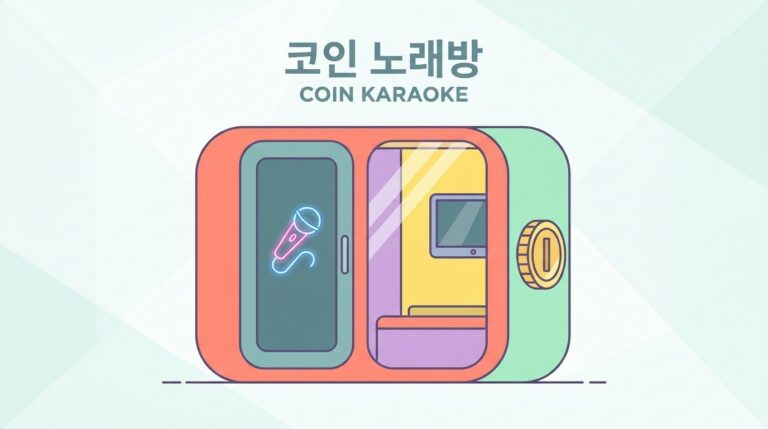
Imagine this: You have just finished a delicious dinner of spicy tteokbokki with your Korean friends in Hongdae. As you walk through the energetic, neon-lit alleys, someone points toward a glowing pastel staircase and shouts, “Let’s go to Kono!” You follow them into a vibrant hallway lined with cozy glass booths. Inside each booth, people are pouring their hearts into wireless microphones, tambourines shaking in rhythm. You step inside an empty booth, holding a crisp blue 1,000-won bill in your hand. The screen flashes with numbers, buttons, and colorful Korean menus. You wonder: How does this coin machine work? How many songs do I get for this bill? How do I ask my friend or the staff without freezing up?
If you have ever felt overwhelmed by the high-tech, fast-paced world of Korean karaoke, you are certainly not alone! Many of our beginner students tell us that stepping into a Coin Noraebang feels like operating a spaceship. But here is the good news: with just one simple sentence—천 원에 네 곡 부를 수 있어요 (Cheon wone ne gok bureul su isseoyo)—you can sing with confidence and navigate any coin karaoke booth in Korea like a seasoned local. Let’s break down everything step-by-step with zero stress!
Phase 2: Core Expressions Breakdown
1. 천 원에 네 곡 부를 수 있어요 (Cheon wone ne gok bureul su isseoyo)
- Pronunciation: [Cheon won-e ne gok bu-reul su i-sseo-yo] (Sound analogy: Say “Chun” like ‘chunk’, “won” like ‘one’, “ne” like ‘net’ without the t, and “isseoyo” like ‘e-seoy-yo’.)
- Meaning: Literal: “For 1,000 won, four songs can be sung.” / Real Nuance: “You can sing four songs for just 1,000 won!”
- K-Culture Moment: You will hear this constantly when students or young K-Drama characters check the coin booth door rate sticker before stepping inside.
- Editor’s Insight: The particle ~에 (~e) here means “per” or “for the price of.” The grammar pattern -(을) 수 있어요 (-(eul) su isseoyo) translates to “can do [action],” expressing possibility.
- Situation Spectrum:
- Casual (Friends): ⚠️ 천 원에 네 곡 부를 수 있어 (Cheon wone ne gok bureul su isseo)
- Semi-formal (Polite everyday): ✅ 천 원에 네 곡 부를 수 있어요 (Cheon wone ne gok bureul su isseoyo)
- Formal (Official announcements): 🚫 천 원에 네 곡 부르실 수 있습니다 (Cheon wone ne gok bureusil su itseumnida)
- 🤔 Think About It: Notice how Korean places the price first (1,000 won), followed by the counter (four songs), and finally the verb (can sing). How does this change what your brain focuses on first compared to English?
2. 코노 갈래요? (Kono gallaeyo?)
- Pronunciation: [Ko-no gal-lae-yo?] (Sound analogy: “Co-no” like a mini cone, “gal-lae-yo” rhymes with ‘call lay yo’.)
- Meaning: Literal: “Do you want to go to Kono?” / Real Nuance: “Wanna hit up a coin karaoke booth?”
- K-Culture Moment: In teen web dramas and campus vlogs, nobody says the full official name Coin Norae Yeonseupjang. Everyone simply says Kono!
- Editor’s Insight: Kono (코노) is a portmanteau of 코인 (Coin) + 노래방 (Noraebang). Adding -(으)ㄹ래요? (-(eu)llaeyo?) turns any activity into a friendly, casual invitation.
- Situation Spectrum:
- Casual (Close friends): ✅ 코노 갈래? (Kono gallae?)
- Semi-formal (Polite peers/coworkers): ✅ 코노 갈래요? (Kono gallaeyo?)
- Formal (Senior boss/elders): 🚫 코인 노래방에 가시겠습니까? (Koin noraebange gasigesseumnikka?)
- 🤔 Think About It: Korean youth love shortening compound words into two punchy syllables (like Kono, Chimaek, Honbap). Does your native language create trendy slang abbreviations the same way?
3. 500원 동전으로 바꿔 주세요 (Obaegwon dongjeoneuro bakkwo juseyo)
- Pronunciation: [O-baek-won dong-jeon-eu-ro bak-kwo ju-se-yo] (Sound analogy: “Oh-back-won dong-jun-oo-ro bah-kwo joo-say-yo”.)
- Meaning: Literal: “Please exchange into 500-won coins.” / Real Nuance: “Could I get change in 500-won coins, please?”
- K-Culture Moment: Used at the counter or when asking someone standing beside the bill-to-coin change machine inside the karaoke lounge.
- Editor’s Insight: 주세요 (Juseyo) is your golden beginner key for “please give/do for me.” Pairing it with (으)로 바꿔 (-(eu)ro bakkwo) clearly states the exact currency denomination you need.
- Situation Spectrum:
- Casual: ⚠️ 500원짜리로 바꿔 줘 (Obaekwonnjjari-ro bakkwo jwo)
- Semi-formal: ✅ 500원 동전으로 바꿔 주세요 (Obaegwon dongjeoneuro bakkwo juseyo)
- Formal: 🚫 500원 동전으로 교환 부탁드립니다 (Obaegwon dongjeoneuro gyohwan butakdeurimnida)
- 🤔 Think About It: In Korea, 500-won coins are the gold standard for arcade games and coin karaoke. Asking specifically for the denomination keeps transactions speedy and polite.
Phase 3: Textbook Korean vs. Real Korean
Situation 1: Suggesting a quick karaoke stop
- 📖 교과서 한국어 (Textbook): 코인 노래 연습장에 가시겠습니까? (Koin norae yeonseupjange gasigesseumnikka? – Would you like to go to the coin singing practice room?)
- 🗣️ 진짜 한국어 (Real-life): 우리 코노 갈래? (Uri kono gallae? – Wanna hit the coin karaoke?)
- 💡 왜 다를까? (Why the difference?): Nobody uses the legal business name (Norae Yeonseupjang) in conversation. Young Koreans shorten it to Kono and drop heavy honorifics among friends.
Situation 2: Checking the price per song
- 📖 교과서 한국어 (Textbook): 천 원을 투입하면 네 곡을 부를 수 있습니다. (Cheon woneul tuiphamyeon ne gogeul bureul su itseumnida. – If you insert 1,000 won, four songs can be sung.)
- 🗣️ 진짜 한국어 (Real-life): 여기 천 원에 네 곡이네! (Yeogi cheon wone ne gogine! – Oh, it’s four songs for 1,000 won here!)
- 💡 왜 다를까? (Why the difference?): Real Koreans rely on the exclamatory ending ~네 (~ne) to express spontaneous realization rather than long conditional grammar.
Phase 4: K-Culture Deep Dive & Non-verbal Manners
4-1. Nunchi & Booth Manners
- The Microphone Pass: When passing the microphone to your friend, hold it with both hands or lightly touch your right forearm with your left hand. It shows respect and care.
- Sanitary Covers First: Near the entrance or counter, always pick up a small plastic pouch containing microphone covers (마이크 커버 – Maikeu keobeo). Put them on the mics before singing!
- Tambourine Balance: Korean coin booths are compact. If your friend is belting out a heart-wrenching ballad by IU or Park Hyo-shin, pause the tambourine shaking. Save the wild rattling for upbeat K-Pop anthems like BTS or NewJeans!
4-2. The Healing Culture of “Kono”
In traditional Korean Noraebang, you pay by the hour (often 20,000 to 30,000 won), requiring a group gathering. However, Coin Noraebang (Kono) transformed Korean youth culture by allowing anyone to pay per song. It became the ultimate sanctuary for Hon-nori (solo leisure). Stressed high schoolers, university students between classes, and tired office workers slip into a booth alone for 15 minutes to sing three or four songs, release their daily stress, and return to their routine refreshed.
Phase 5: Real-Life Roleplay Scenario
- Setting: A bustling, fluorescent-lit Coin Noraebang near Hongik University Station.
- Character: Minji (민지), your bubbly Korean university classmate who knows all the best karaoke spots.
- 민지: 와, 밥 진짜 배부르게 먹었다! 이제 어디 갈까?
(Wa, bap jinjja baebureuge meogeotda! Ije eodi galkka?)
“Wow, that meal was so filling! Where should we go now?”
🎭 Patting her stomach happily and looking around the street -
You: 코노 갈래요?
(Kono gallaeyo?)
“Do you want to go to a coin karaoke?”
🎭 Pointing toward the glowing blue karaoke sign with a smile -
민지: 대박, 좋아요! 저기 2층에 새로 생긴 코노 가요!
(Daebak, joayo! Jeogi icheunge saero saenggin kono gayo!)
“Awesome, let’s do it! Let’s go to that new Kono on the second floor!”
🎭 Grabbing your arm excitedly and climbing the stairs -
민지: 여기 방 하나 비어 있어요. 가격 볼까요?
(Yeogi bang hana bieo isseoyo. Gagyeok bolkkayo?)
“There’s an empty booth right here. Shall we check the price?”
🎭 Looking at the glass door pricing sticker -
You: 오! 천 원에 네 곡 부를 수 있어요.
(O! Cheon wone ne gok bureul su isseoyo.)
“Oh! You can sing four songs for 1,000 won.”
🎭 Showing your 1,000-won bill while pointing at the sticker -
민지: 진짜 싸다! 보통 세 곡인데 여기 좋네요. 현금 있어요?
(Jinjja ssada! Botong se goginde yeogi jonneyo. Hyeongeum isseoyo?)
“That’s so cheap! Usually it’s three songs, this place is great. Do you have cash?”
🎭 Reaching into her tote bag for her wallet -
You: 네, 천 원짜리 세 장 있어요.
(Ne, cheon-wonjjari se jang isseoyo.)
“Yes, I have three 1,000-won bills.”
🎭 Holding up the crisp blue bills proudly -
민지: 완벽해요! 마이크 커버 챙겨서 얼른 들어가요!
(Wanbyeokhaeyo! Maikeu keobeo chaenggyeoseo eolleun deureogayo!)
“Perfect! Grab the mic covers and let’s hurry inside!”
🎭 Handing you the sanitized mic covers and opening the booth door
🔀 Interactive Choice Point
You are inside the booth. The machine has a bill slot and a coin slot, but it also shows a card terminal. What do you do?
- Option A: Say: “천 원에 네 곡 부를 수 있어요. 현금 넣을게요!” (Cheon wone ne gok bureul su isseoyo. Hyeongeum neoheulgeyo! – You can sing four songs for 1,000 won. I’ll insert cash!)
👉 Feedback [Best]: Spot on! Cash is the most foolproof method in older or standard coin machines. Minji smiles, and you both get your four songs immediately! - Option B: Insert your foreign credit card without checking the minimum charge limit.
👉 Feedback [Risk]: Many Kono card readers require a minimum payment of 3,000 or 5,000 won (or purchase by time rather than song count). You might end up paying for an entire hour unintentionally! - Option C: Shout loudly toward the hallway: “사장님, 노래 주세요!” (Sajangnim, norae juseyo! – Boss, give me songs!)
👉 Feedback [Bad]: Coin Noraebangs are almost completely unstaffed (무인 – Muin)! The machine operates automatically once you insert coins or bills.
Phase 6: 10-Second Emotion Shadowing Drill
Practice these lines aloud! Follow the rhythm pauses (/) and embody the emotion tags:
[😊 Exciting invitation]
우리 / 코노 / 갈래요?
(Uri / kono / gallaeyo?)
“Shall we / go / to Kono?”-
[🤩 Pleasant surprise]
우와, / 천 원에 / 네 곡 부를 수 있어요!
(Uwa, / cheon wone / ne gok bureul su isseoyo!)
“Wow, / for 1,000 won / we can sing four songs!” -
[🤝 Polite & confident inquiry]
500원 동전으로 / 바꿔 주세요.
(Obaegwon dongjeoneuro / bakkwo juseyo.)
“Into 500-won coins, / please exchange.”
Phase 7: K-Culture Mini Dictionary
-
코노 (Kono)
Literal: Coin Noraebang
Usage: The ubiquitous slang word used by teens, 20-somethings, and university students across Korea to refer to coin karaoke. -
서비스 (Seobiseu)
Literal: Service (Complimentary bonus)
Usage: In traditional hourly Noraebangs, the owner often gifts you 10 to 30 free minutes. In automated Kono, you rarely get seobiseu, which is why knowing the song-per-won rate is crucial! -
마이크 커버 (Maikeu Keobeo)
Literal: Microphone cover
Usage: Disposable sanitary fabric caps located in baskets near the entrance counter. Essential etiquette for hygiene. -
18번 (Sip-pal-beon)
Literal: Number 18
Usage: A classic Korean idiom meaning someone’s “go-to signature song” that they always sing at karaoke.
Phase 8: Survival Kit for Travelers
Top 3 Survival Phrases
- 카드 결제 돼요? (Kadeu gyeolje dwaeyo?)
Romanization: [Ka-deu gyeol-je dwae-yo?]
Pro Tip: Ask this if you run out of cash. Many modern Kono machines now accept local and international credit cards. - 동전 교환기 어디 있어요? (Dongjeon gyohwangi eodi isseoyo?)
Romanization: [Dong-jeon gyo-hwan-gi eo-di i-sseo-yo?]
Pro Tip: If you only hold 5,000 or 10,000-won bills, look for the tall exchange machine near the hallway entrance. - 취소 버튼 어디예요? (Chwiso beoteon eodiyeyo?)
Romanization: [Chwi-so beo-teon eo-di-ye-yo?]
Pro Tip: Picked the wrong song? Press the red 취소 (Cancel) button on the remote before 5 seconds pass to save your song credit!
Editor’s Travel Note
- Navigation Tip: To find top-rated coin karaoke spots near you, use the Naver Map app on mobile and search for 코인노래방. It will show real-time opening hours and user reviews.
- Cash Recommendation: Always keep two to three 1,000-won bills in your pocket when exploring Korea. While Korea is largely cashless, coin karaoke bill-acceptors remain the most reliable way to start singing without card authorization hiccups.
Phase 9: Going One Step Deeper
In Western karaoke culture, singing is often treated as a public performance on a bar stage, accompanied by drinks and cheers from strangers. In contrast, Korean Noraebang culture evolved as an intimate, protected communal space where people let their guards down with close peers. Coin Noraebangs take this one step further by embracing Gojok (solo culture). In an ultra-connected, high-expectation society, stepping into a dimly lit, soundproofed room with a microphone gives Koreans total freedom to sing off-key, shout out their frustrations, or shed tears over an emotional song without anyone judging them.
💬 Your Turn: What is your all-time favorite song to sing when you need to relieve stress? Would you sing it solo or with friends in Korea? Share in the comments below!
Phase 10: FAQ & Mistake Prevention
Q: Can I pay with 10,000-won bills directly into the song machine inside the booth?
A: Be careful! Most in-booth machines only accept 1,000-won bills or 500-won coins. If you insert a 10,000-won bill directly into a booth machine, it may register 40 songs at once without giving back change! Use the lobby coin exchanger first.
Q: What is the difference between “Time mode” (시간제) and “Song mode” (코인제)?
A: On modern Kono screens, you will see two options: Time mode (e.g., 30 minutes for 4,000 won) and Song mode (e.g., 4 songs for 1,000 won). If you like singing fast-tempo songs without breaks, Time mode is great. If you like chatting and picking songs slowly, always choose Song mode!
Q: Do I have to leave right when my songs reach zero?
A: Yes! Unlike traditional hourly karaoke rooms where an employee checks you out, coin karaoke rooms are monitored by lobby cameras or automated door locks. Once your song count hits 0, tidy up your trash, return the mics to their holders, and exit politely for the next guest.
🚨 Common Mistakes Warning Board
| Foreign Learner Mistake | What Happens | Correct Action (정답) |
|---|---|---|
| Putting a 1,000-won bill in without checking the screen | Machine might be set to ‘Card-only’ mode, trapping the bill | Check that the coin slot light is blinking green before feeding cash |
| Forgetting to put on the mic cover | Unhygienic and frowned upon by locals | Pick up the 2-pack 마이크 커버 from the front basket upon arrival |
| Singing the first 10 seconds and pressing Cancel | You lose that song credit completely | Preview songs on your phone first; the machine deducts credits instantly |
Phase 11: Action Missions & Community Engagement
- 🥉 Bronze Mission (Solo Practice): Stand in front of your mirror. Hold your phone like a microphone and say aloud 3 times: 천 원에 네 곡 부를 수 있어요 (Cheon wone ne gok bureul su isseoyo) with rhythmic intonation!
- 🥈 Silver Mission (Social Audio): Record your voice saying 코노 갈래요? (Kono gallaeyo?) on Instagram Stories or TikTok and tag
@DailyHangulto get pronunciation feedback from our editors. - 🥇 Gold Mission (Real-world Challenge): Next time you visit Korea (or your local Koreatown karaoke lounge), ask the cashier or kiosk for change using 500원 동전으로 바꿔 주세요 (Obaegwon dongjeoneuro bakkwo juseyo)!
- 🎮 K-Culture Mission: Watch an episode of a Korean youth drama (like Twenty-Five Twenty-One or True Beauty). Spot the scene where the characters go to Noraebang and count how many times they hit the tambourine!
Phase 12: Interactive Quiz Challenge
Test your knowledge before hitting the streets of Seoul!
Question 1: Situation Check
You walk into a Coin Noraebang with your friend. You want to ask them if they want to go into a booth. Which sentence is most natural?
* A) 코인 노래 연습장에 가시겠습니까?
* B) 코노 갈래요?
* C) 노래방 돈을 내세요.
Question 2: Fill in the Blank
Complete the sentence meaning: “You can sing four songs for 1,000 won.”
천 원에 네 곡 ______ ______ 있어요.
(Hint: starts with the verb to sing – 부르다)
Question 3: True or False (Culture)
True or False: In Korean coin karaoke (Kono), it is considered bad manners to go and sing alone in a booth.
👉 Click here to reveal the answers and explanations!
Answer 1: B (코노 갈래요?)
Explanation: Kono is the natural, trendy conversational term. Option A is overly formal textbook language, and Option C is an awkward demand to pay money!
Answer 2: 부를 수 (bureul su)
Explanation: Combined with 있어요 (isseoyo), the pattern 부를 수 있어요 means “can sing.”
Answer 3: False!
Explanation: Solo karaoke (Hon-noraebang) is one of the most popular solo trends in modern Korea! People of all ages routinely sing alone to relax and relieve stress.
🎬 Watch Our Daily Videos! (Daily Hangul Official Instagram)
Review the expressions you learned in this article with our fun daily short videos! Check out native pronunciation and real-life nuances in action.
- Instagram @dailyhangul_en







