

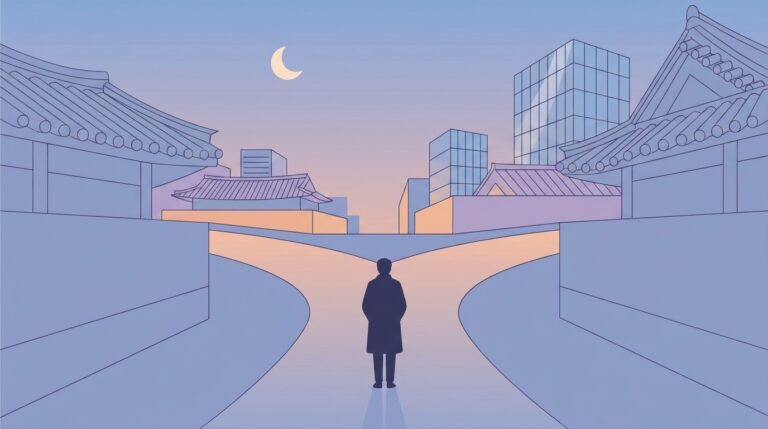
Master C2 Korean Through Existentialism: Forging Essence in a High-Pressure Society
Phase 1: Empathy (Story-Driven Opening)
안녕하세요! 매일한글 에디터입니다. (Annyeonghaseyo! It’s your Daily Hangul editor.)
Have you ever found yourself sitting at a neon-lit Pojangmacha in Euljiro at 2 AM, nursing a glass of soju, while your Korean friend sighs deeply and talks about feeling like a cog in an indifferent machine? In South Korea, life often feels like a hyper-scripted playbook: get into a SKY university, land a spot at a major conglomerate (대기업), get married by thirty-two, and buy an apartment in the Seoul metropolitan area. Just like Jean-Paul Sartre’s famous paperknife—manufactured with an exact purpose before it even exists—Korean society can sometimes pressure people to believe their “essence” was predestined by family expectations and corporate metrics.
Yet, underneath this relentless current, a powerful existential counter-current is surging. When you listen to dialogue in celebrated K-dramas like My Liberation Notes (나의 해방일지) or indie music from Hongdae, you hear the raw, resonant yearning of Heidegger’s Dasein (현존재)—humans who find themselves “thrown” into worldly anxiety (불안), daring to shatter preset molds through radical, authentic choices.
Reaching C2 Korean isn’t merely about passing exams; it is about articulating the very core of human freedom, existential anxiety, and personal accountability in natural, philosophically rich Korean. This masterclass is drawn directly from advanced seminars and real-life late-night debates with bilingual thinkers. By the end of this guide, you will be able to navigate profound existential debates in Korean with nuance, razor-sharp precision, and empathetic elegance.
Phase 2: Core Expressions Deep Dive (핵심 표현 3선)
1. 실존이 본질에 앞선다 (Siljoni bonjire apseonda)
- Pronunciation: [Sil-jo-ni bon-ji-re ap-seon-da] (Think: “Seel-zone-ee bone-jee-reh ahp-seon-dah”)
- Meaning: “Existence precedes essence.” Literally, concrete living existence comes before any predefined purpose or societal mold.
- K-Culture Moment: Used in introspective intellectual shows like The Dictionary of Useless Knowledge (알아두면 쓸데없는 신비한 잡학사전) or deep character arcs in psychological dramas where a protagonist abandons an elite medical career to find their authentic self.
- Editor’s Insight: At the C2 level, you do not just use this as a textbook quote. You use it as a rhetorical weapon against deterministic thinking. When someone tells you, “You’re a foreigner, so you can’t understand this,” or “You’re a developer, so stick to code,” this phrase asserts that human action defines capability, not a static label.
- Situation Spectrum: Casual: ⚠️ (sounds hyper-academic) | Semi-formal: ✅ | Formal/Debate: ✅
- 🤔 Think About It: In many Western philosophies, individual autonomy is taken for granted. In Korean discourse, where social roles (직책, 효도) traditionally define identity, what revolutionary weight does declaring “실존이 본질에 앞선다” hold?
2. 주체적인 선택을 내리다 (Juchejeogin seontaegeul naerida)
- Pronunciation: [Ju-che-jeo-gin seon-tae-geul nae-ri-da] (Think: “Joo-cheh-juh-geen sun-taek-eul neh-ree-dah”)
- Meaning: Literal: “To hand down an autonomous choice.” Nuance: Making an existential, sovereign decision where you shoulder the entire existential weight and consequences without deflecting blame onto parents, company, or fate.
- K-Culture Moment: Evoked in Itaewon Class when Park Saeroyi rejects the corrupt corporate playbook to chart his own moral and commercial trajectory against overwhelming odds.
- Editor’s Insight: Notice the verb 내리다 (to hand down / decree). Unlike the pedestrian 선택하다 (to choose), 결정을/선택을 내리다 implies that you are the sovereign judge of your own destiny. It carries supreme gravitas.
- Situation Spectrum: Casual: ⚠️ | Semi-formal: ✅ | Formal/Debate: ✅
- 🤔 Think About It: Does your native tongue have a distinction between simply “making a choice” and “decreeing an autonomous verdict on your life”?
3. 스스로를 끊임없이 기투하다 (Seuseuro-reul kkeunimeopsi gituhada)
- Pronunciation: [Seu-seu-ro-reul kkeu-nim-eop-si gi-tu-ha-da] (Think: “Soo-soo-roh-reul kkeun-eem-up-shee gee-too-hah-dah”)
- Meaning: Literal: “To endlessly project oneself forward.” Nuance: Translating the existential concept of Entwurf (projection). It means humans are never static; we continuously redefine ourselves by hurling our present being toward future possibilities.
- K-Culture Moment: Indie essays and avant-garde art critiques in Mangwon-dong literary cafes frequently use this phrase when discussing artists who refuse to reproduce their past commercial hits.
- Editor’s Insight: 기투(企投) is a high-register Sino-Korean philosophical term composed of 企 (to plan/stand on tiptoe) and 投 (to throw/cast). When you use this verb in intellectual circles, native speakers will instantly recognize your grasp of phenomenology.
- Situation Spectrum: Casual: 🚫 | Semi-formal: ⚠️ | Formal/Academic: ✅
- 🤔 Think About It: Why does modern Korean culture admire both “hyper-stable career civil servants” (공무원) and the artistic impulse to “기투하다”? How do these two conflicting ideals coexist in Seoul?
Phase 3: Textbook Korean vs. Real Korean (교과서 vs 진짜 한국어)
Situation 1: Explaining that you resigned from a safe corporate job to find yourself
- 📖 교과서 한국어: 저는 회사를 그만두고 제 진정한 자아를 찾기 위해 새로운 일에 도전하기로 결심했습니다. (Jeoneun hoesareul geumandugo je jinjeonghan ja-areul chatgi wihae saeroun ire dojeonhagiro gyeolsimhaesseumnida.)
- “I decided to quit the company and challenge a new endeavor to find my true ego.”
- 🗣️ 진짜 한국어 (C2 High Register): 남들이 짜놓은 트랙에서 벗어나서, 온전히 제 선택에 책임을 지는 삶을 살고 싶었어요. (Namdeuri jjanoun teuraegeseo beoseonaseo, onjeonhi je seontaege chaegimeul jineun salmeul salgo sipeosseoyo.)
- “I wanted to step off the track laid out by others and live a life where I take absolute accountability for my own choices.”
- 💡 왜 다를까?: Textbook Korean sounds like an essay translation. Real native speakers use spatial metaphors like “남들이 짜놓은 트랙에서 벗어나다” (derailing from the track others built) and emphasize “온전한 책임” (undiluted responsibility).
Situation 2: Dismissing deterministic complaints (“It was just meant to be this way”)
- 📖 교과서 한국어: 운명을 탓하지 마세요. 우리는 자유로운 의지를 가지고 있습니다. (Unmyeongeul tathaji maseyo. Urineun jayuroun uijireul gajigo itseumnida.)
- “Do not blame fate. We possess free will.”
- 🗣️ 진짜 한국어 (C2 Conversational Nuance): 상황 핑계 대지 말자. 결국 지금의 우릴 만든 건 매 순간 우리가 내린 선택의 총합이잖아. (Sanghwang ping-gye daeji malja. Gyeolguk jigeumui uril mandeun geon mae sungan uriga naerin seontaegui chonghab-ijana.)
- “Let’s not make excuses about circumstances. In the end, what made us who we are right now is the sum of choices we made at every single moment, isn’t it?”
- 💡 왜 다를까?: Rather than pedantic declarations of “free will” (자유의지), advanced native discourse uses “선택의 총합” (the sum total of choices) to capture Sartre’s radical existential responsibility in an organic, persuasive tone.
Phase 4: K-Culture Deep Dive & Non-Verbal Manners
4-1. 눈치(Nunchi) & Existential Assertion
In Korean communication, existential rebellion must be delivered with calibrated body language. If you assert radical independence with aggressive posture or direct, unwavering eye contact towards a senior (선배 or 상사), you will be dismissed not as an existential thinker, but as someone lacking basic decorum (싸가지 없는 사람).
* The C2 Posture: When declaring an unconventional life choice, lower your vocal pitch, pause briefly before answering, and maintain a calm, collected gaze. A slight nod of acknowledgment toward the other person’s conventional perspective shows high-level social maturity (눈치) while holding firm to your existential autonomy.
4-2. Cultural Code Analysis: My Liberation Notes and “추앙 (Worship/Liberation)”
In the hit K-drama My Liberation Notes, the characters do not suffer from material deprivation; they suffer from Heideggerian everydayness (일상성)—a suffocating sense that they are living an inauthentic existence dictated by commuter trains and corporate evaluation sheets. The viral keyword 추앙(崇仰)—demanding to be unconditionally uplifted and recognized as an autonomous, existing soul rather than evaluated for social utility—is existential phenomenology distilled into modern Korean drama.
Phase 5: Real-World Roleplay Scenario (실전 롤플레이)
Setting: A quiet craft-beer pub in Seochon, Seoul. Rainy Tuesday night.
Characters:
* Min-woo (선배): A 35-year-old senior project manager at a top IT firm, burnt out yet terrified of abandoning the conventional track.
* You: A cosmopolitan professional choosing an unconventional, self-directed path in Seoul.
Turn 1
민우: 야, 너 진짜 멀쩡한 직장 그만두고 프리랜서로 독립하겠다고? 세상이 그렇게 만만치 않아. (Ya, neo jinjja meoljjeonghan jikjang geumandugo peuriraenseoro dongniphagettago? Sesangi geureoke manmanchi ana.)
🎭 민우는 맥주잔을 만지작거리며 진심 어린 걱정 반, 불안 반이 섞인 표정으로 당신을 쳐다본다.
(Hey, are you seriously quitting a perfectly stable job to go independent? The world isn’t that forgiving.)
Turn 2
나: 만만치 않다는 건 알아요, 형. 하지만 이미 용도가 정해진 종이칼처럼 남의 기준대로 소모되고 싶진 않아요. (Manmanchi antaneun geon arayo, hyeong. Hajiman imi yongdoga jeonghaejin jong-ikalcheoreom namui gijundae-ro somodoego sipjin anayo.)
🎭 차분하게 미소를 지으며 잔을 내려놓는다.
(I know it’s not forgiving, Hyeong. But I don’t want to be consumed by other people’s standards like a paperknife manufactured with a preset utility.)
Turn 3
민우: 종이칼? 참 철학적인 비유네. 그래도 조직 안에 있을 때 주어지는 안전함이라는 게 있잖아. (Jong-ikal? Cham cheolhakjeogin biyune. Geuraedo jojik ane isseul ttae jueojineun anjeonham-iraneun ge itjana.)
🎭 고개를 절레절레 흔들며 쓴웃음을 짓는다.
(Paperknife? That’s quite a philosophical metaphor. Still, there is safety that only exists while you’re inside an organization.)
Turn 4
나: 그 안전함이 하이데거가 말한 ‘비본래적인 삶’의 핑계가 될까 봐 두려워요. (Geu anjeonhami haide-geoga malhan ‘bibonraejeogin salm’ui ping-gyega doelkka bwa duryeowoyo.)
🎭 시선을 민우의 눈에 담담히 맞춘다.
(I’m terrified that this very safety will become an excuse for what Heidegger called an ‘inauthentic life.’)
Turn 5
민우: 비본래적 삶이라… 하지만 매달 꽂히는 월급 없이는 불안해서 견디기 힘들 텐데? (Bibonraejeok salm-ira… hajiman maedal kkochineun wolgeup eopsineun buranhaeseo gyeondigi himdeul tende?)
🎭 맥주를 한 모금 들이켜며 깊은 한숨을 내쉰다.
(Inauthentic life, huh… But without a paycheck hitting your account every month, the existential dread will be unbearable, won’t it?)
Turn 6
나: 그 불안이야말로 내가 살아있다는 증거이자, 진짜 주체적인 선택을 내릴 기회라고 생각해요. (Geu buran-iyamallo naega saraittaneun jeung-geo-ija, jinjja juchejeogin seontaegeul naeril gihoerago saenggakaeyo.)
🎭 목소리에 확신을 실어 또박또박 발음한다.
(That anxiety is the very proof that I am alive, and the opportunity to make a genuinely autonomous choice.)
Turn 7
민우: 하, 너 정말 못 말리겠다. 솔직히 말하면… 네 용기가 조금 부럽기도 해. (Ha, neo jeongmal mot malligetta. Soljiki malhamyeon… ne yong-giga jogeum bureopgido hae.)
🎭 맥주잔을 들어 당신의 잔에 가볍게 부딪힌다.
(Ha, there really is no stopping you. To be honest… I’m a bit envious of your courage.)
Turn 8
나: 부러워만 하지 마시고, 형도 스스로를 새롭게 규정해 보세요. 건배할까요? (Bureowoman haji masigo, hyeongdo seuseuro-reul saeropge gyujeonghae boseyo. Geonbaehalkkayo?)
🎭 밝게 웃으며 잔을 맞받아친다.
(Don’t just envy it; redefine yourself anew too, Hyeong. Shall we toast?)
🔀 Interactive Branching Point
If Min-woo sighs and asks: “Where do I even start when everything feels so set in stone?”
* Option A (Best – C2 Nuance): “거창한 것부터 바꿀 필요 없어요. 매 순간 타인의 기대에 무의식적으로 동조하던 관성부터 끊어내는 거죠.” (You don’t have to overhaul everything overnight. Start by severing the inertia of unconsciously complying with others’ expectations at every turn.)
* Feedback: Perfect existential empathy combined with high-register phrasing (관성을 끊어내다).
* Option B (Bad – Textbook Cliché): “일단 사표를 쓰고 당신의 꿈을 향해 달려가세요! 인생은 한 번뿐입니다!” (Quit immediately and run toward your dream! You only live once!)
* Feedback: Sounds like a cheap motivational speaker. Completely ignores the existential reality and social nuance in Korea.
* Option C (Risk – Overly Aggressive): “형이 여태 나약하게 남 탓만 하고 살아서 그래요.” (It’s because you’ve been living weakly and blaming others your whole life, Hyeong.)
* Feedback: Instant relationship killer. Violates Korean relational dynamics without offering existential solidarity.
Phase 6: 10-Second Emotion Shadowing Drill (감정 섀도잉)
Master the rhythm, breath pauses (/), and philosophical conviction.
[🔥 단호하고 주체적인 어조로]
“인간은 / 제작자의 목적대로 만들어진 도구가 아니에요. / 매 순간의 결단으로 / 스스로의 본질을 만들어갈 뿐이죠.”
(Inganeun / jejakjaui mokjeokdaero mandeureojin doguga anieyo. / Mae sunganui gyeoldaneuro / seuseuroui bonjireul mandeureogal ppun-ijyo.)-
[☕ 차분하면서도 지적인 고찰을 담아]
“불안은 / 결코 회피해야 할 결함이 아니라, / 내 삶의 주권을 회복하라는 / 실존의 신호예요.”
(Buraneun / gyeolko hoepihayeoya hal gyeolhami anira, / nae salmui jugwoneul hoebokhara-neun / siljonui sinhoyeyo.) -
[🤝 상대방을 깊이 공감하고 위로하듯이]
“남들이 정해준 레일에서 벗어나는 순간 / 비로소 / 진짜 당신이라는 현존재가 시작되는 겁니다.”
(Namdeuri jeonghaejun reireseo beoseonaneun sungan / biroso / jinjja dangsin-iraneun hyeonjonjaega sijakdoeneun geomnida.)
Phase 7: K-Culture Mini Dictionary (핵심 키워드 4개)
-
현존재 (Hyeon-jon-jae) | Dasein / Concrete Human Existence
- Literal: Existing right here in this specific temporal world. In intellectual Korean media and modern literary essays, it refers to human beings who actively reflect on their mortality and existence rather than existing passively.
- 본질주의 (Bon-jil-ju-ui) | Essentialism
- The belief that entities have set characteristics predetermined by nature or purpose. Often used critically in Korean cultural debates to dismantle patriarchal norms, corporate hierarchy, or rigid career timelines.
- 자기결정권 (Ja-gi-gyeol-jeong-gwon) | Right to Self-Determination
- High-frequency legal, ethical, and conversational term. Refers to an individual’s sovereign right to determine their own life path, medical choices, marriage decisions, or creative career without external coercion.
- 갓생 (Gat-saeng) | God-Life (Neologism / Slang)
- Blend of English “God” + Korean “생 (Life)”. Originally meant hyper-diligent productivity, but in advanced cultural circles, it is evolving to mean an “existentially authentic day”—living purposefully on one’s own sovereign terms rather than just grinding mindlessly.
Phase 8: Traveler’s Survival Kit (Intellectual & Cultural Spaces)
Survival Expressions TOP 3
- “이 책방의 큐레이션에는 어떤 철학이 담겨 있나요?”
(I chaekbang-ui kyureisyeon-eneun eotteon cheolhagi damgyeo innayo?)- Pro Tip: Use this when visiting independent bookshops in Seochon or Yeonhui-dong. It unlocks deep conversations with curated-bookstore owners.
- “정형화된 일상에서 벗어나 새로운 시각을 얻고 싶어 찾아왔습니다.”
(Jeonghyeonghwadoen ilsang-eseo beoseona saeroun sigageul eotgo sipeo chajawasseumnida.)- Pro Tip: Exceptional greeting when visiting cultural salons, indie art exhibitions, or philosophically themed tea houses.
- “각자의 선택이 존중받는 분위기가 참 인상적이네요.”
(Gakjaui seontaegi jonjungbanneun bunwigiga cham insangjeogineyo.)- Pro Tip: High-register social compliment when attending indie film screenings or open philosophical discussion meetups in Seoul.
Editor’s Travel Note: Finding Existential Havens in Seoul
If you want to step beyond tourist hotspots, head to Seochon (서촌) and Mangwon-dong (망원동). Check out independent philosophical bookstores such as The Book Society or quiet salon cafes in Mullae-dong’s converted steel alleyways. Make sure you use the Naver Map app download instead of Google Maps to discover hidden spots tagged with #독립서점 (independent bookstore) and #철학살롱 (philosophy salon).
Phase 9: “한 발 더 깊이” (One Step Deeper: The Philosophical Essay)
Traditional Korean culture has historically championed the collective “우리” (We)—where individual identity is deeply harmonized within communal solidarity and filial duty. When Jean-Paul Sartre proclaimed that humans are “condemned to be free” (자유라는 형벌에 처해졌다), he wrote for an atomized European society. In contemporary Korea, however, existentialism operates as a profound healing salve: it does not demand the destruction of community, but invites individuals to love their community as an autonomous, self-chosen act rather than a passive obligation.
💬 Your Turn: Have you ever felt like a “paperknife” bound by societal expectations in your own culture? How would you articulate your decision to carve your own path in Korean? Leave a comment below using the phrase “제 인생의 본질은 ~을 통해 만들어 가요”!
Phase 10: FAQ & Common Mistakes (자주 묻는 질문 & 실수 교정)
Q: Can I use “실존” in everyday casual conversation with close friends?
A: Use it judiciously! If you shout “나의 실존적 위기야!” when ordering tteokbokki, your friends will burst out laughing. However, during late-night talks over drinks when the conversation turns to future careers, burnout, or identity, native speakers welcome this depth with open arms.
Q: What is the exact difference between ‘주체적’ (Juchejeok) and ‘자기중심적’ (Jagijungsimjeok)?
A: A huge danger zone! 주체적 means self-directed, autonomous, and taking full responsibility for one’s actions. 자기중심적 means self-centered, selfish, or narcissistic. Never confuse them when defending your choices!
Q: How does Heidegger’s ‘불안’ (Angst) differ from medical anxiety (불안장애)?
A: In everyday Korean, 불안 means anxiety or nervousness. In existential discourse, specify it as 실존적 불안 (existential anxiety)—the profound awareness of human freedom and mortality—to clearly separate it from physiological panic or clinical anxiety disorders.
🚨 Common Mistakes Board (흔한 실수 TOP 3)
- ❌ Mistake 1: Saying “저는 자유의지로 회사를 그만둡니다” (Sounds like a 19th-century manifesto).
- ✅ Correct Action: Say “충분한 고민 끝에 주체적으로 내린 결정입니다.” (Demonstrates sophisticated professional autonomy).
- ❌ Mistake 2: Using “본질적” to mean “fundamental” when you meant “본격적” (genuine/full-scale).
- ✅ Correct Action: Check whether you mean philosophical nature (본질) or active commencement (본격).
- ❌ Mistake 3: Dropping particles when using philosophical idioms like “실존 본질 앞선다”.
- ✅ Correct Action: Keep the grammatical particles intact: “실존이 본질에 앞선다”.
Phase 11: Action Missions (실천 액션 미션)
- 🥉 Bronze Mission (Solo Practice): Stand in front of your mirror and shadow the 3 emotional drills in Phase 6 with full vocal projection and appropriate pauses.
- 🥈 Silver Mission (Social Challenge): Share an Instagram story or tweet featuring a quote about your personal goal, incorporating the phrase: “매 순간의 주체적인 선택이 모여 나를 만든다.”
- 🥇 Gold Mission (Real-World Engagement): Next time you converse with a Korean language partner or tutor, steer the conversation toward future aspirations and ask: “00씨는 삶의 본질을 스스로 정의하는 편인가요?”
🎮 K-Culture Media Mission: Watch Episode 1 of My Liberation Notes (나의 해방일지). Pay special attention to the moments of silence during the siblings’ subway commute and identify how their body language reflects existential weariness.
Phase 12: Interactive Quiz Challenge (퀴즈 챌린지)
- Situational Judgment: In an intellectual debate, someone tells you that your background restricts what you can achieve. Which response demonstrates C2 existential fluency?
- (A) 저는 제 마음대로 할 거예요, 신경 끄세요.
- (B) 인간의 실존은 규정된 본질에 갇히지 않고, 주체적 선택을 통해 매 순간 갱신된다고 봅니다.
- (C) 운명은 바꿀 수 없는 것이니 수용하겠습니다.
- Fill-in-the-Blank: 사르트르는 인간이 미리 만들어진 종이칼과 달리, (________)이/가 본질에 앞선다고 주장했다.
-
True / False: In high-register Korean discourse, ‘내리다’ cannot be combined with ‘선택’ to denote an autonomous decision. (T / F)
정답 및 해설 보기 (Click to Reveal Answers)
- 정답: (B)
- 해설: (B) is the quintessential C2 philosophical statement—articulate, composed, and intellectually devastating. (A) is rude, and (C) is fatalistic.
- 정답: 실존 (Sil-jon)
- 해설: The famous maxim is “실존이 본질에 앞선다” (Existence precedes essence).
- 정답: False (F)
- 해설: ‘선택을 내리다’ or ‘결단을 내리다’ is a prestigious, sophisticated collocation emphasizing the grave authority of the decision maker.
- 해설: ‘선택을 내리다’ or ‘결단을 내리다’ is a prestigious, sophisticated collocation emphasizing the grave authority of the decision maker.
🎬 Watch Our Daily Videos! (Daily Hangul Official Instagram)
Review the expressions you learned in this article with our fun daily short videos! Check out native pronunciation and real-life nuances in action.
- Instagram @dailyhangul_en







