

Phase 1: Empathy (Story-Driven Opening)
안녕하세요! 매일한글 에디터입니다. (Hello! It’s your Daily Hangul editor.)
Picture this: You just spent an unforgettable weekend unwinding at a traditional Korean bathhouse (jjimjilbang, 찜질방) in Seoul, enjoying cold sweet rice punch (sikhye) after hot saunas and baths. But the next morning, you wake up and something feels desperately wrong. Your right ear feels heavy, blocked, and muffled, like you are listening to the world through a thick layer of wet cotton. Every time someone speaks to you, their voice echoes inside your skull with a strange, hollow vibrating buzz.
You try tilting your head and hopping on one foot. You try shaking your head. Nothing works. Panic sets in: “I need to see a doctor right now, but how do I explain this in Korean? What if I say the wrong thing and they think my eardrum burst?”
Take a deep breath! You are not alone. Describing physical sensations in a foreign language is one of the scariest hurdles for learners. But here is the good news: Korean clinics are among the most accessible, modern, and efficient in the world. Based on real classroom coaching with hundreds of beginner (A2) students, this guide cuts through clinical textbook jargon to give you the exact, natural sensory words that real Koreans use to get prompt, gentle relief at the doctor’s office. Let’s get your ears clear and your confidence back!
Phase 2: Core Expressions (Top 3 In-Depth Analysis)
Here are the three golden phrases you need to describe ear blockages to any doctor or pharmacist in Korea.
1. 귀가 먹먹해요 (Gwi-ga meongmeok-haeyo)
- Pronunciation: [Gwi-ga meong-meok-hae-yo] (Think of ‘meong’ rhyming with ‘sung’ and ‘meok’ like a short, soft ‘muck’)
- Meaning: Literal: “My ear is choked/stuffy” vs. Actual Nuance: “My ear feels muffled/clogged (like being on an airplane or underwater).”
- K-Culture Moment: You often hear this in K-dramas when a character experiences sudden shock, an explosion nearby, or rides a high-speed KTX train through a deep tunnel.
- Editor’s Insight: 먹먹하다 (meongmeokhada) is a uniquely expressive Korean adjective. It describes that heavy, sealed-off sensory state when pressure changes or fluid blocks sound. It is far more common in daily speech than technical medical words for “hearing loss”.
- Situation Spectrum: Casual: ✅ | Semi-formal: ✅ | Formal: ✅ (Polite ending -요 makes it universally safe and respectful at any clinic).
- 🤔 Think About It: In English, we often say “my ear is popped” or “stuffed”. Why do you think Korean uses a word that evokes a feeling of quiet, stifled blockage? How does naming sensory feelings directly build empathy between doctor and patient?
2. 소리가 웅웅거려요 (So-ri-ga ung-ung-georyeoyo)
- Pronunciation: [So-ri-ga oong-oong-geo-ryeo-yo] (Say ‘oong’ like the low hum of a heavy refrigerator, followed by ‘guh-ryeo-yo’)
- Meaning: Literal: “Sounds are doing ‘oong-oong'” vs. Actual Nuance: “Sounds are echoing / buzzing / humming hollowly.”
- K-Culture Moment: In Korean variety shows (like Running Man), when a member gets dizzy after spinning on an obstacle or hears a chaotic room, caption editors flash “웅~ 웅~” across the screen.
- Editor’s Insight: 웅웅거리다 is a classic Korean mimetic/sound-symbolic verb (uiseong-eo). It paints an acoustic picture of deep, reverberating bass sounds trapped inside your ear canal.
- Situation Spectrum: Casual: ✅ | Semi-formal: ✅ | Formal: ✅
- 🤔 Think About It: English uses distinct words like “humming,” “buzzing,” or “reverberating.” Korean relies on vivid onomatopoeia to mimic acoustic vibrations. Does sound mimicry feel more intuitive to you than medical definitions?
3. 귀에 물이 들어간 것 같아요 (Gwi-e mul-i deul-eo-gan geot gat-ayo)
- Pronunciation: [Gwi-e mu-ri deu-reo-gan geot ga-ta-yo] (Flow ‘mul-i’ together smoothly as ‘moo-ree’)
- Meaning: Literal: “It seems like water entered my ear” vs. Actual Nuance: “I think water got into my ear.”
- K-Culture Moment: You will hear this constantly at water parks like Caribbean Bay or Ocean World during hot summer days when swimmers step into first-aid stations.
- Editor’s Insight: The pattern -ㄴ 것 같아요 (it seems like…) is the holy grail of polite, natural Korean. Rather than making a definitive medical claim (“Water is in my ear!”), it softens your observation, leaving the professional diagnosis to the doctor.
- Situation Spectrum: Casual: ✅ | Semi-formal: ✅ | Formal: ✅
- 🤔 Think About It: Why are Koreans so fond of softening statements with “it seems like” (-것 같아요) even when they are almost certain? How does this reflect the cultural value of humility and deference to expertise?
Phase 3: Textbook Korean vs. Real Korean
| Situation | 📖 Textbook Korean | 🗣️ Real Korean | 💡 Why Is It Different? |
|---|---|---|---|
| Explaining ear fullness to the doctor | 제 청력이 일시적으로 저하되었습니다. (Je cheongryeog-i ilsi-jeog-euro jeohwa-doeeossseumnida. – My hearing has temporarily deteriorated.) | 귀 안이 너무 먹먹해요. (Gwi an-i neomu meongmeok-haeyo. – The inside of my ear feels so muffled/clogged.) | Medical textbooks teach clinical diagnostic terminology. Real native speakers use descriptive sensory words (먹먹해요) which immediately tell the doctor your exact comfort level. |
| Explaining echoing sensations | 귀 내부에서 진동 소음이 감지됩니다. (Gwi naebu-eseo jindong soeum-i gamji-doemnida. – Vibration noise is detected inside the ear.) | 소리가 계속 웅웅거려요. (Sori-ga gyesok ung-ung-georyeoyo. – The sounds keep buzzing and echoing.) | Direct translations of English medical terms sound robotic and artificial. In Korea, everyday onomatopoeia like 웅웅 is universally understood and welcomed by physicians. |
Phase 4: K-Culture Deep Dive & Non-Verbal Manners
4-1. Nunchi & Clinic Body Language
When you step into a Korean Ear, Nose, and Throat clinic (이비인후과, Ibiinhugwa), non-verbal cues help you establish great rapport instantly:
* Gentle Indication: When explaining your symptoms, lightly touch or point to the area just below your earlobe or behind the ear. Avoid aggressively sticking your finger into your ear canal in front of the doctor, as this is viewed as unhygienic.
* Attentive Nodding: Korean doctors speak quickly because consultation times are brisk. Nod slightly (끄덕끄덕) while making polite eye contact to signal you understand their basic instructions.
* Two-Hand Rule (두 손): Always hand over your Alien Registration Card (ARC), passport, or credit card with two hands at the reception desk, and receive your prescription paper (처방전) with both hands as a sign of mutual respect.
4-2. Cultural Code: The Magic of “Dongne” Clinics
In many Western countries, seeing an ENT specialist requires a referral from a general practitioner and weeks of waiting. In South Korea, neighborhood specialist clinics (동네 이비인후과, dongne ibiinhugwa) are on almost every major commercial street near subway exits!
You can simply walk in without an appointment, pay a modest consultation fee (often under $15-$25 USD even without national health insurance, or under $5-$10 with NHIS), and have an ENT specialist inspect your ear with a high-definition endoscope within 15 minutes. Because access is so easy, Koreans do not “wait it out” when their ear feels muffled; they visit the clinic immediately before swimmer’s ear or an infection worsens.
Phase 5: Real-World Roleplay Scenario
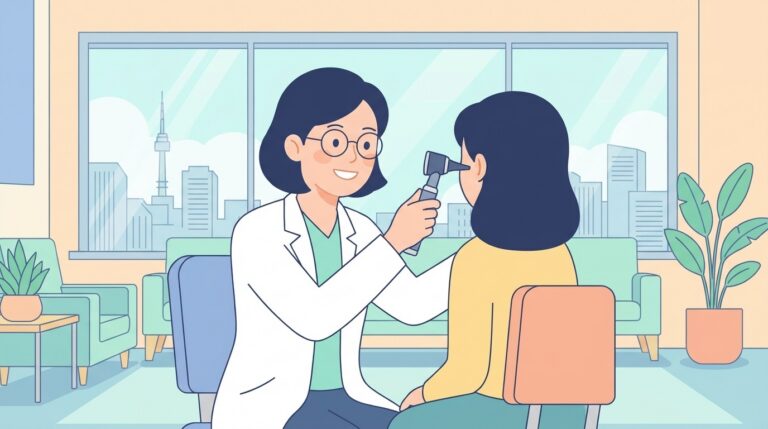
Setting: A bright, quiet ENT clinic in Mapo-gu, Seoul. You are sitting across from Dr. Min, a kind doctor holding an otoscope.
- Doctor Min: 안녕하세요, 어디가 불편해서 오셨어요? (Annyeonghaseyo, eodi-ga bulpyeon-haeseo osyeosseoyo?)
“Hello, what brings you in today? / Where is the discomfort?”
🎭 Leaning forward warmly with a gentle smile. - You: 귀에 물이 들어간 것 같아요. (Gwi-e mul-i deul-eo-gan geot gat-ayo.)
“I think water got into my ear.”
🎭 Lightly gesturing towards your right ear with a worried look. - Doctor Min: 아, 언제부터 그러셨어요? 통증도 있나요? (A, eonje-buteo geureosyeosseoyo? Tongjeung-do innayo?)
“Ah, since when has it been like that? Do you have pain as well?”
🎭 Preparing the ear camera display screen. - You: 어제부터요. 아프지는 않은데 귀 안이 먹먹해요. (Eoje-buteoyo. Apeujineun aneunde gwi an-i meongmeok-haeyo.)
“Since yesterday. It doesn’t hurt, but the inside of my ear feels muffled.”
🎭 Shaking your head gently to indicate no sharp pain. - Doctor Min: 소리가 잘 안 들리거나 울리나요? (Sori-ga jal an deulligeona ullinayo?)
“Is it hard to hear, or does sound echo?”
🎭 Tapping near his own ear to demonstrate. - You: 네, 소리가 계속 웅웅거려요. (Ne, sori-ga gyesok ung-ung-georyeoyo.)
“Yes, sounds keep echoing and humming.”
🎭 Nodding honestly. - Doctor Min: 한번 볼게요. 고개를 왼쪽으로 살짝 돌려주세요. (Hanbeon bolgeyo. Gogae-reul oenjjog-euro saljjak dollyeojuseyo.)
“Let me take a look. Please tilt your head slightly to the left.”
🎭 Gently examining your ear with the illuminated camera. - You: 네, 감사합니다. (Ne, gamsahamnida.)
“Yes, thank you.”
🎭 Sitting still and following the doctor’s gentle cue.
🔀 Interactive Choice Point
The doctor finishes cleaning out some trapped water and earwax with a tiny suction tube, then asks: “이제 좀 어떠세요?” (How does it feel now?)
- Choice A: “귀가 훨씬 시원해요! 감사합니다.” (Gwi-ga hwolssin siwonhaeyo! Gamsahamnida. – My ear feels so much clearer/refreshed! Thank you.)
- Outcome (Best): Perfect response! Koreans use 시원하다 (cool/refreshing/relieved) to describe the sensation of an unblocked ear. The doctor will smile broadly at your natural phrasing.
- Choice B: “귀가 이제 죽었어요.” (Gwi-ga ije jugeot-eoyo. – My ear is dead now.)
- Outcome (Bad): Awkward disaster! In English, slang like “I’m dead” can mean shock or relief, but in Korean, saying a body part “died” sounds like severe permanent paralysis or necrosis.
- Choice C: “약 필요 없어요! 그냥 갈게요!” (Yak piryo eopseoyo! Geunyang galgeyo! – I don’t need medicine! I’ll just leave!)
- Outcome (Risk): Culturally blunt and rude. If the doctor prescribes ear drops to prevent swimmer’s ear inflammation, abruptly refusing medicine without hearing the explanation disrupts clinical etiquette.
Phase 6: 10-Second Emotional Shadowing Drill
Practice matching these rhythm breaks (/) and emotional moods out loud:
[🥺 답답하고 걱정스럽게 - Frustrated and worried]
귀에 / 물이 들어간 것 같아요. / 귀 안이 / 너무 먹먹해요.
(Gwi-e / mul-i deul-eo-gan geot gat-ayo. / Gwi an-i / neomu meongmeok-haeyo.)
“Water seems to have gotten into my ear… / The inside feels so muffled.”-
[🤔 의아하고 불편하게 - Puzzled and uncomfortable]
말할 때마다 / 소리가 / 웅웅거려요.
(Malhal ttaemada / sori-ga / ung-ung-georyeoyo.)
“Every time I speak, / sounds keep / echoing and buzzing.” -
[😌 안도하며 정중하게 - Relieved and polite]
치료해 주셔서 / 감사합니다. / 이제 훨씬 / 시원해요!
(Chiryohae jusyeoseo / gamsahamnida. / Ije hwolssin / siwonhaeyo!)
“Thank you for treating me. / It feels so much / clearer now!”
Phase 7: K-Culture Mini Dictionary
- 이비인후과 (Ibiinhugwa) | ENT Clinic (Ear, Nose, Throat)
Look for these four Chinese characters (耳鼻咽喉科) on building directories. It combines the words for Ear (이/耳), Nose (비/鼻), Throat (인후/咽喉), and Department (과/科). - 먹먹하다 (Meongmeokhada) | Muffled / Clogged / Stuffy (sensation)
Describes physical sensory blockage in ears, but also poetically describes a heavy, choked-up heart when crying during emotional K-drama moments. - 웅웅거리다 (Ung-ung-georyeoda) | To echo / reverberate / hum
An onomatopoeic verb describing bass-heavy resonance, engine drones, or hollow auditory feedback inside blocked ears. - 처방전 (Cheobangjeon) | Medical Prescription Paper
The sheet given to you at the clinic front desk. You take this directly to any nearby pharmacy (약국, yakguk) on the same block to receive ear drops or oral medication.
Phase 8: Traveler’s Survival Kit
Top 3 Immediate Survival Expressions
- 이비인후과가 어디에 있어요? (Ibiinhugwa-ga eodi-e isseoyo?)
“Where is the nearest ENT clinic?”
Pro Tip: Ask the hotel front desk or your Airbnb host this directly if your ear is clogged. - 귀에 넣는 물약 처방해 주세요. (Gwi-e neonneun mullyak cheobanghae juseyo.)
“Please prescribe ear drops for my ear.”
Pro Tip: ‘Mullyak’ (liquid medicine) is the easiest way for beginners to specify ear drops instead of pills. - 면봉을 쓰면 안 되나요? (Myeonbong-eul sseumyeon an doenayo?)
“Should I not use cotton swabs?”
Pro Tip: Doctors will strongly advise against pushing water deeper with cotton swabs (면봉).
Editor’s Travel Note: Navigating Korean Clinics
Don’t let medical visits intimidate you! Download the 네이버 지도 앱 다운로드 (Naver Map App Download) to search for “이비인후과” nearby. Look for clinics with high star ratings and reviews mentioning “친절해요” (kind staff). Bring your passport or registration card. When you walk in, state: “진료 받으러 왔어요” (I’m here for a consultation). Most clinics handle registration seamlessly without prior appointments!
Phase 9: A Step Deeper (한 발 더 깊이)
Korean culture places immense value on rapid empathy and somatic descriptions. In the Korean language, bodily sensations are rarely described with cold, clinical distance. Instead, speakers use visceral, living words like 먹먹하다 (stifled blockage) and 웅웅거리다 (echoing hum). These words bridge the gap between patient and doctor by communicating the exact emotional texture of physical discomfort.
Furthermore, visiting a neighborhood clinic is considered a routine part of maintaining everyday wellness in Korea, not an emergency measure of last resort. There is zero stigma in getting professional ear cleaning when home remedies fail.
💬 Your Turn: Have you ever experienced water stuck in your ear while traveling abroad? How would you describe that sound or feeling in your native language? Share your story in the comments below!
Phase 10: FAQ & Common Mistakes
Q: Can I visit an ENT clinic in Korea without an appointment?
A: Yes! The vast majority of local neighborhood clinics (동네 의원) accept walk-ins. You simply sign your name at the front desk, wait a few minutes in the lobby, and see the specialist.
Q: What if I don’t have Korean National Health Insurance?
A: You can still be treated easily. Simply show your passport. An uninsured routine ear exam and cleaning typically costs between 25,000 to 45,000 KRW (approx. $18–$35 USD)—much more affordable than in many Western healthcare systems.
Q: How do I tell the doctor which ear is bothering me?
A: Use 오른쪽 귀 (oreunjjok gwi – right ear) or 왼쪽 귀 (oenjjok gwi – left ear). For example: “오른쪽 귀가 먹먹해요.” (My right ear feels muffled.)
🚨 Common Mistakes Alert
- Saying “귀가 아파요” (My ear hurts) when it only feels blocked.
Problem: The doctor might suspect acute otitis media (ear infection) instead of trapped water or earwax blockage.
Correct Action: Say “아프지는 않은데 먹먹해요” (It doesn’t hurt, but it’s muffled). - Translating “My ear is ringing” as “벨이 울려요” (A bell is ringing).
Problem: It sounds literal, like a phone ringtone is playing.
Correct Action: Use “소리가 웅웅거려요” (sounds echo/buzz) or “삐- 소리가 나요” (there is a high-pitched beep). - Attempting to dig water out with a cotton swab in front of the doctor.
Problem: Korean ENT doctors will lecture you immediately because cotton swabs push wax against the eardrum!
Correct Action: Let the doctor use their specialized medical vacuum tool (흡인기).
Phase 11: Action Missions
- 🥉 Bronze Mission (Solo Shadowing): Stand in front of a mirror and say “귀에 물이 들어간 것 같아요. 소리가 웅웅거려요.” three times smoothly without pausing.
- 🥈 Silver Mission (Voice Memo): Record a 15-second audio clip describing a fictional clogged ear using 먹먹해요 and listen to your pronunciation cadence.
- 🥇 Gold Mission (Real-Life Simulation): Next time you walk past an 이비인후과 in Korea, snap a mental photo of the sign and rehearse how you would check in at the counter.
- 🎮 K-Culture Mission: Watch an episode of a medical K-drama (like Hospital Playlist) or an outdoor variety show, and listen closely for the words 먹먹하다 or 시원하다!
Phase 12: Interactive Quiz Challenge
Test your clinic instincts with these three quick questions!
Question 1 (Scenario Judgment)
You spent the afternoon swimming at the Han River outdoor pool. Your left ear is full of water and muffled. What is the most natural sentence to say to the receptionist at the clinic?
A) 귀가 완전히 고장 났어요. (Gwi-ga wanjeonhi gojang nasseoyo.)
B) 수영하고 나서 왼쪽 귀가 먹먹해요. (Suyeonghago naseo oenjjok gwi-ga meongmeok-haeyo.)
C) 청력을 영원히 잃어버렸습니다. (Cheongryeog-eul yeong-wonhi ireobeoryeotseumnida.)
Question 2 (Fill-in-the-Blank)
Fill in the blank with the correct mimetic verb for echoing sounds:
“귀 안에서 소리가 자꾸 ______________ (echoes / buzzes).”
Question 3 (True or False Cultural Quiz)
True or False: In Korea, you must always get a referral letter from a university hospital before you are allowed to visit a local neighborhood ENT clinic (이비인후과).
👉 Click to reveal answers & explanations!
- Answer: B
Explanation: Option B is natural, polite, and describes the cause (수영하고 나서 – after swimming) and sensation (먹먹해요). Option A means “My ear broke down like a machine,” and Option C dramatically says “I have lost my hearing forever!” -
Answer: 웅웅거려요 (ung-ung-georyeoyo)
Explanation: 웅웅거리다 is the natural descriptive verb for hollow, vibrating resonance inside the ear. -
Answer: False
Explanation: Neighborhood primary clinics (동네 의원) require zero referral letters! You can walk directly in off the street anytime during operating hours.
🎬 Watch Our Daily Videos! (Daily Hangul Official Instagram)
Review the expressions you learned in this article with our fun daily short videos! Check out native pronunciation and real-life nuances in action.
- Instagram @dailyhangul_en






