

Phase 1: Empathy & Story Opening
안녕하세요! 매일한글 에디터입니다. (Hello! I’m your Daily Hangul editor.)
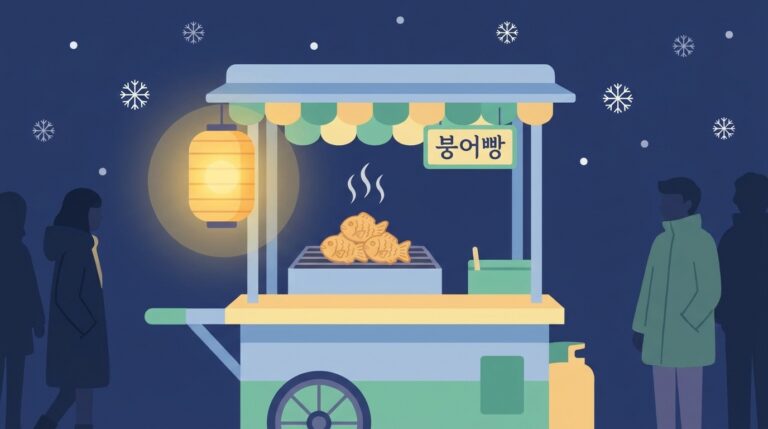
Picture this: It’s a crisp, freezing evening in Seoul. The wind is biting through your coat as you walk past the glowing entrance of a bustling subway station. Suddenly, a sweet, irresistible aroma stops you in your tracks. You turn your head and spot a quaint, yellow-tarped street stall where hot steam billows into the night air. The vendor is flipping golden, fish-shaped waffle molds on a sizzling iron grill. Your mouth waters. You know exactly what it is—bungeoppang (붕어빵)!
You walk up with confidence, excited to try both the classic sweet red bean and the rich, velvety custard cream. But as the vendor turns around and cheerfully asks, “몇 개 드릴까요?” (Myeot gae deurilkkayo? / How many would you like?), your mind goes completely blank. How do you say “custard” again? Which native Korean number counter do you use for items? You panic, point awkwardly, and end up with four red bean pastries when you desperately wanted custard.
Don’t worry, you are not alone! Over the past ten years coaching beginner Korean learners, I’ve heard this exact story dozens of times. Street food stalls move fast, which can make them intimidating for beginners. But with just one simple, modular sentence pattern, you will order like a confident local every single winter. Let’s master the art of ordering bungeoppang together!
Phase 2: Core Expressions Deep Dive
1. 슈크림 두 개, 팥 두 개 주세요 (Syukeurim du gae, pat du gae juseyo)
- Pronunciation: [Syukeurim du gae, pat du gae juseyo] (Sounds like: Shoo-k’ream doo geh, paht doo geh joo-seh-yo)
- Meaning: “Two custard cream, two red bean, please.”
- K-Culture Moment: You will hear this everywhere in Korean winter dramas and variety shows whenever friends stop at a roadside cart for a quick, heartwarming snack.
- Editor’s Insight: In Korean, the item name comes first, followed by the native number and the general item counter 개 (gae), followed by 주세요 (juseyo, please give me). 슈크림 (syukeurim) is borrowed from the French chou à la crème, and 팥 (pat) refers to sweet boiled red adzuki beans.
- Situation Spectrum: Casual: ✅ | Semi-formal: ✅ | Formal: ⚠️ (Too polite or stiff for a cozy food stall)
- 🤔 Think About It: In English, we say “two custard pastries.” In Korean, the noun comes first (슈크림), followed by count (두 개). Notice how Korean prioritizes the essence of the item before quantifying it!
2. 포장해 주세요 (Pojanghae juseyo)
- Pronunciation: [Pojanghae juseyo] (Sounds like: Poh-jahng-heh joo-seh-yo)
- Meaning: Literal: “Please pack this” / Real Nuance: “To-go, please” or “Please put it in a paper bag.”
- K-Culture Moment: Seen in romantic K-dramas where the lead buys a warm brown paper bag full of fresh pastries to tuck into their coat pocket for their crush.
- Editor’s Insight: Most bungeoppang stalls will hand your pastries over in a vintage perforated brown paper bag by default so the crust stays crunchy. Saying this confirms you want it bagged to eat as you stroll.
- Situation Spectrum: Casual: ✅ | Semi-formal: ✅ | Formal: ✅
- 🤔 Think About It: Why does Korean use the verb 포장하다 (to package) instead of “take out”? It emphasizes wrapping the food safely rather than the act of you leaving.
3. 얼마예요? (Eolmayeyo?)
- Pronunciation: [Eolmayeyo?] (Sounds like: Uht-mah-yeh-yo?)
- Meaning: “How much is it?”
- K-Culture Moment: The universal phrase heard from traditional markets to modern street stalls across Korea.
- Editor’s Insight: Street stalls often display bundle prices (e.g., 2 for 1,000 KRW or 3 for 2,000 KRW). When in doubt, asking 얼마예요? with a polite nod will instantly get you the total price.
- Situation Spectrum: Casual: ✅ | Semi-formal: ✅ | Formal: ✅
- 🤔 Think About It: At A1 level, keeping it short and polite is far better than constructing complex questions. 얼마예요? is your ultimate economic survival key!
Phase 3: Textbook Korean vs. Real Korean
- Situation 1: Specifying Your Flavor Ratio
- 📖 Textbook Korean: 슈크림 붕어빵 두 개와 팥 붕어빵 두 개를 주십시오. (Syukeurim bungeoppang du gaewa pat bungeoppang du gaereul jusipsio. – Please give me two custard fish breads and two red bean fish breads.)
- 🗣️ Real Korean: 슈크림 둘, 팥 둘 주세요! (Syukeurim dul, pat dul juseyo! – Two custard, two red bean, please!)
- 💡 Why is it different? At a bustling street cart, repeating the word 붕어빵 (bungeoppang) and using rigid formal particles like ~와 (and) sounds unnaturally robotic. Dropping the counter 개 (gae) and just saying the numbers 둘 (dul) makes you sound like an effortless local.
- Situation 2: Asking if you can pay by bank transfer
- 📖 Textbook Korean: 은행 계좌로 송금해도 되겠습니까? (Eunhaeng gyejwaro songgeumhaedo doegesseumnikka? – Would it be acceptable if I remit funds via bank account?)
- 🗣️ Real Korean: 계좌이체 돼요? (Gyejwache dwaeyo? – Is bank transfer okay?)
- 💡 Why is it different? Modern Korean street food carts rarely take foreign credit cards, but nearly all accept instant mobile transfers (계좌이체). Everyday speech prefers short, punchy verbs (돼요? = Does it work/Is it okay?).
Phase 4: K-Culture Deep Dive & Non-Verbal Manners
4-1. Nunchi (눈치) & Street Cart Gestures
Street cart interactions rely heavily on subtle, warm non-verbal communication:
* Two-Hand Rule for Payments: Even at a casual street stall, always hand your cash or card over with both hands (or your right hand supported by your left wrist). It communicates instant respect to the elder vendor (사장님, sajangnim).
* The Paper Bag Open-Top Rule: When the vendor hands you the hot paper bag, never fold the top closed immediately! Koreans keep the top wide open to let the steam escape so the crispy batter doesn’t turn soggy on the walk home.
4-2. The Great Cultural Debate: Pat-bung vs. Syu-bung (팥붕 vs. 슈붕)
In Korea, winter is defined by a passionate, friendly culinary rivalry:
* Team Pat-bung (팥붕): Purists who believe the authentic essence of bungeoppang lies in earthy, lightly sweetened red bean paste.
* Team Syu-bung (슈붕): Custard lovers who adore the warm, creamy vanilla custard bursting out of the crispy shell.
* The Personality Test: Koreans even believe your eating style reveals your character: biting the head first means you are ambitious and decisive, while biting the tail first suggests you are thoughtful and romantic!
Phase 5: Real-Life Roleplay Scenario
Setting: A steamy winter street stall right outside Exit 3 of Hongik University Station. An energetic older vendor with a bright woolen hat is tending the iron grill.
- 사장님 (Vendor): 어서 오세요! 뭐 드릴까요? (Eoseo oseyo! Mwo deurilkkayo? / Welcome! What can I get you?) 🎭 Wipes hands on an apron and smiles warmly.
- 당신 (You): 안녕하세요! 붕어빵 있어요? (Annyeonghaseyo! Bungeoppang isseoyo? / Hello! Do you have bungeoppang?) 🎭 Looks eagerly at the grill.
- 사장님 (Vendor): 그럼요! 팥이랑 슈크림 있어. (Geureomyo! Pat-irang syukeurim isseo. / Of course! We have red bean and custard cream.) 🎭 Points tongs at the fresh batch.
- 당신 (You): 슈크림 두 개, 팥 두 개 주세요! (Syukeurim du gae, pat du gae juseyo! / Two custard and two red bean, please!) 🎭 Holds up two fingers on each hand with a bright smile.
- 사장님 (Vendor): 알겠어요. 여기서 먹고 가요, 아니면 포장? (Algesseoyo. Yeogiseo meokgo gayo, animyeon pojang? / Got it. Eating here, or to-go?) 🎭 Opens a paper bag with a snap.
- 당신 (You): 포장해 주세요! (Pojanghae juseyo! / Please pack it to-go!) 🎭 Nods politely.
- 사장님 (Vendor): 네~ 4개에 3천 원이에요. (Ne~ ne gae-e samcheon won-ieyo. / Alright~ That’s 3,000 won for four.) 🎭 Places golden pastries into the paper bag.
- 당신 (You): 여기 3천 원이요. 감사합니다! (Yeogi samcheon won-iyo. Gamsahamnida! / Here is 3,000 won. Thank you!) 🎭 Hands the crisp 1,000-won bills with both hands.
🔀 Interactive Decision Point
The vendor asks: “뜨거운데 바로 먹을 거예요?” (It’s piping hot, are you going to eat it right away?). How do you reply?
- Option A: 네, 바로 먹을게요! (Ne, baro meogeulgeyo! – Yes, I’ll eat it right away!)
- 👉 Feedback (Best!): The vendor will likely hand you a small paper cup or napkin so you can grab one directly without burning your fingers. Natural and polite!
- Option B: 싫어요. (Sireoyo. – I hate it / No.)
- 👉 Feedback (Bad): 싫어요 is overly blunt and sounds like you are rejecting them angrily. To say no politely, say 괜찮아요 (Gwaenchanayo / It’s okay, thank you).
- Option C: 아니요, 집에서 먹을게요. (Aniyo, jib-eseo meogeulgeyo. – No, I will eat it at home.)
- 👉 Feedback (Good / Safe): Clear and understandable. The vendor will hand you the bag carefully and remind you not to crush it.
Phase 6: 10-Second Shadowing Drill
Practice these natural rhythm pauses (/) and emotional cues:
[😊 Cheerful & Bright]슈크림 두 개, / 팥 두 개 / 주세요! (Syukeurim du gae, / pat du gae / juseyo!)[🙋 Confident & Polite]포장해 / 주세요! (Pojanghae / juseyo!)[👀 Inquiring & Gentle]계좌이체 / 돼요? (Gyejwache / dwaeyo?)
Phase 7: K-Culture Mini Dictionary
- 붕어빵 (Bungeoppang): Fish-shaped waffle pastry filled with sweet toppings. The literal translation is “crucian carp bread,” though there is no fish in the recipe!
- 슈붕 & 팥붕 (Syubung & Patbung): Popular Korean slang abbreviations for custard bungeoppang and red bean bungeoppang respectively.
- 붕세권 (Bungsegwon): A trendy portmanteau of bungeoppang and yeoksegwon (station influence zone). It jokingly describes an apartment neighborhood blessed with nearby bungeoppang stalls.
- 계좌이체 (Gyejwache): Mobile bank-to-bank transfer. In street markets, vendors post their account numbers and bank names on laminated placards for seamless cashless payments.
Phase 8: Traveler’s Survival Kit
TOP 3 Survival Phrases for Street Food
- 하나 더 주세요 (Hana deo juseyo): “Please give me one more.” (Pro Tip: Perfect when the pastry is so heavenly you instantly need another before leaving!)
- 뜨거워요? (Tteugeowoyo?): “Is it hot?” (Pro Tip: Prevents burns on your tongue—custard fillings stay molten inside for minutes!)
- 계산해 주세요 (Gyesanhae juseyo): “Check, please / I’d like to pay.” (Pro Tip: Handy when you’ve enjoyed fish cakes and soup inside a tent stall and are ready to settle up.)
Editor’s Travel Note
- Street stalls are cash-friendly: Keep a few 1,000 KRW and 5,000 KRW bills in your wallet. If you don’t have cash, ask if 계좌이체 (bank transfer) or KakaoPay is accepted.
- Want to hunt down the closest stall like a local? Make sure to download the Naver Map app for street food navigation and search “붕어빵”—Korean netizens actively pin open stalls in real time during winter!
Phase 9: A Step Deeper (한 발 더 깊이)
In modern Seoul, sleek high-rises and automated kiosks dominate the city. Yet, the modest bungeoppang cart remains an untouchable symbol of warmth. These stalls represent Jeong (정)—the uniquely Korean bond of communal affection and unspoken empathy. When a vendor slips an extra pastry into your bag on a freezing evening with a brief “따뜻할 때 먹어요” (Eat it while it’s warm), you are experiencing the true soul of Korean hospitality.
💬 Your Turn: If you were standing at a Seoul street stall tonight, are you choosing Team Custard (슈붕) or Team Red Bean (팥붕)? Tell us your pick in the comments below!
Phase 10: FAQ & Common Mistakes
Q: Can I buy just one bungeoppang?
A: Most carts sell them in sets of two, three, or four (e.g., 2 for 1,000 or 2,000 KRW). While you can ask for 하나만 주세요 (Just one, please), ordering at least two is standard street etiquette.
Q: Can I mix flavors in one order?
A: Absolutely! That’s why today’s key phrase (슈크림 두 개, 팥 두 개 주세요) is a superstar formula. You can mix and match flavors as long as you meet the vendor’s quantity set.
Q: Are street food carts open all year round?
A: Bungeoppang is strictly a seasonal delicacy that appears from late October through early March. During summer, many vendors switch to selling waffles, roasted corn, or snacks.
🚨 Common Mistakes Warning Board
- Mistake: Using Sino-Korean numbers (이 개 주세요 – I gae juseyo).
- Correct Action: Always use Native Korean counters (하나, 둘, 셋, 넷 becoming 한 개, 두 개, 세 개, 네 개).
- Mistake: Closing the paper bag tightly immediately after purchase.
- Correct Action: Leave the top open to vent steam so your pastry stays crispy!
- Mistake: Assuming all street stalls take foreign credit cards.
- Correct Action: Always keep emergency 1,000 won bills or prepare a domestic transfer app.
Phase 11: Action Missions
- 🥉 Bronze Mission (Solo Practice): Stand in front of your mirror and say “슈크림 두 개, 팥 두 개 주세요!” 3 times in under 5 seconds without pausing.
- 🥈 Silver Mission (Social Share): Snap your favorite sweet snack today, post it to your Instagram story, and caption it with: 붕어빵 먹고 싶어요! (I want to eat bungeoppang!). Tag @DailyHangul.
- 🥇 Gold Mission (Real-World Test): Visit a local Korean supermarket, bakery, or street food stall and order using the [Item] + [Number] 개 주세요 formula!
🎮 K-Culture Mission: Next time you watch a winter K-drama episode, spot whether the characters buy bungeoppang and listen closely for the words 슈크림 (custard) or 단팥 (sweet red bean)!
Phase 12: Interactive Quiz Challenge
1. Situation Challenge:
You are at a cart and want 3 custard pastries and 1 red bean pastry. How do you order?
* A) 슈크림 삼 개, 팥 일 개 주세요.
* B) 슈크림 세 개, 팥 한 개 주세요.
* C) 슈크림 셋, 팥 하나 주십시오.
2. Fill-in-the-Blank:
To ask for your order to-go in everyday Korean, say: “________해 주세요!”
3. True or False:
Bungeoppang contains actual fish ingredients.
Click to reveal answers & explanations!
- Answer: B (슈크림 세 개, 팥 한 개 주세요)
- Explanation: When counting objects with 개 (gae), native numbers 1 (하나) and 3 (셋) change to their modifying forms 한 (han) and 세 (se).
- Answer: 포장 (Pojang)
- Explanation: 포장해 주세요 (Pojanghae juseyo) is the gold standard expression for “Please pack it to-go.”
- Answer: False
- Explanation: Bungeoppang is simply shaped like a crucian carp. The fillings are sweet red bean, custard, sweet potato, or chocolate!
- Explanation: Bungeoppang is simply shaped like a crucian carp. The fillings are sweet red bean, custard, sweet potato, or chocolate!
🎬 Watch Our Daily Videos! (Daily Hangul Official Instagram)
Review the expressions you learned in this article with our fun daily short videos! Check out native pronunciation and real-life nuances in action.
- Instagram @dailyhangul_en







