

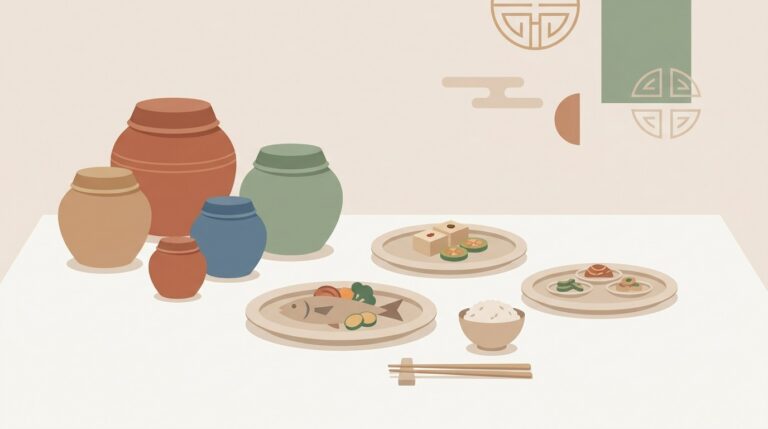
Phase 1: Empathy (Immersive Culinary Opening)
안녕하세요! 매일한글 에디터입니다. Have you ever sat across from an internationally acclaimed chef at a counter in Cheongdam-dong or Hannam-dong, watched them plate a delicate sphere of charred seasonal turnip lacquered with a fifteen-year-old ssiganjang (씨간장, heirloom seed soy sauce), and felt completely tongue-tied? You comprehend the biochemistry of microbial terroir. You appreciate how wild yeasts in nuruk (누룩) synthesize complex esters differently from French wine lees. Yet, when the sommelier asks for your sensory impressions, you find yourself retreating into flat, generic adjectives like “맛있어요” (It is delicious) or “특이해요” (It is unique).
It is deeply frustrating when your cognitive appreciation of contemporary Korean gastronomy operates at an elite level, but your linguistic repertoire traps you in kindergarten compliments. Modern Korean fine dining—championed by visionary establishments bridging temple culinary philosophy, ancestral artisanal fermentation, and modern French culinary architecture—has exploded into a global phenomenon. In these sacred spaces of haute gastronomy, discourse is not mere chit-chat; it is a shared philosophical rite.
This guide is crafted precisely for those seeking C2-level proficiency in Korean culinary rhetoric. Based on hundreds of hours dissecting sensory evaluations alongside Seoul’s elite sommeliers, culinary researchers, and native epicures, this manual will arm you with the precise linguistic apparatus required to articulate microbial terroir, sensory architecture, and contemporary narrative nuance like a true insider.
Phase 2: Core Expressions Deep Dive
1. 덧장의 세월이 빚어낸 깊은 감칠맛의 층위 (Deotjang-ui sewori bijeonaen gipeun gamchilmat-ui cheungwi)
- Pronunciation: [Deot-jjang-ui se-wo-ri bi-jeo-naen gi-peun gam-chil-ma-sui cheung-wi] (Think of deot as a crisp percussive snap like “dough” ending with a sharp “t”, transitioning into sewol like “say-wall”).
- Meaning: Literal: “The layers of deep umami forged by the passage of time in replenished mother-sauce.” / Nuanced: Captures the profound, resonant complexity of an ancient jang base that has been continually replenished over decades without breaking the microbial lineage.
- K-Culture Moment: Evident in high-stakes culinary documentaries like Culinary Class Wars or Michelin three-star counter presentations where a master chef unveils an ancestral earthenware crock (onggi) passed down through three generations.
- Editor’s Insight: Deotjang (덧장) refers to the ancestral practice of adding fresh soy brine to aged mother-sauce to perpetuate fermentation without killing living microflora. Using 층위 (layers/strata) instead of a simple word like 맛 (taste) elevates your critique to professional organoleptic analysis.
- Situation Spectrum: Casual 🚫 | Semi-formal ⚠️ | Formal/Connoisseur ✅
- 🤔 Think About It: While Western classic cuisine relies heavily on thermal reductions (glaces, demi-glaces) for umami, Korean gastronomy views time and living microorganisms as the primary reducing agents. How does your native language describe passive transformation versus active manipulation?
2. 제철 토종 식재료 본연의 미감과 발효 과학의 절묘한 접점 (Jecheol tojong sikjaeryo bon-yeon-ui migam-gwa balhyo gwahak-ui jeolmyohan jeopjeom)
- Pronunciation: [Je-cheol to-jong sik-jae-ryo bo-nyeo-nui mi-gam-gwa bal-hyo gwa-ha-gui jeol-myo-han jeop-jjeom]
- Meaning: Literal: “The exquisite convergence of the innate aesthetic of seasonal heirloom ingredients and fermentation science.” / Nuanced: A sophisticated tribute acknowledging that a dish neither masks the raw ingredient nor relies solely on fermentation, but strikes an effortless equilibrium.
- K-Culture Moment: Used by elite food critics reviewing restaurants like Onjium (온지음) or Mingles (밍글스) when evaluating wild edible greens (namul) paired with indigenous grain vinegars.
- Editor’s Insight: 미감 (aesthetic sense/taste palate) surpasses basic sensory description; it refers to the intrinsic culinary dignity of the produce. Pairing it with 절묘한 접점 (exquisite inflection point) signals that you recognize culinary restraint as an art form.
- Situation Spectrum: Casual 🚫 | Semi-formal ✅ | Formal/Connoisseur ✅
- 🤔 Think About It: In modern haute cuisine, when does manipulation of an ingredient become excessive? Reflect on how Korean cuisine balances raw nature (do-un) with microbial alchemy.
3. 전통 발효의 테루아가 현대적 조리 기법과 유려하게 맞물리네요 (Jeontong balhyo-ui teruaga hyeondaejeok jori gibeop-gwa yuryeohage manmullineyo)
- Pronunciation: [Jeon-tong bal-hyo-ui te-ru-a-ga hyeon-dae-jeok jo-ri gi-beop-gwa yu-ryeo-ha-ge mang-mul-li-ne-yo]
- Meaning: Literal: “The terroir of traditional fermentation interlocks fluidly with modern culinary techniques.” / Nuanced: You are commending the chef for avoiding clunky fusion; the regional microclimate captured in the fermentation medium forms a seamless dialogue with modern kitchen techniques (sous-vide, spherification, or French emulsification).
- K-Culture Moment: Frequently heard at table-side conversations during collaborative four-hands dinners between Seoul’s contemporary innovators and visiting Parisian three-star masters.
- Editor’s Insight: The loanword 테루아 (terroir) has been thoroughly adapted into Korean fine dining parlance to signify local airborne yeasts, mountain humidity, seasonal temperature shifts, and the microclimate of breathing onggi pottery.
- Situation Spectrum: Casual ⚠️ | Semi-formal ✅ | Formal/Connoisseur ✅
- 🤔 Think About It: Does terroir reside purely in the soil and climate, or does human bacterial lineage (son-mat) count as microbial terroir?
Phase 3: Textbook Korean vs. Real Korean
Situation 1: Describing the Deep, Funky Fermentation Aroma of Aged Doenjang or Makgeolli Lees
- 📖 교과서 한국어 (Textbook Korean):
냄새가 아주 강하고 발효가 오래된 것 같아요. (Naemsaega aju ganghago balhyoga oraedoen geot gat-ayo.)
“The smell is very strong and it seems to have been fermented for a long time.” - 🗣️ 진짜 한국어 (Real Connoisseur Korean):
쿰쿰하면서도 응축된 장향 뒤로 은은한 단맛과 산미가 매력적으로 받쳐주네요. (Kumkumhamyeonseodo eungchukdoen janghyang dwiro euneunhan danmat-gwa sanmiga maeryeokjeogeuro batchyeojuneyo.)
“Behind that funk-forward, condensed fermented aroma, a subtle sweetness and crisp acidity provide an exquisite structural backbone.” - 💡 왜 다를까? (Why the divergence?): Textbook Korean treats pungent fermented aromas with cautious or clinical terminology (강한 냄새). Cultured Korean epicures utilize evocative onomatopoeic adjectives like 쿰쿰하다 (pleasantly pungent/earthy) and praise the balance (받쳐주다) of acidity and latent sweetness.
Situation 2: Praising an Artisanal Cheongju (Clear Rice Wine) Pairing
- 📖 교과서 한국어 (Textbook Korean):
이 술은 생선 요리와 정말 잘 어울리는 조합입니다. (I su-reun saengseon yoriwa jeongmal jal eoullineun johabimnida.)
“This alcohol is a really good combination with fish dishes.” - 🗣️ 진짜 한국어 (Real Connoisseur Korean):
누룩 특유의 곡물 터치와 깔끔한 주질이 제철 흰살생선의 기름진 감칠맛을 단정하게 정돈해 주네요. (Nuruk teuk-yu-ui gongmul teochiwa kkalkkeumhan jujiri jecheol huinsalsaengseon-ui gireumjin gamchilmat-eul danjeonghage jeongdonhae juneyo.)
“The wild *nuruk grain notes and pristine liquor texture cleanly harmonize the fatty umami of the seasonal white fish.”* - 💡 왜 다를까? (Why the divergence?): Using generic terms like 어울린다 (goes well) fails to explain why the pairing functions. Sophisticated diners discuss texture (주질), grain accents (곡물 터치), and palate-cleansing efficiency (정돈해 주다).
Phase 4: K-Culture Deep Dive & Non-Verbal Manners
4-1. Nunchi (눈치) & Non-Verbal Protocol at Haute Counters
In modern Korean fine dining spaces like Mosu, KwonSookSoo, or 7th Door, the relationship between the diner, the chef, and the narrative (seosa, 서사) is contemplative.
* The Visual and Tactile Pause: When an heirloom course arrives in artisanal ceramic ware (such as buncheong or forged bronzeware yugi), do not reach immediately for your fork or chopsticks (sujeo). Take a three-second observational pause. Slightly incline your head toward the plate to observe the plating architecture and inhale the thermal steam carrying the volatile esters of the jang. This signals to the culinary team that you revere their craftsmanship.
* The Two-Handed Vessel Acknowledgement: If the chef-patron or sommelier personally pours an ancestral pairing—say, a small batch Iyangju (이양주)—cradle the base of your stemless glass or porcelain cup lightly with your left hand while holding it with your right, nodding gently with direct eye contact before bringing the rim to your lips.
4-2. Cultural Code: The Narrative Architecture of Modern Hansik
Modern Korean fine dining is not a rejection of traditional home cooking (jipbap); it is its ontological elevation. Contemporary chefs operate as historians and microbiologists. They traverse island regions (like Ulleungdo) to resurrect nearly extinct endemic botanicals and collaborate with Buddhist monastic masters to acquire 20-year aged soybean pastes. When you dine in Seoul today, you are participating in a cultural reclamation project that seeks to define Korean luxury not through truffles and caviar, but through the microbial biodiversity nurtured inside breathable clay jars.
Phase 5: Real-World Roleplay Scenario
Setting
Counter seats at ‘Mugunghwa-ro (무궁화로)’, an avant-garde one-star establishment in Bukchon. The interior smells of toasted sesame oil, cedar, and aged cedar barrels. Master Chef Kang Min-woo places a course before guest Julian.
Dialogue
셰프 강민우 (Chef Kang Min-woo):
이번 코스는 지리산 자락에서 채취한 자연산 송이버섯과 12년 숙성 씨간장으로 글레이징한 한우 채끝 등심입니다. (Ibeon koseuneun Jirisan jaraegeseo chaechwihan jayeonsan song-ibeoseot-gwa sibinyeon sukseong ssiganjang-euro geulleijinghan han-u chaekkeut deongsim-imnida.)
🎭 Presenting the burnished cast-iron vessel with calm, reverent pride.
“This course features wild pine mushrooms harvested from the foothills of Mount Jiri, paired with Korean Hanwoo striploin glazed in our twelve-year aged seed soy sauce.”
줄리안 (Julian):
시각적인 조형미뿐만 아니라, 뿜어져 나오는 훈연 향과 묵은 장의 응축된 아로마가 압도적이네요. (Sigakjeogin johyeongmibbbunman anira, ppum-eojyeo naoneun hun-yeon hyang-gwa mugeun jang-ui eungchukdoen aromaga apdojeogineyo.)
🎭 Inhales deeply with a contemplative nod, eyes tracing the glossy glaze.
“Beyond the visual sculptured elegance, the billow of smokiness married with the condensed aroma of the aged jang is breathtaking.”
셰프 강민우 (Chef Kang Min-woo):
눈치채셨군요. 일반 양조간장 대신 전통 발효 간장의 쿰쿰함을 프렌치 글라세 테크닉으로 부드럽게 감싸 안았습니다. (Nunchichaesyeotgun-yo. Ilban yangjoganjang daesin jeontong balhyo ganjang-ui kumkumham-eul peurenchi geullase tekeunik-euro budeureopge gamssa anassumnida.)
🎭 Smiles subtly, delighted by Julian’s recognition of the aromatic profile.
“You caught that. Instead of commercial soy sauce, we enveloped the earthy pungency of traditional fermented ganjang using a French glace technique.”
줄리안 (Julian):
첫 점을 입에 넣으니 산화 발효 특유의 산뜻한 산미가 지방의 농후함을 완벽하게 제어해 줍니다. (Cheot jeom-eul ib-e neoeuni sanhwa balhyo teuk-yu-ui santseut-han sanmiga jibang-ui nonghuham-eul wanbyeokhage jeeohae jumnida.)
🎭 Chews thoughtfully, closing his eyes to savor the textural transition.
“As the first bite lands on the palate, the crisp acidity unique to oxidative fermentation impeccably cuts through the unctuous marbling of the beef.”
셰프 강민우 (Chef Kang Min-woo):
함께 페어링해 드린 석탄주(惜呑酒)와의 상성은 어떻습니까? (Hamkke peeoringhae deurin Seoktanju-wa-ui sangseong-eun eotteosumnikka?)
🎭 Gestures gently toward the frosted white porcelain goblet.
“How do you find its affinity with the Seoktanju we paired for you?”
줄리안 (Julian):
누룩의 복합적인 과실향과 약주 본연의 기품 있는 잔당감이 간장의 염도와 기막힌 마리아주를 형성하네요. (Nuruk-ui bokhapjeogin gwasilhyang-gwa yakju bon-yeon-ui gipum inneun jandang-gami ganjang-ui yeomdowa gimakhin mariajureul hyeongseonghaneyo.)
🎭 Sips slowly, allowing the residual sweetness to cleanse the savory finish.
“The complex stone-fruit esters of the wild nuruk and the refined residual sugar of the yakju create an astonishing marriage against the salinity of the ganjang.”
셰프 강민우 (Chef Kang Min-woo):
전통 발효의 서사를 이토록 정밀하게 읽어주시니 요리사로서 큰 보람을 느낍니다. (Jeontong balhyo-ui seosareul itorok jeongmilhage ilgeojusini yorisaroseo keun boram-eul neukkumnida.)
🎭 Places hand over his apron in heartfelt appreciation.
“Having our narrative of traditional fermentation deciphered with such surgical precision brings immense fulfillment to our kitchen.”
줄리안 (Julian):
한국의 미생물 테루아가 현대 요리의 정점에서 어떻게 발현될 수 있는지 명확히 보여주는 코스였습니다. (Hanguk-ui misaengmul teruaga hyeondae yori-ui jeongjeom-eseo eotteoke balhyeondoel su inneunji myeonghwakhi boyeojuneun koseuyeossumnida.)
🎭 Offers a respectful bow from the chest, laying chopsticks down neatly.
“It was a masterclass course demonstrating how Korean microbial terroir can manifest at the apex of contemporary cuisine.”
🔀 Interactive Branching Point
The sommelier approaches Julian with an unexpected blind pour of a deeply golden liquid fermented from heirloom black rice and wild herbs. How do you respond?
- Option A: “이 술은 좀 달아서 고기랑 안 어울릴 것 같은데, 다른 와인으로 바꿔 주실 수 있나요?” (I su-reun jom daraseo gogirang an eoullil geot gateunde, dareun wain-euro bakkwo jusil su innayo?)
- Option B: “당도가 꽤 도드라지는데, 이 잔당감이 고기의 묵직한 마이야르 풍미와 어떻게 대비를 이루도록 설계하신 건가요?” (Dangdoga kkwae dodeurajineunde, i jandang-gami gogi-ui mukjik-han maiyareu pungmiwa eotteoke daebireul irudorok seolgyehasin geon-gayo?)
- Option C: “우와, 색깔이 엄청 예쁘네요! 사진 찍어서 인스타에 올리기 딱 좋겠어요!” (Uwa, saekkkari eomcheong yeppeuneyo! Sajin jjigeoseo inseuta-e olligi ttak jokkesseoyo!)
Detailed Analysis & Feedback
- Option A (Risk / Inept): Outright requesting a replacement before hearing the conceptual narrative disrupts the curated progression. Traditional Korean yakju pairings rely on sweet-savory dialectics (dan-jjan), not traditional Western dry structures.
- Option B (Best / Mastery Level ✅): Exceptional C2 discourse. Instead of reflexively judging sweetness, you employ technical phrasing (잔당감, 마이야르 풍미, 대비를 이루다) to invite the sommelier to articulate their pairing thesis.
- Option C (Bad / Superficial): While enthusiastic, reducing an ultra-rare artisanal spirit to Instagram fodder signals a lack of serious engagement with the gastronomy.
Phase 6: 10-Second Emotion Shadowing Drill
Sharpen your cadence using rhythmic pause markers (/) and emotional intentionality.
Drill 1
- Sentence: 전통 장의 쿰쿰한 매력이 / 현대적인 테크닉을 만나 / 놀랍도록 세련된 밸런스를 구축했네요. (Jeontong jang-ui kumkumhan maeryeogi / hyeondaejeogin tekeunik-eul manna / nollapdorok seryeondoen baelleonseu-reul guchukhaenneyo.)
- Emotion Tag:
[🍷 지적인 경탄과 세련된 어조](Intellectual marvel with composed, elite poise) - Pacing Guide: Linger on 쿰쿰한 (draw out the vowels), hit 만나 crisp and clean, then deliver 세련된 밸런스 with steady, unhurried cadence.
Drill 2
- Sentence: 누룩의 야생 효모가 자아낸 산미 덕분에 / 코스 전체의 서사가 / 한층 입체적으로 다가옵니다. (Nuruk-ui yasaeng hyomoga jaanaen sanmi deokbune / koseu jeonche-ui seosaga / hancheung ipchejeogeuro dagaomnida.)
- Emotion Tag:
[🌿 깊은 음미와 진심 어린 존경](Deep organoleptic savoring and profound respect) - Pacing Guide: Drop your vocal pitch slightly on 산미 덕분에, pause briefly after 서사가, and project quiet warmth on 입체적으로 다가옵니다.
Phase 7: K-Culture Mini Dictionary
- 씨간장 (Ssiganjang)
Literal: Seed soy sauce.
Nuance & Application: The maternal culinary DNA of a Korean house. High-end restaurants use micro-drops of 20- to 100-year-old aged soy sauce as finishing accents. When you reference 씨간장의 생명력 (the vitality of seed soy sauce), you acknowledge the lineage of living bacilli. -
누룩 테루아 (Nuruk Terroir)
Literal: Wild fermentation starter cake terroir.
Nuance & Application: Unlike Japanese koji, which utilizes a single, isolated fungal strain (Aspergillus oryzae), Korean nuruk traps diverse wild airborne molds, yeasts, and lactic acid bacteria endemic to a specific valley or granary. Highlighting this explains why a drink smells wild, rustic, or floral. -
마리아주 / 페어링 상성 (Mariaju / Peeoring Sangseong)
Literal: Marriage / Pairing affinity.
Nuance & Application: Korean epicures frequently combine the French culinary loanword 마리아주 with the traditional Sino-Korean concept of 상성 (intrinsic constitutional compatibility) when evaluating how liquor structures interact with unctuous or fermented profiles. -
손맛의 과학화 (Son-mat-ui Gwahakhwa)
Literal: The scientific systematization of the “taste of hands”.
Nuance & Application: Traditionally, son-mat was romanticized as maternal intuition or ancestral muscle memory. In contemporary gastronomy, it represents empirical microbiology—the unique personal microflora, salinity calibration, and physical pressure applied during kneading and fermentation.
Phase 8: Survival Kit for Travelers
Survival Expressions TOP 3
-
혹시 오늘 코스에 사용된 전통 장의 숙성 연도와 내력을 여쭤봐도 될까요?
(Hoksi oneul koseu-e sayongdoen jeontong jang-ui sukseong yeondowa naeryeog-eul yeojjwo-bwado doelkkayo?)
Pro Tip: Asking for both the age (숙성 연도) and lineage (내력) of the fermented seasoning immediately establishes you as an elite epicure. -
와인 페어링 대신 전통주 페어링으로 진행하고 싶은데, 산미 중심의 라인업인지 궁금합니다.
(Wain peeoring daesin jeontongju peeoring-euro jinhaenghago sipeunde, sanmi jungsim-ui rain-eob-inji gung-geumhamnida.)
Pro Tip: Clarifying if the traditional liquor progression leans toward acidity (산미) shows you understand that contemporary pairings actively steer away from overly sweet, cloying profiles. -
알레르기가 있는 것은 아니지만, 발효 강도가 높은 요리는 셰프님의 의도대로 온전히 경험해 보고 싶습니다.
(Allereugiga inneun geoseun anijiman, balhyo gangdoga nopeun yorineun syepeunim-ui uidodaero onjeonhi gyeongheomhae bogo sipsumnida.)
Pro Tip: Service staff often tone down assertive fermented pastes for non-Korean diners. This sentence politely commands the kitchen to present their unfiltered culinary vision.
Editor’s Travel Note
- Essential Reservation Platform: Secure exclusive Michelin counters through the 캐치테이블 앱 다운로드 (CatchTable Korea App) platform, which operates in English and accepts foreign credit cards. Bookings for iconic dining rooms typically open on the 1st or 15th of each month at midnight KST.
- Culinary Pilgrimage Logistics: When moving between gastronomy hubs in Gangnam and Samcheong-dong during peak evening dining hours (17:30–19:30), avoid surface taxis due to heavy congestion; rely on the Seoul Metro Line 3 (Orange Line) or Kakao T Black.
Phase 9: “One Step Deeper” (Reflective Prompt)
In conventional Western reduction cooking, the chef is a demiurge: heat, butter, and stock are wielded to bend organic matter to human will. Conversely, the Korean fermentation paradigm is an ethic of radical surrender. When a chef seals a crock of soybeans with sea salt and straw, they relinquish control to invisible consortia of Bacillus subtilis and wild fungi.
Modern Korean fine dining derives its revolutionary energy not from escaping this ancient surrender, but from staging it within the crisp geometry of modern culinary plates. The aged ssiganjang or rustic makgeolli does not hide its unruly temporal lineage; it acts as an anchor of authenticity amidst globalized modernist technique.
💬 Your Turn: Does true gastronomic luxury lie in human technical perfection, or in our ability to curate the chaotic beauty of microbial time? Share your philosophical perspective in Korean below.
Phase 10: FAQ & Misconception Buster
Q: Why do Korean chefs emphasize “acidity” (산미) so much in modern traditional liquor pairings?
A: Historically, commercial mass-market makgeolli relied on artificial sweeteners like aspartame, leading people to believe traditional alcohol is cloying. Contemporary artisanal distillers and fine-dining sommeliers celebrate wild fermentations with bright lactic and succinic acids that slice through fat, cleanse the palate, and mimic the structural tension of high-acid dry whites like Chablis or Riesling.
Q: Is it considered rude to say a dish smells “쿰쿰하다” (kumkumhada) in front of the chef?
A: Not at all, provided it is used within a proper connoisseur framework! While 쿰쿰하다 describes musty or funky aromas, when uttered with appreciation for aged jang or natural liquor, it serves as high praise for depth and biological authenticity. However, never use 쉰내 난다 (smells spoiled) or 비리다 (smells fishy).
Q: How does terroir apply to Korean Jang when the soybeans are sourced nationally?
A: Terroir in Korean fermentation is fundamentally atmospheric and ceramic. The microclimate—ambient humidity, altitude, the unique bacterial communities thriving in decades-old onggi earthenware jars, and the seasonal thermal cycles of freezing winters and sweltering monsoons—imprints a distinct bio-signature on the sauce that cannot be reproduced in a sterile stainless steel laboratory.
🚨 Common Mistakes Warning Board
- Mistake: Calling all Korean clear alcohols “Soju” (소주).
- Correct Action: Distinguish between Cheongju/Yakju (청주/약주, brewed and clarified grain wine) and Jeungnyuju (증류주, distilled artisanal spirit). Conflating a delicate 14% clarified fermented wine with distilled liquor causes immediate confusion.
- Mistake: Using Western sensory markers exclusively (e.g., comparing aged doenjang only to Marmite or Roquefort).
- Correct Action: Ground your critique in Korean organoleptic concepts first (구수함, 깊은 장맛, 단아함) before drawing cross-cultural parallels.
- Mistake: Masking discomfort with high salinity by saying “너무 짜요” (It’s too salty).
- Correct Action: Use refined descriptors such as “염도가 다소 직관적으로 다가오네요” (The salinity arrives rather assertively) to provide constructive feedback.
Phase 11: Action Missions & Engagement
- 🥉 Bronze Mission (Solo Shadowing): Stand before your mirror with a glass of water. Practice Phase 6’s two shadowing drills three times each, focusing on the throat resonance of 쿰쿰한 and the dignified descent of 구축했네요.
- 🥈 Silver Mission (Social Media Micro-Review): Post a photo of your next artisanal culinary experience on Instagram or Threads. Draft a two-sentence Korean caption employing the phrase: “[식재료] 본연의 미감과 발효 과학의 절묘한 접점” and tag @DailyHangul.
- 🥇 Gold Mission (Real-World Execution): During your next fine dining or wine bar reservation, ask the sommelier: “이 페어링은 효모의 산미와 식재료의 감칠맛 중 어느 쪽에 더 초점을 맞추신 건가요?” Report their answer in our comment section.
- 🎮 K-Culture Discovery Mission: Watch Episode 3 of Netflix’s Culinary Class Wars or the Jeong Kwan episode of Chef’s Table. Transcribe three distinct adjectives used by the culinary masters to describe aged condiments.
Phase 12: Interactive Quiz Challenge
1. Situational Judgment
You are tasting a modern reinvented dessert: fermented soybean ice cream topped with a reduction of 20-year-old soy sauce. Which reaction reflects the highest level of culinary appreciation?
* (A) 달콤하고 짭짤해서 그냥 단짠단짠 간식 같아요! (Dalkomhago jjapjjalhaeseo geunyang danjjan-danjjan gansik gat-ayo!)
* (B) 장의 염도와 카라멜라이징된 발효 풍미가 유지방과 유려하게 녹아들어 우아한 감칠맛의 여운을 남기네요. (Jang-ui yeomdowa karamellaijingdoen balhyo pungmiga yujibang-gwa yuryeohage noga-deureo uahan gamchilmat-ui yeo-un-eul namgineyo.)
* (C) 아이스크림에서 된장 냄새가 너무 심하게 나서 디저트로는 부적절합니다. (Aiseukeurim-eseo doenjang naemsaega neomu simhage nasa dijeoteuroneun bujeokjeolhamnida.)
2. Fill-in-the-Blank
씨간장은 새로운 간장을 계속 덧대어 끓이고 숙성시키는 [ ? ]의 과정을 통해 수십, 수백 년 동안 고유한 미생물 균총을 이어갑니다.
(Ssiganjang-eun saeroun ganjang-eul gyesok deotdaeeo kkeurigo sukseongsikineun [ ? ]-ui gwajeong-eul tonghae susip, subaek nyeon dong-an goyuhan misaengmul gyunchong-eul ieogamnida.)
3. Cultural True or False
True or False: The microbial profile of Korean nuruk is singular and chemically synthesized, identical across all regional traditional distillers in Gyeonggi and Jeolla provinces.
👉 Click to Reveal Answers & Master Explanations
- Answer: (B)
Explanation: Option (B) correctly dissects the interplay between salinity (염도), Maillard/caramelized fermentation notes (카라멜라이징된 발효 풍미), dairy fat (유지방), and lingering umami finish (감칠맛의 여운). Option (A) uses colloquial youth slang (단짠단짠), which diminishes the critical discourse. -
Answer: 덧장 (Deotjang)
Explanation: Deotjang is the foundational practice of replenishing ancient mother sauces with fresh batches to keep microbial lineages alive across generations. -
Answer: False
Explanation: Nuruk relies on spontaneous, non-inoculated capture of indigenous wild yeasts and fungi unique to each geographic basin, microclimate, and production facility, making it the supreme manifestation of Korean microbial terroir.
🎬 Watch Our Daily Videos! (Daily Hangul Official Instagram)
Review the expressions you learned in this article with our fun daily short videos! Check out native pronunciation and real-life nuances in action.
- Instagram @dailyhangul_en







