

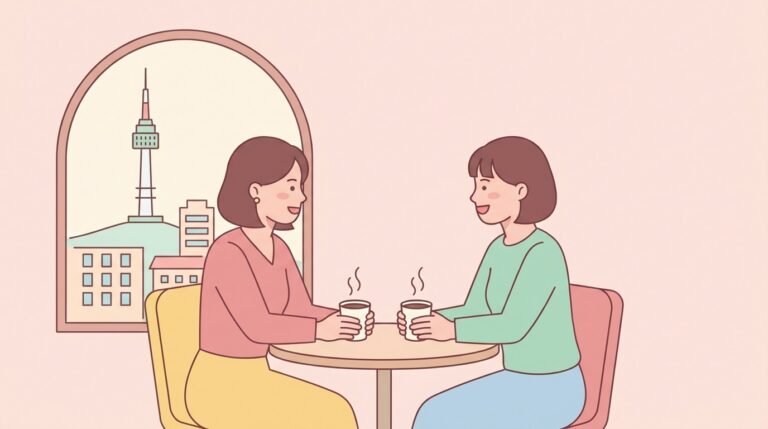
Phase 1: Empathy & K-Culture Reality Check
안녕하세요! 매일한글 에디터입니다.
Picture this: You are sitting at a bustling outdoor pocha (포장마차) in Hongdae, sharing steaming tteokbokki and chilled drinks with Korean friends you’ve grown to love. The laughter is flowing, the vibe is cozy, and everyone feels like family. Then suddenly, out of nowhere, someone drops a blunt comment about your dating life, your weight, or why you haven’t found a “real job” yet. The table chuckles, but your smile instantly turns into a frozen mask.
In Western cultures, you might raise an eyebrow and firmly say, “Hey, that’s none of your business.” But here in Korea, you hesitate. If you laugh it off, your stomach twists with resentment, and they will definitely do it again. If you snap or give a stone-cold glare (정색, jeongsaek), you instantly bring the dreaded gap-bun-ssa (갑분싸, a sudden freeze in the atmosphere) and make everyone feel terrible.
Over the past ten years coaching international learners living in Seoul, this is by far one of the most painful social tightropes foreign residents face. How do you draw a crisp line without blowing up the bond? The answer lies in Korean cultural nuance. In this guide, you will master the exact emotional vocabulary to safeguard your boundaries warmly, clearly, and naturally—just like a savvy native speaker.
Phase 2: Top 3 Core Expressions for Healthy Boundaries
1. 그건 좀 선 넘었지 (Geugeon jom seon neomeotji)
- Pronunciation: Geu-geon jom seon neo-meot-ji (Sounds like “Goo-gun jome sun num-ut-jee”)
- Meaning: Literal: “That crossed the line a bit” | Real Nuance: “Hey, that’s going a bit too far, buddy—reel it back in.”
- K-Culture Moment: You hear this constantly on Korean variety programs like Running Man or Knowing Bros. When a cast member teases someone just an inch too far, the other person chuckles lightly while flashing a firm look and calling out the “line.”
- Editor’s Insight: The magic word here is 좀 (jom, a little/a bit). It acts as an airbag. Without 좀, it sounds like an aggressive legal indictment; with 좀, it serves as a conversational yellow card that lets your friend save face while stepping back.
- Situation Spectrum: Casual ✅ | Semi-formal ⚠️ | Formal 🚫
- 🤔 Think About It: In Korean culture, why does using a spatial metaphor like “crossing a line” feel less hurtful than directly saying “You are rude”?
2. 농담이라도 그런 말은 상처받아 (Nongdam-irado geureon mareun sangcheobat-a)
- Pronunciation: Nong-dam-i-ra-do geu-reon ma-reun sang-cheo-ba-da (Sounds like “Nong-dahm-ee-rah-doh goo-run mah-run sahng-chuh-bah-dah”)
- Meaning: Literal: “Even if it’s a joke, words like that get hurt” | Real Nuance: “I know you’re only teasing, but that actually stung me. Please don’t say that.”
- K-Culture Moment: A staple in emotional slice-of-life K-dramas (think Reply 1988 or Hospital Playlist) where childhood besties talk late at night on a park bench after an insensitive remark caused friction.
- Editor’s Insight: By using the construction 상처받아 (sangcheobat-a, I get hurt), you utilize classic “I-statements.” You acknowledge their intent was humor (농담이라도), which disarms their defensiveness, while making your emotional reality undeniable.
- Situation Spectrum: Casual ✅ | Semi-formal ✅ | Formal 🚫
- 🤔 Think About It: How does validating their comedic intent stop the speaker from countering with the classic excuse: “Hey, can’t you take a joke?”
3. 우리 친하지만 그 얘기는 안 했으면 좋겠어 (Uri chin-hajiman geu yaegineun an haesseumyeon jokgesseo)
- Pronunciation: U-ri chin-ha-ji-man geu yae-gi-neun an haes-seu-myeon jok-ges-seo (Sounds like “Oo-ree cheen-hah-jee-mahn goo yeh-ghee-neun ahn heh-ssu-myun jote-get-so”)
- Meaning: Literal: “We are close, but I’d prefer it if we didn’t talk about that” | Real Nuance: “I value our friendship so much that I need us to steer clear of this sensitive topic.”
- K-Culture Moment: Two close colleagues or college classmates having an earnest one-on-one conversation over coffee when one person asks an overly intrusive family question.
- Editor’s Insight: The structure
[Relationship Affirmation] + [Clear Boundary]is the gold standard of adult communication in Korea. Starting with 우리 친하지만 (uri chin-hajiman) reassures the listener that the bond itself is safe. - Situation Spectrum: Casual ✅ | Semi-formal ✅ | Formal ⚠️
- 🤔 Think About It: In high-context cultures where group harmony is valued, why is reaffirming closeness essential before delivering a boundary?
Phase 3: Textbook Korean vs. Real Korean
Situation 1: Shutting down intrusive questions about dating or personal matters
- 📖 교과서 한국어 (Textbook): 제 사생활에 대해 간섭하지 마세요. (Je sasaenghware daehae ganseophaji maseyo. / Please do not interfere with my personal life.)
- 🗣️ 진짜 한국어 (Real-life): 에이, 그건 내 프라이버시니까 노코멘트할래! (Ei, geugeon nae peuraibeosinikka nokomeonteuhallae! / Come on, that’s my privacy, so I’m pleading the fifth!)
- 💡 왜 다를까? Textbook phrases sound like an excerpt from a restraining order. Real Koreans often use lighthearted Konglish words like 프라이버시 (privacy) or 노코멘트 (no comment) coupled with an upbeat delivery to signal an ironclad boundary with a smile.
Situation 2: Stopping unsolicited body or appearance comments
- 📖 교과서 한국어 (Textbook): 외모에 대한 지적은 매우 불쾌합니다. (Oemoe daehan jijeogeun maeu bulkwaehamnida. / Remarks regarding appearance are very offensive.)
- 🗣️ 진짜 한국어 (Real-life): 야, 내 외모 평가는 정중히 사양할게~ (Ya, nae oemo pyeong-ganeun jeongjunghi sayanghalge~ / Hey, I’ll politely pass on the appearance critique, thanks~)
- 💡 왜 다를까? 사양할게 (sayanghalge, I decline/pass) is traditionally used to decline food or gifts. Using it playfully for unsolicited opinions highlights that the comment was an unwanted “gift,” defusing the tension instantly.
Phase 4: K-Culture Deep Dive & Non-Verbal Manners
4-1. Nunchi & Physical Body Language
When setting a boundary in Korea, your non-verbal cues (비언어적 태도) carry 70% of the message:
* The 2-Second Smile Pause: When the boundary-crossing comment happens, do not laugh politely. Stop smiling, maintain gentle eye contact for 2 seconds, and then speak calmly. That 2-second stillness triggers their Nunchi (눈치, social radar) without you having to yell.
* Open Palms, Not Pointing: Never point your index finger (손가락질), as it is viewed as aggressive confrontation. Instead, keep both hands resting on the table or place a palm softly on your chest to convey: “This is about my inner feelings, not an attack on you.”
4-2. The Cultural Meaning of “Seon” (선, The Line)
In traditional Korean culture, Jeong (정, deep bonding affection) often meant having zero boundaries. People asked about your salary, your weight, and your marital plans because in a collectivist village, “caring” meant knowing everything.
However, in contemporary Korea—especially within modern media like Workman and YouTube talk shows such as No Prepare (차린건 쥐뿔도 없지만)—the concept of 선을 지키다 (seoneul jikida, keeping the line) has become the supreme social virtue. Modern Koreans believe: “The closer we are, the more we must preserve each other’s private line.”
Phase 5: Real-World Roleplay Scenario
- Location: A lively chicken & beer (Chimaek) pub in Sinchon, Seoul.
- NPC Character: Min-ho (민호), your extroverted Korean university classmate who means well but occasionally teases without thinking.
[1] 민호: 야, 너 요즘도 연애 안 해? 나이 더 차기 전에 눈 좀 낮춰야 하는 거 아냐?
(Ya, neo yojeumdo yeonae an hae? Nai deo chagi jeone nun jom natchwoya haneun geo anya?)
"Hey, you still not dating anyone? Shouldn't you lower your standards before getting any older?"
[🎭 맥주잔을 부딪치며 짓궂게 씩 웃는다 - Clinking beer glasses with a mischievous grin]

[2] 나: 민호야, 에이~ 그건 좀 선 넘었지!
(Minhoya, ei~ geugeon jom seon neomeotji!)
"Min-ho, hey now~ that crossed the line a bit!"
[🎭 웃던 표정을 차분하게 가다듬고 민호의 눈을 똑바로 본다 - Dropping the smile, looking into his eyes calmly]

[3] 민호: 아, 왜 그래? 그냥 친하니까 장난친 건데 진지해지네.
(A, wae geurae? Geunyang chin-hanikka jangnanchin geonde jinjihyeojine.)
"Ah, what's up with you? I was just joking because we're close, don't get so serious!"
[🎭 당황한 듯 머리를 긁적이며 닭다리를 내려놓는다 - Scratching head awkwardly, putting down chicken]

[4] 나: 농담인 건 아는데, 반복해서 들으니까 솔직히 좀 상처받아.
(Nongdamin geon aneunde, banbokhaeseo deureunikka soljikhi jom sangcheobat-a.)
"I know you're joking, but hearing it repeatedly honestly hurts my feelings."
[🎭 담담하지만 부드러운 어조로 말한다 - Speaking in a composed yet gentle tone]

[5] 민호: 아... 진짜? 난 너 재미있으라고 한 건데, 기분 상했으면 미안해.
(A... jinjja? Nan neo jaemi-isseurago han geonde, gibun sanghaesseumyeon mianhae.)
"Ah... really? I just wanted to make you laugh. If I hurt your feelings, I'm truly sorry."
[🎭 눈치를 살피며 조심스럽게 사과한다 - Watching your reaction carefully, apologizing cautiously]

[6] 나: 우리 친하잖아. 그래서 앞으로도 편하게 보려고 솔직히 말한 거야.
(Uri chin-hajana. Geuraeseo apeurodo pyeonhage boryeogo soljikhi malhan geoya.)
"We're close friends. That's why I'm being honest, so we can stay comfortable with each other."
[🎭 따뜻한 미소를 지으며 민호에게 맥주를 따라준다 - Giving a warm smile, pouring beer for Min-ho]

[7] 민호: 그래, 내가 생각이 짧았다! 연애 얘기는 이제 패스! 자, 마시자!
(Geurae, naega saeng-gagi jjalbatda! Yeonae yaegineun ije paeseu! Ja, masija!)
"Right, I was thoughtless! Let's pass on the dating topic for good. Cheers!"
[🎭 안도하며 밝게 잔을 들어 올린다 - Lifting his glass with relief and energy]

[8] 나: 좋아, 건배하자!
(Joa, geonbaehaja!)
"Sounds great, cheers!"
[🎭 잔을 시원하게 맞부딪친다 - Clinking glasses cheerfully]
🔀 Interactive Branching Moment
If Min-ho made that insensitive comment, what would you choose?
* Option A: “야, 닥쳐. 네 인생이나 똑바로 살아.” (Shut up, go fix your own life.)
* ❌ Result [BAD]: Nuclear reaction. You created a massive fight in public, completely destroyed the social atmosphere, and made reconciliation nearly impossible.
* Option B: (억지로 웃으며) “아하하… 그래? 내가 문제인가 봐…” (Laughing nervously: Haha, yeah? I guess I’m the problem…)
* ⚠️ Result [RISK]: Doormat trap. Min-ho assumes you don’t mind and will tease you even harder next time, leaving you emotionally exhausted.
* Option C: “민호야, 농담이라도 그 얘기는 그만하자. 나 진짜 불편해.” (Min-ho, even as a joke let’s stop that topic. I feel really uncomfortable.)
* ✅ Result [BEST]: Elegant mastery. You addressed the topic directly without attacking his personality, preserving both your self-respect and the friendship.
Phase 6: 10-Second Emotion Shadowing Drill
Practice these three key lines aloud. Pay close attention to the pause markers (/) and the emotional guidance tags:
[😐 단호하지만 차분하게 / Calm and firm]
민호야, / 그건 좀 / 선 넘었지!
(Minhoya, / geugeon jom / seon neomeotji!)-
[🥺 솔직하고 담백하게 / Honest and grounded]
농담이라도 / 그런 말은 / 솔직히 상처받아.
(Nongdam-irado / geureon mareun / soljikhi sangcheobat-a.) -
[🤝 다정하면서도 명확하게 / Warm yet crystal clear]
우리 친하니까 / 이런 얘기는 / 서로 조심하자.
(Uri chin-hanikka / ireon yaegineun / seoro josimhaja.)
Phase 7: K-Culture Mini Dictionary
- 선 넘다 (Seon neomda) | To cross the line
- Originating as slang, this phrase is now ubiquitous in daily conversation, variety shows, and corporate boardrooms to denote crossing interpersonal etiquette.
- 정색하다 (Jeongsaekhada) | To suddenly turn stone-faced / dead serious
- The act of instantly wiping a smile from one’s face. While sometimes necessary, doing it too abruptly can shock Korean acquaintances.
- 눈치 챙기다 (Nunchi chaeng-gida) | To activate one’s social radar / be perceptive
- Used when someone lacks awareness and says something awkward. Friends will tell each other, “눈치 좀 챙겨!” (Read the room!).
- 뼈 때리다 (Ppyeo ttaerida) | To hit right in the bone (hit a painful truth)
- When someone’s teasing isn’t just playful banter, but hits an insecure spot with painful accuracy.
Phase 8: Survival Kit for Travelers & Expats
TOP 3 Boundary Survival Expressions
- 그 질문은 조금 부담스러워요. (Geu jilmuneun jogeum budamseureowoyo. / That question is a bit overwhelming/burdensome for me.)
- Pro Tip: Perfect for well-meaning older adults (택시 기사님, 식당 이모님) asking about your income, religion, or relationship status.
- 제가 알아서 잘 할게요~ (Jega araseo jal halgeyo~ / I will take care of it myself, don’t worry~)
- Pro Tip: The ultimate shield against intrusive advice regarding your career, diet, or life decisions.
- 오늘은 그 얘기 패스할래요! (Oneureun geu yaegi paeseuhallae! / I’d like to take a pass on that topic today!)
- Pro Tip: High-energy, casual way to deflect awkward chatter during group hangouts.
Editor’s Travel Note
If you find it nerve-wracking to deliver boundaries face-to-face, sending a polite KakaoTalk message right after the meeting is completely acceptable in Korea! You can use the KakaoTalk messenger app download to stay connected. When setting up an honest conversation with a friend, pick a quiet aesthetic café using the Naver Map search app rather than a noisy pub.
Phase 9: A Step Deeper (한 발 더 깊이)
For generations, Korean society was built upon the concept of Uri (우리, “we/us”), where privacy was minimal because everyone took collective responsibility for the tribe. However, as modern Korea embraces individual identity, a new interpersonal philosophy has emerged: true respect means knowing where “I” ends and “You” begins. Establishing a boundary is not an act of rejection; it is an invitation to build a friendship that lasts for decades.
💬 Your Turn: Have you ever experienced a moment when a Korean friend or colleague asked a question that felt way too personal? How did you react? Share your story in the comments below!
Phase 10: FAQ & Avoiding Misunderstandings
Q: Won’t saying “그건 좀 선 넘었지” make my Korean friend angry?
A: Not if your vocal delivery is relaxed! If you shout it with clenched fists, they will get defensive. But if you deliver it with a half-smile, steady eye contact, and a relaxed posture, it acts as a friendly warning beep that native speakers use all the time.
Q: Can I use these phrases with my Korean boss or older professors?
A: No. These phrases are tailored for peer-level relationships (friends, classmates, close colleagues of similar age). For elders or superiors, use honorific deflection: “그 부분은 말씀드리기 조금 조심스럽습니다.” (Geu bubuneun malsseumdeurigi jogeum josimseureopseumnida – “I feel a bit cautious discussing that topic.”)
Q: What if my friend replies: “너 왜 이렇게 예민해?” (Why are you so sensitive?)
A: This is a classic gaslighting deflection. Remain calm and respond: “예민한 게 아니라, 서로 조심하자는 거지.” (Yeminhan ge anira, seoro josimhajaneun geoji. – “It’s not about being sensitive; it’s about being considerate of each other.”)
🚨 Common Mistakes Alert
- The Icy Silent Stare (정색): Abruptly dropping your facial expression into stone-cold silence kills the mood and creates awkward resentment. Correct Action: Maintain a relaxed, soft gaze while speaking clearly.
- Giggling While Protesting: If you laugh out loud while saying “하지 마~” (Don’t do that~), Koreans perceive it as playful encouragement (애교 or fake protest). Correct Action: Pause your laughter for 2 full seconds before stating your boundary.
- Accusing the Person Directly: Saying “너 진짜 예의 없다” (You have zero manners) attacks their dignity. Correct Action: Focus on the topic or your feelings using 그 얘기 (that topic) or 상처받아 (I feel hurt).
Phase 11: Action Missions
- 🥉 Bronze Mission (Solo Practice): Stand before a mirror. Practice saying “그건 좀 선 넘었지!” with a calm expression 5 times until it feels effortless.
- 🥈 Silver Mission (Social Media): Find a K-Drama scene where a character draws a line and share it on Instagram or Threads tagging #DailyHangulBoundaries.
- 🥇 Gold Mission (Real Life): The next time anyone asks an uncomfortable question, smoothly deflect it using: “오늘은 그 얘기 패스할래요!”
- 🎮 K-Culture Scavenger Hunt: Watch any episode of the variety show Running Man or Workman and count how many times the caption or cast uses the word 선 (Line)!
Phase 12: Interactive Quiz Challenge
Test your real-world boundary skills below!
1. [Situation Judgment] You are drinking with close Korean classmates, and one keeps teasing you about your past ex. What is the most culturally savvy response?
* (A) 술상을 엎고 나간다. (Flip the table and storm out.)
* (B) “야, 그건 좀 선 넘었지! 다른 얘기 하자.” (Say: “Hey, that crossed the line a bit! Let’s talk about something else.”)
* (C) 아무 말 없이 고개를 숙이고 운다. (Stay silent, look down, and cry.)
2. [Fill in the Blank] Fill in the missing verb to state your feelings warmly:
* “농담이라도 그런 말은 솔직히 [_________].”
(Even as a joke, those words honestly hurt me.)
3. [True or False] In Korea, because close friends share deep affection (정), setting personal boundaries is considered an insult to the friendship.
* (True / False)
👉 Click here to check the answers and explanations!
1. Answer: (B)
Explanation: Option B establishes a firm boundary using 선 넘었지 while smoothly offering a conversational exit (다른 얘기 하자), keeping the friendship intact without being a doormat.
2. Answer: 상처받아 (sangcheobat-a)
Explanation: 상처받다 means “to receive a wound / to be hurt.” Expressing this clearly clarifies the emotional consequence of their teasing.
3. Answer: False
Explanation: While traditional culture prioritized collectivism, modern Korean friendship etiquette strongly highlights 친할수록 예의를 지켜야 한다 (“The closer you are, the more courtesy you must keep”).
🎬 Watch Our Daily Videos! (Daily Hangul Official Instagram)
Review the expressions you learned in this article with our fun daily short videos! Check out native pronunciation and real-life nuances in action.
- Instagram @dailyhangul_en







