

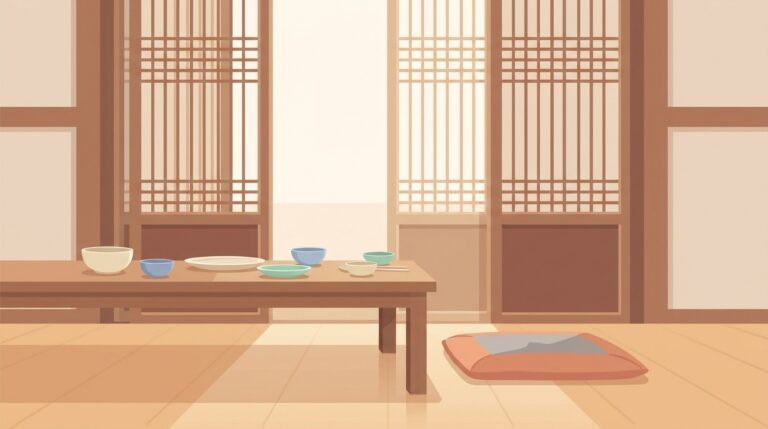
Master Korean Business Dining: The Art of Reserving Private Rooms and Mastering Seating Etiquette
Phase 1: Empathy (Story-Driven Opening)
안녕하세요! 매일한글 에디터입니다. (Hello! It’s your Daily Hangul editor!)
Picture this: You are closing a landmark partnership deal with a major Korean corporation in Seoul. Your counterpart suggests dinner to finalize the details. Eager to impress, you pick a trendy, Michelin-recommended spot in Gangnam. But the moment you arrive, your stomach drops. The dining hall is a chaotic symphony of sizzling grill plates, clinking soju glasses, and loud laughter bouncing off exposed concrete walls. Every time you lean in to discuss sensitive contract terms, a server swoops in to flip the meat, or your counterpart has to shout, “네? 뭐라고 하셨죠?” (Ne? Mworago hasyeotjyo? / “Pardon? What did you say?”). You catch your guest subtly checking their watch, and the confidential pricing strategy you wanted to share remains locked in your briefcase.
If you have ever felt that cold sweat during a professional meeting in Korea, you are not alone. In K-dramas like Misaeng (미생) or Reborn Rich (재벌집 막내아들), notice where real power shifts occur: never in open-floor barbecue joints, but behind the hushed sliding doors of a refined hanjeongsik (traditional multi-course) or upscale sushi restaurant. In Korean corporate culture, securing a private room—geobyeol rum (개별 룸)—is not merely about quiet dining; it is a profound declaration of respect, discretion, and strategic hospitality (jeopdae, 접대).
Drawing from years of coaching global executives and intermediate learners (B2), this guide breaks down the exact phrases, acoustic etiquette, and subtle seating hierarchies (sangseok, 상석) you need to navigate high-stakes Korean business dinners effortlessly. By the end of this guide, you will know exactly how to book the right space, guide your VIP to their seat, and orchestrate an evening that seals the deal.
Phase 2: Core Expressions Deep Dive
Here are three essential B2-level phrases that will immediately elevate your professional Korean.
1. 조용히 이야기 나눌 수 있게 룸으로 예약했습니다.
- Hangul & English: 조용히 이야기 나눌 수 있게 룸으로 예약했습니다. (Joyonghi iyagi nanul su itge rumeuro yeyakhaessseumnida. / I reserved a private room so we could speak quietly.)
- Pronunciation: [Jo-yong-hee ee-ya-gi na-nul su it-ge roo-meu-ro ye-yak-haet-seum-ni-da]. (Think of joyonghi starting soft like “joy”, and rum sounding just like “room” with a clean Korean ‘u’ vowel).
- Meaning: Literal: “In order to share stories quietly, I reserved with a room.” / Actual Nuance: “I purposely secured a discreet, private dining room so our confidential business discussion remains comfortable and undisturbed.”
- K-Culture Moment: The dependable project manager walking a prospective investor into an upscale Hannam-dong venue before opening their proposal folder.
- Editor’s Insight: The connective suffix
-게(-ge) indicates purpose (“so that…”). Using 이야기 나누다 (to share conversation) instead of simply 말하다 (to speak) adds warmth and mutual respect.- Situation Spectrum: Casual 🚫 | Semi-formal ⚠️ | Formal ✅
- 🤔 Think About It: In many Western settings, a lively bistro implies popularity and energy. Why does Korean business culture prioritize complete sonic isolation for important discussions?
2. 안쪽 편안한 상석으로 모시겠습니다.
- Hangul & English: 안쪽 편안한 상석으로 모시겠습니다. (Anjjok pyeon-an-han sangseogeuro mosigesseumnida. / Allow me to escort you to the comfortable head seat inside.)
- Pronunciation: [An-jjok pyeon-an-han sang-seo-geu-ro mo-shi-get-seum-ni-da]. (The double consonant jj in anjjok should snap sharply like the ‘c’ in “crisp”).
- Meaning: Literal: “I will serve/guide you toward the inner comfortable upper seat.” / Actual Nuance: “Please take the seat of honor away from the door where you can relax.”
- K-Culture Moment: An executive assistant guiding a partner CEO to the booth seat facing the landscape window, furthest from hallway traffic.
- Editor’s Insight: 모시다 (mosida) is the honorific equivalent of 데려가다 (to bring/guide). Using 상석 (seat of honor) acknowledges the counterpart’s social and professional status without sounding subservient.
- Situation Spectrum: Casual 🚫 | Semi-formal ⚠️ | Formal ✅
- 🤔 Think About It: How does your native language verbally designate the “host” versus the “guest of honor” at a dining table?
3. 대화가 밖으로 새어 나가지 않는 정갈한 곳입니다.
- Hangul & English: 대화가 밖으로 새어 나가지 않는 정갈한 곳입니다. (Daehwaga bakkeuro saeeo nagaji anneun jeonggalhan gosimnida. / It is a neat and refined establishment where our conversation will not leak outside.)
- Pronunciation: [Dae-hwa-ga bak-keu-ro sae-eo na-ga-ji an-neun jeong-gal-han go-shim-ni-da]. (The word jeonggal rolls smoothly like “jung-gahl”).
- Meaning: Literal: “A neat place where talk does not leak outside.” / Actual Nuance: “This is a clean, reputable restaurant with excellent soundproofing, ensuring our privacy.”
- K-Culture Moment: An experienced legal consultant assuring their client that their dinner conversation remains 100% confidential.
- Editor’s Insight: 정갈하다 (jeonggalhada) is a high-level B2/C1 adjective describing food, interior, and atmosphere that is impeccably clean, balanced, and dignified.
- Situation Spectrum: Casual 🚫 | Semi-formal ⚠️ | Formal ✅
- 🤔 Think About It: The verb 새어나가다 (to leak out) treats sensitive words as precious liquid. What does this metaphor say about trust in professional relationships?
Phase 3: Textbook Korean vs. Real Korean
Situation 1: Calling a venue to verify room soundproofing
- 📖 교과서 한국어 (Textbook): 이 식당은 조용합니까? 방이 있습니까? (I sikdangeun joyonghamnikka? Bang-i itseumnikka? / Is this restaurant quiet? Do you have rooms?)
- 🗣️ 진짜 한국어 (Real-life): 중요한 비즈니스 미팅이라 그런데, 방음 잘되는 개별 룸으로 배정 가능할까요? (Jung-yohan bijeuniseu miting-ira geureonde, bang-eum jal-doeneun gaebyeol rumeuro baejeong ganeunghalkkayo? / This is an important business meeting; would it be possible to assign us an individual room with good soundproofing?)
- 💡 왜 다를까? (Why is it different?): Textbook queries sound blunt and robotic. Native speakers soften inquiries with context (-라 그런데, “Since it is…”) and specify 개별 룸 (individual private room) and 방음 (soundproofing) so the venue doesn’t place them in a partitioned room divided only by thin sliding screens.
Situation 2: Directing your guest to take their seat
- 📖 교과서 한국어 (Textbook): 여기에 앉으세요. (Yeogie anjeuseyo. / Sit here.)
- 🗣️ 진짜 한국어 (Real-life): 안쪽 상석으로 모시겠습니다. 편하게 앉으세요. (Anjjok sangseogeuro mosigesseumnida. Pyeonhage anjeuseyo. / Allow me to guide you to the head seat inside. Please make yourself comfortable.)
- 💡 왜 다를까? (Why is it different?): Telling a senior guest 여기 앉으세요 can sound like an imperative command. Specifying 안쪽 (the inner area) and 상석 explicitly shows you respect social hierarchy and have planned the arrangement in advance.
Phase 4: K-Culture Deep Dive & Non-Verbal Manners
4-1. 눈치 (Nunchi) & Gestures: The Architecture of Seating Hierarchy
In Korea, table geography speaks louder than words. The golden rule of Sangseok (상석, Head Seat) is simple: furthest from the entrance, facing the door.
* The Logic: The person seated in the Sangseok should never have servers or patrons walking behind their back. They should have a clear, commanding view of the entrance and the room’s decor.
* The Host’s Seat (Malseok, 말석): As the host or junior representative, you sit closest to the door (chul-ipgu, 출입구). Why? Because you are responsible for signaling servers, receiving side dishes, pouring water, and settling the bill without disturbing the guest.
* The Guiding Gesture: Never point with a single index finger when ushering someone to a seat. Extend your full hand with fingers gently held together, palm angled slightly upward at a 45-degree angle, motioning smoothly toward the inner chair.
4-2. Cultural Code: The Evolution of Jeopdae (접대) Culture
While 1990s K-dramas depicted business dining as heavy drinking marathons in noisy barbecue joints, modern corporate Korea operates under strict corporate compliance laws (such as the Kim Young-ran Act). Today’s business dining centers on culinary refinement, privacy, and curated atmosphere. Venues specializing in Hanjeongsik (traditional multi-course), modern Korean fine dining, or private room omakase have become the standard battleground for corporate deal-making. Offering a quiet, private room signals to your counterpart that their time is valued and their corporate privacy is bulletproof.
Phase 5: Real-Life Roleplay Scenario
Setting: Cheongdam Hanok Dining, an upscale private-room restaurant in Seoul.
Characters:
* Alex (알렉스): Regional Director at a global tech firm.
* Director Park (박 전무): Senior Executive from a Korean partner conglomerate.
Turn 1: Alex
🎭 (Bows at a 30-degree angle, opening the sliding door of the private room)
박 전무님, 먼 길 오시느라 고생 많으셨습니다.
(Bak jeonmunim, meon gil osineura gosaeng maneusyeotseumnida.)
“Director Park, thank you so much for making the long trip here.”
Turn 2: Director Park
🎭 (Smiles warmly, glancing around the serene wooden interior)
아닙니다, 알렉스 이사님. 식당 분위기가 아주 단아하고 좋네요.
(Animnida, Allekseu isanim. Sikdang bunwigiga aju danahago jonneyo.)
“Not at all, Director Alex. The atmosphere of this restaurant is exceptionally elegant and lovely.”
Turn 3: Alex
🎭 (Extends an open palm toward the plush inner seat facing the door)
대화가 외부로 새어 나가지 않고 조용하게 이야기 나눌 수 있도록 프라이빗 룸으로 예약했습니다. 안쪽 상석으로 모시겠습니다.
(Daehwaga oeburo saeeo nagaji anko joyonghage iyagi nanul su itdorok peuraibit rumeuro yeyakhaessseumnida. Anjjok sangseogeuro mosigesseumnida.)
“I booked a private room so confidential business talk could flow quietly without leaking outside. Please let me escort you to the head seat inside.”
Turn 4: Director Park
🎭 (Nods approvingly and takes the seat with relaxed shoulders)
배려해 주셔서 감사합니다. 요즘 식당들이 워낙 시끄러워서 미팅하기 힘든데, 참 센스 있으시네요.
(Baeryeohae jusyeoseo gamsahamnida. Yojeum sikdangdeuri wonak sikkeureowoseo mitinghagi himdeunde, cham senseu itseusineyo.)
“Thank you for your thoughtfulness. Restaurants are so noisy these days that holding meetings is difficult; you have great taste and sense.”
Turn 5: Alex
🎭 (Takes the seat closest to the door, unfolding the napkin onto their lap)
정갈한 코스 요리로 준비했으니, 오늘 편안하게 식사하시면서 말씀 나누시죠.
(Jeonggalhan koseu yoriro junbihaesseuni, oneul pyeon-anhage siksahasimyeonseo malsseum nanusijo.)
“We have prepared a refined course meal, so let’s enjoy our meal comfortably today as we talk.”
Turn 6: Director Park
🎭 (Unbuttons suit jacket, leaning forward with genuine interest)
좋습니다. 지난번 보내주신 제안서 내용부터 편하게 짚어볼까요?
(Joseumnida. Jinanbeon bonaejusin jeanseo naeyongbuteo pyeonhage jipeobolkkayo?)
“Excellent. Shall we casually go over the proposal points you sent over last time?”
Turn 7: Alex
🎭 (Gently pours water into Director Park’s glass with two hands)
네, 전무님. 식사 중간에 천천히 검토해 주시면 감사하겠습니다.
(Ne, jeonmunim. Siksa junggan-e cheoncheonhi geomtohae jusyimyeon gamsahagetseumnida.)
“Yes, Director. I would appreciate it if we could review it at your pace throughout dinner.”
Turn 8: Director Park
🎭 (Takes a sip of tea, visibly relaxed)
덕분에 오늘 좋은 결과가 나올 것 같습니다.
(Deokbune oneul joeun gyeolgwaga naol geot gatseumnida.)
“Thanks to your arrangement, I feel we will achieve great results today.”
🔀 Interactive Decision Point
As the server enters with the first course, Director Park notices the wine menu and asks if you would like to order a bottle. How do you respond?
- Option A: “저는 술 안 마시는데 전무님 드시고 싶은 걸로 아무거나 시키세요.” (Jeoneun sul an masineunde jeonmunim deusigo sipeun geollo amugeotna sikiseyo. / “I don’t drink, so order whatever you want.”)
- 🚫 Risk: Cold and dismissive. In business hospitality, bluntly saying “order whatever you want” places conversational burden on the guest and dampens the celebratory rapport.
- Option B: “전무님, 귀한 자리인 만큼 이곳의 대표 전통주나 선호하시는 와인으로 한 병 모셔도 될까요?” (Jeonmunim, gwihan jari-in mankeum igosui daepyo jeontongjuna seonhohasineun wain-euro han byeong mosyeodo doelkkayo? / “Director, since this is a special occasion, may I order a bottle of their signature traditional liquor or your preferred wine?”)
- ✅ Best: Shows high respect, proactive hosting, and allows the guest to choose while establishing a refined celebratory tone.
- Option C: “비즈니스 이야기해야 하니까 술은 빼고 탄산음료로 하시죠.” (Bijeuniseu iyagihaeya hanikka sureun ppaego tansan-eumryoro hasijo. / “We need to talk business, so let’s skip alcohol and have soda.”)
- ⚠️ Bad: Overly rigid. While alcohol is never mandatory, outright vetoing it before gauging the guest’s mood can create unnecessary friction.
Phase 6: 10-Second Emotion Shadowing Drill
Practice reading these sentences aloud, following the emotional cues and pauses (/).
[💼 정중하고 신뢰감 있게 / Respectfully and with authority]
대화가 외부로 새어 나가지 않고 / 조용하게 이야기 나눌 수 있도록 / 프라이빗 룸으로 예약했습니다.
(Daehwaga oeburo saeeo nagaji anko / joyonghage iyagi nanul su itdorok / peuraibit rumeuro yeyakhaessseumnida.)-
[🤝 정중하게 안내하며 / Graciously guiding]
바깥쪽은 번잡하니 / 안쪽 편안한 상석으로 / 모시겠습니다.
(Bakkatjjogeun beonjaphani / anjjok pyeon-an-han sangseogeuro / mosigesseumnida.) -
[😊 화기애애하고 편안하게 / Warmly and welcoming]
음식이 정갈하게 잘 나오는 곳이니 / 편안하게 식사하시면서 말씀 나누시죠.
(Eumsigi jeonggalhage jal naoneun gosini / pyeon-anhage siksahasimyeonseo malsseum nanusijo.)
Phase 7: K-Culture Mini Dictionary
-
룸식당 (Rum-sikdang)
Literal translation: Room-restaurant.
Usage: Refers to dining venues where tables are partitioned into fully isolated private rooms. In urban centers like Yeouido, Gwanghwamun, and Gangnam, these restaurants cater heavily to government officials, corporate executives, and confidential networking. -
상석 (Sangseok)
Literal translation: Upper seat / Seat of honor.
Usage: In traditional Neo-Confucian architecture and modern corporate seating, this is the safest, most visually commanding seat, situated deepest inside the room facing the door. The opposite is 말석 (Malseok, bottom seat), reserved for the host. -
정갈하다 (Jeonggalhada)
Literal translation: To be neat, pure, and clean.
Usage: A high-register aesthetic term used to praise meals (especially banchan and course menus) and venues that demonstrate balance, minimalism, and impeccable hygiene. -
방음 (Bang-eum)
Literal translation: Sound-proofing.
Usage: Vital when booking a rum. Many pseudo-private rooms use thin wooden lattice or paper screens (hanji), which allow sound to travel. Experienced executives always ask venues, “방음 잘되나요?” (Is the soundproofing reliable?).
Phase 8: Survival Kit for Travelers & Expats
Top 3 Survival Phrases for Reservations
- 개별 룸으로 배정 부탁드립니다.
(Gaebyeol rumeuro baejeong butakdeurimnida.)
Pro Tip: “Please assign us an individual private room.” (Guarantees a standalone room rather than a semi-partitioned divider). - 조용한 안쪽 자리로 잡아주실 수 있나요?
(Joyonghan anjjok jariro jabajusil su innayo?)
Pro Tip: “Could you reserve a quiet seat deep inside?” (Crucial fallback if private rooms are fully booked). - 코스 요리 나오는 속도를 조절해 주실 수 있을까요?
(Koseu yori naoneun sokdoreul jojeolhae jusil su isseulkkayo?)
Pro Tip: “Could you adjust the pace of the course meal?” (Keeps servers from interrupting sensitive contract negotiations).
Editor’s Local Logistics Note
- Booking Apps: Download the CatchTable app for global users to locate and book fine-dining private rooms in Seoul with real-time room availability filters. For checking real customer reviews on soundproofing, use the Naver Map application and filter reviews using the tag
#룸식당. - Billing Protocol: Never wait for the check to arrive at the table in front of your guest. Excuse yourself to “use the restroom” (화장실 잠시 다녀오겠습니다) around the second-to-last course, settle the bill quietly at the front counter, and return to the room. This avoids the clumsy dance over the credit card.
Phase 9: Going One Step Deeper (Reflections on Relational Architecture)
In contemporary Western dining culture, an open, bustling room is often associated with vitality, high social proof, and democratic dining. Everyone sits under the same vaulted ceiling, and seeing others creates an ambient buzz.
In Korean corporate life, however, hospitality is inherently architectonic. Traditional Korean homes (Hanok) were strictly segregated by social boundaries: the outer quarters (Sarangchae) for guests and the inner sanctum (Anchae) for private family life. When a Korean host arranges a fully enclosed geobyeol rum, they are symbolically welcoming you into their inner sanctum. Privacy is not viewed as secretive; it is considered the ultimate form of psychological comfort and undivided attention. In a country where collective life is intense and omnipresent, silence and spatial isolation are the true luxury commodities.
💬 Your Turn: Have you ever experienced a dinner where the physical environment dictated the outcome of a negotiation? How does your culture demarcate “status” and “comfort” at the dining table? Share your reflections below!
Phase 10: FAQ & Avoiding Misconceptions
Q: Can I just book a regular table and ask for a quiet corner?
A: For a casual catch-up, yes. But for a critical business negotiation or meeting a senior executive, no. Open tables in Korean restaurants are notoriously loud due to communal banchan service and hard surfaces. If sensitive corporate data, personnel issues, or pricing structures are on the table, failing to book a room looks unprepared and careless.
Q: What if the private room requires taking off shoes (좌식, Jwasik)?
A: Most modern upscale rum-sikdang now use ipsik (입식, standard chairs) or horigotatsu (sunken floor where legs can stretch down). However, if it is a traditional floor-seating room, ensure your socks are spotless with no holes, and avoid tight, unyielding trousers. When taking off shoes, point your shoe toes outward toward the hallway so you can step into them smoothly upon leaving.
Q: Who enters the private room first—the host or the guest?
A: The host slides the door open, stands to the side holding the door, and invites the guest to enter first by gesturing toward the Sangseok (the head seat deep inside). The host enters last and sits closest to the entrance.
🚨 Common Mistakes (흔한 실수) Warning Board
- Mistake: Sitting down first because you arrived early, taking the inner window seat.
Correct Action: Even if you arrive early to inspect the room, leave the Sangseok vacant. Stand or take the seat closest to the door to greet your guest when they arrive. - Mistake: Placing phones, briefcases, and car keys on the dining table.
Correct Action: Korean business dining tables are sacred spaces for food and hospitality. Hang your coat on the wall racks provided inside the room and place briefcases on empty side chairs or floor luggage stands. - Mistake: Shouting “여기요!” (Yeogiyo! / “Over here!”) to call the server from inside the room.
Correct Action: Look for the electronic call bell (call-bell, 호출벨) discreetly attached to the side or underside of the tabletop. Press it once and wait patiently; servers monitoring private hallways will arrive promptly.
Phase 11: Action Missions
- 🥉 Bronze Mission (Solo Mastery): Stand in your living room and practice saying the sentence: 대화가 외부로 새어 나가지 않고 조용하게 이야기 나눌 수 있도록 프라이빗 룸으로 예약했습니다. Record yourself on your phone voice memo app until the rhythm flows in under 6 seconds without stumbling.
- 🥈 Silver Mission (Social Sharing): Open your preferred restaurant reservation app (e.g., CatchTable or Google Maps) and find three restaurants in Seoul tagged with 룸식당. Screenshot one that looks ideal for a meeting and write in your notes why its layout fits the criteria.
- 🥇 Gold Mission (Real-world Execution): The next time you dine out with Korean colleagues or language partners, initiate the seating process: proactively guide the most senior person to the inner seat using the open-palm gesture and the phrase 안쪽 편안한 자리로 모시겠습니다.
🎮 K-Culture Mission: Watch Episode 1 of the K-drama Misaeng or Episode 2 of Reborn Rich. Spot the scene set in a private dining room (rum). Observe: Where is the most powerful person sitting? Where does the junior employee sit? Note how the sliding door functions as a psychological boundary.
Phase 12: Interactive Quiz Challenge
Test your mastery of Korean business dining etiquette and expressions!
1. Situational Judgment
You are hosting a dinner for an important Korean client. You arrive at the restaurant room. Which seat should you guide the client to?
* (A) The seat right next to the sliding door so they can leave quickly.
* (B) The seat furthest inside the room, facing the door with a clear view.
* (C) Whichever seat has the prettiest lighting, regardless of where the door is.
2. Fill-in-the-Blank
Complete the sentence to tell your guest that the room has good soundproofing and prevents conversations from leaking:
대화가 밖으로 _______ 나가지 않는 정갈한 곳으로 잡았습니다.
* (A) 흘러 (heulleo)
* (B) 새어 (saeeo)
* (C) 날아 (nara)
3. Cultural True or False
Statement: In Korean dining culture, sitting closest to the door (Malseok) is a sign of disrespect, and whoever sits there is considered the least valued person by the restaurant.
* [True / False]
🔍 Click here to check your answers and detailed explanations!
- Answer: (B)
Explanation: The Sangseok (seat of honor) is always positioned deepest inside the room, facing the entrance. This protects the guest from foot traffic and gives them an authoritative, comfortable perspective of the space. -
Answer: (B) 새어
Explanation: The idiom 대화가 새어 나가다 (words/talk leak out) uses the verb 새다 (to leak). 새어 나가지 않다 means keeping speech securely contained within the room. -
Answer: False
Explanation: Sitting near the door (Malseok) is the designated honor position for the host or junior organizer. It represents service, responsibility, and attentiveness, because that person manages service orders, handles billing, and shields the guest from disturbances.
🎬 Watch Our Daily Videos! (Daily Hangul Official Instagram)
Review the expressions you learned in this article with our fun daily short videos! Check out native pronunciation and real-life nuances in action.
- Instagram @dailyhangul_en







