

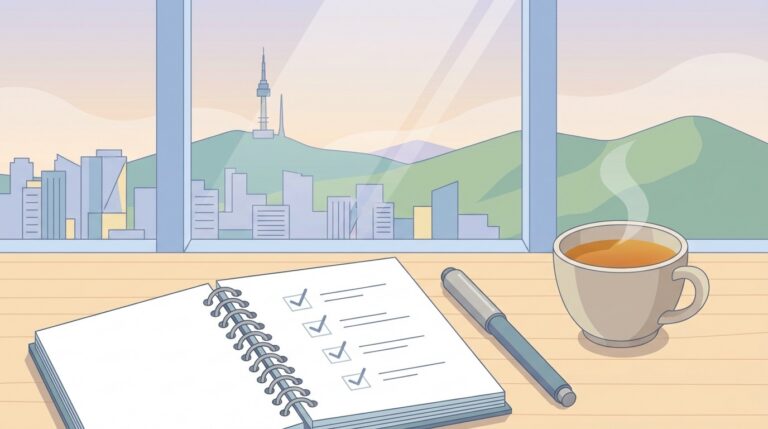
Phase 1: Empathy (Story Immersion Opening)
안녕하세요! 매일한글 에디터입니다. (Hello! This is your Daily Hangul editor.)
Picture this classic K-Drama scene straight out of Misaeng (Incomplete Life): You are sitting in a bustling open office in Gangnam or Yeouido. The clock on the wall ticks loudly toward 5:00 PM. Your team leader walks over to your desk, eyebrows furrowed, holding the quarterly slide deck you submitted an hour ago. There is a glaring data mismatch on slide 4, and the final client presentation is tomorrow morning. Your heart drops into your stomach. Your hands start sweating over your keyboard.
In Western office cultures, you might quickly offer an explanation or say, “Sorry about that, I’ll update it now!” But in a Korean corporate setting, simply saying “죄송합니다 (I am sorry)” often feels incomplete. It can leave your manager wondering: Does this person actually understand what went wrong? Will this happen again tomorrow?
In Korea, an apology isn’t just an admission of guilt—it is a two-part harmony consisting of sincere accountability and an actionable blueprint for prevention. When you know how to say, “Taking this as a lesson, I will create a checklist to ensure the same mistake is never repeated,” you instantly transform from an anxious rookie into a dependable, growth-minded professional. This guide is crafted directly from real-life feedback given to expat professionals and Korean learners just like you. Let’s learn how to turn a stressful workplace blunder into an opportunity that wins your team’s respect.
Phase 2: Deep Dive into 3 Core Expressions
1. 이번 일을 계기로 체크리스트를 만들겠습니다 (Ibeon ireul gyegiro chekeuliseuteureul mandeulgetseumnida)
- Pronunciation: ee-beon ee-reul gye-gee-ro che-keu-ri-seu-teu-reul man-deul-get-seum-ni-da (Imagine the ending -getseumnida snapping shut firmly like an executive briefcase).
- Meaning: Literally: “Taking this event as an opportunity/catalyst, I will make a checklist.” Nuance: “I am not making excuses; I am proactively upgrading my work system so this never happens again.”
- K-Culture Moment: Think of rookie sales rep Jang Geu-rae in Misaeng bowing respectfully to his manager after a delivery mix-up, pulling out his pocket notebook to demonstrate immediate structural self-improvement.
- Editor’s Insight: The magic word here is 계기 (gyegi), meaning a turning point, catalyst, or milestone. Using this noun proves to your Korean colleagues that you view mistakes as stepping stones for maturity rather than shameful failures.
- Situation Spectrum: Casual: 🚫 | Semi-formal: ⚠️ | Formal: ✅ (Essential for office emails, performance reviews, and manager debriefs)
- 🤔 Think About It: In English, we often say “I won’t let it happen again.” Why do you think Korean professionals prefer specifying the system (like a checklist) rather than relying only on individual willpower?
2. 같은 실수가 반복되지 않도록 하겠습니다 (Gateun silssuga banbokdoeji antorok hagetseumnida)
- Pronunciation: gah-teun sheel-soo-gah bahn-bok-dweh-jee ahn-toh-rok hah-get-seum-ni-da (The word silssu sounds like a sharp hiss, like a minor slip on ice).
- Meaning: Literally: “I will act so that the identical mistake does not repeat.” Nuance: “You have my solemn professional guarantee that this error stops here.”
- K-Culture Moment: Frequently heard in Korean startup debriefs or corporate apologies on the news when a project hits a technical snag.
- Editor’s Insight: The grammar pattern -도록 하겠습니다 (-dorok hagetseumnida) carries a much stronger sense of dedication and future intention than simply saying “안 할게요 (I won’t do it).” It signals proactive effort.
- Situation Spectrum: Casual: 🚫 | Semi-formal: ⚠️ | Formal: ✅
- 🤔 Think About It: How does taking collective ownership of an error in your native language compare to the Korean emphasis on reassuring the entire team unit?
3. 혹시 마감 기한을 조금만 연장해 주실 수 있습니까? (Hoksi magam gihaneul jogeumman yeonjanghae jusil su itseumnikka?)
- Pronunciation: hohk-shee mah-gahm gee-hahn-eul joh-geum-mahn yeon-jahng-hae joo-sheel soo eet-seum-nee-kkah? (Softly slide the hoksi like you are gently knocking on an office door).
- Meaning: Literally: “By any chance, could you extend the deadline just a little bit?” Nuance: “I am deeply aware of the inconvenience, but I want to guarantee flawless quality.”
- K-Culture Moment: When an ambitious webtoon illustrator or K-Drama scriptwriter begs their publishing producer for just one extra evening to polish their episode.
- Editor’s Insight: Starting with 혹시 (hoksi – by any chance) cushions the request, signaling high nunchi (tactful awareness) and softening what could otherwise sound like a demanding question.
- Situation Spectrum: Casual: 🚫 | Semi-formal: ✅ | Formal: ✅
- 🤔 Think About It: Why does adding words like “혹시” (by chance) and “조금만” (just a little) make a huge difference in workplace hierarchy?
Phase 3: Textbook Korean vs. Real Korean
Situation 1: Owning Up to a Calculation Mistake
- 📖 Textbook Korean: 미안합니다. 다음에는 잘하겠습니다. (Mianhamnida. Daeumeneun jalhagetseumnida. / I am sorry. Next time I will do well.)
- 🗣️ Real Korean: 죄송합니다. 이번 실수를 계기로 확인 절차를 다시 점검하겠습니다. (Joesonghamnida. Ibeon silssureul gyegiro hwagin jeolchareul dasi jeomgeomhagetseumnida. / I apologize. Taking this mistake as a lesson, I will re-examine the verification process.)
- 💡 Why is it different? Saying mianhamnida or “I’ll do well next time” sounds like an elementary school student talking to a teacher. Working adults in Korea use concrete business verbs like jeomgeomhada (to inspect/audit) and formal honorific apologies (joesonghamnida).
Situation 2: Asking for a Few Extra Hours on a Report
- 📖 Textbook Korean: 시간을 더 주세요. (Siganeul deo juseyo. / Give me more time.)
- 🗣️ Real Korean: 완성도를 높이기 위해, 혹시 오늘 퇴근 전까지 시간을 주실 수 있을까요? (Wanseongdoreul nop-igi wihae, hoksi oneul toegeun jeon-kkaji siganeul jusil su isseulkkayo? / To improve the completeness, could you possibly give me until the end of the work day today?)
- 💡 Why is it different? Simply commanding someone to give you time sounds blunt and irresponsible. Real Korean professionals frame the extension around 완성도 (quality/completeness), reassuring the boss that the extra time is for the company’s benefit, not personal laziness.
Phase 4: K-Culture Deep Dive & Non-Verbal Manners
4-1. 눈치 (Nunchi) & Office Body Language
When delivering an apology and proposing a checklist in a Korean workspace:
1. The Notebook Posture: Never apologize empty-handed! Walk over with a notebook and pen held in both hands. Jotting down your senior’s feedback shows active listening and readiness to learn.
2. The 30-Degree Angle: Stand or sit upright, keep your chin tucked slightly down, and bow at approximately 30 degrees while saying “죄송합니다.” Avoid aggressive, unblinking eye contact; focus on the area around their collarbone or top shirt button.
3. Two-Handed Delivery: When handing over revised papers or presenting your tablet screen, always support your right forearm with your left hand, or hold the item with both hands.
4-2. Cultural Code Analysis: The K-Drama Workplace Ethos
In popular Korean business dramas like Start-Up or Search: WWW, mistakes are inevitable because things move at 빨리빨리 (ppalli-ppalli / fast-fast) speed. However, Korean corporate culture places immense value on 책임감 (chaegimgam / sense of responsibility). When a junior employee says, “I will make a checklist,” it taps into the collective Korean belief that individual errors can be systematized away. Colleagues do not expect perfection from newcomers; they expect structural humility.
Phase 5: Real-Life Roleplay Scenario
Setting: Mirae Tech Office, 4:30 PM. Alex (a foreign junior associate) approaches Team Leader Park (박 팀장님) after finding a missing figure in the monthly report.
- 박 팀장: 알렉스 씨, 방금 보낸 월간 보고서 확인했는데 3페이지 매출 수치가 비어 있네요? (Alex-ssi, bang-geum bonaen wolgan bogoseo hwaginhaenneunde sam-peeji maechul suchiga bieo inneyo? / Alex, I just checked the monthly report you sent, and the sales figures on page 3 are missing.)
- 알렉스:
🎭 (Quickly standing up, bowing his head slightly)앗, 정말 죄송합니다, 팀장님! 제가 최종 확인을 놓쳤습니다. (At, jeongmal joesonghamnida, timjangnim! Jega choejong hwagineul notchyeotseumnida. / Ah, I am truly sorry, Team Leader! I missed the final verification.) - 박 팀장: 거래처 미팅이 내일 아침인데, 이거 오늘 중으로 정리될 수 있어요? (Georaecheo miting-i naeil achim-inde, igeo oneul jung-euro jeongnidoel su isseoyo? / The client meeting is tomorrow morning, can this be sorted out by the end of today?)
- 알렉스:
🎭 (Holding pen and notepad with two hands)네, 즉시 수정하겠습니다. 그리고 이번 일을 계기로 체크리스트를 만들어서 같은 실수가 반복되지 않게 하겠습니다. (Ne, jeuksi sujeonghagetseumnida. Geurigo ibeon ireul gyegiro chekeuliseuteureul mandeul-eoseo gateun silssuga banbokdoeji an-ge hagetseumnida. / Yes, I will correct it immediately. And taking this as a lesson, I will create a checklist to ensure the same mistake is never repeated.) - 박 팀장:
🎭 (Sighs softly, expression easing)알겠어요. 체크리스트 만들면 나한테도 공유해 줘요. 마감은 언제까지 가능해요? (Algetseoyo. Chekeuliseuteu mandeulmyeon nahantedo gong-yuhae jwoyo. Magam-eun eonjekkaji ganeunghaeyo? / Understood. Once you create the checklist, share it with me too. When can you meet the deadline?) - 알렉스: 수치를 다시 꼼꼼히 대조해야 해서, 혹시 오늘 6시까지 마감 기한을 연장해 주실 수 있습니까? (Suchireul dasi kkomkkomhi daejohaeya haeseo, hoksi oneul yeoseotsi-kkaji magam gihaneul yeonjanghae jusil su itseumnikka? / Since I need to cross-check the numbers thoroughly, could you possibly extend the deadline until 6:00 PM today?)
- 박 팀장:
🎭 (Nods with a reassuring smile)네, 6시까지 보내주세요. 꼼꼼히 확인 부탁해요. (Ne, yeoseotsi-kkaji bonaejuseyo. Kkomkkomhi hwagin butakhaeyo. / Yes, send it by 6:00. Please check it thoroughly.) - 알렉스:
🎭 (Bows cleanly)감사합니다! 6시 전까지 정확하게 수정하여 보고드리겠습니다. (Gamsahamnida! Yeoseotsi jeonkkaji jeonghwakhage sujeonghayeo bogodeurigetseumnida. / Thank you! I will revise it accurately and report back before 6:00.)
🔀 Interactive Decision Point
When Team Leader Park points out the mistake, how should you respond?
* Option A: “시스템 오류 때문에 숫자가 지워진 것 같습니다!” (It seems the numbers got erased due to a system glitch!)
* Feedback: BAD. Blaming computers or external circumstances destroys trust instantly in Korean workplaces.
* Option B: “죄송합니다. 이번 일을 계기로 체크리스트를 만들어 다시 점검하겠습니다.” (I apologize. Taking this as a lesson, I will make a checklist and re-verify.)
* Feedback: BEST. Takes full ownership, proposes a systemic solution, and reassures the team leader.
* Option C: “네, 알겠습니다. 내일 아침까지 해놓겠습니다.” (Yes, understood. I will have it done by tomorrow morning.)
* Feedback: RISK. Unilaterally deciding a deadline without asking permission will likely irritate a Korean manager.
Phase 6: 10-Second Emotional Shadowing Drill
Practice these lines aloud, matching the rhythm markers (/) and the emotional cues!
[🥺 진심 어린 반성과 신뢰감]
“이번 일을 계기로 / 체크리스트를 만들어서 / 같은 실수가 / 반복되지 않게 하겠습니다.”
(Ibeon ireul gyegiro / chekeuliseuteureul mandeul-eoseo / gateun silssuga / banbokdoeji an-ge hagetseumnida.)-
[💼 정중하고 조심스럽게]
“혹시 / 마감 기한을 / 6시까지 / 조금만 연장해 주실 수 있습니까?”
(Hoksi / magam gihaneul / yeoseotsi-kkaji / jogeumman yeonjanghae jusil su itseumnikka?) -
[🤝 든든하고 프로페셔널하게]
“꼼꼼하게 재검토하여 / 오늘 안으로 / 다시 보고드리겠습니다.”
(Kkomkkomhage jaegeomto-hayeo / oneul an-euro / dasi bogodeurigetseumnida.)
Phase 7: K-Culture Mini Dictionary
- 계기 (Gyegi): Turning point / Catalyst / Motive. Commonly used in interview questions like “한국에 오게 된 계기가 무엇인가요?” (What was the catalyst for coming to Korea?). In business, it converts a failure into a positive milestone.
- 체크리스트 (Chekeuliseuteu): Checklist. A ubiquitous Konglish term used in every Korean office, cafe, and corporate team. Combining it with “만들다 (to make)” proves your organizational skills.
- 마감 (Magam): Deadline / Closing. Derived from finishing touches. Phrases like “마감 임박 (deadline imminent)” or “마감 시간 (cutoff time)” are everyday office staples.
- 피드백 (Pideubaek): Feedback / Constructive input. When a senior colleague critiques your work, asking for “피드백 감사합니다 (Thank you for the feedback)” instantly marks you as an eager learner.
Phase 8: Traveler & Expat Survival Kit
Top 3 Survival Expressions
- 제가 다시 확인하겠습니다. (Jega dasi hwaginhagetseumnida.)
- Meaning: I will check it again.
- Pro Tip: Use this whenever an order or document looks slightly off. It shows proactive initiative without arguing.
- 조금만 더 시간을 주실 수 있을까요? (Jogeumman deo siganeul jusil su isseulkkayo?)
- Meaning: Could you give me just a little more time?
- Pro Tip: The polite question ending -eulkkayo? is gentler than direct demands and works beautifully in semi-formal situations.
- 다음부터는 더 주의하겠습니다. (Daeumbuteoneun deo ju-uihagetseumnida.)
- Meaning: I will be more cautious from next time.
- Pro Tip: The textbook-perfect closing sentence when a senior manager advises you on company etiquette.
Editor’s Travel & Expat Note
To keep track of tight schedules and avoid missed deadlines while living or working in Korea, synchronize your routine with the Naver Calendar scheduling application. It supports Korean public holidays, lunar calendar events, and team share features indispensable for expats navigating local deadlines!
Phase 9: One Step Deeper (Reflection Question)
In Korean corporate life, harmony (화합 / hwahap) and mutual reliability (신뢰 / sinroe) are the bedrock of any team. Because Korean offices function like extended family or tightly coordinated sports squads, an unchecked mistake by one member directly impacts everyone down the line. When you suggest a 체크리스트 (checklist), you are acknowledging that the team’s shared peace of mind is your personal priority.
💬 Your Turn: In your home culture, when someone makes a mistake on a team project, what is considered the most respectful way to bounce back? How does it compare to the Korean emphasis on preventative systems? Let us know in the comments below!
Phase 10: FAQ & Avoiding Misunderstandings
Q: Can I just say “죄송해요 (Joesonghaeyo)” when my manager points out an error?
A: While grammatically polite, “죄송해요” is semi-formal (haeyo-che). In a formal workplace debrief, always use the high-honorific “죄송합니다 (Joesonghamnida)”. It demonstrates formal respect and serious professional accountability.
Q: Is asking for a deadline extension seen as rude in Korea?
A: Not if done properly! What is considered rude is going past the deadline in silence. If you communicate before the cutoff time, offer a valid reason focusing on quality (완성도), and provide an exact new target time (e.g., “오늘 6시까지”), Korean managers will appreciate your transparency.
Q: What is the difference between 실수 (silssu) and 잘못 (jalmot)?
A: 실수 (silssu) refers to an accidental mistake or oversight (like a typo or forgotten file attachment), whereas 잘못 (jalmot) often carries moral fault or intentional wrongdoing. In general business slip-ups, stick to “제 실수입니다 (It was my mistake).”
🚨 Common Mistakes Warning Board
- Mistake: Staying silent and hoping nobody notices until the next morning.
- Correct Action: Alert your manager immediately with: “제가 확인해 보니 누락된 부분이 있습니다. 바로 수정하겠습니다.” (I checked and found a missing part. I will fix it right away.)
- Mistake: Over-explaining personal excuses (e.g., “My alarm didn’t go off” or “My internet was slow”).
- Correct Action: Focus on the solution, not the excuse: “제 불찰입니다. 체크리스트로 재발을 방지하겠습니다.” (It was my oversight. I will prevent recurrence with a checklist.)
- Mistake: Saying “알았어 (Arasseo)” to your senior.
- Correct Action: Always say “알겠습니다 (Algetseumnida)” or “확인했습니다 (Hwaginhaetseumnida)” in work environments.
Phase 11: Action Missions
- 🥉 Bronze Mission (Solo Shadowing): Stand in front of your mirror with a notepad in hand. Practice bowing 30 degrees while saying: “이번 일을 계기로 체크리스트를 만들겠습니다.” three times smoothly.
- 🥈 Silver Mission (Community Share): Write your own sample workplace apology in the comments below using the word 계기 (gyegi) and ask for a 2-hour deadline extension.
- 🥇 Gold Mission (Real Life Application): The next time you forget a chore or miss a personal task with a Korean friend or colleague, send a polite message stating what system or alarm you set up so it won’t happen again!
- 🎮 K-Culture Mission: Watch an episode of a workplace drama like Misaeng or King the Land. Listen closely for how junior employees respond when a senior says “이거 다시 해와요 (Do this again).” Write down any keywords you recognize!
Phase 12: Interactive Quiz Challenge
Test your knowledge with these three practical questions!
1. Situational Judgment
You sent a client proposal with an incorrect phone number. Which of the following responses is the most professional?
* A) “핸드폰 번호는 원래 자주 바뀌니까 괜찮습니다.” (Phone numbers change often anyway, so it’s fine.)
* B) “죄송합니다. 이번 일을 계기로 체크리스트를 만들어 발송 전 재확인하겠습니다.” (I apologize. Taking this as a lesson, I will make a checklist to double-check before sending.)
* C) “어제 너무 피곤해서 잘못 적었습니다.” (I wrote it wrong because I was too tired yesterday.)
2. Fill-in-the-Blank
Complete the sentence to politely ask for an extension:
“혹시 마감 기한을 조금만 ________ 주실 수 있습니까?”
* (Hint: The Korean verb for ‘to extend’ is 연장하다)
3. Cultural True or False
True or False: In a Korean office, looking directly into your manager’s eyes with a big smile while apologizing is considered confident and polite.
Click to reveal answers & explanations!
- Answer: B
- Explanation: Option B takes accountability and presents an immediate systematic prevention plan. Option A downplays the error, and Option C makes personal excuses.
- Answer: 연장해 (yeonjanghae)
- Explanation: The combination is 연장하다 (to extend) + -어 주다 (to do for someone) + -실 수 있습니까 (honorific potential question) = 연장해 주실 수 있습니까?
- Answer: False
- Explanation: Smiling during a serious workplace reprimand can be interpreted as not taking the matter seriously. Maintain a sincere, composed expression with eyes lowered toward their collar or table.
- Explanation: Smiling during a serious workplace reprimand can be interpreted as not taking the matter seriously. Maintain a sincere, composed expression with eyes lowered toward their collar or table.
🎬 Watch Our Daily Videos! (Daily Hangul Official Instagram)
Review the expressions you learned in this article with our fun daily short videos! Check out native pronunciation and real-life nuances in action.
- Instagram @dailyhangul_en






