

Standing at a Korean Funeral: The Complete Guide to Chrysanthemum Etiquette and Condolences
Phase 1: Empathy (Story-Driven Opening)
안녕하세요! 매일한글 에디터입니다. (Hello! This is your editor from Daily Hangul.)
Imagine this: You receive a sudden KakaoTalk message with black-and-white text—a Bugobogo (부고 / obituary). A close Korean colleague or a dear friend’s parent has passed away. You put on a neat black suit, hurry to a hospital basement funeral parlor (장례식장 – jangnyesikjang), and take off your shoes at the entrance of the memorial room. The air is quiet, fragrant with burning incense. You are handed a single white chrysanthemum.
Suddenly, your heart starts pounding. You freeze. Wait, which direction should the blossom face? Should the petals face me, or should they face the portrait of the deceased? Do I bow once, twice, or just bow my head?
If you have ever watched emotional scenes in K-dramas like My Mister or Crash Landing on You, you know Korean funerals are deep communal spaces filled with warmth, sorrow, and very delicate unwritten rules. Making a cultural misstep here feels scary because you want nothing more than to show genuine respect. Don’t worry! Drawing from real feedback from our intermediate B1 learners living and working in Korea, this guide breaks down every step—from placing the chrysanthemum correctly to handing over condolence envelopes—so you can express comfort with total confidence.
Phase 2: Core Expressions in Deep Analysis
Here are three essential expressions you will encounter and need when attending a Korean funeral.
1. 삼가 고인의 명복을 빕니다 (Samga goin-ui myeongbogeul bimnida)
- Pronunciation: [Sam-ga go-in-ui myeong-bo-geul bim-ni-da] (Sound analogy: Think “Sahm-gah go-een-we myung-boh-guhl beem-nee-dah”)
- Meaning:
- Literal translation: “I humbly pray for the deceased’s blessings in the next world.”
- Real nuance: The universal, gold-standard Korean phrase for “Rest in peace” and “My heartfelt condolences.” It carries profound solemnity and reverence.
- K-Culture Moment: You will see this written on mourning ribbons hanging across floral wreaths in dramas, on memorial banners, and sent as the primary line in condolence text messages.
- Editor’s Insight: The word Samga (삼가) means “humbly and with utmost care,” while Goin (고인) refers to “the person who has passed away.” Because of its high formality, you never shorten this or say it casually.
- Situation Spectrum: Casual 🚫 | Semi-formal ⚠️ | Formal ✅
- 🤔 Think About It: In English, we often say “I am so sorry for your loss,” centering empathy on the living. Korean focuses on blessing the journey of the departed (myeongbok). How does shifting the focus to the soul change your mindset?
2. 국화꽃의 꽃봉오리가 영정 사진을 향하게 놓아주세요 (Gukhwakkot-ui kkotbong-origa yeongjeong sajin-eul hyanghage noaju-seyeo)
- Pronunciation: [Guk-hwa-kkot-ui kkot-bong-o-ri-ga yeong-jeong sa-jin-eul hyang-ha-ge no-a-ju-se-yo] (Sound analogy: “Gook-hwah-kkoht-wee kkoht-bong-oh-ree-gah yung-jung sah-jeen-uhl hyahng-hah-geh noh-ah-joo-seh-yoh”)
- Meaning:
- Literal translation: “Please place the chrysanthemum so that the flower bud faces toward the memorial portrait.”
- Real nuance: The directional guideline for the flower-offering ritual (heonhwa). The blossom is offered directly to the spirit of the deceased, so the face of the flower looks toward them.
- K-Culture Moment: In Korean business or political dramas, an usher quietly reminds newcomers at the altar how to lay the chrysanthemum when paying their respects.
- Editor’s Insight: A very common mistake is pointing the stem toward the portrait because that is how you naturally hold it. Remember: the flower blossom “gazes” at the portrait.
- Situation Spectrum: Casual 🚫 | Semi-formal ✅ | Formal ✅
- 🤔 Think About It: Why do you think the blossom faces the deceased rather than the living guest? Consider how Korean ancestral rituals (Jerye) treat the spirit as the honored guest at the table.
3. 얼마나 상심이 크십니까 (Eolmana sangsim-i keusimnikka)
- Pronunciation: [Eol-ma-na sang-sim-i keu-sim-ni-kka] (Sound analogy: “Uhl-mah-nah sahng-sheem-ee kuh-sheem-nee-kkah”)
- Meaning:
- Literal translation: “How great must your heartbreak be?”
- Real nuance: “Words cannot capture the depth of your sorrow; my heart goes out to you.” Spoken directly to the bereaved family members (sangju).
- K-Culture Moment: Said when you step down from the altar, face the chief mourner, and exchange a deep condolence bow.
- Editor’s Insight: You do not need to deliver long speeches. Grief in Korean culture is expressed through understated, quiet phrases. This short question acknowledges their pain without demanding an explanation.
- Situation Spectrum: Casual 🚫 | Semi-formal ⚠️ | Formal ✅
- 🤔 Think About It: Comparing this to casual English phrases like “Hang in there,” notice how the honorific suffix -si- (시) honors the mourner’s emotional state.
Phase 3: Textbook Korean vs. Real Korean
Textbooks often give archaic or overly stiff lines. Here is how modern Koreans actually speak at a funeral parlor.
Situation 1: Sending an obituary response text (부고 답장)
- 📖 교과서 한국어 (Textbook):
삼가 조의를 표하오며 고인의 유덕이 후세에 영원히 이어지기를 앙망하나이다. (Samga jouireul pyohayeomyeo goin-ui yudeogi huse-e yeong-wonhi ieojigireul angmanghanaida.)
“I express my condolences and pray that the virtues of the deceased are forever carried forward.” - 🗣️ 진짜 한국어 (Real Korean):
삼가 고인의 명복을 빕니다. 갑작스러운 비보에 얼마나 슬프실지 가늠조차 되지 않네요. 먼 곳에서나마 마음 깊이 애도합니다. (Samga goin-ui myeongbogeul bimnida. Gapjakseureoun biboe eolmana seulpeusilji ganeumjocha doeji annehyo. Meon goseseonama maeum gipi aedohamnida.)
“Rest in peace to the deceased. I cannot fathom your grief after such sudden news. Sending my deepest condolences from afar.” - 💡 왜 다를까? (Why the difference?):
Old literary expressions like angmanghanaida feel robotic on KakaoTalk. Modern Koreans combine formal respect (Samga goin-ui myeongbok…) with relatable, warm empathy.
Situation 2: Greeting the chief mourner at the altar (상주와의 인사)
- 📖 교과서 한국어 (Textbook):
상심을 금할 길이 없습니다. 부디 옥체 보존하십시오. (Sangsimeul geumhal giri eopseumnida. Budi okche bojonhasipsio.)
“I have no way to suppress my sorrow. Please preserve your jade body.” - 🗣️ 진짜 한국어 (Real Korean):
얼마나 상심이 크십니까… 몸 잘 챙기세요. (Eolmana sangsim-i keusimnikka… Mom jal chaenggiseyo.) / (Or simply a quiet bow without words)
“Your grief must be immense… Please look after your health.” - 💡 왜 다를까? (Why the difference?):
Over-talking at a Korean funeral is considered poor etiquette (shillye). A gentle sentence or even a silent, respectful bow conveys ten times more dignity than theatrical prose.
Phase 4: K-Culture Deep Dive & Non-verbal Manners
4-1. 눈치 (Nunchi) & Physical Manners: The Chrysanthemum Offering
When it is your turn to approach the altar table (jeondan), follow these precise steps:
1. Approach the altar: Walk slowly toward the portrait table and stop one step before it. Keep your hands clasped together in front of your lower abdomen.
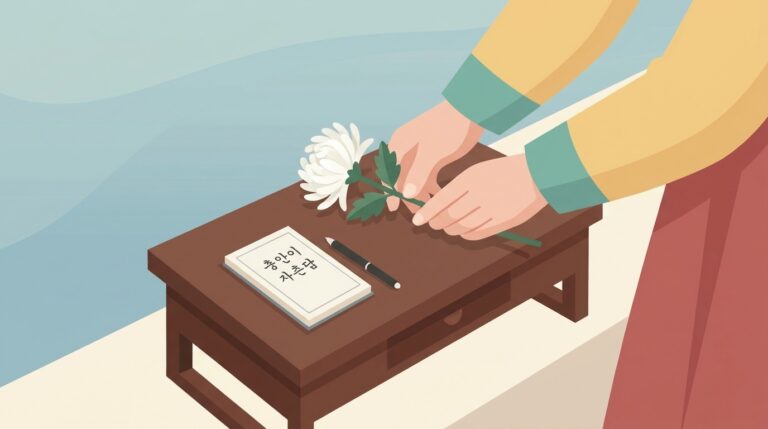
2. Pick up the flower: Use your right hand to gently hold the stem of the white chrysanthemum flower (gukhwakkot), and use your left hand to support your right wrist or gently cradle underneath the stem. Never grab it like a broom handle!
3. Place the flower (헌화 – Heonhwa): Lay the flower down on the table smoothly. Crucial rule: The white blossom must point toward the portrait of the deceased, with the stem pointing toward you.
4. Bowing vs. Silent Prayer:
* Traditional/Buddhist format: Step back, stand straight, raise your hands to eye level, and perform two full deep bows to the floor (큰절 – keunjeol), followed by one standing half-bow.
* Christian/Protestant format: Instead of bowing to the floor, bow your head slightly while standing and observe a moment of silent prayer (mungnyeom – 묵념) for 5 to 10 seconds.
5. Greeting the Mourner: Turn to the chief mourner (sangju), exchange one deep bow, and softly say: 얼마나 상심이 크십니까 (Eolmana sangsim-i keusimnikka).
4-2. Cultural Code: The Yukgaejang Table & The Comfort of Presence
In Western funerals, people usually gather for a service and then disperse. In Korea, the real solace happens in the dining hall connected to the funeral suite. After paying respects at the altar, you are led to low tables where the family serves you a warm meal: spicy red beef soup (yukgaejang – 육개장), boiled pork slices (suyuk), rice cakes, and drinks.
Why red soup? Traditionally, the vibrant red color of red pepper broth was believed to ward off negative spirits (aek-un) and protect guests on their journey home. More importantly, staying to eat and talk quietly with colleagues or friends keeps the hall lively, ensuring the grieving family does not feel abandoned in cold silence.
Note: You may drink soju or beer, but never clink glasses (geonbae)! Clinking is a celebratory ritual and is strictly forbidden at a funeral.
Phase 5: Real-Life Roleplay Scenario
Setting: Hall 2 of the Funeral Parlor at Severance Hospital in Seoul. You meet your Korean team leader, Minwoo, who is serving as the chief mourner for his grandfather.
- Minwoo (Chief Mourner): 어서 오세요. 바쁘신데 와주셔서 감사합니다.
(Eoseo oseyo. Bappeusinde wajusyeoseo gamsahamnida.)
[🎭 Bows head lightly with red eyes, holding hands in front.]
“Welcome. Thank you so much for coming despite your busy schedule.” -
Learner: 팀장님, 부고 소식 듣고 깜짝 놀랐습니다.
(Timjangnim, bugo sosik deutgo kkamjjak nollasseumnida.)
[🎭 Steps forward respectfully with a subdued, calm posture.]
“Team Leader, I was so shocked when I heard the news.” -
Minwoo (Chief Mourner): 갑작스럽게 떠나셔서… 아직 실감이 잘 안 나네요.
(Gapjakseureopge tteonasyeoseo… ajik silgami jal an naneyo.)
[🎭 Sighs softly, looking toward the altar.]
“He passed away so suddenly… It still hasn’t fully sunk in.” -
Learner: 먼저 헌화하고 인사드리겠습니다.
(Meonjeo heonhwahago insadeurigesseumnida.)
[🎭 Takes a step toward the altar with both hands held together.]
“I will offer a flower and pay my respects first.” -
Minwoo (Chief Mourner): 네, 편하게 조문해 주십시오.
(Ne, pyeonhage jomunhae jusipsio.)
[🎭 Steps slightly to the side to give you space before the portrait.]
“Yes, please take your time to pay your respects.” -
Learner: [🎭 Lays the flower blossom toward the portrait using two hands, performs two deep bows, then turns to Minwoo] 얼마나 상심이 크십니까.
(Eolmana sangsim-i keusimnikka.)
“Words cannot express how heartbroken you must be.” -
Minwoo (Chief Mourner): 찾아와 주셔서 정말 큰 힘이 됩니다.
(Chajawa jusyeoseo jeongmal keun himi doemnida.)
[🎭 Returns a deep bow, hands pressed together.]
“Your visit gives me immense strength.” -
Learner: 삼가 고인의 명복을 빕니다. 식사 자리에서 조금 더 뵙겠습니다.
(Samga goin-ui myeongbogeul bimnida. Siksa jarieseo jogeum deo boepgesseumnida.)
[🎭 Steps back two paces before turning around toward the dining area.]
“May he rest in peace. I will see you shortly in the dining hall.”
🔀 Interactive Choice Point
You are about to place the chrysanthemum flower down on the altar. How do you lay it?
- Choice A: Lay it flat with one hand quickly, with the blossom pointing toward you so you can admire the flower.
Feedback: ❌ Bad. Using one hand appears careless and disrespectful. Pointing the blossom at yourself reverses the offering; the flower is meant for the spirit of the deceased! - Choice B: Hold the stem with your right hand, support the stem with your left hand, and gently lay it down with the flower head facing the portrait.
Feedback: 🌟 Best! You observed both two-handed etiquette (du-son) and proper orientation (hyanghagi). The family will appreciate your attentiveness. - Choice C: Place the flower stem directly into the incense bowl (hyangno) on top of the burning ashes.
Feedback: ⚠️ Risk. Chrysanthemums are laid flat on the table, not stuck into the incense ashes. Only burning incense sticks (hyang) go inside the incense burner!
Phase 6: 10-Second Emotion Shadowing Drill
Practice reading these lines aloud with proper breath control and emotional pauses (/).
[🖤 정중하고 차분하게 - Solemn and calm]
삼가 / 고인의 명복을 / 빕니다.
(Samga / goin-ui myeongbogeul / bimnida.)
“Humbly / for the deceased’s soul’s blessing / I pray.”-
[🕊️ 깊은 애도를 담아 - With deep empathy]
얼마나 / 상심이 / 크십니까.
(Eolmana / sangsim-i / keusimnikka.)
“How / your heartbreak / must be immense.” -
[🤝 따뜻하고 힘이 되는 목소리로 - Warm and reassuring]
부디 / 기운 내시고 / 몸 잘 챙기세요.
(Budi / giun naesigo / mom jal chaenggiseyo.)
“Please / find strength / and take good care of your health.”
Phase 7: K-Culture Mini Dictionary
-
조문 (Jomun)
Meaning: Condolence call / Paying respects at a funeral.
Usage: Used formally to describe attending a funeral: “퇴근하고 장례식장에 조문 다녀오겠습니다 (I will pay a condolence visit to the funeral hall after work).” -
헌화 (Heonhwa)
Meaning: Flower offering ritual.
Usage: Refers directly to offering the white chrysanthemum: “헌화를 할 때는 두 손으로 꽃을 잡습니다 (When offering flowers, hold the flower with both hands).” -
영정사진 (Yeongjeongsajin)
Meaning: The framed memorial portrait of the deceased placed on the altar, decorated with black ribbon and white flowers.
Usage: “영정 사진을 마주 보고 묵념을 올립니다 (Facing the memorial portrait, we observe a silent prayer).” -
부의금 (Bu-uigeum) / 조의금 (Joe-uigeum)
Meaning: Condolence money gift.
Usage: Monetary gift placed inside a plain white envelope. “접수대에 부의금을 전달하고 방명록을 씁니다 (Hand the condolence money to the reception desk and sign the guest register).”
Phase 8: Survival Kit for Travelers
Survival Expressions TOP 3
- 봉투는 어디에 넣으면 되나요? (Bongtuneun eodie neoeumyeon doenayo?)
“Where should I place the envelope?”
Pro Tip: Funeral halls have a collection box (bujeham) or an attendant seated behind a front desk with a guestbook (bangmyeongnok). - 조의금 봉투 있나요? (Joe-uigeum bongtu innayo?)
“Do you have a condolence money envelope?”
Pro Tip: If you couldn’t buy one at a convenience store, every Korean funeral hall provides free white envelopes with pre-printed Chinese characters (Buyi or Geunjo) near the entrance. - 상주님, 힘내세요. (Sangjunim, himnaeseyo.)
“Chief mourner, please stay strong.”
Pro Tip: A safe, respectful sentence if formal classical phrases feel too intimidating to pronounce under pressure.
Editor’s Travel Note
- Navigation: Funeral halls are often located in hospital annexes (장례식장). To avoid getting lost in sprawling medical campuses, search the exact hall name using the KakaoMap navigation app download for real-time indoor and building-specific guidance.
- Cash & Envelopes: Most Korean hospitals do not accept card payments for bu-uigeum. Always withdraw fresh cash from an ATM beforehand. Use crisp bills (typically 50,000 KRW, 100,000 KRW, or odd numbers: 30,000, 50,000, 70,000, 100,000). Write your name vertically on the back-left corner of the envelope, with your affiliation (company/school) written to the right of your name.
Phase 9: A Step Deeper (Reflection)
Korean funerals are fundamentally about Pumasi (품앗이)—the ancient agricultural practice of reciprocal communal labor and mutual aid. In traditional Korean villages, no single family could afford to harvest crops, hold weddings, or bury ancestors alone. Today, high-tech hospital funeral halls preserve that exact spirit. By showing up, laying down a chrysanthemum, handing over condolence money, and finishing a bowl of hot soup together, you are telling the grieving family: “You are not carrying this heavy grief on your own; our community shares the weight with you.”
💬 Your Turn: In your home country, what flower or physical ritual is used to honor those who have passed away? Does the direction or hand gesture matter like it does in Korea? Tell us your experience in the comments below!
Phase 10: FAQ & Avoiding Common Mistakes
Q: Can I wear dark navy or dark grey if I don’t own a pure black suit?
A: Yes, absolutely! While solid black is ideal, dark navy, deep charcoal, or muted dark tones with white or dark shirts are completely acceptable for foreign guests. Avoid bright colors, flashy patterns, red ties, and exposed bare ankles (wear dark socks).
Q: I am not Christian, but I don’t feel comfortable doing the traditional full floor bow (keunjeol). What should I do?
A: You are never forced to do the deep floor bow! In modern Korea, observing a standing silent bow (mungnyeom) with your head tilted down for 5-10 seconds is recognized and respected as a standard, dignified alternative.
Q: Which hand goes on top when clasping my hands at a funeral?
A: This is a classic test of Korean etiquette! In daily life or during happy holidays (like Chuseok), men put their left hand on top, and women put their right hand on top. However, at a funeral, it reverses: men place their right hand on top, and women place their left hand on top.
🚨 Common Mistakes Alert
- Mistake: Clinking glasses (짠! / 건배!) while drinking in the funeral dining hall.
Correct Action: Drink quietly without clinking cups together; celebration gestures are taboo. - Mistake: Pointing the chrysanthemum flower blossom toward yourself when placing it down.
Correct Action: Always lay the flower down with the blossom pointing toward the portrait of the deceased. - Mistake: Handing condolence money (bu-uigeum) with only one hand.
Correct Action: Hand the envelope over with both hands, or support your right elbow/wrist with your left hand.
Phase 11: Action Missions
- 🥉 Bronze Level: Practice laying a pen or ruler on your desk using both hands, making sure the “tip” (the flower head) faces away from you toward an imaginary photo. Whisper: 삼가 고인의 명복을 빕니다 (Samga goin-ui myeongbogeul bimnida).
- 🥈 Silver Level: On your social media notes or learning journal, write down the difference between Heonhwa (헌화) and Jomun (조문), and explain why the flower blossom points toward the portrait.
- 🥇 Gold Level: Find an obituary text template on KakaoTalk or your notebook, fill in the blanks with proper honorifics, and practice reading it aloud without checking romanization.
- 🎮 K-Culture Mission: In the next K-drama episode you watch that features a funeral (e.g., Hospital Playlist, Queen of Tears, My Mister), spot whether the characters perform keunjeol (two floor bows) or mungnyeom (standing silent prayer). Watch their flower hand placement!
Phase 12: Interactive Quiz Challenge
Test your understanding of Korean funeral etiquette with these 3 quick questions!
- Situational Judgment: You enter the altar room. The attendant hands you a white chrysanthemum flower. What is the correct way to hold and place it?
- (A) Grab it firmly with your left hand and drop it facing sideways.
- (B) Hold the stem with your right hand, support underneath with your left hand, and lay the blossom facing the portrait.
- (C) Hand the flower directly to the chief mourner to let them place it.
- Fill-in-the-Blank: Complete the formal condolence phrase:
“삼가 고인의 ________을 빕니다.” (I humbly pray for the deceased’s soul’s blessings.) -
True or False: At the dining hall of a Korean funeral, it is polite to clink soju glasses together with coworkers to cheer up the grieving atmosphere. (True / False)
Click here for answers and explanations
- Answer: (B) Always hold the stem with your right hand while supporting with your left hand, and ensure the blossom faces toward the portrait.
- Answer: 명복 (Myeongbok) The complete phrase is: 삼가 고인의 명복을 빕니다 (Samga goin-ui myeongbogeul bimnida).
- Answer: False. Clinking glasses (geonbae) is strictly forbidden at funerals because it represents celebration. Drinks are enjoyed quietly without toasts.
🎬 Watch Our Daily Videos! (Daily Hangul Official Instagram)
Review the expressions you learned in this article with our fun daily short videos! Check out native pronunciation and real-life nuances in action.
- Instagram @dailyhangul_en







