

Phase 1: Empathy & Storytelling Opening
안녕하세요! 매일한글 에디터입니다. (Hello! I’m your Daily Hangul editor.) Imagine standing on the breezy platform of Osong Station on a rainy Friday evening. You are on your way from Seoul to Jeonju for an unforgettable weekend food tour. But there is a catch: your initial KTX was held up by 25 minutes due to heavy downpours, and as you sprint down the escalators, you watch your connecting train vanish into the mist. Your heart drops, and panic starts to creep in. “Do I have to buy another expensive ticket? Am I stranded here tonight?”
Don’t worry! Every experienced traveler in Korea has faced this exact bump in the road. In fact, Korail has one of the world’s most organized transfer protection systems—if you know what to say. This B1-level guide draws from real international student experiences to teach you how to turn a transit mishap into a smooth, penalty-free journey with confidence and poise.
Phase 2: Core Expressions Deep Dive
1. 앞선 기차가 연착돼서 다음 기차를 놓쳤어요. (Apseon gichaga yeonchakdwaeseo daeum gichareul nochyeosseoyo.)
- Pronunciation: Ap-seon gi-cha-ga yeon-chak-dwae-seo da-eum gi-cha-reul no-chyeo-sseo-yo. (Sounds like: up-sun ghee-cha-gah yawn-chack-dway-suh dah-eum ghee-cha-reul no-chyaw-ssuh-yo)
- Meaning: “Because the preceding train was delayed, I missed my connecting train.”
- Literal: Preceding train delayed-because, next train missed.
- Nuance: A calm, objective factual statement informing the ticket agent that your missed connection is the railway company’s operational responsibility, not your personal tardiness.
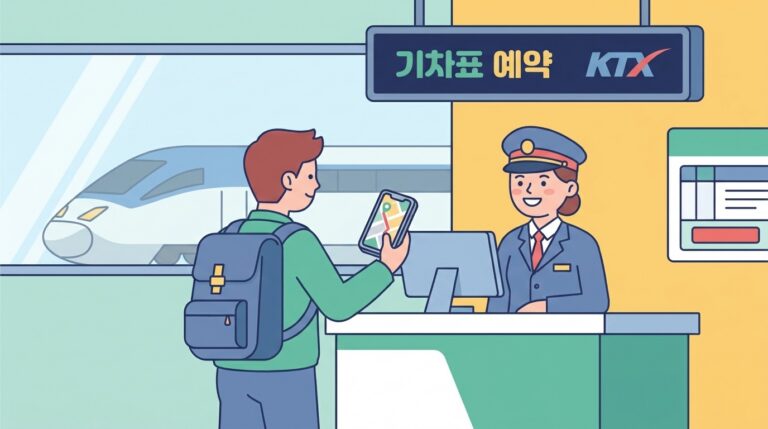
- K-Culture Moment: You will see this scene constantly in K-dramas whenever an ambitious protagonist rushes to an out-of-town wedding or job interview, holding their smartphone screen toward the station master with an urgent yet polite look.
- Editor’s Insight: Using the phrase “앞선 기차” (preceding train) combined with “-는 바람에” or “-돼서” signals to the agent instantly that this is a recognized transfer failure (환승 단절), triggering internal support protocols.
- Situation Spectrum: Casual ⚠️ | Semi-formal ✅ | Formal ✅
- 🤔 Think About It: In English, we often say “I missed my train because of a delay.” Notice how Korean places the system event first (앞선 기차가 연착돼서) before the outcome (놓쳤어요), naturally softening personal fault.
2. 수수료 없이 다음 열차로 변경 가능한가요? (Susuryo eopsi daeum yeolcharo byeongyeong ganeunghangayo?)
- Pronunciation: Su-su-ryo eop-si da-eum yeol-cha-ro byeon-gyeong ga-neung-han-ga-yo? (Rhymes with Shoe-shoe-rio up-she dah-eum yawl-cha-ro byun-gyung gah-neung-hahn-gah-yo)
- Meaning: “Is it possible to change to the next train without any fee?”
- Literal: Commission without next train-to change possible-is-it?
- Nuance: Confidently asserting your right to a fee-free ticket reissuing under railway delay guidelines without sounding confrontational.
- K-Culture Moment: Travel YouTubers documenting solo trips across Gangwon-do use this exact phrase at station counters to seamlessly swap departure times during snowstorms.
- Editor’s Insight: The word “수수료” (fee/commission) is your golden shield. Normally, changing a departed train’s ticket incurs a cancellation fee of up to 70%, but showing proof of the connected train’s delay waives 100% of it.
- Situation Spectrum: Casual 🚫 | Semi-formal ✅ | Formal ✅
- 🤔 Think About It: Korean service culture is fast and rule-driven. Asking politely about “수수료” upfront shows you understand consumer rights, and clerks will gladly assist you quicker.
3. 지연 배상금이나 할인 쿠폰 받을 수 있어요? (Jiyeon baesanggeumina hal-in kuponeul badeul su isseoyo?)
- Pronunciation: Ji-yeon bae-sang-geum-i-na hal-in ku-pon-eul ba-deul su it-seo-yo? (Sounds like Jee-yuhn bay-sahng-geum-ee-nah hahl-een coo-pohn-eul bah-deul soo ee-ssuh-yo)
- Meaning: “Can I receive delay compensation or a discount coupon?”
- Literal: Delay compensation-or discount coupon receive can-I?
- Nuance: Inquiring about standard statutory compensation for train delays exceeding 20 minutes.
- K-Culture Moment: Featured regularly in consumer advocacy segments on Korean morning broadcasts (such as 생생정보통), highlighting smart ways passengers can claim transit credits.
- Editor’s Insight: If a high-speed train (KTX/SRT) arrives more than 20 minutes behind schedule, you are legally entitled to a cash refund of 12.5% to 50% or a voucher worth up to double that value for future bookings.
- Situation Spectrum: Casual 🚫 | Semi-formal ✅ | Formal ✅
- 🤔 Think About It: In many Western transit systems, compensation requires filling out arduous online forms weeks later. In Korea, you can often settle it immediately at the physical counter!
Phase 3: Textbook Korean vs Real Korean
Situation 1: Telling the ticket counter you missed your train
- 📖 교과서 한국어 (Textbook): 저는 열차에 탑승하지 못했습니다. (Jeoneun yeolchae tapseunghaji mothaesseumnida. / I failed to board the train.)
- 🗣️ 진짜 한국어 (Real-World): 앞 차가 늦게 와서 환승 기차를 놓쳐 버렸어요. (Ap chaga neutge waseo hwanseung gichareul nochyeo beoryeosseoyo. / The previous train came late, so I ended up missing my transfer train.)
- 💡 왜 다를까? (Why is it different?): Textbook phrases sound like an official police report. Native speakers use everyday words like “앞 차” instead of “선행 열차”, and employ the auxiliary verb “-어 버리다” to convey unexpected disappointment.
Situation 2: Asking if there will be extra charges
- 📖 교과서 한국어 (Textbook): 추가 비용이 부과됩니까? (Chuga biyongi bugwadoemnikka? / Will an additional cost be levied?)
- 🗣️ 진짜 한국어 (Real-World): 이거 추가 요금 따로 안 내도 되죠? (Igeo chuga yogeum ttaro an naedo doejo? / I don’t have to pay an extra charge for this, right?)
- 💡 왜 다를까? (Why is it different?): Instead of stiff passive nouns (부과), native speakers use the conversational ending “-도 되죠?” (It’s okay to…, right?) which gently confirms an expectation with natural politeness.
Phase 4: K-Culture Deep Dive & Non-Verbal Manners
4-1. 눈치 (Nunchi) & Counter Etiquette
When dealing with a missed connection at a major hub like Dongdaegu or Osong, stations move at blistering speeds. Do not rush the counter waving both hands or shouting from afar. Instead:
* Approach the 고객만족센터 (Customer Service Center) or 매표소 (Ticket Counter) with your smartphone screen already unlocked, displaying your ticket on the KorailTalk app.
* Present your phone using both hands (양손) with a gentle head nod. This shows respect and instantly defuses any tension.
* Keep your tone calm: Korean station staff are exceptionally fast problem-solvers, and showing composed patience (여유) makes them go the extra mile to find you the best remaining seats.
4-2. The “Ppalli-Ppalli” Transfer Reality
Korea’s rail spine connects the country in under 3 hours, turning stations into precision gearboxes. When a delay happens, everyone is racing the clock. You will notice locals heading straight to the customer desk rather than wandering around. Being prepared with your transfer itinerary showcases great cultural competence in navigating Korea’s famous 빨리빨리 (fast-paced) public transit ecosystem.
Phase 5: Real-World Roleplay Scenario
- Location: Osong Station Customer Service Counter (오송역 고객만족센터)
- Characters:
- Alex (알렉스): An international traveler who missed his KTX to Gwangju due to a preceding train delay.
- Agent Min-ji (역무원 민지): A calm, efficient Korail customer representative.
Alex: 저기요, 죄송한데 앞 기차가 20분 늦어서 광주행 환승 열차를 놓쳤어요. (Jeogiyo, joesonghande ap gichaga isipbun neujeoseo Gwangjuhaeng hwanseung yeolchareul nochyeosseoyo. / Excuse me, I’m sorry, but the first train was 20 minutes late, so I missed my connecting train to Gwangju.) [🎭 Shows the mobile ticket with a worried expression]
Agent Min-ji: 아, 정말 당황하셨겠어요. 승차권 확인해 드릴 테니 잠시만 보여주시겠어요? (A, jeongmal danghwanghasyeotgesseoyo. Seungchakwon hwaginhae deuril teni jamsiman boyeojusigesseoyo? / Oh, you must have been so flustered. May I see your ticket so I can check it for you?) [🎭 Receives the phone with both hands and scans the barcode]
Alex: 네, 여기요. 다음 기차로 바로 갈아탈 수 있나요? (Ne, yeogiyo. Daeum gicharo baro garatal su innayo? / Yes, here it is. Can I transfer to the next train right away?) [🎭 Leans forward attentively]
Agent Min-ji: 네, 고객님. 전산상으로 직전 열차의 20분 연착이 확인되었습니다. (Ne, gogaeknim. Jeonsansangeuro jikjeon yeolchawi isipbun yeonchagi hwagindoeeotseumnida. / Yes, customer. We have confirmed the 20-minute delay of your previous train on our system.) [🎭 Rapidly checks available seats on the computer]
Alex: 다행이네요. 혹시 수수료 없이 다음 열차로 변경 가능한가요? (Dahaeng-ineyoyo. Hoksi susuryo eopsi daeum yeolcharo byeongyeong ganeunghangayo? / What a relief. Could it be changed to the next train without a fee?) [🎭 Speaks with a polite, hopeful smile]
Agent Min-ji: 물론입니다. 철도공사 귀책이라 15분 뒤에 출발하는 KTX 열차로 수수료 없이 변경해 드립니다. (Mollon-imnida. Cheoldogongsa gwichaek-ira sibobun dwie chulbalhaneun KTX yeolcharo susuryo eopsi byeongyeonghae deurimnida. / Of course. Since the delay is the railway’s responsibility, I will rebook you on the KTX departing in 15 minutes with no fee.) [🎭 Prints the physical exchange voucher]
Alex: 감사합니다! 혹시 연착 배상금도 따로 신청해야 하나요? (Gamsahamnida! Hoksi yeonchak baesanggeumdo ttaro sincheonghaeya hanayo? / Thank you! Do I also need to apply separately for delay compensation?) [🎭 Takes the new ticket carefully]
Agent Min-ji: 앱으로 결제하셨으니 20분 지연에 대한 12.5% 할인 쿠폰이 코레일톡에 자동 적립됩니다. (Aebeuro gyeoljehasyeosseuni isipbun jiyeone daehan sibo-jeom-o proseenteu hal-in kupon-i Koreiltoge jadong jeongnipdoemnida. / Since you paid via the app, a 12.5% discount coupon for the 20-minute delay will automatically be credited to your KorailTalk account.) [🎭 Smiles and points toward Platform 3]
🔀 Interactive Decision Point
What should you do if the station agent says the next train only has standing tickets (입석) available?
* Option A: Start yelling and demand a free first-class seat immediately.
* Outcome (Risk): Counterproductive. In Korea, aggressive disruptions at public service counters can trigger station security intervention.
* Option B: Say: “입석이라도 괜찮으니 가장 빠른 열차로 부탁드려요.” (Ipseog-irado gwaenchanheuni gajang ppareun yeolcharo butakdeuryeoyo. / Even standing room is fine, so please give me the earliest train.)
* Outcome (Best): The agent will reissue the ticket instantly and may even assign an unreserved jump seat in between passenger cabins!
* Option C: Leave the counter, open your app, and purchase an entirely new ticket out-of-pocket.
* Outcome (Bad): You forfeit your delay protection privilege and lose both money and compensation eligibility.
Phase 6: 10-Second Emotion Shadowing Drill
Practice matching the cadence, pauses (/), and emotional tone of these crucial sentences:
[🥺 Urgent & Apologetic]
저기요, / 앞 기차가 연착돼서 / 환승 기차를 놓쳤어요.
(Jeogiyo, / ap gichaga yeonchakdwaeseo / hwanseung gichareul nochyeosseoyo.)-
[🙏 Polite & Assertive Inquiry]
혹시 / 수수료 안 내고 / 다음 차로 바꿀 수 있을까요?
(Hoksi / susuryo an naego / daeum charo bakkul su isseulkkayo?) -
[😊 Relieved & Grateful]
친절하게 도와주셔서 / 정말 감사합니다!
(Chinjeolhage dowajusyeoseo / jeongmal gamsahamnida!)
Phase 7: K-Culture Mini Dictionary
- 연착 (Yeonchak) / Delay: Used specifically for vehicles, trains, and planes running behind schedule. Synonymous in daily conversation with 지연 (Jiyeon).
- 환승 (Hwanseung) / Transfer: Applicable to trains, buses, and subways. Essential for booking interconnected routes on Korail or the nationwide express bus system (KOBUS).
- 배상금 (Baesanggeum) / Compensation: Money or credits reimbursed by a company when services fail standard guarantees.
- 입석 (Ipseok) / Standing Room Ticket: Sold at a discount when all regular seats are fully booked; highly useful when you must reach your destination right away.
Phase 8: Survival Kit for Travelers
Top 3 Survival Phrases
- 다음 기차 언제 있어요? (Daeum gicha eonje isseoyo?)
- Meaning: When is the next train?
- Pro Tip: Keep this handy on your phone notes app for quick emergency reference.
- 환승 통로가 어디예요? (Hwanseung tongroga eodiyeyo?)
- Meaning: Where is the transfer passageway?
- Pro Tip: Look up at the ceiling signs for the green transfer symbol (환승).
- 영수증하고 지연확인서 주세요. (Yeongsujeunghago jiyeonhwaginseo juseyo.)
- Meaning: Please give me the receipt and a train delay certificate.
- Pro Tip: Essential if you need official proof for employers, schools, or travel insurance claims.
Editor’s Travel Note
- Essential Navigation: Before embarking on regional trips, complete your 코레일톡 앱 다운로드 so your digital tickets update train tracking in real time.
- Physical Counters vs Kiosks: If a connection is missed due to a delay, automated ticket vending machines (키오스크) cannot evaluate transfer fault. Always head straight to the staffed counter (매표 창구).
Phase 9: 한 발 더 깊이 (Cultural Insight)
In South Korea, public transit is not merely viewed as a commercial business—it is considered a core social covenant. When a high-speed train runs late, Korean railway authorities assume institutional accountability rather than treating it as an individual passenger’s bad luck. This collective sense of responsibility explains why delay compensations and fee waivers are standardized, transparent, and prompt. When you respectfully state your situation using clear language, the personnel are primed to restore your schedule swiftly.
💬 Your Turn: Have you ever experienced a sudden travel delay in Korea or your home country? How did you solve it? Share your story in the comments below!
Phase 10: FAQ & Mistake Prevention
Q: What if my first train was a regular Mugunghwa and my missed connection was a KTX?
A: As long as both legs were purchased together as an official connecting ticket (환승 승차권) on Korail, you are fully protected. Korail will place you on the next available KTX without change fees.
Q: Can I get cash back instead of a discount coupon for delay compensation?
A: Yes! While the app defaults to discount vouchers (which often offer 100% higher redemption value for future rides), you can request an actual cash refund back to your payment card at any station desk within one year.
Q: What if the delay was caused by extreme weather or a typhoon?
A: Under Korean railway consumer standards, natural disasters may alter direct cash liability, but station agents are still required to rebook you on subsequent available services or provide full refunds without cancellation penalties.
🚨 Common Mistakes Alert (외국인 학습자 흔한 실수 TOP 3)
- Mistake: Canceling the missed ticket on your mobile app yourself while waiting in line.
- Correct Action: Never hit “반환” (Refund/Cancel) on your app after a delay! That triggers standard cancellation penalties. Let the station master process it manually.
- Mistake: Assuming you can just step onto the next train and explain it to the conductor on board.
- Correct Action: Boarding without an amended ticket can be considered unauthorized boarding (무임승차), risking a surcharge of up to 0.5x to 10x the fare. Always get your ticket reissued at the counter first.
- Mistake: Forgetting to show both train itineraries.
- Correct Action: If you booked the legs as two separate single tickets, show both tickets together so the agent can see the linked timeline.
Phase 11: Action Missions
- 🥉 Bronze Mission (Solo Practice): Read the Phase 5 roleplay dialogue aloud three times, emphasizing proper intonation on “앞선 기차가 연착돼서”.
- 🥈 Silver Mission (Social Share): Write down your favorite Korean phrase from this lesson and post it in your language study group or Instagram story tagging
#DailyHangul. - 🥇 Gold Mission (Real-World Execution): Next time you pass through a major Korean train station or subway junction, locate the customer service desk (고객만족센터) and note its exact Korean signage!
- 🎮 K-Culture Mission: Watch an episode of a travel show (like 텐트 밖은 유럽 or a KTX travel vlog) and listen for the words 연착, 지연, and 환승.
Phase 12: Interactive Quiz Challenge
1. Situational Judgment: Your train arrived 30 minutes late, and you missed your connecting train. Which sentence is the most natural and effective to say at the counter?
* ① 왜 기차가 늦어요? 돈 다 돌려주세요! (Wae gichaga neujeoyo? Don da dollyojuseyo!)
* ② 앞선 기차가 연착돼서 다음 기차로 수수료 없이 변경하고 싶어요. (Apseon gichaga yeonchakdwaeseo daeum gicharo susuryo eopsi byeongyeonghago sipeoyo.)
* ③ 다음 기차 그냥 타면 되죠? (Daeum gicha geunyang tamyeon doejo?)
정답 및 해설 보기 (Click to view answer & explanation)
- Correct Answer: ②
- Explanation: Sentence ② clearly explains the cause (앞선 기차가 연착돼서) and specifies the polite request for a fee-free rebooking (수수료 없이 변경하고 싶어요). Sentence ① is overly aggressive, and ③ risks getting fined for boarding without an updated ticket.
2. Fill-in-the-Blank: Complete the sentence with the appropriate vocabulary:
“기차가 20분 이상 늦게 도착하면 코레일에서 지연 ________을/를 받을 수 있습니다.”
(If the train arrives more than 20 minutes late, you can receive delay ________ from Korail.)
정답 및 해설 보기 (Click to view answer & explanation)
- Correct Answer: 배상금 (Baesanggeum – compensation) or 할인 쿠폰 (Hal-in kupon – discount coupon)
- Explanation: Under Korail guidelines, passengers delayed over 20 minutes qualify for statutory delay compensation (지연 배상금) or discount credits.
3. True or False Cultural Quiz:
* If you miss your connection due to a delay on your first train, you must pay a 50% cancellation fee to get a seat on the next train. (True / False)
정답 및 해설 보기 (Click to view answer & explanation)
- Correct Answer: False
- Explanation: When the missed connection is caused by railway operations (철도공사 귀책), you are protected against cancellation fees and will be rebooked free of charge.
🎬 Watch Our Daily Videos! (Daily Hangul Official Instagram)
Review the expressions you learned in this article with our fun daily short videos! Check out native pronunciation and real-life nuances in action.
- Instagram @dailyhangul_en







