

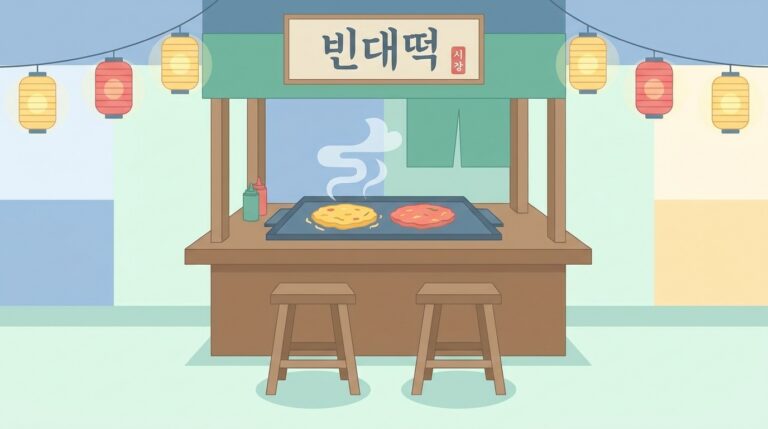
Conquer Gwangjang Market: How to Order Street Food Like a True Seoulite
Phase 1: 공감 (Story-Immersive Opening)
안녕하세요! 매일한글 에디터입니다.
Imagine stepping under the glowing neon entrance of Gwangjang Market (광장시장) in Jongno on a Friday evening. The air hits you first: a mouthwatering cloud of nutty roasted sesame oil, bubbling garlic broth, and the unmistakable hiss of golden mung bean pancakes sizzling in shallow pans. Everywhere you look, narrow alleys are packed shoulder-to-shoulder with laughing locals, university students clinking green bottles of makgeolli, and market aunties expertly tossing noodles into steaming metal bowls.
You have seen this vibrant spectacle on your favorite K-dramas and Netflix street food documentaries. You came specifically to feel this lively market energy (시장 분위기). But suddenly, your stomach rumbles and reality sets in: there are no host stands, no English menus with pictures, and every single wooden bench looks completely crammed. The busy auntie (이모님) is moving at 100 miles per hour, flipping three pancakes at once. You freeze. How do I ask if there is room for me to sit? Will she be annoyed if I just want a small snack? What if I cannot finish the huge portion?
Take a deep breath! Over the past ten years coaching international learners in Seoul, I have seen hundreds of students face this exact frozen moment. Korean traditional markets look chaotic from the outside, but they run on a warm, rhythmic, and predictable social dance. With just three core phrases and a tiny sprinkle of market etiquette, you will slide onto those cozy heated benches and eat like an experienced local. Let’s dive in!
Phase 2: 핵심 표현 3선 심층 분석 (Top 3 Key Expressions)
1. 여기 자리 있어요? (Yeogi jari isseoyo?)
- Pronunciation: [Yeo-gi ja-ri ee-sseo-yo?] (Sounds like: “Yaw-gi jah-ree ee-saw-yo?”)
- Meaning: Literal: “Is there a seat here?” / Real Nuance: “Excuse me, can I squeeze into this open spot?”
- K-Culture Moment: You will recognize this line in almost every slice-of-life K-drama whenever characters wander into a bustling pojangmacha (street cart) or night market, looking for a cozy spot to chat.
- Editor’s Insight: Traditional market stalls do not have reservation books or greeters. You walk right up to an empty stool, catch the vendor’s eye, and politely ask this question. It shows great manners without being overly stiff.
- Situation Spectrum: Casual: ✅ | Semi-formal: ✅ | Formal: ⚠️
- 🤔 Think About It: In many Western dining setups, sitting inches away from a total stranger feels like an intrusion of personal space. Why do you think Korean market culture embraces shared benches so warmly?
2. 1인분만 주세요 (Ir-inbun-man juseyo)
- Pronunciation: [I-rin-bun-man ju-se-yo] (Sounds like: “Ear-in-boon-mahn joo-seh-yo”)
- Meaning: Literal: “Give me only 1 portion, please” / Real Nuance: “Just one serving to start with, please!”
- K-Culture Moment: Seen during market food-crawl variety shows where K-pop idols sample food from stall to stall without getting full too quickly.
- Editor’s Insight: The magic particle here is -만 (-man), meaning “only” or “just.” It signals to the vendor that you are solo dining or food-hopping, gently setting expectations so they don’t prepare a banquet-sized platter!
- Situation Spectrum: Casual: ✅ | Semi-formal: ✅ | Formal: ✅
- 🤔 Think About It: In English, we order items (“one pancake”), but Korean market culture counts food by human servings (“1인분” = 1 person portion). What does this reveal about how food is conceptualized in Korea?
3. 남은 거 포장해 주세요 (Nameun geo pojanghae juseyo)
- Pronunciation: [Na-meun geo po-jang-hae ju-se-yo] (Sounds like: “Nah-moon gaw poh-jahng-hae joo-seh-yo”)
- Meaning: Literal: “Pack the remaining thing, please” / Real Nuance: “Could you wrap the leftovers to take home?”
- K-Culture Moment: Think of that heartwarming drama scene where a character walks home under streetlights holding a crinkly plastic market bag filled with savory bindaetteok for their family.
- Editor’s Insight: Korean street market portions are famously generous. Vendors hate seeing good food go to waste; asking for pojang (takeout wrapping) is seen as a huge compliment to the cook’s delicious cooking!
- Situation Spectrum: Casual: ✅ | Semi-formal: ✅ | Formal: ✅
- 🤔 Think About It: Leaving food behind versus asking to package it: how does showing respect for the cook’s labor translate differently across cultures?
Phase 3: 교과서 한국어 vs 진짜 한국어 (Textbook vs Real-World Korean)
Situation 1: Getting the vendor’s attention to order
- 📖 교과서 한국어: “실례합니다, 이것을 주문해도 될까요?” (Excuse me, may I order this?)
- 🗣️ 진짜 한국어: “이모님, 이거 하나 주세요!” (Auntie, one of this please!)
- 💡 왜 다를까? Textbook Korean sounds like you are addressing a university professor. In a loud food alley, calling the cook “이모님” (Imo-nim / Auntie) creates instant kinship, cutting straight through the sizzle of frying oil!
Situation 2: Asking for the bill
- 📖 교과서 한국어: “총 얼마를 지불해야 합니까?” (How much must I pay in total?)
- 🗣️ 진짜 한국어: “이모님, 계산해 주세요!” (Auntie, check please!)
- 💡 왜 다를까? Market transactions are fast-paced. “계산해 주세요” (Literally: Please calculate) is clear, polite, and universally understood across every dining counter in South Korea.
Phase 4: K-Culture 딥다이브 & 비언어적 매너 (Deep Dive & Body Language)
4-1. 눈치 (Nunchi) & Gestures
- The One-Finger High-Five: When approaching a crowded bench, raise your index finger subtly at chest level while making brief eye contact with the vendor. This non-verbal sign translates to: “Just one solo diner looking for any tiny gap!”
- The Heated Bench Slide: In cooler months, Gwangjang Market benches are electrically heated! If someone steps away, market nunchi dictates that you slide over smoothly to consolidate empty space so new diners can sit. Leaving wide gaps while hungry people are standing is considered inconsiderate.
4-2. 문화 코드 분석 (The Cultural Code)
- The Magic of ‘이모님’ (Imo-nim): While “이모” technically means your mother’s sister, using “이모님” for female market cooks establishes a relationship of warmth, trust, and affection. The secret reward? You will almost always receive a brighter smile, extra pickled onions (양파절임), and maybe even a complimentary drink (서비스)!
- Communal Table Charm: Sitting side-by-side with strangers eating piping hot food under buzzing market lights is the heart of Seoul’s working-class heritage. Embracing this proximity connects you directly to the heartbeat of the city.
Phase 5: 실전 롤플레이 시나리오 (Real-World Roleplay)
- Setting: Stall #34 at Gwangjang Market. The giant griddle is bubbling with golden bindaetteok. Steam billows into the crisp night air.
- Character: Auntie Sun-hee (박이모님), a friendly market veteran with a floral apron and lightning-fast spatula skills.
- 이모님: 어서 와요! 몇 명이에요? (Eoseo wayo! Myeot myeong-ieyo? / Welcome! How many people?) 🎭 Wipes down a stool on the wooden counter with a friendly grin.
- You: 혼자예요. 여기 자리 있어요? (Honja-yeyo. Yeogi jari isseoyo? / Just me. Is there a seat here?) 🎭 Points politely to the open wooden stool while smiling.
- 이모님: 응, 거기 따뜻해, 앉아요! 뭐 줄까? (Eung, geogi ttatteut-hae, anjayo! Mwo julkka? / Yep, it’s warm there, sit down! What can I get ya?) 🎭 Pats the heated cushion invitingly.
- You: 빈대떡 1인분만 주세요. (Bindaetteok ir-inbun-man juseyo. / Just one order of mung bean pancake, please.) 🎭 Holds up one index finger clearly.
- 이모님: 막걸리는 안 필요해? 빈대떡엔 막걸린데! (Makgeollineun an piryohae? Bindaetteogen makgeollinde! / Don’t need makgeolli? Makgeolli is best with bindaetteok!) 🎭 Winks and points her spatula toward the beverage cooler.
- You: 오늘은 사이다 하나 주세요! (Oneureun saida hana juseyo! / Just a cider/lemon-lime soda today, please!) 🎭 Laughs sheepishly and rubs back of neck.
- 이모님: 그래, 금방 줄게! 뜨거우니까 조심해! (Geurae, geumbang julge! Tteugeo-unicca josimhae! / Alright, coming right up! Watch out, it’s hot!) 🎭 Slides a sizzling platter of pancake with dipping sauce toward you.
- You: 와, 맛있겠다! 잘 먹겠습니다! (Wa, masitgetda! Jal meokgetseumnida! / Wow, looks delicious! Thank you for the meal!) 🎭 Snaps chopsticks apart with genuine excitement.
🔀 인터랙티브 분기점 (Interactive Branching Point)
You have finished half of the enormous pancake, but your stomach is completely stuffed! What do you do?
* Choice A: You catch the vendor’s eye and say: “이모님, 남은 거 포장해 주세요!”
* Feedback (Best): Auntie Sun-hee beams, whips out aluminum foil, and packs it into a tidy bag. You saved delicious food and proved your market etiquette!
* Choice B: You place your cash silently on the counter, leave half the pancake behind, and walk away.
* Feedback (Bad): Auntie looks worried and wonders if her pancake was too oily or didn’t taste right. It leaves an awkward lingering feeling.
* Choice C: You stand up and say: “이모님, 너무 많아서 남겼어요. 환불해 주세요!” (Refund half please!)
* Feedback (Risk): Never ask for a partial refund on freshly cooked food. The entire stall will go dead silent from second-hand embarrassment!
Phase 6: 10초 감정 섀도잉 드릴 (10-Second Emotion Shadowing Drill)
Practice these lines with rhythm, pausing at the / marks, and channeling each emotion tag:
[😊 밝고 조심스럽게]여기 / 자리 / 있어요? (Yeogi / jari / isseoyo?)[😋 군침 돌며 또렷하게]빈대떡 / 1인분만 / 주세요! (Bindaetteok / ir-inbun-man / juseyo!)[🙏 싹싹하고 예의 바르게]이모님, / 남은 거 / 포장해 주세요! (Imo-nim, / nameun geo / pojanghae juseyo!)[😄 만족스럽고 씩씩하게]정말 맛있어요! / 계산해 주세요! (Jeongmal masisseoyo! / Gyesanhae juseyo!)
Phase 7: K-Culture 미니 사전 (Mini Dictionary)
- 먹자골목 (Meokjagolmok) | Food Alley / Eat Street | An iconic alleyway tightly packed with specialized food vendors, representing Korea’s vibrant night food culture.
- 이모님 (Imo-nim) | Respected Auntie | An endearing and polite title used for middle-aged female restaurant and stall owners, creating immediate friendly rapport.
- 빈대떡 (Bindaetteok) | Savory Mung Bean Pancake | A classic crispy pancake made from soaked and ground mung beans, pork, and vegetables shallow-fried to perfection.
- 1인분 (Ir-inbun) | One Serving / One Portion | The standard unit for ordering Korean food; literally translates to “one person’s portion.”
Phase 8: 여행자를 위한 생존 키트 (Traveler’s Survival Kit)
서바이벌 표현 TOP 3 (Survival Phrases)
- 얼마예요? (Eolmayeyo?) – How much is it?
Pro Tip: Traditional stalls love fast transactions. Have your cash ready when asking this! - 물은 셀프예요? (Mureun selpeuyeyo?) – Is water self-service?
Pro Tip: At almost all market stalls, water cups and metal coolers are located at the end of the counter for you to grab yourself. - 화장실 어디예요? (Hwajangsil eodiyeyo?) – Where is the restroom?
Pro Tip: Gwangjang Market is huge; public restrooms are located near the central intersection under the large numbered signs.
Editor’s Travel Note
- Getting There Fast: Take Seoul Subway Line 1 to Jongno 5-ga Station (종로5가역), Exit 8. Walk straight for 50 meters, and you will step right into the mouth of the food alley.
- App Navigation: Don’t rely on global map apps which often lack accurate pedestrian alley routes in Seoul. Make sure you complete the Naver Map app download to easily check market operating hours and stall locations.
- Payment Manners: While many vendors accept cards, stall equipment can get glitchy during peak hours. Keep 1,000 KRW, 5,000 KRW, and 10,000 KRW crisp paper bills handy. Cash or Korean bank transfer (계좌이체) is always appreciated.
Phase 9: “한 발 더 깊이” (One Step Deeper)
In modern cities, dining has become increasingly solitary and digitalized behind self-order kiosks and individual booths. Yet at a traditional Korean market like Gwangjang, humanity remains unapologetically collective. Sitting cheek-by-jowl on a bench warmed by an electric wire, passing the soy sauce dish to a stranger, and sharing the aroma of crispy bindaetteok evokes the ancient Korean virtue of 정 (Jeong)—an invisible bond of affection and community. When you order food here in Korean, you are not merely buying a meal; you are participating in a living ritual of collective hospitality.
💬 Your Turn: Have you ever eaten at a crowded communal food market in your home country or while traveling? How did it feel compared to a private restaurant table? Share your experience in the comments below!
Phase 10: FAQ & 오해 방지 (FAQ & Common Mistakes)
Q: Can I visit Gwangjang Market stalls alone, or do I need a group?
A: Solo dining (혼밥) is completely normal! Stalls are designed with single-stool counter seating, and ordering 1 portion (1인분) is welcome everywhere.
Q: What if the auntie speaks very fast and I don’t understand her?
A: Don’t panic! Smile, point gently to what you want on the griddle, and say: “이거 1인분 주세요” (Igeo ir-inbun juseyo – One serving of this, please). Market vendors are world champions at body language!
Q: Is it rude if I do not order an alcoholic drink like makgeolli?
A: Not at all. Vendors might playfully ask if you want alcohol because bindaetteok pairs famously with makgeolli, but ordering soda (사이다) or plain water is 100% fine.
🚨 흔한 실수 (Common Mistakes) 경고판
- Mistake: Standing awkwardly behind people waiting for a waiter to seat you.
Correct Action: Market stalls do not have host staff. Look for an open stool, step up, make eye contact, and ask: “여기 자리 있어요?” - Mistake: Calling young or middle-aged vendors “아가씨” (Agassi / Young lady) or shouting “저기요” too aggressively.
Correct Action: Use the warm and beloved term “이모님” (Imo-nim) or the respectful “사장님” (Sajangnim / Boss). - Mistake: Trying to pay for a 3,000 KRW snack with a large 50,000 KRW bill.
Correct Action: Carry smaller notes (1,000 KRW and 5,000 KRW) to keep the line moving smoothly.
Phase 11: 액션 미션 & 참여 유도 (Action Missions)
- 🥉 Bronze Mission (Solo Practice): Stand in front of your mirror, smile, raise one index finger, and say out loud three times: “이모님, 여기 자리 있어요?”
- 🥈 Silver Mission (Social Sharing): Take a photo of your next street food or meal, upload it to Instagram or Threads, and write: “1인분만 주세요!” Tag #DailyHangul so we can cheer you on!
- 🥇 Gold Mission (Real-Life Mastery): Visit a Korean restaurant or market stall this weekend. Skip English entirely and order your food using: “이모님, 이거 1인분 주세요!”
- 🎮 K-Culture Mission: Watch an episode of a Korean street food travel show (such as Netflix’s Street Food: Asia – Seoul episode). Count how many times you spot people sharing wooden benches and calling out “이모님!”
Phase 12: 인터랙티브 퀴즈 챌린지 (Interactive Quiz Challenge)
Q1. [Situational Judgment] You walk into Gwangjang Market and find a narrow opening on a counter bench between two people. What should you say to the vendor?
* A) 비키세요! (Move aside!)
* B) 여기 자리 있어요? (Is there a seat here?)
* C) 얼마 지불할까요? (How much shall I pay?)
Q2. [Fill in the Blank] When you are stuffed and want to take your leftover food back to the hotel, you say:
“이모님, 남은 거 _________ 주세요!”
Q3. [True / False Cultural Check] In Korean traditional markets, calling a middle-aged female stall owner ‘이모님’ (Auntie) is considered disrespectful because she is not your real relative.
(True / False)
👉 Click to reveal answers & explanations!
- Q1 Answer: B) 여기 자리 있어요?
Explanation: This is the polite, natural way to ask if an open stool is available before sitting down. - Q2 Answer: 포장해 (Pojanghae)
Explanation: “포장” means packaging or wrapping to go. Combining it with “-해 주세요” means “Please wrap/pack it for me.” - Q3 Answer: False!
Explanation: It is the exact opposite! Calling a female vendor ‘이모님’ is an affectionate sign of friendliness that brings instant smiles in Korean food markets.
🎬 Watch Our Daily Videos! (Daily Hangul Official Instagram)
Review the expressions you learned in this article with our fun daily short videos! Check out native pronunciation and real-life nuances in action.
- Instagram @dailyhangul_en







