

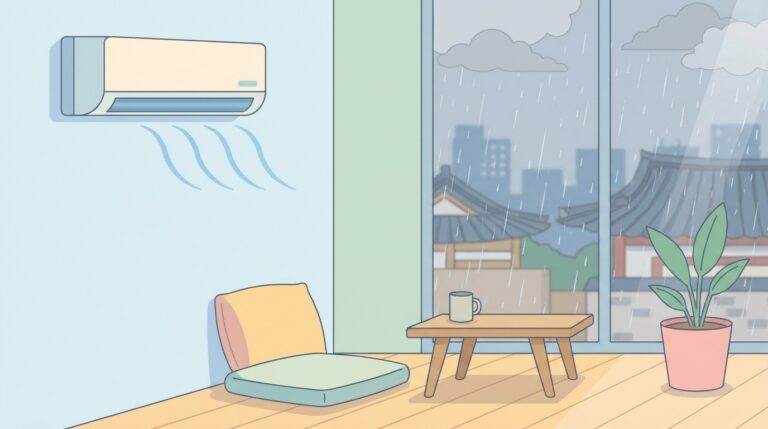
Stop AC Mold Smell in Korea: The Secret 30-Minute Fan Mode Hack
Phase 1: Empathy (Story-Driven Opening)
안녕하세요! 매일한글 에디터입니다. (Hello! I’m your Daily Hangul editor.)
Picture this: It’s mid-July in Seoul. The relentless monsoon season—Jangma (장마)—has turned the entire city into an outdoor steam sauna. You finally escape the sticky, rain-soaked streets and collapse inside your cozy Hongdae studio apartment. You grab the remote and blast the wall-mounted air conditioner, expecting a rush of arctic bliss. But instead? A blast of sour, damp, wet-sock funk hits you right in the face.
“Wait, did I leave a wet towel inside the machine?” you wonder in horror. You didn’t, but mold (곰팡이) did move in rent-free. In Korean studio apartments (원룸), poor ventilation and constant cooling create trapped condensation. Countless international students and expats find themselves frantically scrubbing vents or losing their rental deposits over mildew stains. Today’s lesson solves this exact nightmare with one golden household secret shared by every savvy Korean local: switching your AC to fan mode before shutoff. Let’s master the phrase that will keep your home fresh and your Korean effortlessly practical!
Phase 2: Top 3 Core Expressions Deep Dive
1. 에어컨을 끄기 전에 송풍 모드로 30분 동안 내부를 말려 주면 퀴퀴한 냄새가 안 나요
- Pronunciation: [Ee-eo-keon-eul kkeu-gi jeon-e song-pung mo-deu-ro sam-sip-bun dong-an nae-bu-reul mal-lyeo ju-myeon kwi-kwi-han naem-sae-ga an na-yo] (Sound analogy: Think of ‘song’ as a music tune and ‘pung’ popping like a bubble: ‘Song-Poong’)
- Meaning: Literal: “If you dry the inside in blower mode for 30 minutes before turning off the air conditioner, musty smell does not come out.” | Real Nuance: “If you run fan mode for 30 minutes to dry the coils before turning off the AC, it prevents that awful damp stench.”
- K-Culture Moment: You will hear meticulous apartment owners or neat-freak characters in lifestyle K-Dramas like Because This Is My First Life preach this exact rule to their new roommates.
- Editor’s Insight: The structure -기 전에 (before doing) combined with -(으)면 (if/when) and -아/어 주다 (to do as a helpful favor) makes this a masterpiece B1 sentence. It sounds polite, constructive, and hyper-practical.
- Situation Spectrum: Casual: ⚠️ | Semi-formal: ✅ | Formal: ✅
- 🤔 Think About It: In English, we often demand action directly (“Dry the AC before turning it off”). Why does Korean prefer conditional phrasing like “If you dry it… the smell won’t happen” to offer domestic advice?
2. 퀴퀴한 냄새가 나요
- Pronunciation: [Kwi-kwi-han naem-sae-ga na-yo] (Sound analogy: ‘Kwi’ rhymes with ‘quick’ without the ‘ck’ sound)
- Meaning: Literal: “A musty smell comes out.” | Real Nuance: “It smells damp, stale, and mildewy.”
- K-Culture Moment: Whenever characters in variety shows like I Live Alone (나 혼자 산다) open a closet after a rainy spell, they wrinkle their noses and mutter, “어디서 퀴퀴한 냄새 나지 않아?” (Doesn’t it smell musty in here?).
- Editor’s Insight: Korean is rich in sensory onomatopoeia and mimetic words. 퀴퀴하다 specifically describes the smell of unventilated basements, damp laundry that dried in the dark, or water trapped in machinery.
- Situation Spectrum: Casual: ✅ | Semi-formal: ✅ | Formal: ✅
- 🤔 Think About It: English has “musty,” “stale,” and “moldy.” Notice how Korean attaches specific sensory adjectives directly to how moisture feels in the room.
3. 곰팡이가 생기지 않게 관리해야 해요
- Pronunciation: [Gom-pang-i-ga saeng-gi-ji ank-ke gwan-ri-hae-ya hae-yo] (Sound analogy: ‘Gom’ like gummy bear, ‘pang’ like popping a pan)
- Meaning: Literal: “Must manage so that mold does not appear.” | Real Nuance: “We have to maintain it properly so mold doesn’t grow.”
- K-Culture Moment: Used constantly between landlords (집주인) and tenants during move-in walkthroughs before the July monsoon season hits Seoul.
- Editor’s Insight: The grammar pattern -지 않게 means “so that [something] does not occur.” It showcases forward-thinking prevention, which is central to Korean home management.
- Situation Spectrum: Casual: ⚠️ | Semi-formal: ✅ | Formal: ✅
- 🤔 Think About It: In Korea, mold prevention is often considered a tenant’s legal and neighborly duty. How does language reflect shared responsibility in rental housing?
Phase 3: Textbook Korean vs. Real Korean
Situation 1: Pointing out that damp, musty smell in your room
- 📖 Textbook Korean:
실내에서 불쾌한 냄새가 발생합니다. (Silnae-eseo bulkwaehan naemsaega balsaenghamnida.)
“An unpleasant odor is occurring inside the room.” - 🗣️ Real Korean:
방에서 퀴퀴한 냄새 나지 않아? (Bang-eseo kwikwihan naemsae naji ana?)
“Doesn’t the room smell super musty right now?” - 💡 Why the Difference?:
Textbooks love formal passive verbs like 발생하다 (to occur). Real Koreans use natural sensory verbs like 냄새가 나다 (a smell emits) paired with evocative adjectives like 퀴퀴하다.
Situation 2: Telling your roommate to use the AC fan mode
- 📖 Textbook Korean:
에어컨 내부 건조 기능을 작동시키십시오. (Eeokeon naebu geonjo gineung-eul jakdongsikisipsio.)
“Please activate the internal drying function of the air conditioner.” - 🗣️ Real Korean:
끄기 전에 송풍으로 싹 말려 줘! (Kkeugi jeone songpung-euro ssak mallyeo jwo!)
“Dry it all the way out on fan mode before turning it off!” - 💡 Why the Difference?:
In actual living rooms, Koreans rarely read button manuals aloud. They use 송풍 (fan/blower mode) and the emphatic adverb 싹 (cleanly/completely) to show how thoroughly something should be dried.
Phase 4: K-Culture Deep Dive & Non-Verbal Manners
4-1. Nunchi (눈치) & Gestures
When mentioning a damp smell (퀴퀴한 냄새) in a shared Korean space or to your landlord, direct bluntness can feel like an accusation.
* The Gentle Sniff Test: Don’t dramatically pinch your nose or say “냄새 더러워요” (The smell is disgusting). Instead, lightly tilt your head, give a slight sniffing motion, and frame it gently: “약간 퀴퀴한 냄새가 나는 것 같아요” (It seems like there’s a slightly musty smell).
* Action First: Before complaining, demonstrate good faith (Nunchi) by cracking a window open and checking whether the remote has 송풍 (Fan) or 자동건조 (Auto Dry) already activated.
4-2. Cultural Code: Jangma & The Great One-Room Mold Battle
During Korea’s rainy season (장마철), humidity frequently tops 85%. While international media highlights romantic rain aesthetics—eating Pajeon (scallion pancakes) and drinking Makgeolli in rustic alleys—Korean renters face a gritty survival reality. Korean apartments rely on double-glazed windows designed to trap winter heat, meaning moisture gets locked inside. If mold damages wallpaper (도배), landlords may deduct hundreds of thousands of won from your security deposit (보증금). Running fan mode is not just a cleanliness quirk; it’s financial self-defense!
Phase 5: Real-World Roleplay Scenario
Setting: A compact studio flat in Sinchon on a rainy July afternoon. You and your Korean flatmate, Minji (민지), are packing up to leave for campus.
- Turn 1 (Minji):
비 오니까 방이 너무 꿉꿉하다. 에어컨 그냥 끄고 나갈까?
(Bi onikka bang-i neomu kkup-kkup-hada. Eeokeon geunyang kkeugo nagalkka?)
🎭 Grabbing her umbrella and pointing the remote at the AC.
“Since it’s raining, the room is so sticky. Should we just turn off the AC and head out?” -
Turn 2 (You):
잠깐만요! 에어컨을 끄기 전에 송풍 모드로 30분 동안 내부를 말려 주면 퀴퀴한 냄새가 안 나요.
(Jamkkanman-yo! Eeokeon-eul kkeu-gi jeon-e song-pung mo-deu-ro sam-sip-bun dong-an nae-bu-reul mal-lyeo ju-myeon kwi-kwi-han naem-sae-ga an na-yo.)
🎭 Gently raising a hand to pause her while smiling warmly.
“Wait a second! If we run fan mode for 30 minutes to dry the inside before turning off the AC, it prevents that musty smell.” -
Turn 3 (Minji):
아, 진짜? 송풍 모드로 두면 전기는 많이 안 나와?
(A, jinjja? Songpung mo-deu-ro dumyeon jeon-gi-neun mani an nawa?)
🎭 Tilting her head with curious eyes.
“Oh, really? Does leaving it on fan mode consume a lot of electricity?” -
Turn 4 (You):
네, 송풍 모드는 실외기가 안 돌아서 선풍기만큼 전기를 적게 써요.
(Ne, song-pung mo-deu-neun sil-oe-gi-ga an dor-a-seo seon-pung-gi-man-keum jeon-gi-reul jeok-ge sseo-yo.)
🎭 Pointing outside toward the balcony.
“Yes, since fan mode doesn’t spin the outdoor compressor unit, it uses as little electricity as an electric fan.” -
Turn 5 (Minji):
대박, 몰랐네! 그럼 리모컨 예약 꺼짐을 30분 뒤로 맞추면 되겠다.
(Daebak, mollanne! Geureom rimokeon yeyak kkeojim-eul samsip-bun dwiro matchumyeon doegetda.)
🎭 Nodding enthusiastically while checking the buttons on the remote.
“Awesome, I had no idea! Then we can just set the AC off-timer for 30 minutes later.” -
Turn 6 (You):
맞아요. 그렇게 하면 안에 맺힌 물방울이 말라서 곰팡이가 안 생겨요.
(Maj-a-yo. Geu-reoh-ge ha-myeon an-e maet-hin mul-bang-ul-i mal-la-seo gom-pang-i-ga an saeng-gyeo-yo.)
🎭 Tapping the AC frame lightly with satisfaction.
“Exactly. If you do that, the condensation drops inside dry up so mold doesn’t grow.” -
Turn 7 (Minji):
너 한국인 다 됐구나! 작년에 냄새 때문에 필터 청소하느라 고생했거든.
(Neo hangukin da dwaetguna! Jangnyeone naemsae ttaemune pilteo cheongsohaneura gosaenghaetgeodeun.)
🎭 Chuckling and giving you a friendly pat on the shoulder.
“You’re practically a full local now! Last year I suffered so much cleaning filters because of that smell.” -
Turn 8 (You):
우리 이번 장마철은 쾌적하게 보내 봐요!
(Uri ibeon jang-ma-cheor-eun kwae-jeok-ha-ge bo-nae bwa-yo!)
🎭 Stepping out the door with a confident smile.
“Let’s spend this monsoon season feeling completely fresh and dry!”
🔀 Interactive Decision Point
Minji asks if she should just spray air freshener directly into the AC louvers to fix the smell. What do you say?
- Option A: 에어컨에 탈취제를 뿌리면 곰팡이랑 섞여서 냄새가 더 심해져요. 송풍으로 말려야 해요. (Eeokeone talchwijereul ppurimyeon gompang-irang seok-kyeoseo naemsaega deo simhaejyeoyo. Songpung-euro mallyeoya haeyo.)
- Option B: 네, 향수를 듬뿍 뿌려 주세요. (Ne, hyangsureul deumpuk ppuryeo juseyo.)
- Option C: 그냥 에어컨을 영원히 틀어 두면 냄새가 사라져요. (Geunyang eeokeoneul yeong-wonhi teureo dumyeon naemsaega sarajyeoyo.)
Feedback Breakdown:
* Option A (Best! ✅): Explains logically that spraying perfume onto mold creates a foul chemical cocktail, recommending fan mode instead. Spot-on B1 communication!
* Option B (Bad! ❌): Spraying cologne inside an AC unit leaves oily residue on the radiator coils, attracting even more dirt and mildew.
* Option C (Risk! ⚠️): Running the compressor indefinitely will rack up an electric bill of 300,000+ KRW and freeze the coils.
Phase 6: 10-Second Emotion Shadowing Drill
Practice out loud! Pay attention to the breath pauses (/) and emotional tone markers:
- [💡 똑부러지게 꿀팁 전수하듯 / Smart & Confident Advice]
에어컨 끄기 전에 / 송풍 모드로 30분만 / 꼭 말려 주세요!
(Ee-eo-keon kkeu-gi jeon-e / song-pung mo-deu-ro sam-sip-bun-man / kkok mal-lyeo ju-se-yo!) -
[😫 퀴퀴한 냄새에 진저리치며 / Disgusted by the Damp Smell]
아, 방에서 / 왜 이렇게 / 퀴퀴한 냄새가 나지?
(A, bang-eseo / wae i-reoh-ge / kwi-kwi-han naem-sae-ga na-ji?) -
[😊 안도하며 뿌듯하게 / Relieved & Satisfied]
송풍으로 바짝 말리니까 / 냄새가 싹 사라졌어요!
(Song-pung-eu-ro ba-jjak mal-li-ni-kka / naem-sae-ga ssak sa-ra-jyeoss-eo-yo!)
Phase 7: K-Culture Mini Dictionary
- 송풍 (Songpung): Fan/Blower Mode. A setting where the air conditioner runs only its interior blower fan without engaging the power-hungry outdoor compressor (실외기). Vital for dehumidifying the appliance itself.
- 퀴퀴하다 (Kwikwihada): Musty, stale, damp-smelling. A classic seasonal descriptive word used when clothing, closets, or AC vents reek of damp shadows.
- 장마철 (Jangmacheol): The Korean summer monsoon season. Typically lasting from late June to late July, characterized by high temperatures and suffocating humidity.
- 물먹는 하마 (Mul-meok-neun Ha-ma): Literally “Water-Eating Hippo.” The iconic, ubiquitous tub of moisture-absorbing calcium chloride pellets found inside every closet, shoe rack, and under-bed drawer across South Korea.
Phase 8: Traveler’s Survival Kit
Top 3 Survival Expressions
- 리모컨에 송풍 버튼이 어디 있어요? (Rimokeone songpung beoteuni eodi isseoyo?)
Where is the fan mode button on the remote control?
Pro Tip: Look for buttons labeled 송풍 (Fan), 청정 (Clean air), or icons showing three breezy horizontal waves. - 에어컨 필터 청소는 어떻게 해요? (Eeokeon pilteo cheongsoneun eotteoke haeyo?)
How do I clean the air conditioner filter?
Pro Tip: Asking this to your guesthouse host or landlord demonstrates great respect for their property. - 방이 너무 꿉꿉해서 제습기나 제습제가 필요해요. (Bangi neomu kkup-kkup-haeseo jeseupgina jeseupjega piryohaeyo.)
The room is so sticky/humid that I need a dehumidifier or moisture absorber.
Editor’s Travel Note
- Essential Dehumidifier Shopping: Head to the nearest Daiso branch in your neighborhood and look for the household aisle. Buy 4–5 tubs of moisture absorbers labeled 제습제 (moisture absorber) or look for the classic hippo icon. Slip them into your luggage and shoe cabinet immediately.
- Smart Home Tip: If your AC remote has a button labeled 자동건조 (Auto Dry), activate it! Modern Korean air conditioners will automatically blow room-temperature fan air for 10–20 minutes every time you press the power-off button.
Phase 9: A Step Deeper (Reflective Cultural Insight)
In Korean culture, maintaining a living space is deeply tied to Jeong (정) and collective harmony. When you rent a one-room apartment in Seoul, preserving wallpaper and preventing mildew is seen as common courtesy to the next occupant and the landlord who entrusted you with the home. Taking care of your air conditioner reflects mindful awareness of shared boundaries. What domestic care habits in your home country reflect this kind of community consideration?
💬 Your Turn: Have you ever experienced a sudden musty AC smell while staying in Korea? What button on the remote saved your day? Leave your story in the comments below!
Phase 10: FAQ & Avoiding Misunderstandings
Q: Does running fan mode (송풍) for 30 minutes cause my electric bill to skyrocket?
A: Not at all! The electric bill (전기세) in Korea increases drastically when the outdoor compressor (실외기) runs during cooling mode (냉방). In fan mode (송풍), only the internal plastic drum fan spins, consuming about the same power as a tiny 30-watt desk fan.
Q: My AC remote doesn’t have a button that says ‘송풍’. What should I press?
A: Look for a button named 모드 (Mode) or 운전선택 (Operation Select). Cycle through the settings: 냉방 (Cooling) ➔ 제습 (Dehumidification) ➔ 송풍 (Fan). On some LG or Samsung remotes, it is labeled 청정 (Air clean).
Q: Can’t I just use Dehumidification mode (제습) to dry out the AC?
A: No! 제습 is actually a gentle cooling cycle. Cold coils still collect water condensation inside. Only pure 송풍 (Fan) circulates room-temperature air to dry the damp internal components completely.
🚨 Common Mistakes Alert
- Mistake: Turning off the AC the exact second you feel cold.
Correct Action: Hit the 30-minute timer and switch to fan mode so trapped droplets evaporate. - Mistake: Closing all windows during fan mode.
Correct Action: Crack open a window slightly so the evaporated moisture actually escapes your room. - Mistake: Using air freshener to mask mold.
Correct Action: Clean the mesh filter under running water once every two weeks during the monsoon season.
Phase 11: Action Missions & Community Challenge
- 🥉 Bronze Mission (Solo Shadowing): Walk up to your AC or remote right now. Say aloud: “끄기 전에 송풍 모드로 말려야지!” (I should dry it in fan mode before turning it off!) with confident pronunciation.
- 🥈 Silver Mission (Social Share): Snap a photo of your Korean AC remote or Daiso moisture absorber, post it on your Instagram Story, and tag
@DailyHangulwith the caption: “Goodbye 퀴퀴한 냄새!” - 🥇 Gold Mission (Real-World Use): Next time you chat with a Korean friend, landlord, or language partner, ask them: “장마철에 에어컨 관리 어떻게 하세요?” (How do you maintain your AC during the monsoon season?).
- 🎮 K-Culture Mission: Watch an episode of a Korean reality home show (like Where is My Home / 구해줘! 홈즈) and spot how often realtors inspect the ceiling AC vents for hidden mold.
Phase 12: Interactive Quiz Challenge
1. Real-Life Situation Judgment
You smell a damp, stale odor in your Seoul apartment after returning from class. Which sentence is the most natural way to describe this to your flatmate?
* A) 방에서 퀴퀴한 냄새가 나요.
* B) 방에서 달콤한 향기가 나요.
* C) 방에서 시끄러운 소리가 나요.
2. Fill in the Blank
Complete this golden life rule:
“에어컨을 끄기 전에 송풍 모드로 30분 동안 내부를 [________] 주면 퀴퀴한 냄새가 안 나요.”
* A) 얼려 (Freeze)
* B) 말려 (Dry)
* C) 태워 (Burn)
3. True or False
True or False: Korean AC fan mode (송풍) consumes a massive amount of electricity because the outdoor unit (실외기) runs at double speed.
👉 Click here to reveal the answers and explanations!
- Answer: A (방에서 퀴퀴한 냄새가 나요).
Explanation: ‘퀴퀴하다’ precisely indicates a musty, mildewy smell. B means sweet aroma, and C means loud noise. - Answer: B (말려).
Explanation: The verb 말리다 means “to dry something out.” The sentence uses the helper verb form 말려 주면 (if you dry it out for it). - Answer: False.
Explanation: In fan mode, the outdoor compressor does not run at all. It uses barely any electricity, functioning like a standard desk fan!
🎬 Watch Our Daily Videos! (Daily Hangul Official Instagram)
Review the expressions you learned in this article with our fun daily short videos! Check out native pronunciation and real-life nuances in action.
- Instagram @dailyhangul_en







