

안녕하세요! 매일한글 에디터입니다.
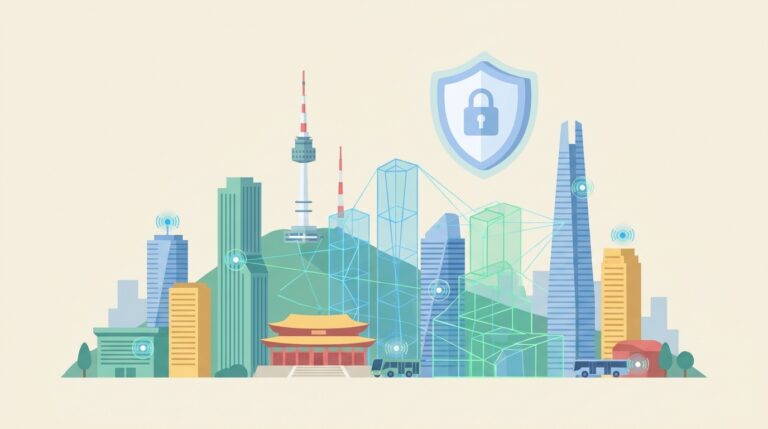
Imagine standing in the glittering heart of Songdo International City or traversing the hyper-connected arteries of Gangnam. Drones hum quietly in the sky, traffic signals adapt within milliseconds through digital twin simulations, and smart waste bins self-compact based on IoT sensor data. South Korea is undeniable proof that the cities of the future are already here. Yet, as our urban centers evolve into high-density, multi-dimensional compact hubs, a darker question inevitably surfaces: where does hyper-efficiency end, and an omniscient digital panopticon begin?
Many advanced Korean learners tell me that while they can effortlessly navigate daily life or pass standard proficiency exams, the moment conversation shifts toward high-stakes socio-technical ethics—such as balancing Seoul’s comprehensive 3D digital twin (S-Map) with constitutional privacy rights—they feel linguistically paralyzed. When debating in boardroom panels, civil society meetups, or academic symposiums, resorting to awkward, textbook-level Korean trivializes your arguments.
This guide is crafted directly from field debriefs with civic-tech specialists, urban planners, and seasoned expatriate researchers in Korea. By the end of this masterclass, you will speak with the analytical gravity and rhetorical nuance of a native policy strategist, articulating data sovereignty and algorithmic oversight with absolute precision.
Phase 2: Core Expressions Deep Dive
1. 데이터 주권을 확립하다 (Daiteo jugwon-eul hwaknip-hada)
- Pronunciation: Dye-tuh joo-gwon-eul hwang-nip-ha-da (Sounds like English “die-tuh” followed by the focused cadence of “joo-gwon”, with the liquid nasal assimilation making “hwak-nip” roll smoothly off the palate).
- Meaning: Literally “to establish data sovereignty”; practically, it means championing citizens’ foundational rights to control, access, and withhold their digital breadcrumbs from municipal or corporate overreach.
- K-Culture Moment: Evocative of high-tension political cyber-dramas like Argon or dystopian thrillers where an investigative team challenges a monolithic enterprise over unlawful user profiling.
- Editor’s Insight: In high-register discourse, using “확립하다” (hwaknip-hada; to establish firmly) rather than the basic “지키다” (jikida; to protect) immediately elevates your position from emotional grievance to legal-philosophical authority.
- Situation Spectrum:
- Casual: 🚫 (Too heavy for casual coffee chats)
- Semi-formal: ⚠️ (Appropriate only if discussing tech trends)
- Formal / Debate: ✅ (The golden standard for symposiums)
- 🤔 Think About It: In English, “privacy” often emphasizes individual boundary-setting, whereas “주권” (sovereignty) frames data autonomy as an unalienable civic birthright. How does this political vocabulary shift the ethical stakes?
2. 양날의 검으로 작용하다 (Yangnal-ui geom-euro jak-yong-hada)
- Pronunciation: Yang-nal-ui geom-eu-ro jahk-yong-ha-da (Notice how “yang-nal” evokes the crisp snap of two blades sliding against one another).
- Meaning: “To act as a double-edged sword.” It describes technologies or policies that deliver profound benefits while simultaneously harboring fatal risks if left unregulated.
- K-Culture Moment: Frequently uttered on flagship investigative journalism broadcasts like KBS’s Current Affairs Window (시사기획 창) when analyzing how ubiquitous intelligent CCTV networks practically erased street crime in Seoul while quietly enabling biometric state surveillance.
- Editor’s Insight: Do not merely say “장단점이 있다” (It has pros and cons). At the C2 level, “양날의 검으로 작용하다” conveys your sophisticated awareness of systemic paradoxes and high-stakes trade-offs.
- Situation Spectrum:
- Casual: ⚠️ (Can sound slightly theatrical)
- Semi-formal: ✅ (Insightful in analytical discussions)
- Formal / Debate: ✅ (Essential rhetorical device)
- 🤔 Think About It: Why does Korean political discourse favor sharp martial metaphors like swords (“검”) when analyzing modern digital policy trade-offs?
3. 빈틈없는 감시망을 경계하다 (Binteum-eomneun gamsimang-eul gyeonggye-hada)
- Pronunciation: Bin-teum-eom-neun gahm-si-mang-eul gyung-gye-ha-da (Flow the nasal transition from “eom” to “neun” smoothly without breaking the breath).
- Meaning: Literally “to be vigilant against a seamless surveillance net.” It speaks directly to guarding against a creeping, all-encompassing digital panopticon.
- K-Culture Moment: Echoes investigative podcasts and social-realist cinema, where civic watchdogs warn that unchecked metropolitan IoT algorithms will quietly extinguish individual civil liberties.
- Editor’s Insight: “빈틈없는” means airtight or without the slightest aperture. Pairing it with “경계하다” (to stay on high alert / guard against) demonstrates that your critical stance is nuanced, proactive, and discerning.
- Situation Spectrum:
- Casual: 🚫
- Semi-formal: ⚠️
- Formal / Debate: ✅
- 🤔 Think About It: How does the visual metaphor of a “net” (망) highlight the invisible, interconnected nature of smart city infrastructures compared to Western concepts of an isolated “eye” (Panopticon/Big Brother)?
Phase 3: Textbook Korean vs. Real Korean
Situation 1: Emphasizing the need for algorithmic anonymization
- 📖 교과서 한국어 (Textbook Korean):
데이터를 모을 때 개인정보를 지워야 시민들의 비밀을 보호할 수 있습니다.
(Daiteo-reul moeul ttae gaeinjeongbo-reul jiwoya simindeul-ui bimil-eul bohohal su itseumnida.)
“When collecting data, personal information must be erased so we can protect citizens’ secrets.” - 🗣️ 진짜 한국어 (Real-World High-Register Korean):
알고리즘의 고도화에 발맞춰 비식별화 조치와 철저한 익명화 프로세스가 제도적으로 담보되어야 합니다.
(Algorijeum-ui godohwa-e balmatchwo bisikbyeolhwa jochi-wa cheoljeohan ingmyeonghwa peuroseseu-ga jedojeok-euro dambo-doe-eoya hamnida.)
“In lockstep with algorithmic advancement, rigorous de-identification protocols and institutional safeguards for anonymization must be guaranteed.” - 💡 Why the Difference?: Native professionals avoid colloquial terms like “지우다” (to erase) or “비밀” (secrets) in policy contexts. Instead, they deploy statutory terminology such as “비식별화 조치” (de-identification measures) and “제도적으로 담보되다” (institutionally guaranteed) to build undeniable credibility.
Situation 2: Warning against unvetted expansion of AI monitoring
- 📖 교과서 한국어 (Textbook Korean):
CCTV가 너무 많아지면 빅브라더가 되니까 조심해야 합니다.
(CCTV-ga neomu manajimyeon bikbeuradeoga doenikka josimhaeya hamnida.)
“If there are too many CCTVs, it becomes Big Brother, so we must be careful.” - 🗣️ 진짜 한국어 (Real-World High-Register Korean):
도시 전역의 센서망이 무분별하게 확충될 경우, 자칫 현대판 판옵티콘으로 변질될 위험성을 내포하고 있습니다.
(Dosi jeon-yeok-ui senseomang-i mubunbyeolhage hwakchungdoel gyeong-u, jachit hyeondaepan pan-optikon-euro byeonjildoel wiheomseong-eul naepohago itseumnida.)
“Should metropolitan sensor grids expand indiscriminately, they harbor the perilous risk of mutating into a modern-day panopticon.” - 💡 Why the Difference?: High-level public debate shuns simplistic conditional warnings. Utilizing conceptual rhetoric like “현대판 판옵티콘” (modern panopticon) and “변질될 위험성을 내포하다” (inherently harbors the risk of corruption) turns a basic warning into a profound structural critique.
Phase 4: K-Culture Deep Dive & Non-Verbal Manners
4-1. Nunchi & Public Sector Deliberation Etiquette
When critiquing technological policy in Korean professional chambers, your non-verbal cues (Nunchi, 눈치) determine whether you are received as a constructive public intellectual or a confrontational agitator.
* The Steady Micro-Pause: Never interrupt an urban planner or director while they are presenting smart city operational metrics. Wait for the concluding discourse breath, lean forward approximately 5 degrees, and initiate your counterpoint with a low-register acknowledgment: “말씀해 주신 효율성의 취지에는 십분 공감합니다만…” (While I fully empathize with the intended efficiency you’ve articulated…).
* Subtle Hand Positioning: Avoid pointing at slides, display monitors, or individuals. When referencing infrastructural vulnerabilities, gesture open-palmed, facing slightly inward. This communicates intellectual humility alongside unyielding intellectual rigour.
4-2. Cultural Code Analysis: The Paradox of Safety vs. Privacy in Korea
To truly grasp this unit, one must understand Korea’s unprecedented social contract. South Korea possesses one of the lowest violent crime rates globally. Locals leave laptops unattended in cafés and wander darkened metropolitan alleys at 3:00 AM without hesitation. Much of this psychological security is credited to the dense network of high-definition municipal CCTVs and synchronized digital tracking networks.
However, this cultural reverence for public order has created a unique governance friction. Korea’s Personal Information Protection Act (개인정보 보호법) is among the most stringent in the world on paper. The central tension is not whether smart cities are technologically desirable—most Koreans enthusiastically embrace smart transport and automated infrastructure—but whether the massive stream of location coordinates, payment logs, and facial signatures could, in a moment of administrative overreach, be stitched together into an unchallengeable regime of civic surveillance. Navigating this cultural paradox requires articulating respect for collective safety while vehemently safeguarding the democratic right to digital anonymity.
Phase 5: Real-World Roleplay Scenario
Setting: The Seoul Metropolitan Smart Governance Forum at the Dongdaemun Design Plaza (DDP). Elena (a visiting civic technologist) is on a panel with Director Park Min-jun (a senior executive leading the municipal Digital Twin Compact City Project).
Turn 1
* 박 실장: 이번 디지털 트윈 기반 압축도시 모델은 서울의 교통 체증과 에너지 과밀을 획기적으로 해결할 국가적 이정표입니다.
(Ibeon dijiteol teuwin giban apchukdosi modeleun seoul-ui gyotong chejeung-gwa eneoji gwa-mireul hoekgijeok-euro haegyeolhal gukgajeok ijeongpyo-imnida.)
“This digital twin-based compact city model is a national milestone that will radically resolve Seoul’s traffic congestion and energy density.”
* 🎭 Action: Director Park proudly gestures toward a dynamic 3D hologram of Seoul, projecting confidence and bureaucratic authority.
Turn 2
* 엘레나: 고도화된 공간 효율성과 탄소 배출 저감이라는 실익에는 전적으로 동의합니다.
(Godohwadoen gonggan hyoyulseong-gwa tanso baechul jeogam-iraneun sirik-eneun jeonjeok-euro dong-uihamnida.)
“I completely agree with the tangible benefits of heightened spatial efficiency and carbon reduction.”
* 🎭 Action: Elena nods steadily, maintaining open eye contact to establish mutual professional respect.
Turn 3
* 박 실장: 그렇다면 어떤 지점에서 본 프로젝트의 공공 수용성에 의구심을 표하시는 건가요?
(Geureotdamyeon eotteon jijeom-eseo bon peurojekteu-ui gonggong suyongseong-e uigusim-eul pyohasineun geon-gayo?)
“In that case, at what specific juncture do you hold reservations regarding the public acceptability of this project?”
* 🎭 Action: Director Park folds his hands thoughtfully on the lectern, inviting precise criticism.
Turn 4
* 엘레나: 도시 전역에 촘촘히 포진된 지능형 IoT 센서와 안면 인식 기제가 자칫 시민 감시망으로 변질될 우려가 상존하기 때문입니다.
(Dosi jeon-yeok-e chomchomhi pojindoen jineunghyeong IoT senseo-wa anmyeon insik gije-ga jachit simin gamsimang-euro byeonjildoel uryeo-ga sangjonhagi ttaemun-imnida.)
“Because there exists a persistent risk that the intelligent IoT sensors and facial recognition mechanisms densely deployed across the city could deteriorate into a surveillance net.”
* 🎭 Action: Elena speaks in a calm, firm, even register, deliberately anchoring the debate on structural vulnerabilities.
Turn 5
* 박 실장: 저희 행정망은 철저한 보안 방화벽과 최첨단 비식별화 알고리즘을 거치므로 정보 유출의 여지가 전혀 없습니다.
(Jeohui haengjeongmang-eun cheoljeohan bo-an banghwabyeok-gwa choecheomdan bisikbyeolhwa algorijeum-eul geochimeuro jeongbo yuchul-ui yeoji-ga jeonhyeo eopseumnida.)
“Our administrative infrastructure undergoes strict security firewalls and cutting-edge de-identification algorithms, leaving zero margin for data leakage.”
* 🎭 Action: Director Park shakes his head slightly, defending the institutional integrity of the municipal systems.
Turn 6
* 엘레나: 기술적 무결성만으로는 부족합니다. 데이터 주권의 주체인 시민들이 알고리즘의 편향성과 수집 범위를 직접 감시할 수 있는 거버넌스가 결여되어 있습니다.
(Gisuljeok mugyeolseong-man-eoroneun bujokhamnida. Daiteo jugwon-ui juchein simindeul-i algorijeum-ui pyeonhyangseong-gwa sujip beomwi-reul jikjeop gamsihal su inneun geobeoneonseu-ga gyeoryeodoe-eo itseumnida.)
“Technical integrity alone is insufficient. It lacks a civic governance framework wherein citizens—the rightful holders of data sovereignty—can directly oversee algorithmic bias and collection scopes.”
* 🎭 Action: Elena gently taps her notepad, emphasizing procedural and democratic legitimacy over mere technical assurances.
Turn 7
* 박 실장: 다시 말해, 행정 편의주의적 데이터 독점을 탈피하고 시민 사회의 실시간 통제권을 제도화하자는 말씀이시군요.
(Dasi malhae, haengjeong pyeon-uiju-uijeok daiteo dokjeom-eul talpihago simin sahoe-ui silsigan tongjegwon-eul jedohwahajaneun malsseum-isigun-yo.)
“In other words, you are proposing that we break away from administrative paternalism and institutionalize civil society’s real-time oversight.”
* 🎭 Action: Director Park looks up, pleasantly surprised by the analytical precision of Elena’s policy conceptualization.
Turn 8
* 엘레나: 정확합니다. 투명한 정보 공개와 시민 참여형 검증 체계야말로 스마트시티가 ‘빅브라더’라는 오명을 피할 수 있는 유일한 해법입니다.
(Jeonghwakhamnida. Tumyeonghan jeongbo gonggae-wa simin cham-yeohyeong geomjeung chegyeyamallo seumateusiti-ga ‘bikbeuradeoraneun’ omyeong-eul pihal su inneun yu-ilhan haebeop-imnida.)
“Precisely. Transparent disclosure of information and participatory civic verification systems are the only viable antidote to liberate smart cities from the stigma of becoming a ‘Big Brother.'”
* 🎭 Action: Elena concludes with a confident, collegial smile, winning the unanimous nod of the panel audience.
🔀 Interactive Branching Moment
If Elena had chosen a different rhetorical pivot in Turn 6, how would the debate have evolved?
- Option A: “한국 정부는 항상 개인정보를 마음대로 쓰니까 절대 믿을 수 없습니다!” (The Korean government always abuses personal data arbitrarily, so it cannot be trusted!)
- Outcome: ❌ Bad (Rhetorical Suicide). Resorting to generalized ad-hominem attacks damages professional credibility, alienates administrative stakeholders, and causes the panel to dismiss you as an uninformed polemicist.
- Option B: “스마트시티 기술은 너무 위험하니 지금 당장 모든 센서 설치를 전면 중단해야 합니다.” (Smart city technology is far too dangerous, so all sensor installations must cease immediately.)
- Outcome: ⚠️ Risk (Techno-Luddite Stigma). In high-efficiency societies like Korea, demanding the outright abandonment of modernization without presenting an infrastructural alternative marks you as disconnected from civic realities.
- Option C: “기술적 안전장치 못지않게 시민 사회가 참여하는 상설 윤리 검증 위원회의 법제화가 선행되어야 합니다.” (Parallel to technological safeguards, the statutory institutionalization of a standing civic ethics verification committee must take precedence.)
- Outcome: 🏆 Best (Master Level). This proposes a constructive policy mechanism, demonstrating C2 mastery by integrating legal institutional vocabulary (“법제화”, “선행되다”) with collaborative democratic ideals.
Phase 6: 10-Second Emotional Shadowing Drill
Imitate the nuanced cadences of a seasoned policy debater. Focus on the tonal inflections marked at each slash (/).
- [🧐 진지하고 단호하게 – Serious and Resolute]
스마트시티의 편익이 / 아무리 지대할지라도 / 데이터 주권이 침해되는 순간 / 그것은 공공의 혁신이 아닌 / 통제에 불과합니다.
(Seumateusiti-ui pyeon-ig-i / amuri jidaehaljirado / daiteo jugwon-i chimhaedoeneun sungan / geugeoseun gonggong-ui hyeoksin-i anin / tongje-e bulgwahamnida.)
“No matter how immense the dividends of a smart city may be / the moment data sovereignty is breached / it ceases to be public innovation / and becomes mere control.” -
[⚖️ 논리정연하고 차분하게 – Analytical and Poised]
원시 데이터의 철저한 비식별화 없이는 / 디지털 트윈의 시뮬레이션 역시 / 시민들의 사생활을 담보로 한 / 위험한 도박일 뿐입니다.
(Wonsi daiteo-ui cheoljeohan bisikbyeolhwa eopsineun / dijiteol teuwin-ui simyulleisyeon yeoksi / simindeul-ui sasaenghwal-eul damboro han / wiheomhan dobagil ppun-imnida.)
“Without the meticulous de-identification of raw data / digital twin simulations remain / nothing more than a dangerous gamble / leveraged against citizens’ privacy.” -
[🤝 설득력 있고 당당하게 – Persuasive and Assertive]
기술적 통제를 넘어선 / 제도적 투명성만이 / 감시 사회에 대한 시민들의 원초적 불안감을 / 해소할 수 있습니다.
(Gisuljeok tongje-reul neomeoseon / jedojeok tumyeongseongmani / gamsi sahoe-e daehan simindeul-ui wonchojeok burangam-eul / haesohal su itseumnida.)
“Only systemic transparency that transcends sheer technical controls / can decisively alleviate / citizens’ foundational anxieties / surrounding a surveillance society.”
Phase 7: K-Culture Mini Dictionary
-
비식별화 (Bisikbyeolhwa) | De-identification / Pseudonymization
- Meaning: The algorithmic process of stripping personally identifiable markers (names, RRNs, specific geolocation anomalies) from datasets to render individual profiling impossible.
- Real-World Usage: Central to all business-to-government (B2G) collaborations in Korea when integrating private telecommunications data into municipal transit algorithms.
- 디지털 트윈 (Dijiteol Teuwin) | Digital Twin
- Meaning: A high-fidelity virtual replica of a physical city that dynamically mirrors real-time urban mechanics using IoT sensors, enabling policy experimentation before real-world rollouts.
- Real-World Usage: Frequently cited by the Seoul Metropolitan Government when modeling urban wind corridors to disperse particulate matter (초미세먼지) or simulating evacuation pathways for multi-dimensional compact zones.
- 사생활 침해 (Sasaenghwal Chimhae) | Invasion of Privacy
- Meaning: Infringing upon a person’s spatial, digital, or psychological solitude.
- Real-World Usage: Deployed in courtrooms, civic editorials, and public hearings whenever corporate entities gather biometric or behavioral trends without explicit, uncoerced consent.
- 시민 거버넌스 (Simin Geobeoneonseu) | Civic Governance
- Meaning: A participatory framework where everyday residents collaborate on equal footing with government institutions and tech conglomerates to oversee public systems.
- Real-World Usage: Widely used in modern Korean policy discourse to emphasize horizontal democracy over old-school, top-down bureaucratic mandates.
Phase 8: Survival Kit for Tech Professionals & Savvy Expats
TOP 3 Survival Phrases
- 개인정보 제3자 제공 동의를 철회하고 싶습니다.
(Gaeinjeongbo jesamja jegong dong-ui-reul cheolhoe-hago sipseumnida.)
Pro Tip: Essential when withdrawing consent for your personal data to be shared with corporate affiliates on Korean tech platforms or mobility apps. -
이 서비스에 비식별 조치 가이드라인이 명확히 적용되었나요?
(I seobiseu-e bisikbyeol jochi gaideurain-i myeonghwakhi jeok-yong-doe-eonnayo?)
Pro Tip: Use this during fintech or civic-app user panels to test whether the developers adhere to rigorous legal de-identification standards. -
알고리즘 영향평가 보고서 열람을 신청할 수 있을까요?
(Algorijeum yeonghyang-pyeongga bogoseo yeollam-eul sincheonghal su isseulkkayo?)
Pro Tip: A lethal, ultra-high-level inquiry to present at municipal public hearings when evaluating whether public sector AI could foster societal profiling or economic bias.
Editor’s Travel Note: Exploring Korea’s Smart Cities
If you want to witness Korea’s smart urban planning firsthand, hop on Line 1 or the Incheon Subway to explore Songdo International City, or head to Sangam DMC in western Seoul. While traveling, observe the ubiquitous digital integration: interactive bus stops displaying real-time transit telemetry, automated thermal scanners, and dynamic pedestrian crossings.
To experience Seoul’s municipal transparency directly, explore the official Seoul S-Map Digital Twin Spatial Web Platform, where you can navigate the entire 3D topographical map of Seoul and examine sunlight simulations, wind paths, and administrative data layers. To track your transit spending and mobility footprint while maintaining maximum data privacy, always manage your registration settings directly through the official T-Money Smart Card Portal.
Phase 9: “한 발 더 깊이” (One Step Deeper: Thought Experiment)
In Western liberal traditions, privacy is frequently conceptualized as an inalienable fortress—a sacred sanctuary protecting the individual against any sovereign gaze. In contemporary Korea, however, decades of condensed industrialization have yielded a distinct cultural calculus: collective safety, seamless infrastructural convenience, and rapid societal mobilization are often viewed as collaborative civic goods worth partial digital compromise. This is why the presence of thousands of CCTV cameras in subways and alleyways is seen by most residents not as an oppressive Panopticon, but as a reassuring, benevolent guardian.
Yet, as smart city algorithms migrate from passive observation to predictive behavioral modeling, this cultural contract faces an unprecedented crisis of conscience. Can an intensely communal society maintain its zero-crime miracle while pioneering an ethical framework robust enough to prevent digital authoritarianism?
💬 Your Turn: Does your home culture view widespread public sensors as an indispensable safety shield or an intolerable violation of human freedom? How would you articulate that delicate boundary in high-level Korean? Share your perspective in the comments below!
Phase 10: FAQ & Common Pitfalls
Q: What is the semantic difference between ‘빅브라더’ (Big Brother) and ‘판옵티콘’ (Panopticon) in Korean academic writing?
A: While both are understood as metaphors for state surveillance, ‘빅브라더’ (bikbeuradeor) carries an active, personal connotation of an authoritarian figure or government manipulating information. In contrast, ‘판옵티콘’ (pan-optikon) is favored in sociological and urban planning literature to describe the structural architecture of invisible, institutionalized surveillance where the observed subject internalizes the gaze of the state.
Q: Can I use the word ‘감시’ (gamsi) in everyday office discussions about data tracking?
A: Exercise extreme caution. ‘감시’ means “surveillance” or “espionage” and carries heavy, negative, and accusatory undertones. In professional settings, unless you are deliberately criticizing authoritarian practices, opt for objective administrative terms such as ‘모니터링’ (moniteoring; monitoring), ‘관제’ (gwanje; operational control), or ‘추적 관리’ (chujeok gwanri; tracking and administration).
Q: How do native speakers distinguish between ‘개인정보 보호’ and ‘데이터 주권’?
A: ‘개인정보 보호’ (Protection of Personal Information) is a defensive, regulatory concept centered around preventing leaks and complying with privacy laws. ‘데이터 주권’ (Data Sovereignty) is an assertive, philosophical, and political claim emphasizing that individuals retain inherent ownership and managerial authority over every bit of digital footprint they generate.
🚨 Common Mistakes Warning Board
| Mistake | Why It Fails | Correct Action (C2 Level) |
|---|---|---|
| 데이터를 지워야 비밀이 돼요. | Sounds juvenile and grammatically clumsy; “비밀이 되다” does not translate to legal privacy. | 원시 데이터에 대한 철저한 익명화 처리가 선행되어야 합니다. (Meticulous anonymization of raw data must precede operations.) |
| CCTV가 많아서 너무 불편해요. | Formulates an epochal socio-technical debate as mere petty personal irritation. | 무차별적인 영상 정보 수집으로 인한 사생활 침해를 경계해야 합니다. (We must guard against the invasion of privacy caused by indiscriminate visual data collection.) |
| 정부는 우리를 감시하면 안 돼요. | Sounds like an emotional, childish protest lacking legal grounding. | 시민의 기본권을 침해하는 감시 체계에 대한 법적 통제권이 확립되어야 합니다. (Statutory oversight against surveillance systems infringing on fundamental rights must be established.) |
Phase 11: Action Missions & Engagement
- 🥉 Bronze Mission (Solo Practice): Read Elena’s closing speech from Turn 8 aloud three times, focusing on executing the nasal sound assimilation in “익명화” (ing-myeong-hwa) and the cadence of “해법입니다” (hae-beob-im-nida).
- 🥈 Silver Mission (Social Sharing): Tweet or post on Threads using the phrase “스마트시티와 데이터 주권의 균형” (The balance between smart cities and data sovereignty) with your personal one-sentence take on urban tech.
- 🥇 Gold Mission (Real-World Application): The next time you encounter an app update in Korea, locate the Terms of Service (이용약관) and identify whether the phrase “개인위치정보의 제3자 제공” (Third-party provision of personal geolocation data) is marked as 필수 (Mandatory) or 선택 (Optional). Opt out of the optional clauses!
- 🎮 K-Culture Media Mission: Watch Episode 1 of the anthology sci-fi series SF8 (or the dystopian techno-thriller drama Black Knight). Listen closely for bureaucratic and technical keywords such as “관제 시스템” (control system), “통제권” (right of control), and “데이터 독점” (data monopoly).
Phase 12: Interactive Quiz Challenge
Test your mastery of C2-level socio-technical Korean!
1. Situational Judgment
You are presenting at a Seoul Metropolitan Urban Planning seminar. You want to caution the city against building an integrated facial recognition network across compact transit hubs without insulting the city engineers. Which sentence do you select?
* (A) 기술자들이 시민들의 자유를 무시하고 감시 도시를 만들고 있습니다.
* (B) 엔지니어들의 노고는 높이 평가하나, 지능형 관제망의 도입은 시민 데이터 주권과 엄격한 법적 통제 속에서 균형을 이루어야 합니다.
* (C) 센서를 전부 끄지 않으면 시민들이 시청 앞에서 대규모 데모를 할 것입니다.
2. Fill in the Blank
디지털 트윈 기술이 시민을 감시하는 ‘빅브라더’로 변질되는 것을 방지하기 위해서는 수집된 정보의 철저한 (________) 처리와 시민사회의 감시 거버넌스가 제도화되어야 한다.
* Hint: Refers to the technical procedure of making individual identification impossible.
3. Cultural True/False
In South Korea, because the public universally cherishes low crime rates, municipal authorities have the unchecked legal right to deploy intelligent CCTV cameras anywhere without complying with the Personal Information Protection Act.
* (True / False)
👉 Click here to reveal the answers and detailed explanations!
- Correct Answer: (B)
- Explanation: Choice (B) elegantly balances diplomatic tact with razor-sharp analytical critique (“엔지니어들의 노고는 높이 평가하나… 균형을 이루어야 합니다”). Choice (A) is an unprofessional personal insult, and Choice (C) is a crude, unrealistic threat.
- Correct Answer: 익명화 (Ingmyeonghwa) or 비식별화 (Bisikbyeolhwa)
- Explanation: Both “익명화” (anonymization) and “비식별화” (de-identification) perfectly complete this high-register sentence on technological governance.
- Correct Answer: False
- Explanation: Despite public appreciation for crime prevention, South Korea’s Personal Information Protection Act (개인정보 보호법) strictly regulates camera angles, notification placards, data retention ceilings, and algorithmic de-identification. Deploying sensors without legal compliance triggers severe administrative and penal sanctions.
🎬 Watch Our Daily Videos! (Daily Hangul Official Instagram)
Review the expressions you learned in this article with our fun daily short videos! Check out native pronunciation and real-life nuances in action.
- Instagram @dailyhangul_en







