

Phase 1: Empathy & Story Immersion
안녕하세요! 매일한글 에디터입니다. (Hello! This is your Daily Hangul editor.)
Picture this: You step through the sliding glass doors of a major tertiary university hospital (상급종합병원, sanggeup jonghap byeongwon) in Seoul, like Severance or Asan Medical Center. It feels less like a clinic and more like an international airport terminal! People are bustling past, electronic kiosks chime continuously, and white-coated doctors rush by looking like they walked straight out of the hit K-drama Hospital Playlist (슬기로운 의사생활).
You have an appointment booked, your precious paper referral letter (진료의뢰서, jinryo-uireseo) in your backpack, and a thin plastic CD case containing MRI scans from your local neighborhood clinic. If you do what many expats do—rush straight up to the doctor’s consultation floor and take a seat—you will hit a frustrating roadblock. When your name is called, the professor will look at their monitor and gently say: “Where are the scans? Nothing has been uploaded to our network.”
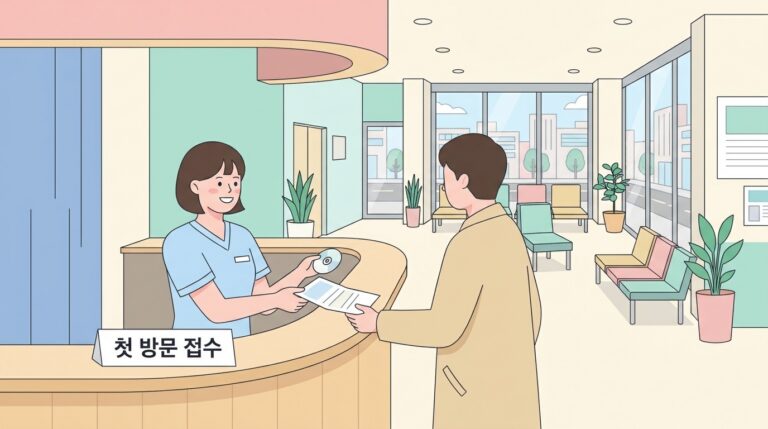
In South Korea’s high-tech tertiary hospitals, there is an unspoken golden rule: Always stop by the ‘첫 방문 고객 창구’ (First-Visit Desk) or the dedicated image upload counter right next to the lobby kiosks before going upstairs. In this comprehensive guide, built on real feedback from international patients and medical coordinators, you will master the exact Korean expressions and cultural nuances needed to register your referral and external imaging CD seamlessly.
Phase 2: Core Expressions Deep Dive
1. 첫 방문인데 진료의뢰서랑 외부 영상 CD 등록하러 왔어요.
- Pronunciation: Cheot bangmun-inde jinryo-uireseo-rang oebu yeongsang CD deungnok-hareo wasseoyo. (Think: Chut bahng-moon-in-deh jin-ryo-wee-reh-suh-rahng weh-boo yung-sahng CD deung-nohk-hah-ruh wah-ssuh-yo)
- Meaning: Literal: “It’s my first visit, and I came to register my referral letter and outside imaging CD.” / Natural: “Hi, this is my first time here; I need to submit my doctor’s referral and upload my outside imaging CD.”
- K-Culture Moment: You hear this phrase constantly in Korean medical dramas whenever a patient transfers from an outlying provincial clinic to a Seoul academic medical center for a specialized consult.
- Editor’s Insight: The phrase 외부 영상 (oebu yeongsang, outside imaging) specifically refers to X-rays, CTs, or MRIs taken at another medical facility. Saying this immediately tells the reception staff that you need CD ingestion into their PACS (Picture Archiving and Communication System).
- Situation Spectrum:
- Casual: 🚫 (Inappropriate with administrative staff)
- Semi-formal: ⚠️ (첫 방문이라 의뢰서랑 CD 내려 왔어요)
- Formal: ✅ (첫 방문인데 진료의뢰서랑 외부 영상 CD 등록하러 왔어요)
- 🤔 Think About It: In many Western hospitals, medical digital records transfer automatically between institutions via cloud networks. In Korea, why do patients still physically carry CDs from clinic to hospital? (Hint: Strict private data security laws and competing hospital server networks!)
2. 진료 전에 교수님 전산에 영상이 바로 뜨나요?
- Pronunciation: Jinryo jeon-e gyosunim jeonsan-e yeongsang-i baro tteunayo? (Think: Jin-ryoh juhn-eh gyoh-soo-nim juhn-sahn-eh yung-sahng-ee bah-roh ddeu-nah-yoh?)
- Meaning: Literal: “Before the consultation, do the images appear directly on the professor’s computer?” / Natural: “Will the scans be uploaded to the professor’s system before my appointment?”
- K-Culture Moment: Used by anxious family members in dramas like Doctor Romantic (낭만닥터 김사부) when ensuring high-resolution scans are ready for immediate surgical review.
- Editor’s Insight: Notice the use of 전산에 뜨다 (jeonsan-e tteuda—to pop up/load onto the digital database). Also note that university hospital attending physicians are addressed as 교수님 (gyosunim, Professor) rather than simply uisa-seonsaengnim.
- Situation Spectrum:
- Casual: 🚫
- Semi-formal: ⚠️ (교수님이 바로 보실 수 있나요?)
- Formal: ✅ (진료 전에 교수님 전산에 영상이 바로 뜨나요?)
- 🤔 Think About It: Calling senior hospital doctors “Professor” reflects Korea’s Confucian reverence for educational hierarchy. How does title inflation alter respect in your home country’s healthcare system?
3. 건강보험 적용되도록 의뢰서 등록 먼저 해 주세요.
- Pronunciation: Geongang-boheom jeokyong-doedorok uireseo deungnok meonjeo hae juseyo. (Think: Guhn-gahng-boh-hum juhk-yong-dweh-doh-rohk wee-reh-suh deung-nohk muhn-juh heh joo-seh-yoh)
- Meaning: Literal: “Please register the referral first so that national health insurance can be applied.” / Natural: “Could you register my referral letter first to ensure my NHIS coverage applies to today’s consultation?”
- K-Culture Moment: Characters who worry about hospital bills in daily melodrama shows verify this meticulously at the counter to prevent paying 100% uninsured rates (일반 수가).
- Editor’s Insight: Without a valid, signed referral letter from a primary or secondary clinic (1차/2차 의료기관), university tertiary hospitals (3차 의료기관) cannot bill the National Health Insurance Service (NHIS). You would be charged the full out-of-pocket rate (전액 본인부담).
- Situation Spectrum:
- Casual: 🚫
- Semi-formal: ⚠️
- Formal: ✅
- 🤔 Think About It: Korea’s tiered healthcare system requires intentional patient flow control. What safeguards exist in your country to prevent tertiary hospitals from becoming overcrowded?
Phase 3: Textbook Korean vs. Real Korean
Situation 1: Uploading your medical CD
- 📖 교과서 한국어 (Textbook): 이 콤팩트디스크(CD)에 들어 있는 컴퓨터단층촬영(CT) 사진을 병원 컴퓨터에 저장해 주십시오. (I kompaekteu diseukeu-e deureo inneun keompyuteodancheungchwaryeong sajin-eul byeongwon keompyuteo-e jeojanghae jusipsio.)
- 🗣️ 진짜 한국어 (Real-life): 외부 영상 CD 등록 좀 부탁드릴게요. 전산에 바로 넘어가나요? (Oebu yeongsang CD deungnok jom butakdeurilgeyo. Jeonsan-e baro neomeoganayo?)
- 💡 왜 다를까? (Why the difference?): Nobody says “콤팩트디스크” or full names like “컴퓨터단층촬영” at hospital counters. Koreans streamline technical jargon into concise industry phrases like 외부 영상 등록 (outside image registration) and 전산에 넘어가다 (transfer onto the digital system).
Situation 2: Asking if the appointment is covered by insurance
- 📖 교과서 한국어 (Textbook): 제가 가져온 의사의 문서를 확인하여 의료보험 감면을 해 주시겠습니까? (Jega gajweoon uisa-ui munseo-reul hwaginhayeo uiryoboheom gammyeon-eul hae jusigesseumnikka?)
- 🗣️ 진짜 한국어 (Real-life): 의뢰서 등록됐으면 건강보험 적용된 거 맞죠? (Uireseo deungnok-dwaesseumyeon geongang-boheom jeokyong-doen geo matjyo?)
- 💡 왜 다를까? (Why the difference?): Natural Korean favors topic marking and confirming state completion (~된 거 맞죠?, “It has been applied, right?”) rather than overly submissive requests.
Phase 4: K-Culture Deep Dive & Non-Verbal Manners
4-1. 눈치 (Nunchi) & Gestures at the Counter
- The Two-Handed Handover (두 손 건네기): When handing your Alien Registration Card (ARC), Health Insurance card, and the paper referral letter to the administrative coordinator, hold the documents with both hands, fingers supporting the bottom edge, accompanied by a polite nod (목례, mongnye). Never toss or slide cards with one hand across the desk acrylic barrier.
- The Kiosk Slip Verification: After the desk staff registers your referral and inserts your CD into the ingestion drive, they will hand you a registration receipt with a barcode. Keep this barcode facing outward. You will scan it at the department reception check-in machine on your destination floor.
- Patient Waiting Queue Respect: Do not stand directly over the shoulder of the person currently speaking to the staff. Stand behind the yellow line (대기선, daegiseon) until your number chime sounds.
4-2. Cultural Insight: The Tertiary Hospital Ecosystem
In South Korea, hospitals are strictly categorized into three tiers:
* Tier 1 (1차): Neighborhood local clinics (의원, uiwon).
* Tier 2 (2차): General hospitals (종합병원, jonghap byeongwon).
* Tier 3 (3차): Tertiary academic university hospitals (상급종합병원, sanggeup jonghap byeongwon).
Because world-renowned specialists practice at Tier 3 institutions, the government mandates a 진료의뢰서 (Referral Letter / Medical Care Request Form) issued within the previous 7 to 14 days by a Tier 1 or 2 doctor. Without this document registered at the first-visit counter, your NHIS benefits are void for that appointment. Koreans treat getting an appointment with a renowned university professor like securing front-row concert tickets—everything must be prepared with precision!
Phase 5: Real-Life Roleplay Scenario
Setting: Lobby Floor of a University Medical Center in Seoul. Coordinator Park Ji-soo sits behind the counter marked 첫 방문 / 영상 등록 (First Visit / Image Upload).
- Coordinator Park: 🎭 (Smiles briskly, bowing head slightly) 어서 오세요. 첫 방문 고객 등록 창구입니다. 번호표 주시겠어요?
(Eoseo oseyo. Cheot bangmun gogaek deungnok changgu-imnida. Beonhopyo jusigesseoyo?)
“Welcome. This is the first-visit customer registration counter. May I have your queue ticket?” -
You: 🎭 (Handing the queue ticket and documents with both hands) 안녕하세요! 11시 신경외과 진료 예약자인데요, 첫 방문이라 의뢰서랑 영상 CD 등록하러 왔어요.
(Annyeonghaseyo! Yeol-hansi singyeong-oegwa jinryo yeyakja-inde-yo, cheot bangmun-ira uireseo-rang yeongsang CD deungnok-hareo wasseoyo.)
“Hello! I have an 11:00 AM appointment in Neurosurgery. Since it’s my first visit, I came to register my referral and imaging CD.” -
Coordinator Park: 🎭 (Receiving documents with a swift nod) 네, 잘 오셨습니다. 신분증이나 외국인등록증도 함께 확인 부탁드릴게요.
(Ne, jal osyeotseumnida. Sinbunjeung-ina oegugin-deungnokjeung-do hamkke hwagin butakdeurilgeyo.)
“Certainly, good thing you stopped by. May I also verify your ID or Alien Registration Card (ARC)?” -
You: 🎭 (Passing your ARC calmly) 여기 외국인등록증 있습니다. 영상 CD는 언제쯤 전산에 업로드되나요?
(Yeogi oegugin-deungnokjeung itseumnida. Yeongsang CD-neun eonjejjeum jeonsan-e eobeurodeu-doenayo?)
“Here is my ARC. Roughly when will the imaging CD be uploaded to the system?” -
Coordinator Park: 🎭 (Inserts the CD into the dedicated disk reader beside her monitor) 지금 바로 영상 전송 시스템에 입력 중입니다. 5분 정도면 교수님 진료실 전산으로 넘어갑니다.
(Jigeum baro yeongsang jeonsong siseutem-e ipryeok jung-imnida. Obun jeongdomyeon gyosunim jinryosil jeonsan-euro neomeogamnida.)
“We are entering it into the image transmission system right now. It takes about 5 minutes to transfer directly into the professor’s consultation computer.” -
You: 🎭 (Checking your phone clock) 다행이네요. 그럼 진료 끝나고 이 CD는 다시 받아 가야 하나요?
(Dahaeng-ineyo. Geureom jinryo kkeutnago i CD-neun dasi bada gaya hanayo?)
“What a relief. Do I need to pick this CD back up after my consultation?” -
Coordinator Park: 🎭 (Hands back the ARC and CD case) 네, 전산 등록이 끝나서 CD는 바로 돌려드립니다. 진료실에는 본관 3층 신경외과 창구 키오스크에 이 영수증 바코드를 찍고 대기하시면 됩니다.
(Ne, jeonsan deungnok-i kkeutnaseo CD-neun baro dollyeodeurimnida. Jinryosil-eneun bongwan samcheung singyeong-oegwa changgu kioseukeu-e i yeongsujeung bakodeu-reul jjikgo daegihasimyeon doemnida.)
“Yes, the digital upload is already finished, so I am returning your CD right now. On the 3rd floor of the main building, scan this receipt barcode at the Neurosurgery kiosk and take a seat in the waiting area.” -
You: 🎭 (Receiving papers with a polite 30-degree bow) 네, 친절하게 안내해 주셔서 감사합니다!
(Ne, chinjeolhage annaehae jusyeoseo gamsahamnida!)
“Understood, thank you very much for your kind assistance!”
🔀 Interactive Choice Point
You are about to take the escalator up to the 3rd floor. You notice you have 25 minutes left before your appointment time. What do you do?
- Option A: Go straight to the 3rd-floor Neurosurgery kiosk, scan your arrival barcode immediately, and sit right in front of Consultation Room #3.
- Option B: Leave the hospital lobby to visit a nearby cafe for 20 minutes since your appointment isn’t for another half hour.
- Option C: Go back to the First-Visit desk to request that they call the professor right now to see if you can enter early.
Feedbacks:
- Option A (Best!): ⭐ Perfectly done! Tertiary university hospitals operate on a strict check-in barcode queue. Checking in 20 minutes prior allows the nursing triage team to take your preliminary blood pressure and update your symptoms so the professor is fully prepared.
- Option B (Risk!): ⚠️ University hospital schedules fluctuate rapidly. If a prior patient’s consultation finishes early, you might miss your turn. If you aren’t present when your number is called, your slot may be bumped to the very end of the morning block!
- Option C (Bad!): ❌ Culturally awkward. University hospital professors manage dozens of complex cases per hour. Front desk staff cannot interrupt a professor’s schedule for early entry.
Phase 6: 10-Second Emotion Shadowing Drill
Practice these lines aloud, copying the exact rhythmic cadence and emotional tone indicated!
[😊 정중하고 명확하게 / Polite & Clear]
첫 방문인데요, / 진료의뢰서랑 외부 영상 CD / 등록 부탁드립니다.
(Cheot bangmun-indeyo, / jinryo-uireseo-rang oebu yeongsang CD / deungnok butakdeurimnida.)
“It’s my first visit; / could you please register my referral / and outside imaging CD?”-
[🤔 궁금하고 살짝 긴장하여 / Inquisitive & Slightly Concerned]
진료 시간 전에 / 교수님 전산에 / 영상 업로드가 완료될까요?
(Jinryo sigan jeon-e / gyosunim jeonsan-e / yeongsang eobeurodeu-ga wanryo-doelkkayo?)
“Before my consult time, / will the scans be fully uploaded / onto the professor’s computer?” -
[😌 안도하며 감사한 마음으로 / Relieved & Grateful]
CD 바로 돌려주셔서 감사합니다. / 3층으로 올라가서 바코드 찍을게요!
(CD baro dollyeojusyeoseo gamsahamnida. / Samcheung-euro ollagaseo bakodeu jjigeulgeyo!)
“Thank you for returning the CD immediately. / I’ll head up to the 3rd floor and scan my barcode!”
Phase 7: K-Culture Mini Dictionary
-
진료의뢰서 (Jinryo-uireseo) | Referral Letter / Medical Care Request Form
A mandatory document issued by a primary clinic allowing a patient to book appointments at a tertiary hospital under NHIS coverage. Without this physical or electronic document, your insurance discount is disqualified. -
외부 영상 (Oebu Yeongsang) | Outside Imaging Data
Medical scans (MRI, CT, Ultrasound, X-ray) performed at an external or local clinic, usually burnt onto a CD or DVD. It must be processed through the hospital’s image registry (영상등록기) before your doctor can view it. -
무인 수납기 (Mu-in Sunapgi) | Unmanned Self-Payment Kiosk
Touchscreen kiosks stationed across hospital lobbies where patients scan barcodes to register arrival, print clinic passes, pay copayments, and receive prescriptions without waiting in long cashier queues. -
특진 / 교수 진료 (Teukjin / Gyosu Jinryo) | Senior Professor Consultation
Consultations conducted by full academic professors rather than clinical fellows or residents. Highly sought after for specialized or complex diagnoses.
Phase 8: Traveler’s Survival Kit
Top 3 Survival Phrases
-
영상 등록 창구가 어디예요?
Yeongsang deungnok changgu-ga eodiyeyo?
“Where is the imaging registration counter?”
Pro Tip: Use this if the main lobby is sprawling and you cannot locate the CD upload station. -
의뢰서 원본 제출해야 하나요?
Uireseo wonbon jechulhaeya hanayo?
“Do I need to submit the original hard copy of the referral?”
Pro Tip: The hospital will inspect and scan the original document. Keep the stamped copy they return to you for insurance claim filing. -
도착 확인 바코드 어디서 찍어요?
Dochak hwagin bakodeu eodiseo jjigeoyo?
“Where do I scan the barcode to confirm my arrival?”
Pro Tip: Every department floor has a dedicated arrival sensor kiosk near the waiting chairs.
Editor’s Travel Note: Tech & Navigating Tertiary Hospitals
- Hospital Smartphone Apps: Leading hospitals have dedicated English apps. Search for the Severance Hospital Official Mobile App or Samsung Medical Center apps. These apps synchronize your daily itinerary, guide you with indoor floor-by-floor maps, and allow automated Bluetooth arrival check-ins!
- Payment Methods: Hospital kiosks accept all major domestic and international credit cards (Visa, Mastercard, UnionPay). However, foreign bank debit cards occasionally fail on older kiosks; always keep a physical credit card or cash handy for the manned cashiers (유인 수납 창구).
Phase 9: A Step Deeper (한 발 더 깊이)
South Korea’s healthcare system achieves an astounding balance of hyper-speed and affordability, but it relies on strict procedural compliance. The requirement to transfer through clinics using a 진료의뢰서 protects university hospitals from being completely paralyzed by minor ailments.
Culturally, this reflects the Korean societal emphasis on 질서 (order) within massive collective infrastructures. While foreigners may initially feel overwhelmed by having to register at the lobby desk, upload a CD at a kiosk, and scan an arrival barcode on another floor, this system allows a single professor to evaluate 40 to 60 patients in an afternoon with complete digital diagnostic imaging ready at a click.
💬 Your Turn: Have you ever navigated a foreign hospital system? How does your home country manage medical records between clinics and major academic hospitals? Share your thoughts below!
Phase 10: FAQ & Common Mistakes
Q: What happens if I forget to bring my referral letter to my appointment?
A: If you do not present a valid 진료의뢰서 on the day of treatment, the hospital will still treat you, but you will be classified as 전액 본인부담 (100% out-of-pocket). You will be required to pay the full, unsubsidized medical fee. If you bring the referral letter within a grace period (often 7 days), the hospital billing team can retroactively refund the difference.
Q: Can I bring an MRI or CT saved on a USB drive instead of a CD?
A: Most Korean university hospital security firewalls strictly block external USB thumb drives to prevent malware and ransomware infections. Always request your imaging files on a standard medical DICOM CD from your referring clinic.
Q: Do university hospital desk staff and professors speak English?
A: Tertiary university hospitals have dedicated International Health Care Centers (국제진료센터). However, if you book through the standard domestic NHIS track, administrative desk staff will speak primarily Korean. Professors almost universally read English medical records flawlessly and can converse in English, but having these Korean registration phrases ready will prevent delays in the lobby.
🚨 Common Mistakes Alert
- Mistake: Going straight to the examination room floor without registering your outside CD at the first-floor counter.
Correct Action: Always clear the lobby “첫 방문/영상 등록” counter first so your scans populate the hospital PACS before your name is called. - Mistake: Throwing away the printed barcode paper after paying.
Correct Action: That paper is your universal key! You must scan that barcode at the pharmacy, at departmental check-in kiosks, and at parking validation booths. - Mistake: Bringing a referral letter that is more than a month old.
Correct Action: Most university departments require referral letters to be issued within 7–14 days of booking your appointment. Verify validity beforehand.
Phase 11: Action Missions
- 🥉 Bronze Mission (Solo Shadowing): Practice saying “첫 방문인데 진료의뢰서랑 외부 영상 CD 등록하러 왔어요” three times out loud until you can say it fluently in under 5 seconds.
- 🥈 Silver Mission (Vocabulary Flashcard): Write down the 4 key terms from Phase 7 (진료의뢰서, 외부 영상, 무인 수납기, 특진) in your Korean study notebook with example sentences.
- 🥇 Gold Mission (Real-Life Readiness): Next time you visit any Korean medical institution or kiosk, identify where the “영상 등록” (Image Registration) station is located and read the digital instructions on the screen.
- 🎮 K-Culture Mission: Watch an episode of Hospital Playlist (슬기로운 의사생활) Season 1, Episode 1. Spot how outpatients wait outside the consultation rooms and observe how the nurses call patient names on the wall monitors!
Phase 12: Interactive Quiz Challenge
Test your mastery of Korean university hospital navigation with these 3 quick questions!
1. Situational Judgment:
You have just arrived at Seoul National University Hospital with an MRI CD from an orthopedic clinic. What is your very first step?
a) Sit in the 2nd-floor orthopedic waiting room immediately.
b) Stop at the ‘첫 방문 고객 창구’ (First-Visit Counter) to submit the referral letter and scan the CD.
c) Go straight to the basement cafeteria for breakfast.
2. Fill in the Blank:
진료 전에 교수님 _______에 외부 영상이 바로 뜨나요?
(Will the outside imaging immediately appear on the professor’s computer database before my consult?)
a) 지갑 (jigap)
b) 전산 (jeonsan)
c) 수첩 (sucheop)
3. True or False:
If you do not register your referral letter (진료의뢰서), you will lose your National Health Insurance subsidy for that appointment and pay 100% out-of-pocket.
(True / False)
👉 Click to reveal answers & explanations!
Answers:
1. b) Stop at the First-Visit Counter. If you go straight upstairs, the doctor will not have access to your scans on their screen.
2. b) 전산 (Jeonsan – internal digital network/system). Jigap means wallet, and sucheop means notebook!
3. True! Tertiary general hospitals require an official referral to bill the NHIS; without it, you will be charged the full un-subsidized rate.
🎬 Watch Our Daily Videos! (Daily Hangul Official Instagram)
Review the expressions you learned in this article with our fun daily short videos! Check out native pronunciation and real-life nuances in action.
- Instagram @dailyhangul_en







